I found some older pictures of a time of my visits to France, these are on paper and took a shot of them to post in my blog as it is after all the story of my life, Thanks for reading me over the years, always appreciated, These includes the cities of Caen, Dieppe, and Saint Valerie en Caux, Let me tell you a bit on curiosities of Normandie, part I !!! Hope you enjoy it as I
Caen is in the department 14 of Calvados in the region of Normandy. It is called the “City of a hundred bell towers”, city of William the Conqueror and capital of the Duchy of Normandy with Rouen, I have written several posts on Caen so will cut to the chase on the abbey of men info and picture.
The Abbaye aux Hommes, or Saint-Étienne Abbey is one of the two great abbeys, along with the Abbaye aux Dames, founded by Guillaume le Bastard, the future conqueror, around 1060, in Caen. The Saint-Étienne Church, the former abbey became a parish church after the French revolution. The convent buildings transformed into a high school in the 19C have housed the city/town hall since the 1960s. On March 26, 1789, the assembly of the nobility of the Bailliage of Caen met in the abbey. On November 2, 1790, the monks were expelled from the abbey under the law of February 13-February 19, 1790, In 1793, the Saint-Étienne Church was transformed into a temple dedicated to the cult of Reason and the Supreme Being. On October 12, 1800, the Académie de Caen, renamed “Lycée de Caen”, was installed in the premises of the abbey. Following the entry into force in 1802 of the Concordat of 1801, Catholic worship was restored in the former abbey, but the latter became a parish church and the religious did not return to the abbey. Finally, the prefectural administration left the abbey in 1806 in order to set up the Imperial High School (current Lycée Malherbe), founded on July 20, 1804. In 1841, an elementary primary school was added.
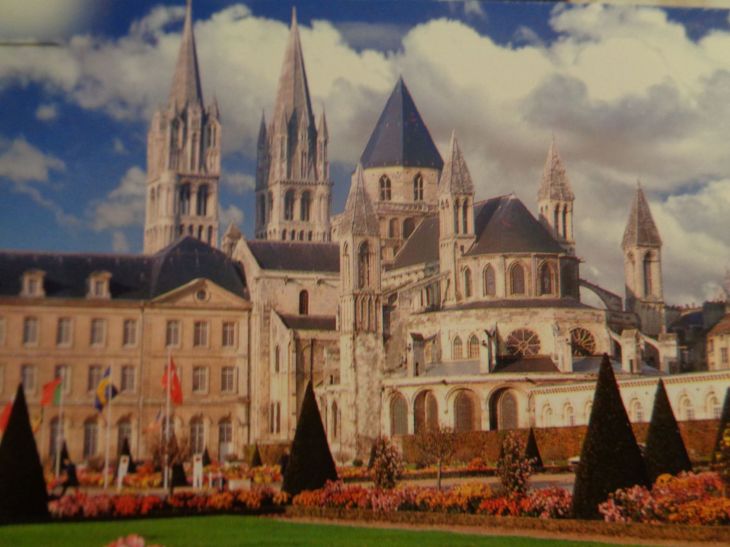
In 1810, part of the gardens of the abbey were amputated in order to create a square linking Place Fontette to La Prairie; the esplanade was then planted with chestnut trees and a gate was installed to separate the promenade for high school students from the newly created public space, called Place du Parc (now
Place Guillouard) and embellished in 1882 with a statue from Place de la Republic. Two new buildings were also built in the gardens: the “class corridor” (currently occupied by the civil status service) built from 1828 to 1830 and the “Petit lycée” (currently occupied by the municipal police services ), During the
Battle of Caen, the school was transformed into a passive defense reception centre. The former abbey also served as a complementary hospital to the main hospital set up at Bon-Sauveur. The municipal administration now occupied the abbey since the opening of the new Lycée Malherbe in 1961. On January 16, 1965, the first meeting of the municipal council of
Caen took place in the chapter house.
The
city of Caen on the abbey of men:
https://caen.fr/abbaye-aux-hommes
The
Caen tourist office on its heritage:
https://www.caenlamer-tourisme.com/discover-caen-la-mer/caen-a-city-with-a-thousand-faces/caen-medieval/
I have written several posts on Dieppe so again will cut it short and go the scene of the new picture in my blog, Briefly, Dieppe is located in the Seine-Maritime department 76 in the Normandy region. The city is nicknamed “the city of four ports” (the cross-Channel ferry/port, the commercial port, the fishing port and the marina).
The
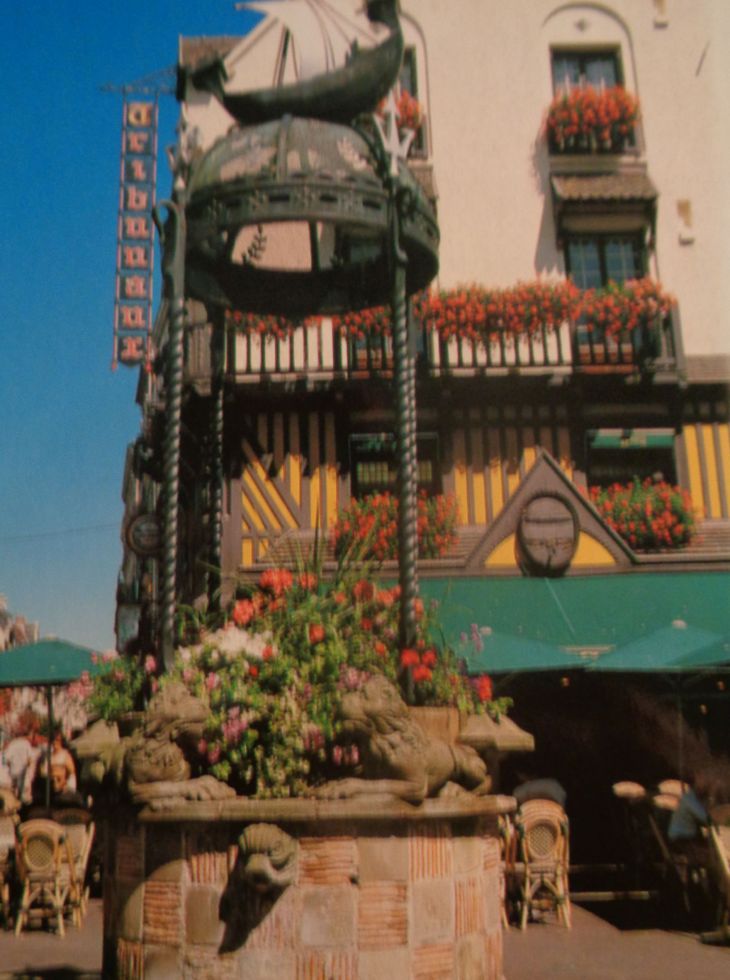
Place du Puits-Salé is the most famous square in
Dieppe. At the corner of the pedestrian streets, Grande Rue and rue de la Barre, adjoining the streets Saint-Jacques, l’Ecosse and Victor-Hugo, not far from the rue du 19 août 1942 reminiscent of the Dieppe Raid. Its
well, replacing since 1930 the old fountain of the Puits-Salé, from 1558, carries water from the source of Saint-Aubin-sur-Scie , On this square is located the
café des Tribunaux, whose half-timbered style neo-Norman, date from the 1920s. This building, which has existed since 1709, has only been a café since the end of the 19C.
The
city of Dieppe on its streets:
https://www.dieppe.fr/menus/decouvrir-dieppe-2/acces-cartes-et-plans-1/le-plan-de-la-ville-16
The
Dieppe tourist office on its heritage:
https://uk.dieppetourisme.com/move/take-a-tour/chateaux-and-monuments/
I found a couple old pictures of my much earlier road warrior trips in my belle France, and will write something for the first time in my blog on nice Saint-Valery-en-Caux , The town is located in the Seine-Maritime department 76 in the Normandy region. about 60 km from Rouen , and 30 km from Dieppe and Fécamp , It is a small seaside resort equipped with a port,which is very nice indeed.
The name of Saint-Valery-en-Caux appears for the first time in a document dating from 990, according to the charter in which Richard I, Duke of Normandy, grants part of his personal property to the Abbey of Fécamp, The city center was almost completely destroyed by bombing during the siege of the city, from June 10 to 12, 1940. Indeed, from June 10, the 7th Panzer Division led by Rommel pierced the positions of the 9th Corps as far as the Seine. General Ihler’s French army corps as well as Major-General Fortune’s 51st (Highland Scottish) Infantry Division, and isolated them , The Allied troops fell back to Saint-Valery-en-Caux, the last port of the pocket , After the battle which took place from June 10 to 12, 1940, Saint-Valery-en-Caux was nearly 70% destroyed , and was finally liberated by the Allies on September 11, 1944, After the war, French cities untouch by the war became sister cities to those destroyed to help in their restoration in an act of solidarity, Saint-Valery-en-Caux learns of the adoption on November 26.1942 by Aix-en-Provence, The official announcement and that of the first installment occurred during the municipal council of December 6, 1942. In order to be able to support its adopted city, Aix-en-Provence multiplied the actions, which made it possible to send several rescuers to Saint-Valery. On January 17 1945, following a failure of the braking system, a train carrying US Army soldiers fails to stop and crosses the terminal station of Saint-Valery. The toll is heavy: 89 American soldiers are killed and 152 are wounded.
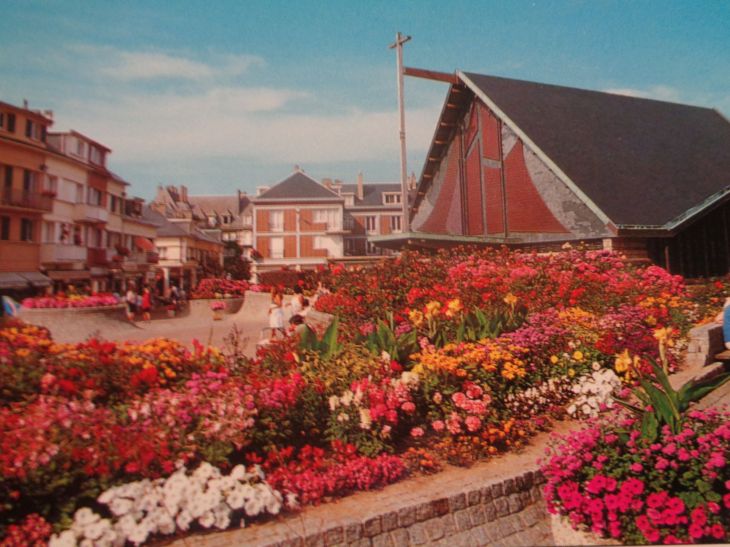
We took our walks during our passing by the Place de la Chapelle, a great place to stop first,In the Place de la Chapelle you can see the Chapel of Notre Dame du Bon Port, plenty of restaurants and parking there and across in the Place du Marché where the market is held,The most lively spot in town, me think.
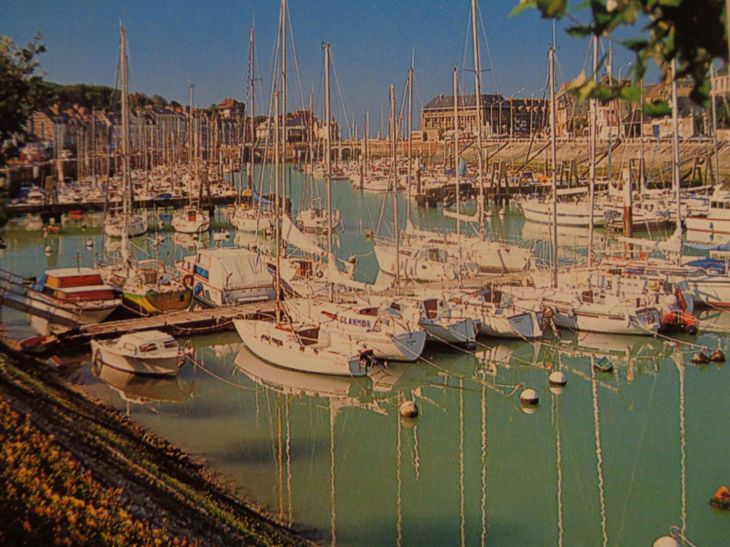
 Also, the Port de Plaisance or Marina with 550 berths; It hosts about 500 boats now. Note the presence of fishing boats in the outer harbor which all year round sell most of their loot when they return to the stalls.
 Some of the other things to see in Saint Valery en Caux me think are the half-timbered house known as Henri IV, also called Maison Ladiré, the Parish Church of Saint-Valery-en-Caux, Its construction dates back to the 16C, and the Military cemetery of WWII, the lighthouse of Saint-Valery-en-Caux; and Camp Lucky Strike that were transit camps for American soldiers, upon their arrival in France or while waiting to be deported to the United States.
The
city of Saint Valery en Caux on the marina: https://saintvaleryencaux.fr/port-de-plaisance/
The
local Alabaster coast tourist office on the marina of Saint Valery en Caux: https://cotealbatre-normandytourism.co.uk/leisure-equipements/230-port-de-plaisance/
The
local Alabaster coast tourist office on the Saint Valery en Caux heritage:
https://cotealbatre-normandytourism.co.uk/cultural-heritage/?ville=saint+valerie+en+caux
There you go folks, a wonderful road warrior tour of gorgeous
Normandie, history and architecture for doing it for the rest of my life. Again, hope you enjoy this post on
curiosities of Normandie, part I !!! as I.
And remember, happy travels, good health, and many cheers to all !!!
Published by pedmar10
I am a lover of travels to Europe , Americas , Africa and Asia as well ,who like to share my experiences of the last 53 years with the world, visiting so far 81 countries; living in 6, working in 5, and Citizen of 4, speaking fluently 4 languages. I can deal with sports especially football/soccer and love music, arts, wine collector/drinker, and go out to restaurants, and just visit the world.
My background comes all the way from Candelaria and Pajara in Tenerife, Spain where my grandparents came from ;not knowing each other then, to Punta Brava, west of Havana, Cuba. There , my parents born in Cuba met and later on I was born there too. 100% guanche (annexed Tenerife to Spain on April 10 ,1496). I left Cuba as many have to Madrid, Spain where I lived for 4 years. Then, move to Perth Amboy ,New Jersey USA (living there 13 yrs) ; where I completed high school, became a US Citizen, learned to drive a car, and learned English. Afterward, went to the university in Florida, ERAU, and upon graduation decided to moved there to Ormond by the Sea, near Daytona Beach, finally moving North Miami, then Hialeah, then another moved to Silver Lakes division in Miramar, Broward county, Florida; in Florida I lived a total of 18 years. Finally , moved to France in 2003 ,Versailles call me for its royalty, and working in Paris was great. It was time to seek frontiers again and moved to Brech near Auray, Morbihan in Brittany , and later move to not too far Pluvigner. Total so far in France has been 20 years, and counting.
Moving average a home every 5.5 years hopefully this will be my last. Cheers
All rights reserved. No part of this blog may be reproduced or transmitted in any form or by any means or stored in a retrieval system of any nature, without the written permission of the copyright holder, me. No part of this work may be modified, without the written permission of the holder, me.No part of this work may be exposed to public view in any form or by any means, without identifying the holder as the author, and with the before mentioned permission.
View all posts by pedmar10


 Paris1972-Versailles2003