
We thought about where to do our family vacation different,and the vote came to Rome , Italy. I was a very memorable family visit looking back it was even better. I have several posts on Rome in my blog, and had one with so many churches in it that decided to split into 3 posts with more text using the older pictures, Hope you enjoy the churches of Rome, part II !! as I
I found the most unique element the churches, after all whether we believe or not ,they mark the cultural essence of a country looking thru the churches. And Rome has plenty, about 900 of them!!! It seems more churches than bars lol ! I would like to tell you our favorites.
The Church Santa Maria in Montesanto located in Campo Marzio, in Piazza del Popolo, between Via del Corso and Via del Babuino, also known as the Church of the Artists. It is commonly known as the Twin Church of Santa Maria dei Miracoli, although it has significant differences especially in the layout. The name of the church comes from the fact that it replaced a small church that belonged to the Carmelite friars from the province of Monte Santo in Sicily. It was built in 1662, initiative Pope Alexander VII, by Cardinal Girolamo Gastaldi that he was later buried. The work was interrupted on the death of the pontiff in 1667; resumed in 1673 and completed in 1679. The church is planted in an elliptical shape, while its so-called “twin” Santa Maria of the Miracles is circular; six are the side chapels, against four of its “twin”.in July 1825 papa Leone XII raised it to the dignity of minor basilica. From 1953 the church became the seat of the “Artists’ Mass”, a unique initiative created in 1941 by Ennio Francia; after changing several places of worship, liturgical event was housed in Piazza del Popolo in the church where every Sunday for over fifty years is celebrated this Eucharistic celebration that take representatives part of the world of culture and the arts, It is also in this church that the funerals of people linked to the world of culture and television are often celebrated. For these reasons it is also known as the “Church of the Artists”. Beneath the twin churches are the remains of two pyramid tombs, very similar in size and shape to Pyramid of Caius Cestius and the Vatican pyramid ; these two tombs were traced and Augustan age were placed monumental entrance to campus Martius, precisely the function that the two churches today. In this church, on August 10, 1904, he was ordained priest Angelo Roncalli, the future Pope Giovanni XXIII , an event commemorated by a plaque affixed during his pontificate. And my oldest son shown below!
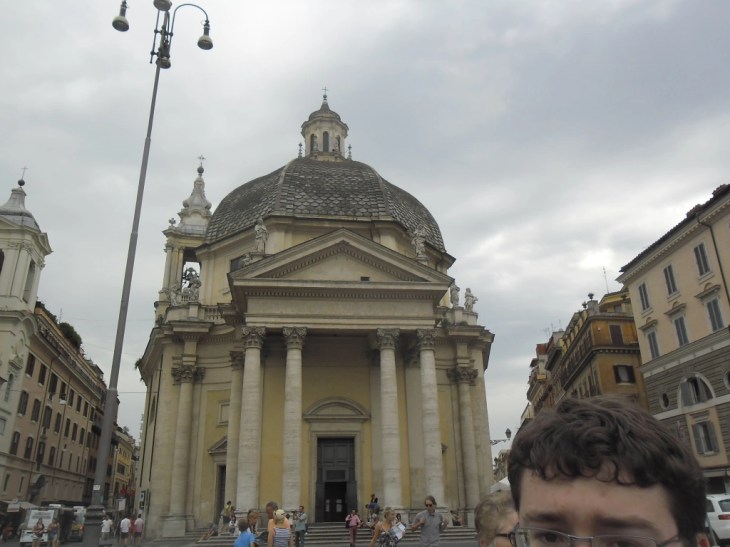
The Rome tourist office on the church: https://www.turismoroma.it/en/places/basilica-di-santa-maria-montesanto-church-artists
The 17C Church of San Rocco is located on the Campo Marzio, near the Tiber. It is next to the Mausoleum of Augustus, exactly at Largo S. Rocco, 1 , It was built in 1499 thanks to the initiative of the Confraternity of San Rocco and Pope Alexander VI ,and dedicated to San Rocco of Montpellier. It was originally a chapel connected to the hospital near the ancient church of San Martino. The one was built to help the plague sufferers on the initiative of the Confraternity of hosts and boatmen, who lived near the Tiber. Nearby was the ancient river port of Ripetta. It was largely rebuilt in 1657 on a project by Giovanni Antonio de Rossi. Valadier’s neoclassical facade dates from the first half of the 19C. A new, Palladio influenced façade was built in 1832. The surroundings were transformed in 1890 with the demolition of the port of Ripetta due to the canalization of the Tiber and the construction of the Ponte Cavour. Then the neighborhood was radically renovated between 1934 and 1938, including the demolition of the hospital.

The Rome tourist office on the church: https://www.turismoroma.it/en/places/church-san-rocco-allaugusteo
The Church Saint Andrew of the Quirinal (Via del Quirinale, 30) is a Jesuit church. It is considered one of the masterpieces of Italian Baroque, often referred to as the most beautiful of the churches designed by Bernini. Its construction, from 1658 to 1670, was led by his pupil, De Rossi. It was Pope Alexander VII who commissioned it to replace an old 16C. The facade is preceded by two concave wings that frame the entrance to which a small semicircular staircase leads. This contour, concave-convex-concave, is characteristic of Bernini’s creations. The entrance portal bears the arms of Camillo Pamphili, who contributed financially to the construction of the building. The nave is elliptical, the shortest axis being that between the entrance and the high altar, the chapels are placed oblique in such a way that they recall the cross of Saint Andrew.
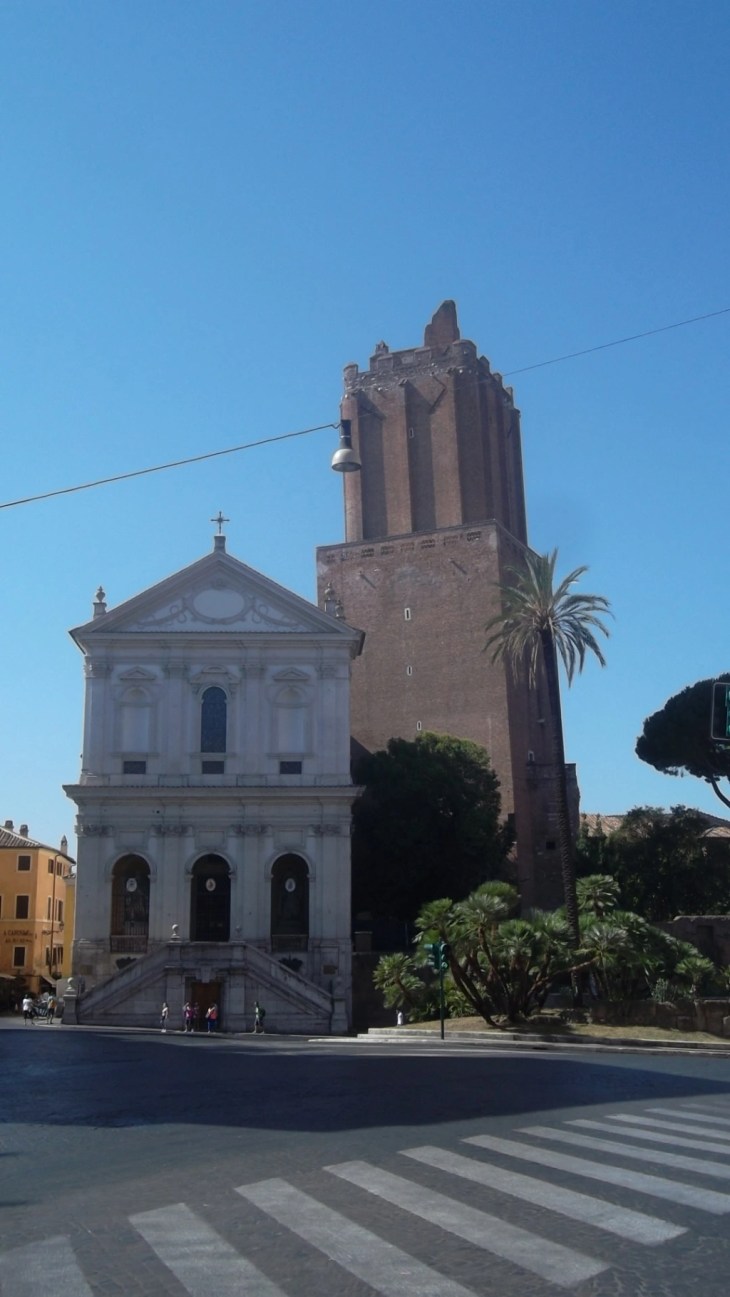
The Rome tourist office on the church: https://www.turismoroma.it/en/places/church-santandrea-al-quirinale
The Church of Saint Bosco or Giavanni Bosco; a minor basilica located at Viale dei Salesiani, 9; the main entrance is on the Piazza San Giovanni Bosco. The basilica is on a monumental axis overlooking a large square (piazza San Giovanni Bosco) which is continued by the wide Viale San Giovanni Bosco to another large square, piazza dei Consoli. The Church was under the care of the Salesians of which St John Bosco was the founder. The Basilica was built in the early 1950s on behalf of the Salesians. On 12 September 1952 the first stone of the new building was laid by the cardinal vicar Clemente Micara, but the actual work began about a year later; the church was inaugurated on 2 May 1959 with solemn consecration by Cardinal Benedetto Aloisi Masella, protector of the Salesian Congregation; most of the interior, however, was still to be built, and it was only in 1964 that the building was completed according to the original plans. The day after the consecration, May 3, Pope John XXIII visited the new church to pray in front of the tomb of the Turin saint to whom the sacred building was named and whose urn, for the occasion, had been transferred from Turin. in Rome. The church was entrusted to the Salesian Fathers, who are the owners of the church. Pope Paul VI, elevated it to cardinal deaconry, with the name of San Giovanni Bosco in via Tuscolana and, follows promoting it to the dignity of minor basilica.
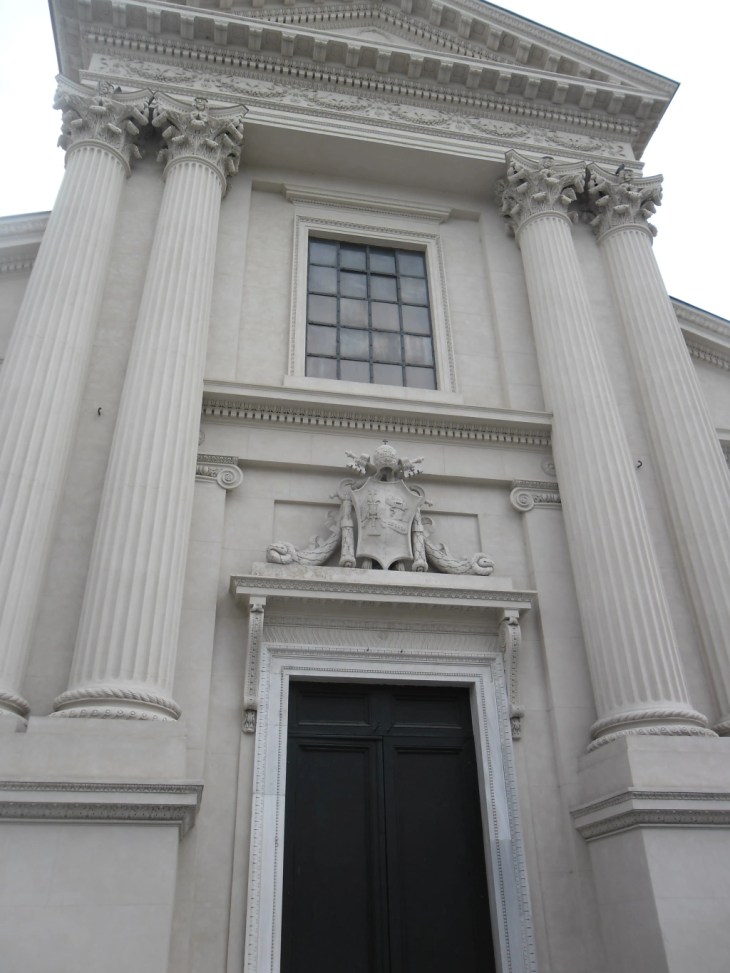
The Rome tourist office on the church: https://www.turismoroma.it/en/places/san-giovanni-bosco
The Basilica di Santa Croce en Gerusalemme or Holy Cross in Jerusalem ( Piazza di S. Croce in Gerusalemme ) is one of the “seven churches of Rome”, the stopovers of pilgrims during holy years. The church is said to have been founded in the 4C, referred to as the Basilica Sessoriana, within a large building from the beginning of the 3C, dedicated to Saint Helena, the mother of Constantine. According to tradition, a relic of the True Cross, brought from Jerusalem by Saint Helena, is kept there. At the time, the Basilica’s floor was covered with soil from Jerusalem, thus acquiring the title in Hierusalem; it is not dedicated to the Holy Cross which is in Jerusalem, but the Basilica itself is “in Jerusalem” in the sense that a piece of Jerusalem was moved to Rome for its foundation. The facade, original with its oval vestibule, dates from a reconstruction of 1744.
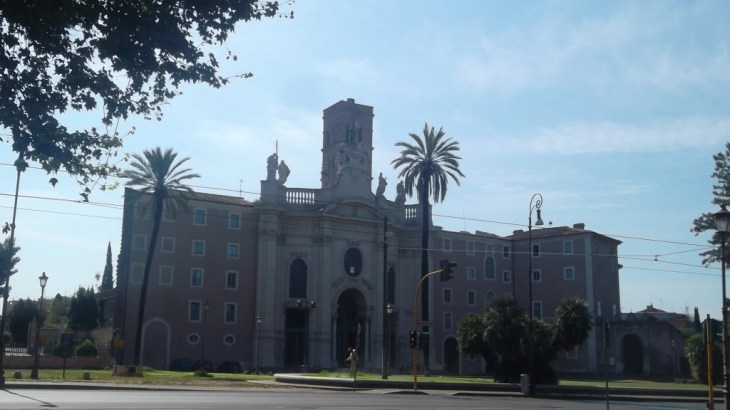
The Rome tourist office on the Basilica: https://www.turismoroma.it/en/places/basilica-santa-croce-gerusalemme
There you go folks,, and this is just my favorites and able to see; there are soo many. Anyway this is Rome, the cradle of the Catholic Church so should be no surprises. The history ,architecture and just beauty are enough to bring you in regardless of your beliefs. They are an integral part of any visit to Rome! And see my many other posts on Rome in my blog. Hope you have enjoy the post of the churches of Rome, part II as I.
This Rome Art Lover site tells them all churches, too numerous for me to post : http://www.romeartlover.it/Churches.html
And remember, happy travels, good health, and many cheers to al! !!!

 Paris1972-Versailles2003