
This is one of those cities that should be visited more. I was there as a child when had my aunt on mother’s side living there in a farm just south of the city near El Saler; when we lived in Madrid we would go there as our “vacation” ; then, their passing took us a dry spell of many, many years, finally with my wife and boys ,we decided upon my request to visit the city. We enjoyed the sites , and have plenty in my blog; however, found new pictures to tell you even more of this nice city by the Mediterranean. I am talking about the curiosities of Valencia !!! Hope you enjoy the post as I.
The Paseo Neptuno or Passeig de Neptú is a promenade that begins in the port of Valencia and runs along Cabanyal Beach, to Malvarrosa Beach. Along this landscaped promenade there are countless traditional Valencian restaurants and cafes where you can have a drink, as well as hotels, including the luxurious Las Arenas spa,The parking Neptuno is located on the beachfront, next to the Club Nautico or Yacht Club, We enjoy the beach and restaurant (see post) and parked undeground at Parking Neptuno, webpage : https://parkingneptuno.com/

The Plaza del Ayuntamiento or Plaça de l’Ajuntament or City/Town Hall Square is the largest square in Valencia.
The bit of history tell us that the square has its origin in the old Convent of San Francisco, whose land King Jaime I granted to the Franciscans to build their convent outside the city walls in the 13C, right where the recreation house of Abu Zayd, the last Almohad governor of the city was located. Since 1423 there is evidence of the name of Plaza de San Francisco to the gardens that were of the Convent of San Francisco. During the 19C ,it had other names such as General Espartero (1840-1843), Isabel II (1843-1868) or La Libertad (1868-1874), to later be called San Francisco again until the year 1900 , From 11 February 1900 the square took the name of Emilio Castelar, one of the presidents during the First Spanish Republic. The name was in force until the end of the Spanish Civil War. Between 1939 and 1979 the square was known as Plaza del Caudillo, even hosting an equestrian sculpture of Gen Franco and during the Spanish democratic transition it changed its name to País Valenciano, until in 1987 ,when it took its current neutral name of Plaza del Ayuntamiento.

The Plaza del Ayuntamiento joins a triangle, and is found south of the plaza del Mercado and north of the València-Nord train station (see post). The City/Town Hall (see post) is found next to the post office building built between 1913 and 1922, as the Palace of Communications (or Post Office), built in an eclectic style, which is one of the reference buildings for the square. The square is characterized by the presence of buildings, most of them in an eclectic and rationalist style, erected during the first half of the 20C. Also noteworthy is its circular fountain and the sculpture that pays tribute to the sworn in chief of the city at the beginning of the 14C, Francesc de Vinatea.
The bus lines C1, 6, 8, 11, 14, 35 and 70 reach the city hall square, While the nearest Metrovalencia station is Xàtiva located on Calle Xàtiva about 150 meters south of the square, where pass lines 3,5 and 9. The MetroValencia webpage:https://www.metrovalencia.es/planificador.php?page=142
The EMT Valencia transports all modes: https://www.emtvalencia.es/ciudadano/index.php
The Plaza de Toros or bullring of Valencia is officially the Monumental Plaza de Toros or bullring that was built throughout the 1850s. It is neoclassical, specifically simple Doric, inspired by Roman civil architecture, Its structure is formed by a 48-sided polygon, with 384 exterior arches, made in brick following the Neo-Mudejar style . There is no doubt that it is one of the most beautiful bullrings in Spain, with its 52 meters in diameter in the arena, subsequently reduced, 108 meters in outside diameter and its capacity for 16,851 seated spectators ,also reduced to 12,884 seats, With these dimensions make it one of the largest bullrings in
Spain. It was inaugurated on June 20, 1859. Since 1085, there has been evidence of bullfighting in Valencia. To gain the rights to exploit the bullring, the Hospital of Valencia requested to king Felipe III for the rights, alluding that the profit obtained in the bullfights could be used to the most needy, the king accepting the proposal, once the rights granted that were in force . But it really was not until 1739 when King Felipe V granted, and in perpetuity, the Valencia Hospital the right and exploitation of bullfights in these removable plazas. Finally, in 1798 a fixed plaza, half masonry, half wood, outside the city walls, next to the Ruzafa gate. That plaza was 74 meters in diameter and had an outer circumference of 334 meters. But it barely lasted a few years. The definitive plaza, similar to how we know it today, was officially inaugurated on June 22, 1859, with bulls from Nazario Carriquiri and the Widow of Zalduendo, for the right-handed Francisco Arjona “Cúchares” In 1983 , the General Directorate of Fine Arts of the competent ministry, declared the Valencia bullring a Historic-Artistic Monument. The Valencia Bullring is located in
Calle Játiva, the downtown district of the city, next to the Nord train Station of Valencia (see post) and very close to the Plaza del Ayuntamiento. The closest metro station is Játiva, with lines 3, 5, and 9.There is, also, a bullfighting museum, which was founded in 1929 with funds from the donation of Luis Moróder Peiró and the bull chopper José Bayard Badia, which for years collected a significant number of materials and objects of Valencian bullfighting of the 19C to the 20C.

The Valencia tourist office on the plaza de Toros: https://www.visitvalencia.com/en/what-to-do-valencia/valencian-culture/monuments-in-valencia/bullring
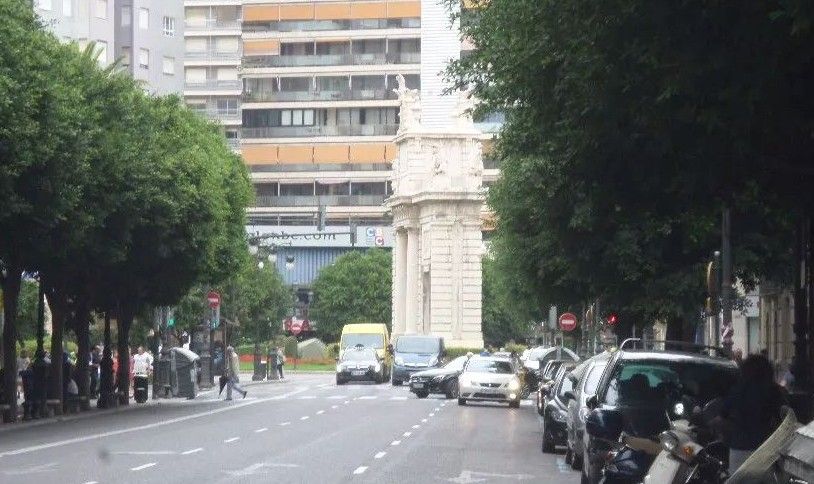
The Plaza Puerta del Mar square in Valencia, where Calle de Colón, the main commercial thoroughfare, ends. Avenida Navarro Reverter, which follows the old road to the sea, leads from it, Calle del Justicia, Calle del General Palanca and Calle del Palacio de Justicia. It occupies part of the space of the square that extended in front of the Citadel of Valencia and the old Puerta del Mar, this door opened the medieval wall on the way to the port of Grao, and that were demolished in 1868 when the walls of the city felled, You have next the Jardin de la Glorieta , the historic garden popular for its large trees. Next to it we find the old Customs building, now the headquarters of the Superior Court of Justice of the Valencian Community. Until the beginning of the 20C, the military citadel and later the barracks that replaced it stood on. Currently the modern buildings occupy the square, next to which the courts of Valencia were located for a long time, until their move to the current City of Justice. The current Puerta del Mar is a reproduction of the old Puerta del Real, which stood a short distance away, opening the way to the disappeared Royal Palace. It has three openings. The central one is higher and culminates in a semicircular arch, while the sides, which are lower in height, are lintelled. On these there are four reliefs that represent “Courage”, “Abnegation”, “La Paz” and “La Gloria”. The original gate had been opened in the wall in 1356. Reformed several times, the last in neoclassical style in 1843, and finally demolished with the rest of the wall.
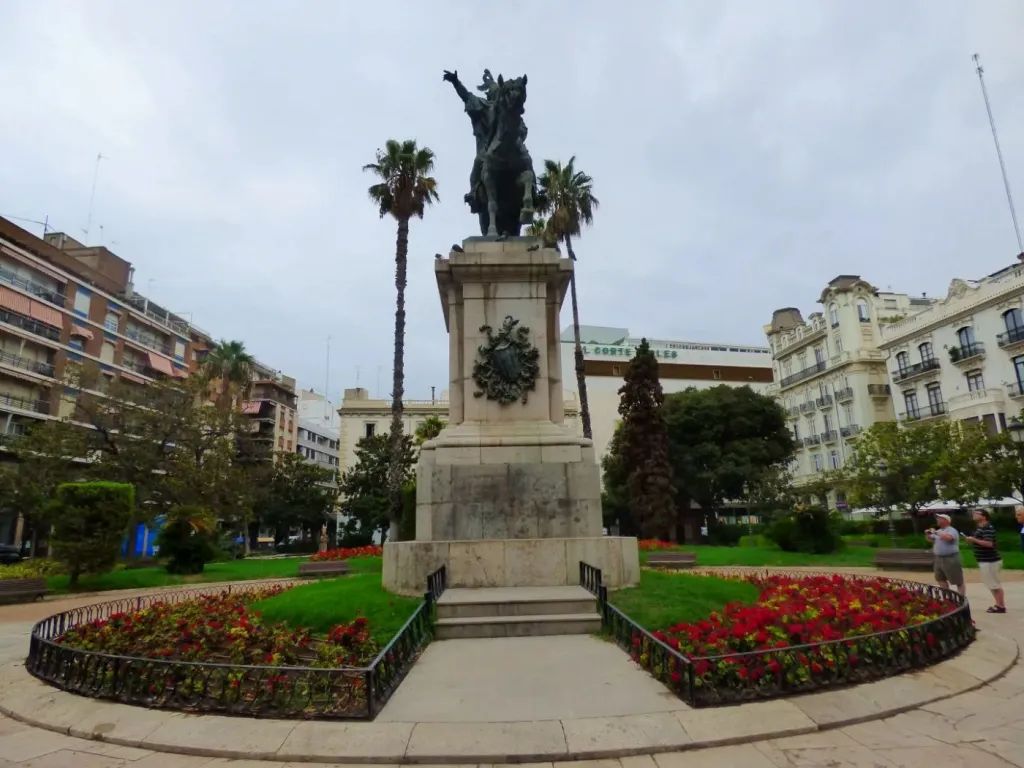
The old Plaza de la Aduana is now Plaça d’Alfons el Magnanim or Plaza Alfonso el Magnánimo, opposite the Porta de la Mar . a fountain dedicated to Neptune. A very monumental cast iron statue presides over this square, dedicated to Jaime I the Conqueror, done in 1857 the sixth centenary of his death. Finally, it will be in 1891 said statue was located in the Parterre. King Jaime I the Conqueror, very much in the local fabric; he was Jaime I de Aragon el Conquistador ( Born Montpellier France in 1208 and died in Alcira in 1276) He was king of Aragon (1213-1276), of Valencia (1238-1276 and Mallorca (1229-1276), Count of Barcelona (1213-1276), Count of Urgel,Lord of Montpellier (1219-1276),and other places in Occitania (covering France and Spain). Since it was built, the Parterre gardens have not undergone major changes. The Riada of 1957 forced to rebuild the garden; of the four ponds it had, only one remains. And I am in the right of the picture with my oldest son !
The city of Valencia on its history/heritage: https://www.valencia.es/cas/la-ciudad
The Autonomous community of Valencia region on Valencia city: https://www.comunitatvalenciana.com/en/valencia/valencia
The Valencia tourist office: https://www.visitvalencia.com/en
There you go folks, I feel better now to show you more of Valencia, the city by the Mediterranean and direct from Madrid on the A3!! We love it ! and will be back, eventually. Again, hope you enjoy this post on the curiosities of Valencia !!! as I.
And remember, happy travels, good health, and many cheers to all !!!


