
This is another wonderful city to walk in my belle France. So many times in Arras, yet not there lately due to the virus syndrome scaring us all. I have plenty written on it in my blog, so will do this one in a general sense with one old picture jus found in my vault. Therefore, here is my take on curiosities of Arras, part II !! Hope you enjoy it as I.
And I take you up to Arras do come here on a Wednesday or Saturday to enjoy the wonderful market in the place des Héros with about 250 merchants ! The Grand’Place and the Place des Héros are perpendicular and link by the rue de la Taillerie with 17 square km ! The two squares are bordered with 55 facades of the 17C to 18C and 300 columns , unique in the world ! All rebuilt after the Great War or WWI. The facades at Place des Héros, and especially the houses with 3 cockerels at no 9, a siren at no 13 and a whale at no 64, On the Grand’Place you see the Maison des Trois Luppars the oldest from the 15C.
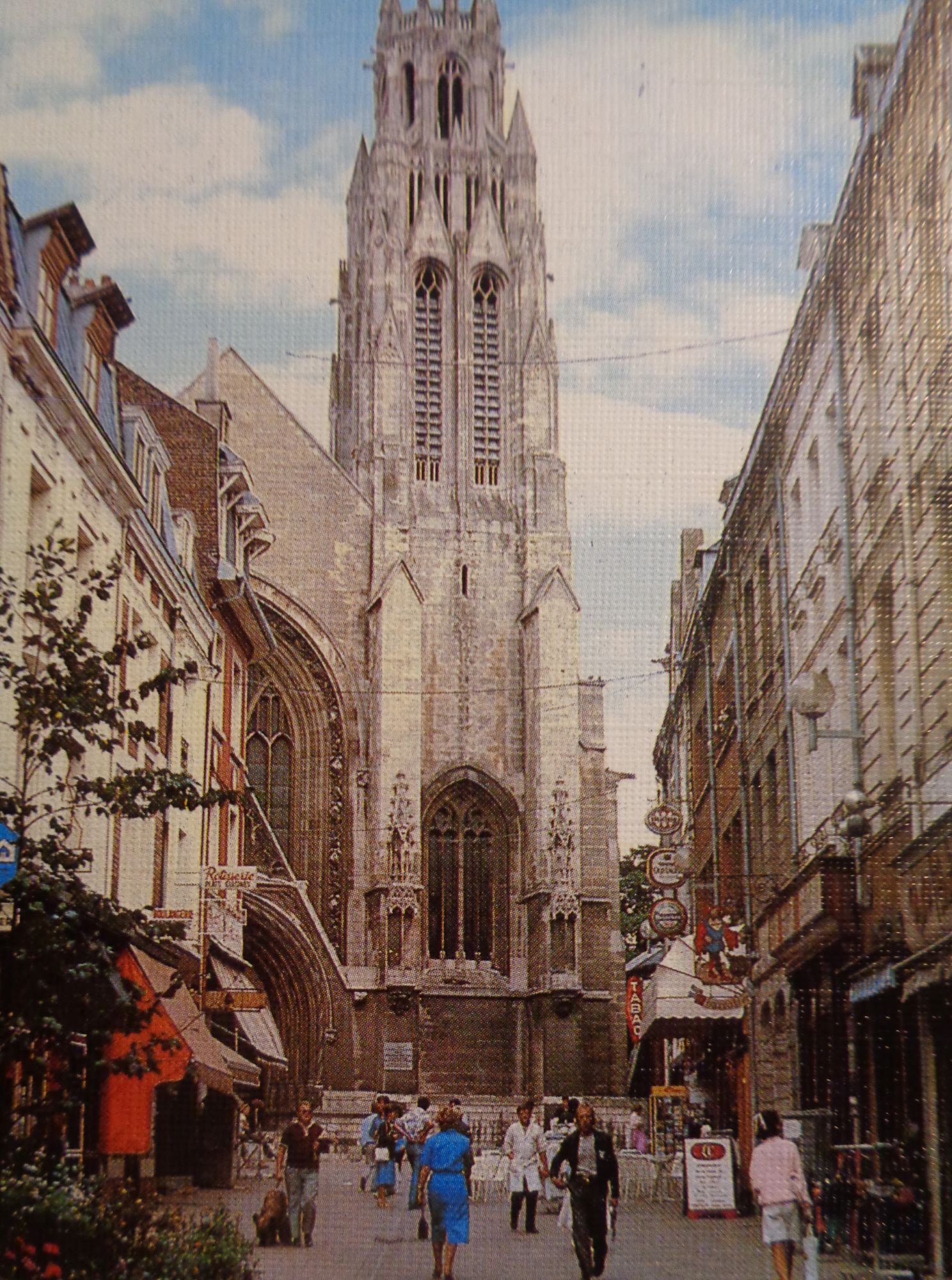
The very commercial nice shopping rue de la Housse is very vibrant and great walks indeed. Mind you this street was completely destroyed during WWII and since nicely rebuilt. The picture is the street going towards the Church St John the Baptist.
Next to the countryside Arras becomes a fairs town, a place of exchanges from the 9C. The city has the biggest cereal market north of Paris and a place for all wines destinations Pays Bas and Belgium, At this period the square Place des Héros also called the Petite Place was bordered with wooden houses and arcades housing shops, taverns, cellars etc as well as a subterranean cave of chalk that can be visited, You can climb the Beffroi or belfry with an elevator lift to see great views of the city, and also entered the cellars. You go on to the Saint Vaast neighborhood, to see the Hôtel de Ville gothic flamboyant style and a Renaissance facade ! When you take the rue de la Taillerie you see the glorious past of bed sheets in Arras as in the Middle Ages the hall of bed sheets was found here. Move on to the Place Guy-Mollet to the left see at no 4 rue du Marché-au-Filé, the Mont de Piété the first example of gables made of curves and countercurves, A bit further you see the Cathedral Saint Vaast built on the old medieval cathedral with imposing dimensions on a gothic layout and a neo classic decoration, Next to it the former abbey sold as national property in the French revolution that houses today the fine arts museum or Beaux-Arts,22 rue Paul Doumer, the original lion that is mounted on the belfry.
The first belfries were used to sound the alarm and gathered the troops in case of an attack, However, from the 11C, the economic push of the cities and a new class made them serve other purposes such as prisons, keeper of the seal and place of meeting of aldermens, Therefore, to show this economic power, one builds a belfry higher than the next town, Until the construction of the belfry of Lille in 1929, the one in Arras was the highest with 75 meters, and built since 1453 ! , The clock is seen on its four faces to be seen by the entire population, and to show the influence of the church, The sound had meanings, such as Banclocque to call the aldermen to meetings, Effroy yells fire, couvre feu meaning sunrise and sunset , and Guet the monitoring of the city . Today the belfry serves a rallient point of the town where concerts are held like in Arras every Saturday morning,
There are still several mansions in the art déco style by rue Saint Aubert or nearby the Italian inspired Theater. Arras is a City of Arts and History designation, and member of the Vauban network; it has 225 monuments classified as historical monuments that makes it the 7th city in France! The wonderful place des Héros, rue de la Taillerie, and the Grand’Place form an extraordinary monumental group of buildings unique in Europe. The bell tower or beffroi in the city hall or hôtel de ville was built between 1463-1554, destroyed by Germans in WWI it was rebuilt to the identical after the war. The huge abbey of Saint-Vaast rebuilt in the 18C in classical architecture today houses the fine arts museum or musée des Beaux-Arts d’Arras, and the municipal library. Originally founded in the 7C ; the Church became the Cathedral of Notre-Dame-et-Saint-Vaast after the old cathedral was destroyed during the French revolution. The lower town has the district that link the city to the Citadelle, around the place Victor-Hugo, built in 1756 in an octagonal shape of which in the center an obelisk was placed. The Citadelle was built between 1668-1672 as a defense in square format as wanted by Vauban, to protect the kingdom from invasion by the Spanish low countries but was never attack. There is a theater on the Italian model built in 1785 and renovated last in 2007. The fine arts museum has sculptures, objects of art, and painting collections from the Flemish, Dutch, Italian, and French schools . There is an agreement between the city and the chateau de Versailles to offered collaboration that will give the museum a royal domain look (of course).
A bit of history I like: the treaty of Madrid of 1526 attached Arras to the Spanish lower countries but was never respected by king François I and conflicts continue until the end of his reign. The city is conquered by king Louis XIII in 1640 and later siege by the Spanish in 1654 ; however , the attachement to France does not happenned until the Treaty of the Pyrénées in 1659.(That set the frontiers of France and Spain to this day). WI or the Great War gave considerable damaged to the city and destruction of its heritage buildings as the town was only 10 km from the front. The beffroi is destroyed then the Cathedral and the palace of Saint-Vaast are bombarded in 1915. In secret the British built the stone quarries of chalk under the city to house the soldiers necessary for the battle of Arras of April 9 1917; the quarry of Wellington is open today to remember what heroic actions were taken place here. After the war, Arras was demolished in 3/4 of it and was rebuilt almost identical later. It had some damaged in WWII but not nearly as much than during the Great War 1914-1918.
The city of Arras on its history: https://www.arras.fr/page/decouvrez-l-histoire-d-arras
The Arras tourist office on its heritage: https://www.arraspaysdartois.com/en/the-essentials/dont-miss-the-must-sees-of-arras-the-top-10/
There you go folks, another dandy city this time of the north of my belle France. This is Arras, and indeed worth the detour for its architecture, history and just plain beauty of the Nord! Again ,hope you enjoy this post on curiosities of Arras, part II !! as I.
And remember, happy travels, good health, and many cheers to all !!!

 Paris1972-Versailles2003