
So I am moving up again to my neighbor Belgium, many times there taken advantange of family near the Belgian border. I have several posts on one of my favorite cities, but feel obligated again to tell you a bit more of its most interesting monuments.I am glad knew it had found pictures in my cd rom vault that should be in my blog for you and me, After all, these were memorable walks with the family which we love to do together when visiting anywhere. What better way to do this then by showcasing the historical and architectural significance in the city of Brussels. Therefore, let me tell you again on the Church Notre Dame des Victoires au Sablon of Brussels ,part II !!! Hope you enjoy the post as I.
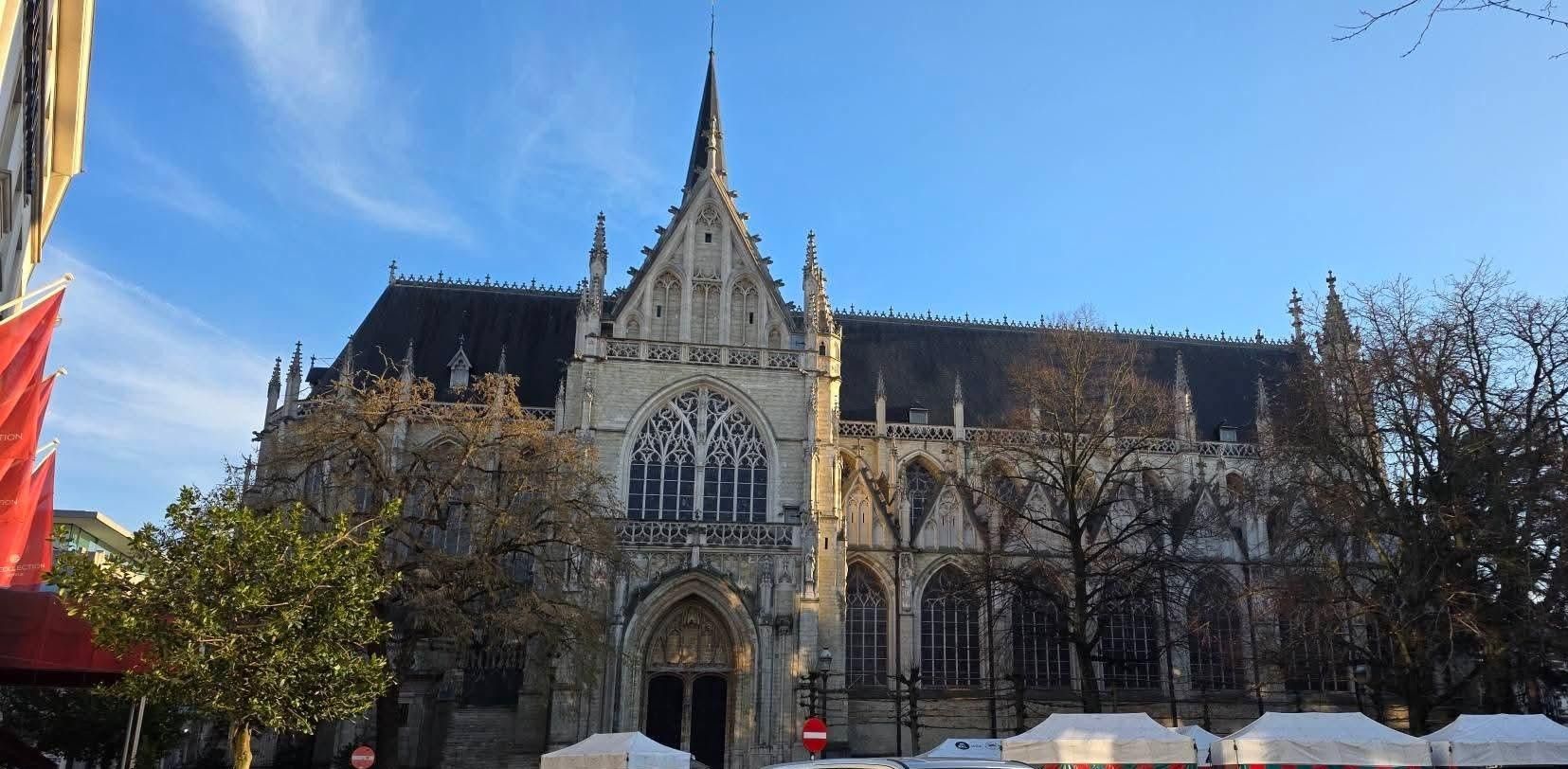
The Church Notre Dame des Victoires au Sablon, or simply the Church of Notre Dame du Sablon, is located on the edge of the Sablon. The arrival in 1348 of a miraculous Virgin, whose cult and procession, known as the Ommegang, would soon supplant the devotion and procession to Saint Michael, gave this church a major role in Brussels social life.
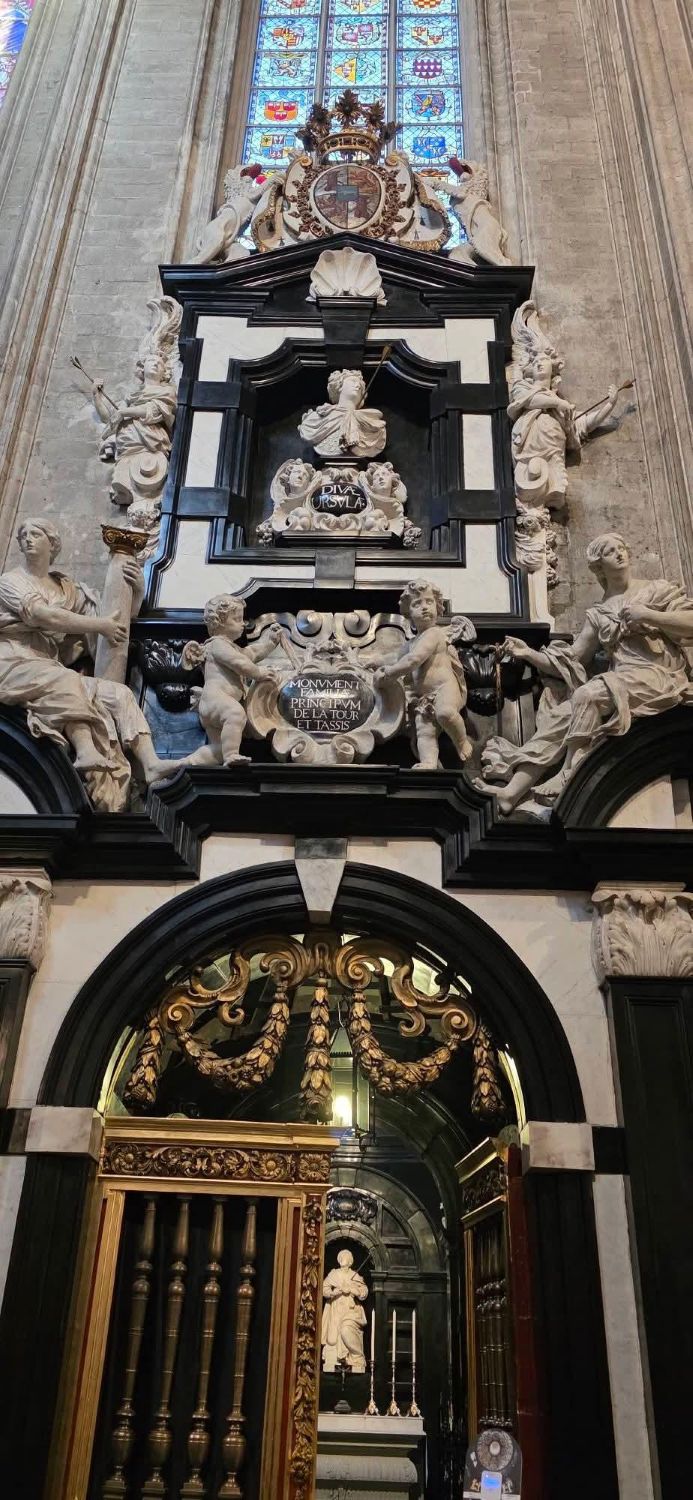
The chancel is lit by eleven lancet windows, each about 14 meters high, separated by clustered pillars. Below the lancets are painted trefoil arches. These paintings, depicting saints, were executed in 1867, based on original paint fragments discovered in 1859 when the whitewash that concealed them was removed. The neo-Gothic high altar dates from 1884. The chancel is very bright thanks to its stained-glass windows. The apse windows were created in 1864-1865. Those in the two straight bays date from 1934 and are dedicated to the confraternities of Saint Hubert and Saint Wivine and to the Knights of the Holy Sepulchre. The chancel is flanked by two Baroque chapels. To the north, the Chapel of Saint Ursula is the burial chapel of the Thurn and Taxis family, postmasters general from the 16C onward. The entrance portal is surmounted by an impressive group of statues: two allegorical statues representing Constancy and Virtue flank two putti bearing an inscription. Above the putti sits a bust of Saint Ursula. The interior is divided into two octagonal sections, each illuminated by a dome. In the first section, the white marble statuary stands out against a black background.
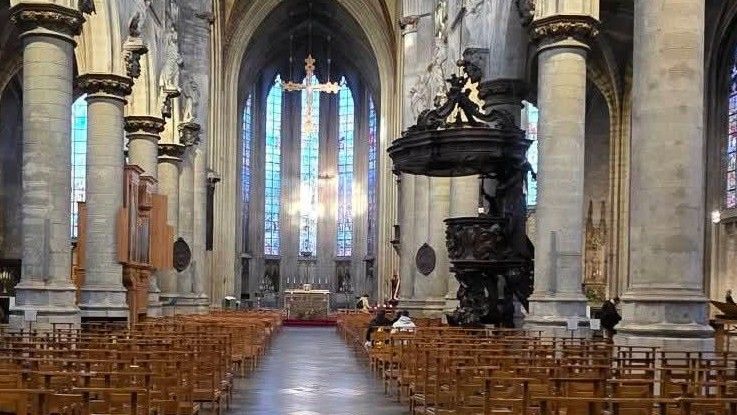
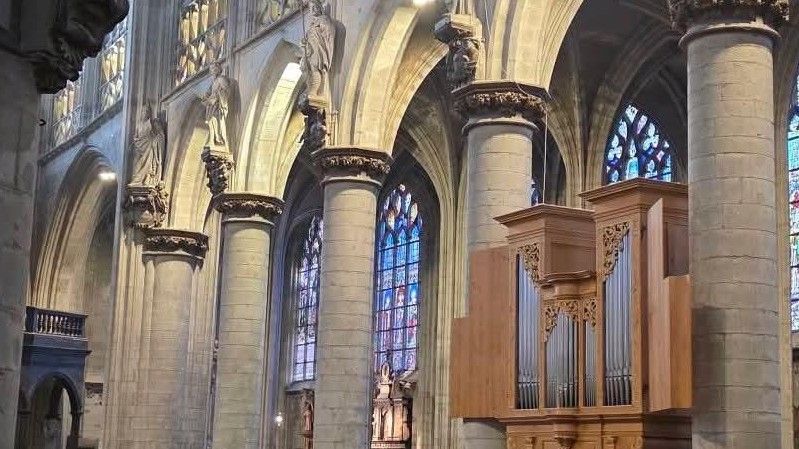
The nave consists of a central aisle flanked by four side aisles. It is divided into seven bays: the five bays originally planned and two additional bays built at the beginning of the 16C. The vault of the nave rests on eight cylindrical columns with octagonal bases and capitals decorated with cabbage leaves, as well as on four large pillars. These supports are adorned with statues of apostles resting on consoles, several of which were created between 1641 and 1646. The Baroque pulpit created in 1697 for the now-vanished Augustinian church. It is decorated with medallions of Saint Thomas Aquinas, the Virgin Mary, and Saint Thomas of Villeneuve. It rests upon sculptures symbolizing the four Evangelists: the angel, the eagle, the ox, and the lion.
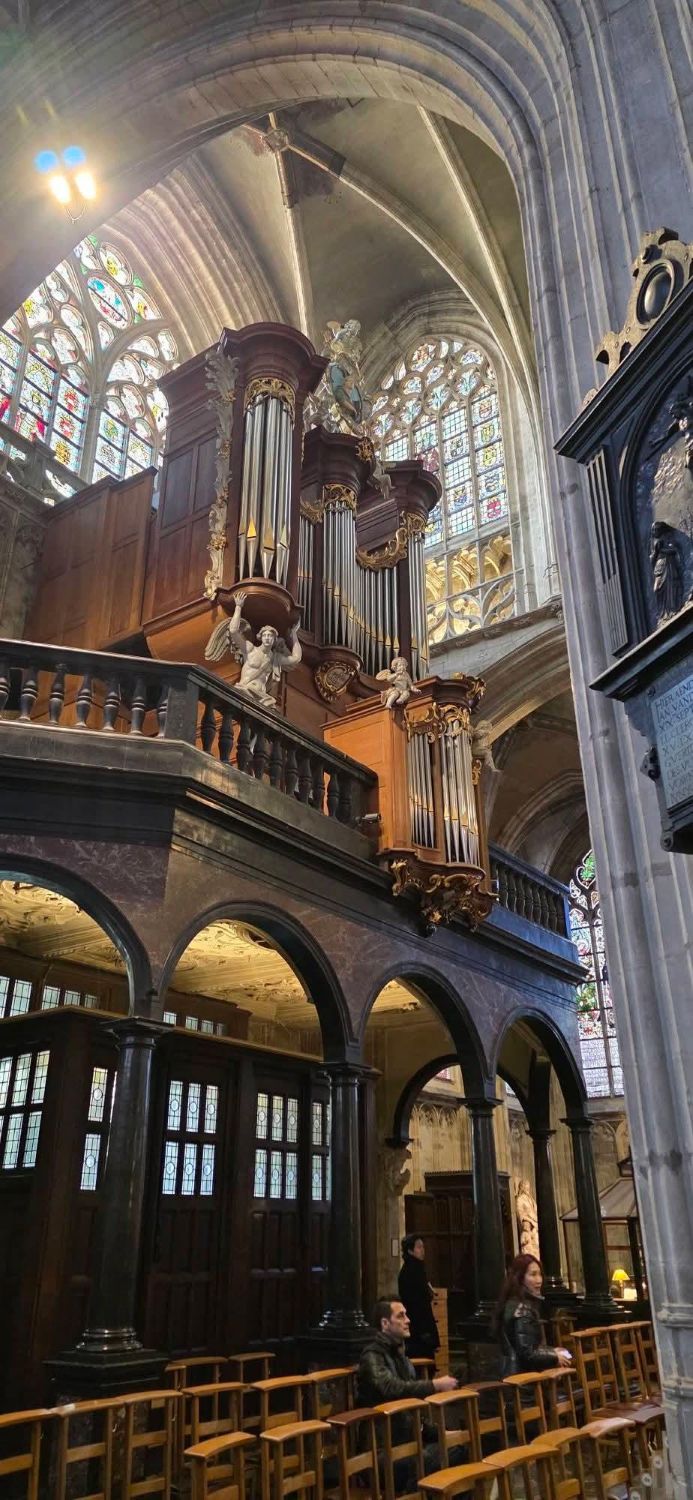
The organ above the gallery was built in 1763, The instrument was rebuilt in 1893. In the nave is a second, more recent organ,
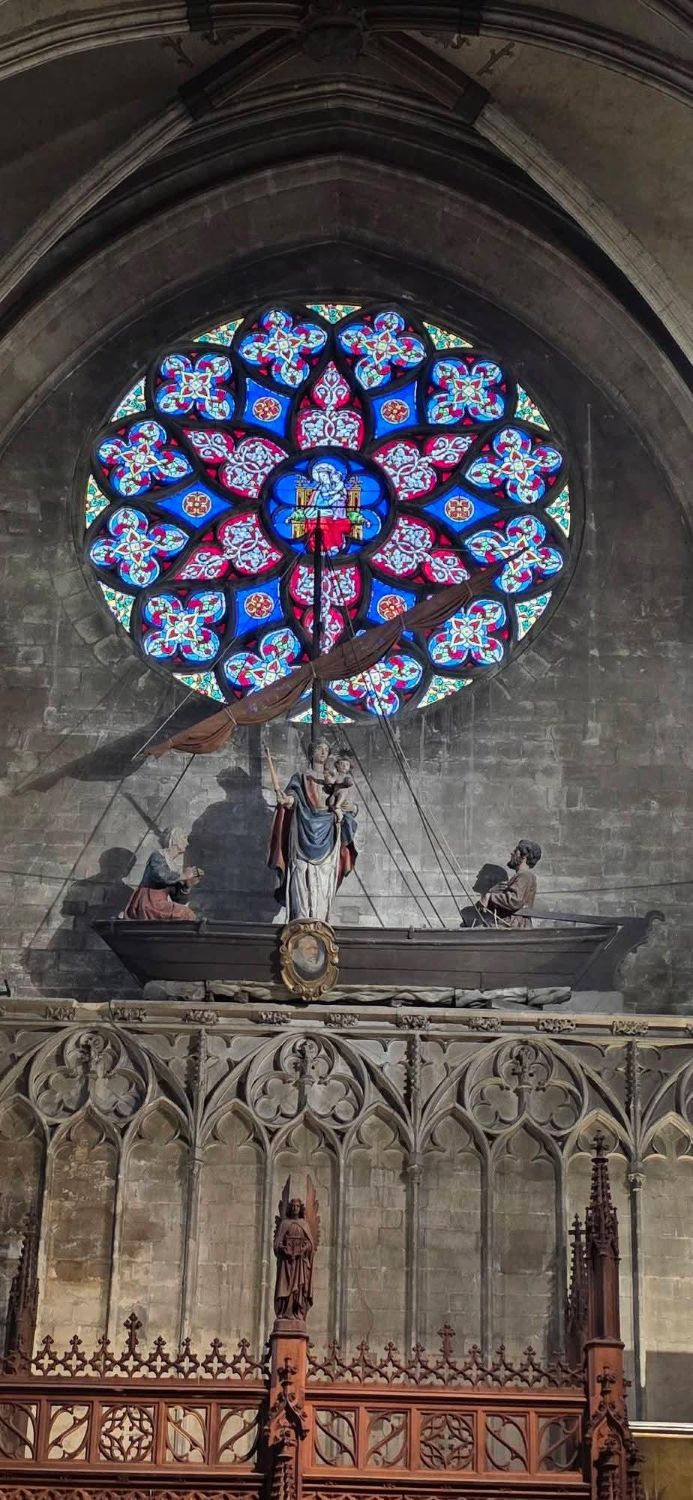
The transept arms are decorated with two registers of arcades surmounted by a frieze of cabbage leaves. The portal of the north transept is surmounted by a window decorated with stained glass depicting the Tree of Jesse, while that of the south transept is surmounted by a large rose window with an unattributed Sedes Sapientiae at its center. In front of this rose window, a large model depicts a theme found elsewhere in the church: the boat in which the miraculous statue of the Virgin was transported by Beatrijs Soetkens from Antwerp to Brussels.
A bit of history I like tell us that in 1304, the Mother Superior of Saint John’s Hospital ceded to the Grand Guild of Crossbowmen a portion of the land the hospital owned in the Sablon district for the construction of a small chapel dedicated to the Virgin. The renown of this modest sanctuary grew when, in 1348, a miraculous statuette of the Virgin was brought there. According to tradition, this statuette was brought from Antwerp by a certain Beatrice Soetkens. The statuette’s fame attracted devotees, and thanks to the influx of offerings, the crossbowmen were able to build a new sanctuary in the 15C. The chancel was completed in 1435, as evidenced by murals bearing this date. The north transept was probably completed around 1450, and work was underway on the south transept and the first five bays of the nave. Work was interrupted during the period of political instability that followed the death of Charles the Bold in 1477. It resumed at the end of the century, and the nave eventually comprised seven bays, the last two of which were intended to be surmounted by a tower that was never built. The sacrarium, a small building constructed as an extension behind the chancel, dates from 1549. At the end of the 16C, the church was ransacked by Calvinists. It was then that the statue of the Virgin Mary was destroyed. In the 17C, the Thurn and Taxis family had two chapels built: the Chapel of Saint Ursula to the north of the choir (1651-1676), and the Chapel of Saint Mark to the south of the choir (1690). It was only from the 18C onward that a written record of the name Notre Dame des Victoires appears, because the people believed it had been founded to celebrate the victory of Duke John I at the Battle of Worringen. In fact, this belief was erroneous, unlike the established reference to the Battle of Lepanto in 1571. Under French rule, the church was spared the anti-religious zeal of the revolutionaries, as its priest had accepted to swear allegiance to the Republic. It was nevertheless closed for a few years, then reopened for worship under Napoleon I, as a branch of the Church of Notre-Dame de la Chapelle.
The Fonds of the Church Notre Dame des Victoires au Sablon : https://en.fondsamiseglisesablon.be/
The Brussels tourist office on the church : https://www.visit.brussels/en/visitors/venue-details.Eglise-Notre-Dame-des-Victoires-du-Sablon.207330
The Brussels region heritage site on the church : https://monument.heritage.brussels/fr/buildings/30493
The City of Brussels on its heritage : https://www.brussels.be/tourism
There you go folks, a bit more just to give you a better overview of this magnificent church in a wonderful district of Sablon in pretty Brussels that is worth a visit, me think. Again, hope you enjoy the post on the Church Notre Dame des Victoires au Sablon of Brussels ,part II !!! as I.
And remember, happy travels, good health, and many cheers to all !!!


