
This one ranks up there as memories flash back as I write. It was a very moving moment in my life and plenty of anecdotes in my blog on it. Walking in my Madrid is been in heavens , lots of beautiful historical architecturally stunning architecture all over, and by this very popular area lies an off the beaten path trail that is worth the detour, me think. Therefore, let me tell you about the cuesta de los ciegos of Madrid !!! Hope you enjoy the post as I.
The Cuesta de los Ciegos is a granite staircase that leads up from Calle de Segovia. It is a small slope with steps that saves the difference in level between Calle de Segovia and Calle Beatriz Galindo towards the Jardines de Las Vistillas gardens. A zigzag staircase at the foot of the Segovia Viaducto (see post) ascends one of the steepest slopes in the city thanks to 254 steps. Its history takes us from the medieval subsoil, which still preserves a network of galleries and passageways shown since the city maps of 1656, to the fountain at its feet, called Caño de La Vecindad, which preserves the coat of arms of the Villa de Madrid during the period of the Spanish Republic.
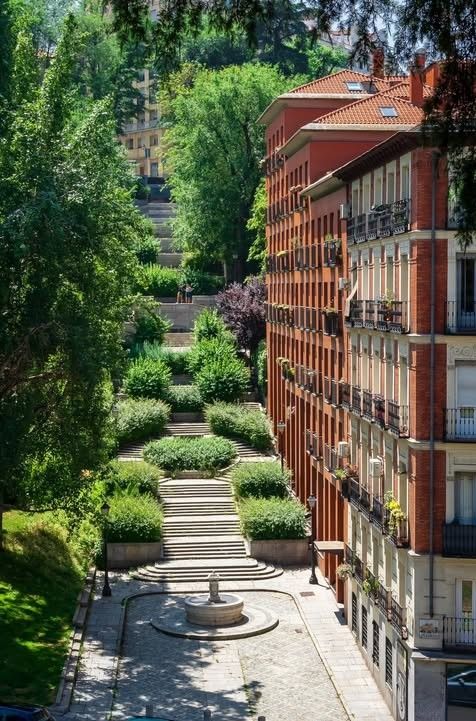
Currently, this staircase that connects Calle de Segovia with Calle de La Morería, the point where the Las Vistillas gardens begin, but until it was built in the 19C as part of the renovation works on the area there was only a steep ravine popularly known as arrastraculos ( ass-crawlers). This nickname was given to it because the locals would descend the slope crouching down to avoid falling, while the children would fall on their bottoms as if it were a slide. Beneath the stairs runs an intricate system of plastered brick passageways, two meters high and one meter wide, leading to the Palacio Real or Royal Palace and connecting it to other important buildings in the city. It may also be part of a secret route, said to have been used by those wishing to leave the city unseen. Today, only clean water runs through the passageway. According to legend, the place is name because during his visit to Spain to complete the Camino de Santiago in 1214, the Saint Francis of Assisi passed through Madrid to found the monastery that, centuries later, would become the Royal Basilica of Saint Francisco El Grande (see posts). One day, as he passed through this hill, he met several blind men begging for alms. Saint Francis of Assisi anointed their eyes with oil, and miraculously, the blind men regained their sight.
From the staircase of Cuesta de los Ciegos, with its characteristic stone construction with steps on both sides and its recurring landings, you can discover an interesting view of both the Viaduct and Calle de Segovia, the green areas of the Jardin de Las Vistillas garden and the back of the Almudena Cathedral. From the Plaza Mayor where we started our walk it is only less than 15 minutes taking Calle Mayor towards the Almudena Cathedral, turn right on Calle de Bailén until Calle de Segovia and on your left is the Cuesta de los Ciegos.
There is nothing in tourist webs of Madrid but the closest to it is found in the Madrid tourist office on the nearby Viaducto : https://www.esmadrid.com/en/tourist-information/viaducto
There you go folks, there is a lot more on my coming and going there in my blog. Madrid is more than just a tourist city for me, it is like home! Capital of the kingdom of Spain and everything in Spain can be found there. This is a wonderful walk even if needs a bit of conditioning and good health to climb up and down the steps, Again, hope you enjoy this post on the cuesta de los ciegos of Madrid !!! as I.
And remember, happy travels, good health, and many cheers to all !!!

 Paris1972-Versailles2003