
Oh yes Madrid has bridges as any city with a river going thru such as the Manzanares. I like to tell you about one specific and peculiar one, the Viaducto or viaduct for you and me. Again, found me a picture in my cd rom vault and with another one taken from another post will do one just for it, well deserving me think. Therefore, here is my take on the viaducto de Segovia in Madrid !!! Hope you enjoy it as I.
The Viaducto de Segovia or viaduct or Viaduct of Bailén, A previous one existed, built in the 1930s to replace an iron one erected in 1874. The current one is the result of numerous restorations carried out to adapt its structures to the growing traffic demand. The purpose of the Segovia Viaduct is to extend Calle Bailén, located at its top, and overcome the difference in level of Calle Segovia, which runs perpendicularly below, connecting the Royal Palace area with Las Vistillas. 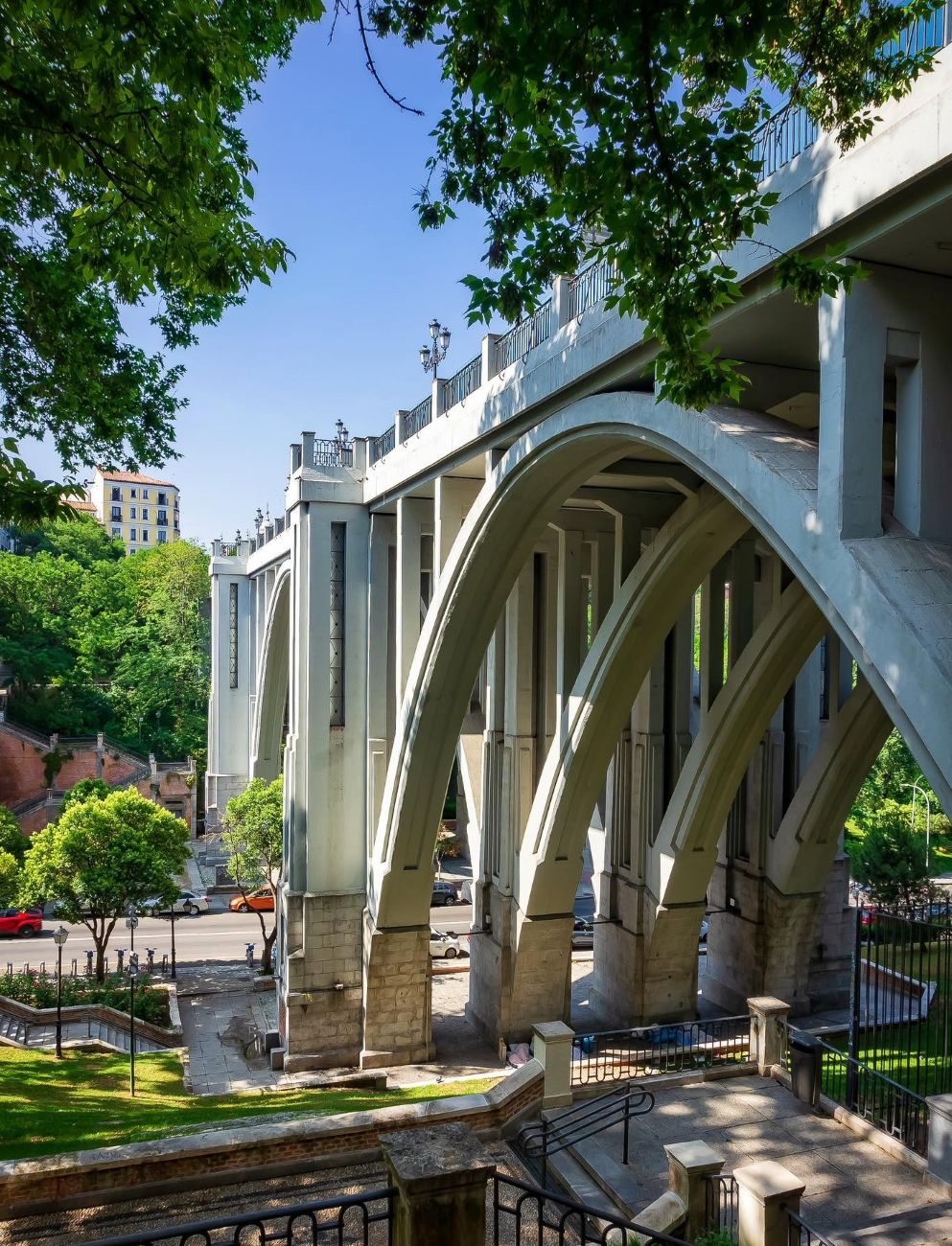
The viaduct spans a difference in level of 23 meters, with the deck supported by a structure of three hyperbolic arches with a span of 35 meters and an annex of four semicircular arches. The entire structure is made of polished reinforced concrete, with pillars covered by a decorative plinth of granite ashlar. It is a large bridge, approximately 200 meters long and 25 meters high at its highest point relative to Calle Segovia, with a deck width of almost 20 meters. It remains one of the main gateways to the city center/downtown/Centro, with its northern end opening into the vicinity of Plaza de Oriente and Calle Mayor.Many times by it and even walked underneath and over see pics.

A bit of wonderful history I like tell us that during the reign of Felipe II (Philip), the Alcázar of Madrid was located in an elevated area on a hill, bordered on one side by the Manzanares River, at a lower elevation, and on the other by the tremendous valley that the descent along Calle Segovia represented. The street sits on a steep ravine, through which the San Pedro stream passed. A stream that rose in the vicinity of the church of San Pedro el Viejo. The urban planning ideas of Philip II’s architects meant that Calle Segovia became an important access point to the new capital, through the construction of the Puente de Segovia bridge,(see post) works that were completed in 1584. Therefore, the area, by the end of the 16C, was already an important passage point to the city.
Going forward, on January 31, 1872, the first piece of iron of the bridge was finally placed. It crossed the pavement of Calle Segovia at a height of 23 meters, and was 120 meters long with a 13-meters wide deck. It was capable of withstanding pressures of 400 kg per square meter. The bridge was inaugurated on October 13, 1874. The poor state of conservation of the old viaduct led the government of the Second Republic to call a competition in 1931 to design the current viaduct; the competition was canceled by the College of Architects and called again the following year. The work was completed in 1934. In 1942 it had to be rebuilt due to its state of deterioration due to the damage suffered during the Spanish Civil War. Already in the post-war period, the new viaduct had to be restored, and it was inaugurated on March 28, 1942.
Moving right along in 1974, in light of the results of the technical study, a proposal was made to the Madrid City Council for its restoration. In 1976, traffic on the viaduct was completely interrupted. Traffic on Calle Bailén was completely interrupted for several years during the 1970s. It was subsequently restored between 1977 and 1978. Designed to allow heavy vehicles to circulate on it simultaneously in both directions. It has two shoulders for pedestrians. A place from which you can see the Casa de Campo, specifically the pump in the center of the lake. The viaduct appears in numerous Spanish films, my favorite of all was/is Taxi (Carlos Saura, 1996). By the way, on the west side of the viaduct we see a plaque located by the Madrid City Council. It says that the Casa de la Moneda, the historical precedent of the National Mint and Stamp Factory, was located on this site until 1861. On the other side is the Casa del Pastor, which houses Madrid’s oldest coat of arms. One last anecdote tell us that the first guest to cross the Viaduct at its inauguration was the coffin bearing the remains of Pedro Calderón de la Barca ! (a Spanish writer, playwright and priest, member of the Venerable Congregation of Secular Priests of Madrid, Saint Peter the Apostle, and knight of the Order of Santiago, known primarily for being one of the most distinguished Baroque writers of the Golden Age, especially for his theatre.), This is how the author of La Vida es Sueño made his final journey across Madrid’s highest bridge.
The Madrid tourist office on the viaducto : https://www.esmadrid.com/en/tourist-information/viaducto
There you go folks, another dandy post of my dear Madrid, always in my mind. The tradition continues, I think I am in good hands with my sons! Madrid is awesome and its bridges beautiful and historical. Again, hope you have enjoy this post on the viaducto de Segovia in Madrid as I.
And remember, happy travels, good health, and many cheers to all !!!

 Paris1972-Versailles2003
One thought on “The Viaducto de Segovia in Madrid !!!”