
This is of course a huge area, and many memorable visits and passing over the years since childhood. I have written that Calatayud is in the province of Zaragoza in the autonomous community of Aragon , and in my dear Spain, It sits on the banks of the Jalon river. There are many roads crossing here such as the A2 and the N234 and old N II (which we still preferred to take more in town) ; The regional roads or autonomous A 1504 to Cariñena , the A202 to Nuévalos and the local road CV 601 to Embid de la Ribera; there is the now wonderful A23 and still away the A24. Wonderful Calatayud,full of nice memories needed to post in my blog after found me an older picture in my cd rom vault that should be in my blog for you and me, Therefore, here is my take on the Church San Andrés of Calatayud !!! Hope you enjoy the post as I.
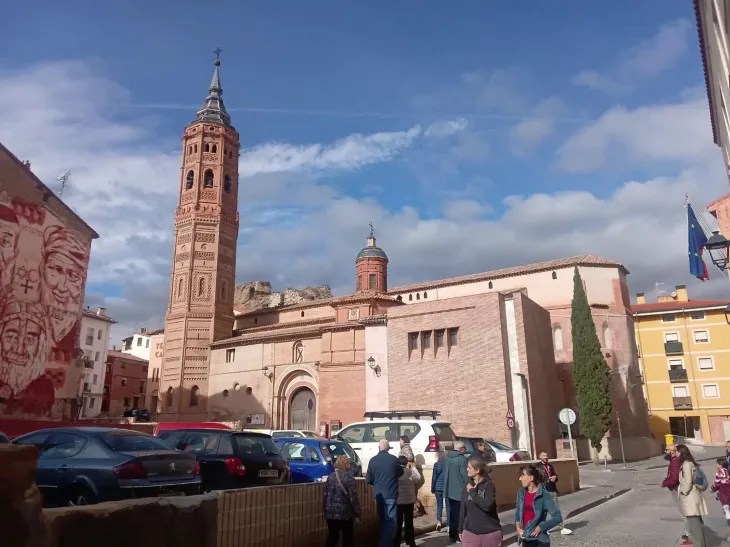
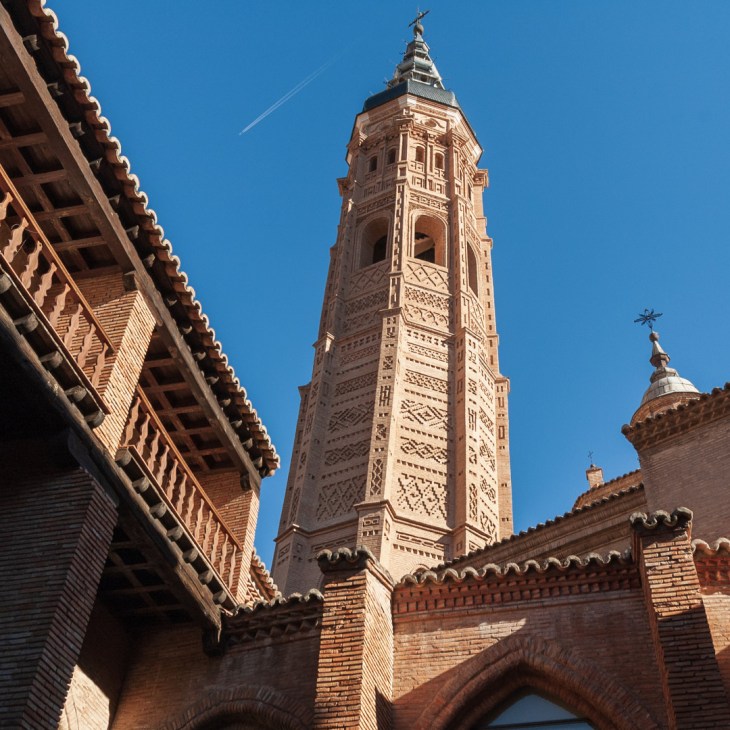
The Church San Andrés,or St Andrew is a Gothic style church The church was commissioned in the 12C after the Reconquista of the town by Alfonso I el Batallador or the battler. Initially likely of Romanesque design, only traces of that church remain above the portal and in the baptismal font. The bell-tower was built in 1508. The church retains its 14C Mudéjar layout with Gothic tracery creating elaborate star-shaped geometric lines. The aisles have four chapels: two of Mudéjar design, including the baptistry. The other two were built in the 18C with Gothic tracery ceilings. The main altar has sculptures of the evangelists Mark and Luke, and two saints. Some panels depict the Fathers of the Roman Church (Augustine, Ambrose, Hieronymus, and Gregory the Great). The central panel has a statue of St Andrew replacing the original painted icon, and it is topped by an 18C canvas of the Immaculate Conception. But what everyone agrees on is the beauty of the Torre de San Andrés or St Andrews’ tower one of the most interesting in Aragonese Mudejar architecture. The structure of the tower is inherited from the minarets of the Hispano-Muslim tradition and,has an interior counter-cowl beneath which the current baptistery space is formed, which houses a spectacular alabaster baptismal font carved from the second half of the 16C. On the exterior, it has three sections of equal height, with a rich decorative ornamentation made of highlighted brick; the two lower ones correspond to the oldest part, dating from the dawn of the 15C, while the bell tower was made between 1506 and 1509. Finally, the spire was completed in 1756. The decoration of the San Andrés tower is exquisite and complex, based on friezes of quincunxes, staggered quincunxes, sebka panels, panels of recessed crosses, blind oculi, lattices and some interesting triangular motifs that some authors have linked to decorations on buildings in Yemen and Egypt. In reality, the tower is composed of two concentric towers with a stairwell inside the latter. The inner tower, hollow, houses a small octagonal chapel. It is almost certain that construction proceeded over decades if not centuries, and that the final bell-unit was not complete till the 16C. The brickwork becomes more highly decorated in the higher stories.
The Church San Andrés is considered by some authors to be one of the first parishes founded after the Reconquista, the church and especially its tower, is one of the symbols of the city of Calatayud. It is a three-nave building with a shallow transept. During a 16C renovation, an additional bay was added to the chancel and the apse was transformed, which is only visible in the central nave. Following the restoration carried out in 1990, the church was painted in various colors, intended to make the differentiation between the various construction stages more evident to visitors, as its origin has sparked an interesting debate. Some authors suggest that the oldest part of the church, corresponding to the four bays of the three naves located between the transept and the foot, are the remains of an ancient mosque dating from between the 11C and 12C. This space, which is currently painted white, is covered with simple ribbed vaults. It is highly likely that it was originally covered by a wooden roof, which was replaced in 1462 by the current vaults. Others, however, maintain that it is a 14C church, enlarged in the 16C.
The city of Calatayud on the Church San Andrés : https://www.calatayud.es/turismo/ficha_visitar/iglesia-de-san-andres
The comunidad or region of Calatayud tourist office on the mudéjar architecture and the church : https://www.aragonmudejar.com/calatayud/sanandres/sanandres1.html
The province of Zaragoza on Calatayud: https://www.turismodezaragoza.es/provincia/comarcas/comarca-calatayud.html
The region of Aragon tourist board on the church: https://www.turismodearagon.com/ficha/iglesia-y-torre-de-san-andres-calatayud/
There you go folks, a dandy places to see in wonderful Calatayud. A jewel of a quant small town to be visit for sure, We shall meet again , eventually, Again, hope you enjoy this post on the Church San Andrés of Calatayud !!! as I
And remember, happy travels, good health and many cheers to all !!!


