
I take you back to my dear Madrid !! love it !! I like to continue the saga of my dear Madrid with new pictures from my cd rom vault that should be in my blog for you and me, This is again my lost walking trails of wonderful sublime Madrid, Therefore, let me tell you about curiosities of Madrid, part V !!! Hope you enjoy the post as I.
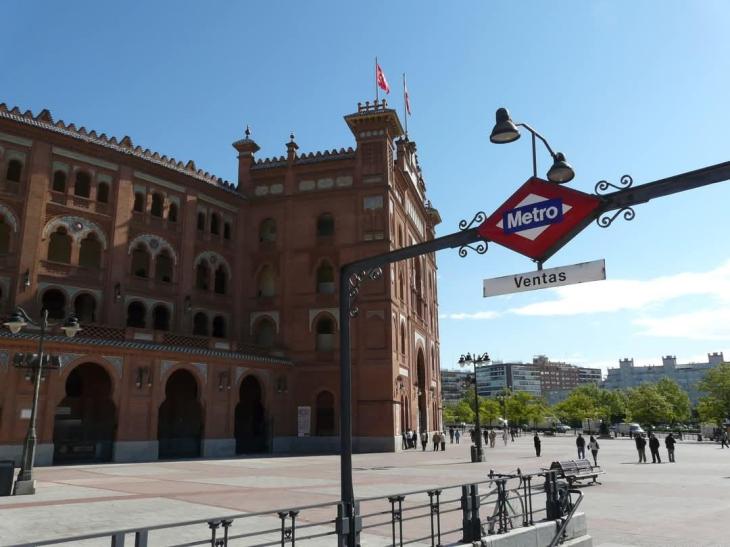
The Ventas metro station by Calle de Alcalá,no, 233,in front of the Monumental Ventas bullfight ring was inaugurated on June 14, 1924. The latest news is that the Ventas metro station will recover a hall that had been closed since 1970 and will have five elevators. On May 28, 1964, it ceased to be a terminal when the line was continued to Ciudad Lineal. On February 26, 1970, the new platforms of line 5 were inaugurated, including the Ventas-Ciudad Lineal section, (where I was able to enjoy while living in the city), and from July 20, 1970, once again becoming the head of line 2. The line 2 station ceased to be the head station on February 16, 2007 when it was extended to La Elipa. The accesses through the Ventas Vestibule or lobby are Plaza de Toros Calle de Alcalá, 237 , opposite Plaza Toros de Las Ventas, Las Ventas is the name given to the bullring in Madrid because it was called the area in which it is located ,the neighborhood of Ventas and in the district of Ciudad Lineal ( mine). One of the cultural and historic icon of the city is the Las Ventas bullfight arena (aka Monumental). The inaugural poster dates back to 1931. A replica is found in the Puerta Grande ( big entrance gate). On that occasion, eight matadors took part in the first bullfight of Las Ventas on June 16. However, the official opening was in 1934. It was built in Neo-mudéjar style, with metal structure and brick façade. There is also a nice ,and informative Museo Taurino or Bullfighting Museum at the back, inaugurated on May 15, 1951.
The Ventas metro station by Calle de Alcalá,no, 233,in front of the Monumental Ventas bullfight ring was inaugurated on June 14, 1924. The latest news is that the Ventas metro station will recover a hall that had been closed since 1970 and will have five elevators. On May 28, 1964, it ceased to be a terminal when the line was continued to Ciudad Lineal. On February 26, 1970, the new platforms of line 5 were inaugurated, including the Ventas-Ciudad Lineal section, (where I was able to enjoy while living in the city), and from July 20, 1970, once again becoming the head of line 2. The line 2 station ceased to be the head station on February 16, 2007 when it was extended to La Elipa. The accesses through the Ventas Vestibule or lobby are Plaza de Toros Calle de Alcalá, 237 , opposite Plaza Toros de Las Ventas, Las Ventas is the name given to the bullring in Madrid because it was called the area in which it is located ,the neighborhood of Ventas and in the district of Ciudad Lineal ( mine). One of the cultural and historic icon of the city is the Las Ventas bullfight arena (aka Monumental). The inaugural poster dates back to 1931. A replica is found in the Puerta Grande ( big entrance gate). On that occasion, eight matadors took part in the first bullfight of Las Ventas on June 16. However, the official opening was in 1934. It was built in Neo-mudéjar style, with metal structure and brick façade. There is also a nice ,and informative Museo Taurino or Bullfighting Museum at the back, inaugurated on May 15, 1951.
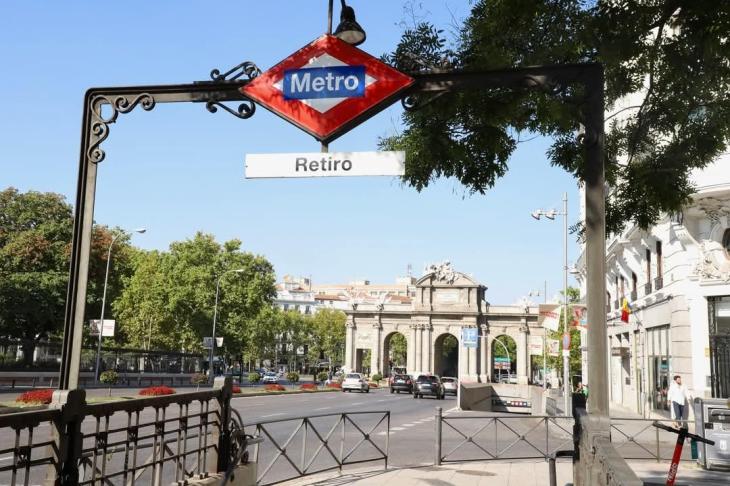
The Retiro metro station is on Line 2, located between the Recoletos neighborhood of the Salamanca district,and Jerónimos neighborhood of the Retiro district, under the emblematic calle de Alcalá (see post), and next to the famous Retiro Park (see posts), from which it takes its name. The station was opened to the public on 14 June 1924 when the first section of Line 2 was put into service. The station has two platforms and three tracks, one of which houses the temporary exhibition hall. The vestibule or access are Lagasca :Calle de Alcalá, 85 (corner Calle Lagasca) Calle Lagasca, 4. Ramp access Retiro Park, Vestibule or lobby Claudio Coello : Calle de Alcalá, 75 (corner Calle Claudio Coello). For Puerta de Alcalá and National Archaeological Museum ,The Puerta de Alcalà is one of the five old gates for entry into Madrid. It is at the Plaza de la Independencia or independence square facing the Retiro Park (my old entry point to the center of Madrid in my days there) . The gate was built on the orders of King Charles III ,the work began in 1769 and continued until the inauguration in 1778. This is the first triumphal arc built in Europe since the fall of the Roman Empire, The gate allowed the entrance in Madrid to travelers from Aragon, Catalonia and France.
The official Metro de Madrid on itineraries : https://www.metromadrid.es/en
The Madrid tourist office on getting around by metro : https://www.esmadrid.com/en/getting-around-madrid-metro
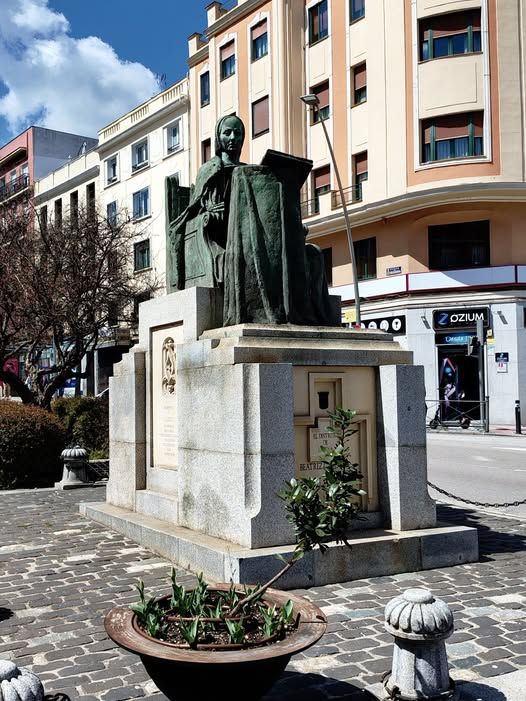
Beatriz Galindo, aka la Latina, born around 1465 in Salamanca, and died on November 23, 1535 in Madrid, was a Madrid-based personality and Spanish educator, a long-time member of the court and advisor to queen Isabel the Catholic. She also founded and managed several social and religious institutions in Madrid, Beatriz saw the deaths of both her sons Fernán (1529) and Nuflo (1525 or 1526). When she died in 1535, she had 14 living grandchildren. Her descendants formed the noble houses of Bornos (Fernán branch) and Rivas (Nuflo branch). Since 1999, the statue of La Latina has presided over the crossroads between Paseo de Extremadura and Plaza de la Puerta del Ángel, opposite the prominent Neo-Mudejar Church of Santa Cristina, a place of long historical memory. The statue incorporates educational symbols and Latin text, reflecting Galindo’s role as a 15C scholar and royal tutor. Madrid honors the memory of Beatriz Galindo in several ways: with the name of Calle Beatriz Galindo in the Jardines de Las Vistillas gardens, and with the place names of two divisions of the city, which allude to her by her nickname. The La Latina neighborhood in the old town owes its traditional name to the former hospital and convent founded by Beatriz Galindo next to the Plaza de la Cebada. Furthermore, in 1971, the city council named one of the districts resulting from dividing Carabanchel, which emerged in 1948 from the annexation of the villages of Carabanchel Alto y Bajo, into three, Latina. The Latina district which should not be confused with, nor is adjacent to, the neighborhood of the same name erected a monument to Beatriz Galindo in 1999 in the Puerta del Ángel square: a colossal bronze statue depicting the lady seated at her supposed desk. Visitors can reach the monument by taking Metro Line 6 to the Puerta del Ángel station and walking north.
The Prado Museum or Museo Nacional del Prado (see posts) is one of the largest and most important museums in the world. It presents mainly European paintings (Flemish, Spanish, French, Italian and German) from the 14C to the beginning of the 19C, collected by the Habsburgs and the Bourbons. The museum also holds collections of drawings and prints (some 6 400 drawings and 3 000 prints), a fund of a thousand sculptures (including an important collection of Greco-Roman sculptures) and a large number of decorative objects and historical documents. It permanently exhibits a collection of 1 300 works in its site, plus 3 000 lent to be exhibited in other galleries and official institutions. The Velázquez statue is a piece of public art located in front of the main entrance of the Museo del Prado, the monument consists of a seated bronze statue of the painter Diego Velázquez by Aniceto Marinas that stands on a stone pedestal. The monument was inaugurated on 14 June 1899 on the occasion of the 300th anniversary of the painter’s birth. The official Prado museum on its history: https://www.museodelprado.es/en/museum/history-of-the-museum

The Palacio de Cristal de Arganzuela or Crystal Palace is located on the premises of what was once part of the Municipal Slaughterhouse of Arganzuela and has an area of 7,100 m². It was popularly known as the Nave de Patatas or potato warehouse, and its large rectangular structure of steel profiles are preserved, which is used as a botanical museum with plants from various parts of the world. It is located on Paseo de la Chopera, next to the Manzanares River, the municipal slaughterhouse was built between 1908 and 1924 as Slaughterhouse and Municipal Cattle Market.

The Madrid tourist office on the Arganzuela palace greenhouse: https://www.esmadrid.com/en/tourist-information/invernadero-del-palacio-de-cristal-de-arganzuela
The Madrid tourist office on La Latina district : https://www.esmadrid.com/en/madrid-neighbourhoods/latina
There you go folks , another wonderful nostalgic, sentimental trip to my dear Spain, A love affairs with my Madrid, as do not know when we will be back, we sure will have this trip in our hearts forever, Again, hope you enjoy this post on curiosities of Madrid, part V !!! as I
And remember, happy travels, good health, and many cheers to all !!!


