
I was on my walking warrior mode in Valencia and passed by this building left unnoticed , I came back to the area and this time ring a bell to see a bit of it , It is worth the detour , me think. I found me a picture in my cd rom vault that should be in my blog for you and me, Therefore, here is my take on the Palacio de Comunicaciones y Telégrafos of Valencia !!! Hope you enjoy as I.
The Plaza del Ayuntamiento or City hall square has a lot of attractions, and one of the most impressive buildings on it is the post office building or Edifici de Correus,aka Palacio de Comunicaciones or Communications Palace. Its correct name is the Palacio de Comunicaciones y Telégrafos or Communications and Telegraph Palace. The Post Office has four floors covering a total surface area of over 9,400 m².
The Palacio de Comunicaciones y Telégrafos‘s entrance is striking, emphasized by a taller, projecting section framed on the ground floor by double Ionic columns and above by a semicircular arch with allegorical figures. The tympanum features a sculptural group of five female figures representing the five classical continents as the five parts of the world: Europe, Asia, Africa, the Americas, and Oceania. The largest figure is the central figure of Europe, carrying the torch of victory; to the left is Africa with the inscription “Suez Canal”; and to the right is another figure representing the Americas with the inscription “Panama Canal.” The figures at the ends represent Oceania, holding an oar, and Asia, identified by the numbers 1, 2, and 3. At the base of the group is a small Tower of Babel. The sculptural ensemble, completed in 1927, Above the triple arch of the main entrance is the stone coat of arms of the city of Valencia. At the ends of the façade are two small towers with zinc-clad domes, adorned with polychrome garlands and ribbons in gold. At the top of the central section, on each side, is a group of winged female figures carrying postal and telegraphic messages, one group on a locomotive (land) and the other on a ship (sea). Airmail had not yet been established. Carved into the semicircular arch is the phrase: correos y telegrafos (Post Office and Telegraphs), and on two side tondos, the date of construction: year 1922. At the top of the arch, in the center, is the royal coat of arms, and above it, a small clock.
Passing through the street entrance, we find ourselves in the lobby, and a little further on, the building’s large central hall. The lobby is a room that formerly housed the mailboxes for collecting mail, leaving the interior for more specific activities. This hall is covered with a coffered wooden ceiling in its natural color, composed of octagons. This hall is notable for its two chandeliers with nude female figures, each holding three lanterns. To enter the large, oval-shaped hall ,formerly the operations courtyard, one must pass through a revolving door. This hall is surrounded by eighteen Ionic marble columns supporting a two-story entablature. The second floor opens onto the central hall through sixteen semicircular arches. Light floods the hall through a large skylight made of iron and stained glass. This skylight was crafted by the Maumejean brothers. At its center is a large coat of arms of the city, from which rays emanate. In addition, there are 370 stained-glass panels bearing the coats of arms of the 48 Spanish provinces, accompanied by rays and letters, typical emblems of the Post and Telegraph Service. In total, more than 3,500 pieces of leaded glass can be counted.Inside, the building, with a ground floor and two upper floors, housed all the offices and departments of this Communications Palace. It also had a basement level for handling mail. On the building’s roof, we see a metal tower-like structure that once served as the telecommunications tower. The original tower was later removed, and recently an exact replica, exactly as it was designed at the time of its construction, has been erected. This 30-meter-high tower contains a spiral staircase leading to a viewing platform. An armillary sphere crowns the structure. On one of the building’s facades ,on the one facing Calle Correos, two lion heads with open jaws stand out, their purpose being to collect mail from the street. They stand out because both figures belong, and have belonged, to the historical memory of many Valencians who, decade after decade, have seen their open jaws on this emblematic building. A commemorative plaque adorns the main facade. In 2022, the Correos building was acquired by the Valencian Regional Government and has lost its original function as a communications hub.It was to be a cultural center dedicated to Europe
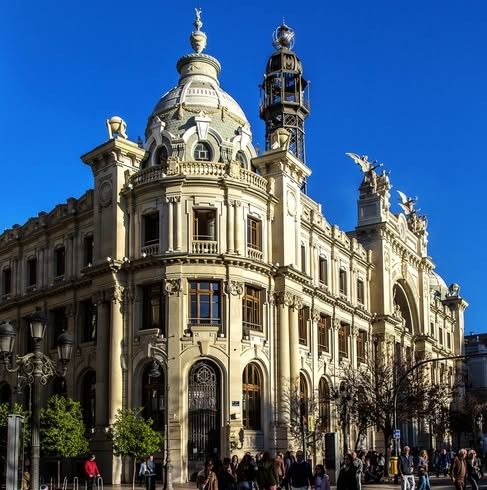
,but also the Fallas Museum, Intangible Cultural Heritage of Humanity ; then it hosted several arts events and could be for the Sorolla museum of Valencia (a native son now with museum in Madrid -see post),
The Valencia tourist office on the palacio de comunicaciones : https://www.visitvalencia.com/en/what-to-do-valencia/valencian-culture/monuments-in-valencia/palacio-de-comunicaciones
There you go folks, another dandy and worth the detour in Valencia. The Lonja de la Seda is one interesting place to see, and we will be back for more, eventually. Again, hope you enjoy the post on the Palacio de Comunicaciones y Telégrafos of Valencia !!!as I
And remember, happy travels, good health, and many cheers to all !!!


