
This is a memorable town visited several times with my dear late wife Martine and we love it ! In this off the beaten path area yet, I have several posts in my blog. This time , I found me a picture in my cd rom vault that should be in my blog for you and me, Therefore, this is my take on the Museo Ulpiano Checa of Colmenar de Oreja !!! Hope you enjoy this post as I.
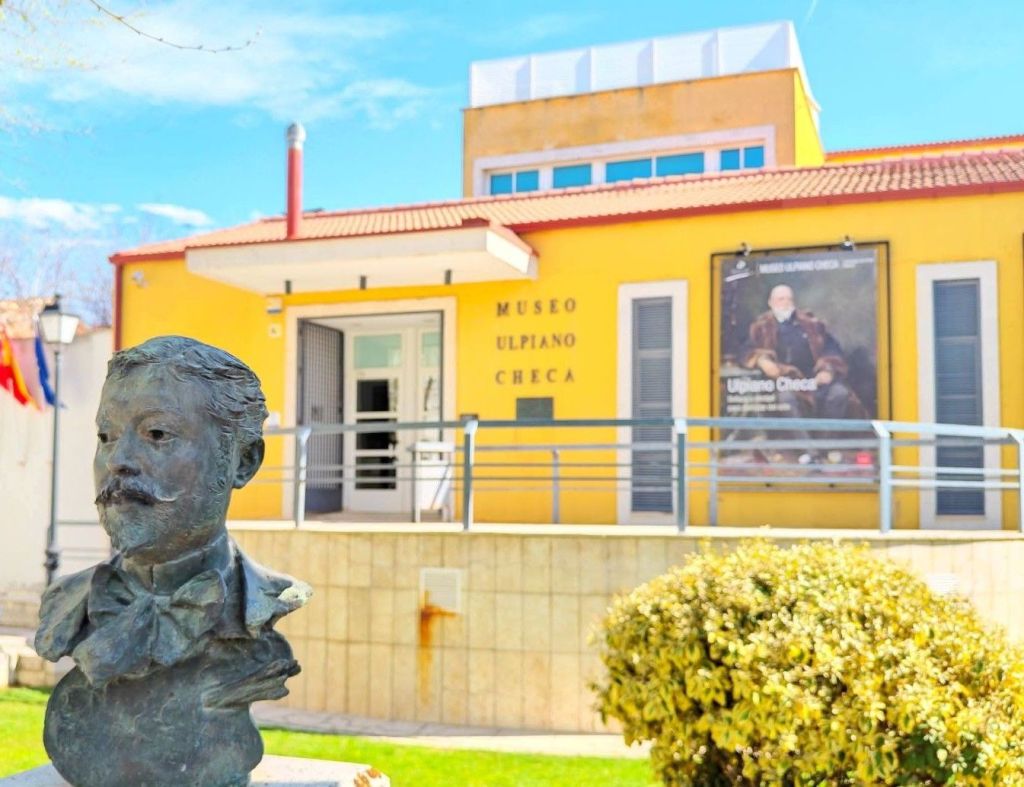
The Museo Ulpiano Checa Museum houses the most extensive collection of works by the painter Ulpiano Checa. The building is accessed through gardens where, in addition to a bust of the painter, there is a monument to the city’s characteristic elements: stone and earthenware jars
.The Ulpiano Checa Museum is now compose of Sala (Room) 1. Colmenar de Oreja. This room contains, on the left wall, paintings related to Colmenar de Oreja, his birthplace. Room 2. Roman World (divided into two rooms). The first room is decorated with Pompeian stucco and contains the first and last large-format works on historical subjects: The Invasion of the Barbarians (gold medal at the National Exhibition of Fine Arts in Madrid in 1887) and The Last Days of Pompeii (gold medal at the Universal Exhibition in Paris in 1900). Among others. The second room, configured like a cinema room where each work is illuminated like a film still, explains the connection between Hollywood’s Ben-Hur and Ulpiano Checa’s Chariot Race, which won a third-place medal at the 1890 Paris Salon. Also in this room are the first editions of Wallace’s novel and the score of The March of Ben-Hur, which reproduced Checa’s work on their covers. Pasillo or Corridor, in this passageway, we find three works from his travels in Italy: Souvenir of Venice (Watercolor on paper), Fountain of Rome (Oil on panel), and Venice (Oil on panel, 1905). Room 3. America. This room houses works produced, exhibited, or awarded prizes in America, from the equestrian portrait of the President of the Argentine Republic, General Mitre, to The Naumachia (gold medal at the Atlanta Exposition). Room 4. Africa. Pasillo ro corridor “Perspective”. This corridor displays engravings from Ulpiano Checa‘s book, published and printed in Paris by the French Society of Art Editions, “Perspective.” and Room 5. Spain.
A bit of history tell us that the Colmenar de Oreja City Council decided to convert the house of “the seven courtyards” into a museum in 1945. In 1950, negotiations began with Carmen and Felipe Checa Chayé (two of the painter’s four children), who agreed to donate twenty works. The building was restored between 1955 and 1959, and it was inaugurated on April 3, 1960, his saint name day and the centenary of his birth, as a monographic museum dedicated to the painter. That same year, it received further donations from Carmen Checa and María Ballester, the painter’s granddaughter. In 1994, the museum’s space was increased by almost 300 square meters. A new two-story building was erected, attached to the old one, housing the auditorium, the permanent exhibition hall, and the temporary exhibition hall. In 1994, the museum had nine rooms and a gallery. Another expansion of over 1,000 m² was carried out, constructing an annex and reorganizing all the rooms. This latest renovation was inaugurated on March 9, 2009.
Well credit where is due with the help of wikipedia let me tell you about this great painter who deserves more recognition , me think, Ulpiano Fernández-Checa y Saiz was born in Colmenar de Oreja on April 3, 1860, at nor 5 on the former Calle de las Damas, which now bears the painter’s name. He was a Spanish painter, sculptor, poster artist, and illustrator. The picture came out yellowish do not if the sun or the camera malfunction but only one can find in my cd rom vault so far.
In 1873, José Ballester, after consulting with Luis Taberner, a renowned artist in Madrid, decided to bring Ulpiano and his family to Madrid. Ulpiano Checa settled in Ballester’s house, who paid for all his studies, acting as his protector and patron. Checa became friends with José Ballester’s son, Eduardo Ballester Estrecha, with whom he lived during his years in Madrid, from 1875 to 1884. He studied at the School of Fine Arts and Crafts, and in 1875, he entered the Royal Academy of Fine Arts of San Fernando, where he stayed until 1880; during his time at the Academy he obtained three medals (Perspective, Drawing of Antiquity and Clothing and Theory and History of Fine Arts) and two scholarships for History Painting. During his time as a scholarship recipient at the Spanish Academy of Fine Arts in Rome, Ulpiano Checa contributed to the magazine La Ilustración Española y Americana. He worked as an assistant to Manuel Domínguez on the decoration of the Linares Palace (see post) and the Basilica of San Francisco el Grande (see post) , the two most important decorative projects in Madrid during the last decades of the 19C. To commemorate the bicentenary of Calderón de la Barca’s death, he made his first contributions as an illustrator to the magazine. Interested in artistic developments, he moved within Madrid’s cultural circles and participated as a founding member in the creation of the Círculo de Bellas Artes (see post) of Madrid. In 1884, he was awarded a scholarship in the history painting section of the Academy of Fine Arts in Rome. Checa then set his sights on Paris, which by that time had already established itself as the cultural epicenter of Europe. In 1889, he settled in Paris, and participated in the Universal Exposition of that year with the painting En la iglesia (In the Church), which was awarded the third medal. He met Matilde Chayé, a woman from a wealthy Gascon family, and they married in 1890. Checa permanently changed his residence, living between Paris and Bagnères-de-Bigorre, a town in the High Pyrenees where the Chayé family, highly regarded in the community, owned a home. He never forgot his roots, however, and returned to Spain on several occasions to spend time relaxing and visiting friends and family in Colmenar de Oreja. In 1890, he achieved his first triumph at the Paris Salons. On the Champs-Élysées, he presented his celebrated Roman Chariot Race and won the third-place medal. A year later, the Spanish government awarded him the Order of Carlos (Charles) III. Within a few years, he established himself as one of the most influential painters of the time, and in 1894, the French government awarded him the Legion of Honor. In 1897, during the summer months, he traveled to Colmenar and, taking advantage of his stay, painted two murals in the presbytery of the parish church of Santa María la Mayor (see post). On the left wall, he depicted the Annunciation, and on the right, the Presentation of the Virgin. Years later, he created a third mural depicting Saint Christopher.
The year 1900 was very important for the painter. He published his Treatise on Perspective, won a gold medal at the Universal Exposition in Paris with The Last Days of Pompeii, and also participated, along with Jules Chéret, Étienne Dinet, and Edmond Grasset, in the advertising for the “Andalusia in the Time of the Moors” pavilion with a lithograph. He also decorated a large dome of the Buffet de la Gare de Lyon Le Train Bleu (see post) at the Gare de Lyon in Paris with four large canvases for its ceilings. Today, it is a National Art Nouveau Monument, representing four cities: Monte Carlo, Toulon, Arles, and Montpellier. After the outbreak of WWI, already ill, he left Paris to settle in Bagnères-de-Bigorre. He soon moved to the nearby town of Dax, where he died on January 5, 1916. At the painter’s express wish, his remains were transferred to Colmenar de Oreja, where he was buried on the 20th of the same month.
The official Museo Ulpiano Checa of Colmenar de Oreja : https://museoulpianocheca.com/
The town of Colmenar de Oreja tourist office on the museum : https://turismo.aytocdo.com/museoulpianocheca/
The Comunidad de Madrid region tourist office on the museum : https://www.visitmadrid.es/en/what-to-do/culture-in-madrid-art-history-and-traditions/culture/museums/art-museums/ulpiano-checa
There you go folks, another gem in the off the beaten path roads to Colmenar de Oreja , an easy ride by car all worth it for a pleasant afternoon away from the City, and plenty of wonderful architecture and history,. Again, hope you enjoy this post on the Museo Ulpiano Checa of Colmenar de Oreja !!! as I.
And remember, happy travels, good health, and many cheers to all !!!


