
I take you back to my dear Madrid again !! love it !! Needless to repeat we have been here many many times over the years and I lived, However, there is always gems to find in the city and I am glad to have found me a picture in my cd rom vault to show in my blog for you and me, As always a thrill as usual to tell you more of Madrid, Therefore, let me give you my take on the Church Santa Teresa and Santa Isabel of Madrid !! Hope you enjoy the post as I.
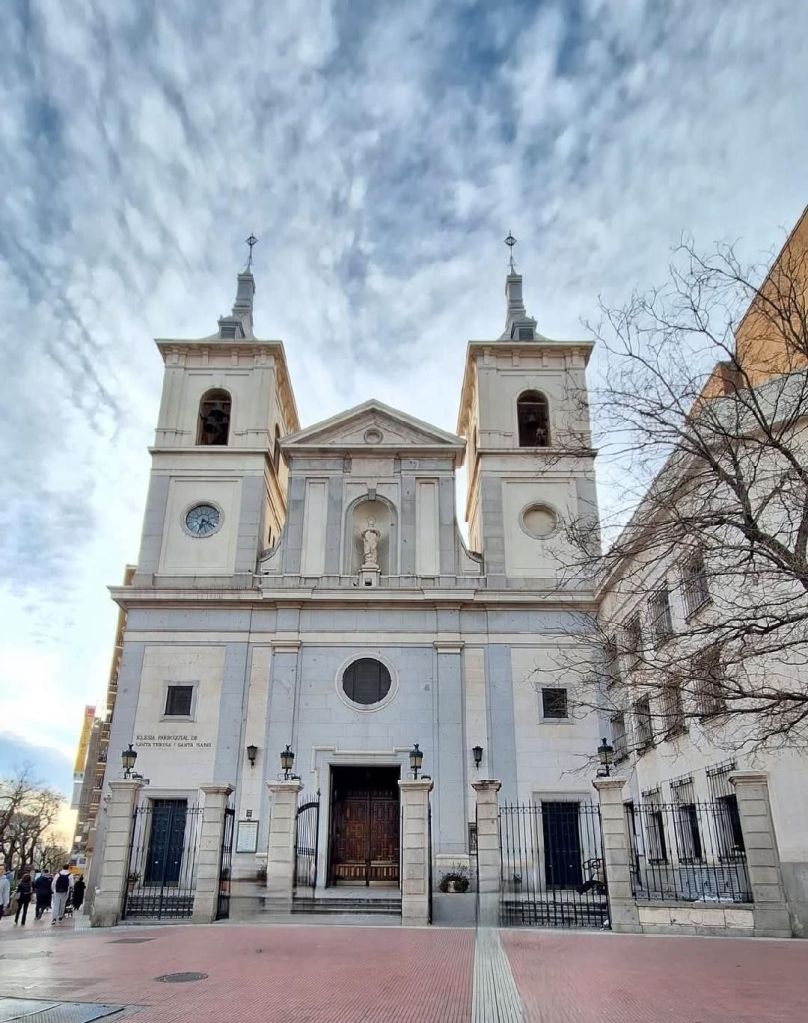
The Church Santa Teresa and Santa Isabel is located in the Glorieta del Pintor Sorolla, 2 in the Chamberí district of Madrid, and in the kingdom of Spain. The location is also known by locals as the Glorieta de Iglesia ,which is also used for the metro station, The official street name is due to its proximity to the Sorolla house-museum (see post). The church, bears the dual patronage of two saints who have little in common ; Santa Teresa (Saint Teresa of Ávila), the mystic doctor, and Santa Isabel (Saint Elizabeth). The exterior is very simple in design: a central section flanked by two twin towers. There are three lintelled doorways, the central one slightly larger than the side ones. In the second section, there is a niche containing a statue of Saint Teresa of Ávila.
The interior has a Latin cross floor plan, with a transept and three naves. The central nave is covered by a barrel vault, while the side aisles have lower vaults, richly decorated with plasterwork featuring floral motifs. It gives the impression as one of ostentatious splendor. All the architectural and artistic elements combine in a neo-Baroque aesthetic, already outdated at the time of its construction. The most important feature is the Baroque altarpiece of the main altar, which comes from the Church of San Pelayo in the Palencia town of Villaumbrales de Campos and was sold by the Diocese of Palencia to the Diocese of Madrid in 1946, along with another altarpiece. It rests on a predella and is topped by an attic housing a Calvary scene. The side panels depict scenes from the life and martyrdom of Saint Pelayo. In the center of the altarpiece, within a niche, is a modern image of Nuestra Señora del Carmen (Our Lady of Mount Carmel), patron saint of the Chamberí district. Throughout the rest of the church, there are numerous Neo-Baroque altars with large images of relative artistic value. A silver bust of Ecce Homo, located on the altar of the Virgen de Fátima or Virgin of Fatima near the entrance on the Gospel side, is particularly noteworthy and is highly venerated.
The history of this church is very short, as brief as that of the Chamberí district where it is located. It is said that this church was promoted by a religious association of residents founded in 1839, named after Santa Teresa and Santa Isabel. They were eager to have a new parish to attend to the spiritual needs of the new district. The first stone was laid on October 22, 1842, but a lack of funds slowed its completion. Finally, on November 1, 1856, the consecration of the new church took place, to which a school and a small hospital were planned. In 1936, this church, like many others in Madrid, was burned and looted, suffering serious damage and losing everything inside. After the Spanish Civil War, a long reconstruction began between 1942 and 1950.
The official Parish Church Santa Teresa and Santa Isabel : https://santateresaysantaisabel.es/
The Madrid tourist office on the district of Chamberi :https://www.esmadrid.com/en/madrid-neighbourhoods/chamberi
There you go folks , another wonderful nostalgic, sentimental side of my dear Madrid , always nostalgic sentimental words cannot describe it ! This is a vibrant cosmopolitan city of friendly faces and smiles to share in long conversations about life and more ; I love it, We will be back ,eventually!, Again, hope you enjoy this post on the Church Santa Teresa and Santa Isabel of Madrid !! as I
And remember, happy travels, good health, and many cheers to all !!!


