
A sentimental town of Huete, an area that will remain in my heart. I , of course, know it well, coming here with my family was huge. An opportunity to show them the roots and having just a great time. One of the quant towns we visited in the last several years ,and have other posts but saw these pictures mix in with other posts and they should have a post of their own for you and me, Therefore, here is my take on the Convento Justinianas de Jesus y Maria of Huete !!! Hope you enjoy the post as I.
The Convento Justinianas de Jesus y Maria or Convent of Jesús y María is located in the town of Huete, in the province of Cuenca, in the Castilla La Mancha region of the kingdom of Spain. Its construction dates back to the second half of the 16C.
The convent stands on a slight rise in the terrain where the Hermitage of Santa Lucía once stood; the hermitage’s bell was reused in the tower of the new structure. The convent was founded by Marcos de Parada, Archdeacon of Alarcón, as a place of seclusion for virtuous young women and to perpetuate his own memory, with the convent serving as the family mausoleum. Construction began in 1554 and concluded twenty-two years later, when nuns from the Order of Saint Lawrence Justinian arrived from Cuenca (see posts) to inhabit it. The convent is a prime example of 16C architecture in the Cuenca region; its rectangular layout is organized around a cloister featuring semicircular arches resting on distinctive square, paneled pillars, a true innovation within the diocese at the time of its construction.
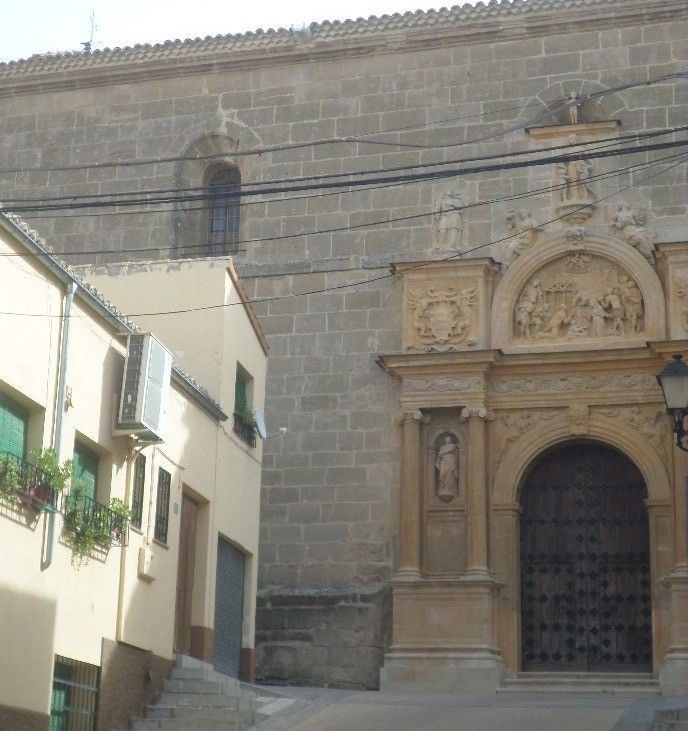
The convent is designed to resemble a lavish Florentine palace, with the founder’s coat of arms incorporated into the convent’s corners. A triangular tower was built to serve as the bell tower, one of the few examples of this type in the world. The austerity of the walls is broken by the magnificent portal of the convent church, one of the finest works of Mannerist architecture in Cuenca. It depicts the Nativity of Our Lord, as well as allegorical figures representing the seven virtues ; virtues that were extolled during the Council of Trent, which had taken place just a few years prior to the convent’s construction.
Following the closure of the monastery in 1835, the convent building passed into the ownership of the Ministry of Finance, while the church became the home of the Santa María de Castejón parish (commonly known as “El Cristo”), which is today a subsidiary of the San Esteban parish. Eusebio Bardají y Azara, a Spanish lawyer, diplomat, and politician who served as interim President of the Council of Ministers between August and December 1837 is buried in the temple. Throughout his life, he held diplomatic posts across Europe and served as Secretary of State and Head of Government during the War of Independence, the Liberal Triennium, and the reign of Isabel II.
The Huete tourist office on the Convento Justinianas de Jesus y Maria : https://www.turismohuete.com/punto-de-interes/antiguo-monasterio-jesus-maria-cristo/
The Culture site of the Castilla La Mancha region tourist office on the Convento Justinianas de Jesus y Maria: https://cultura.castillalamancha.es/patrimonio/catalogo-patrimonio-cultural/iglesia-y-convento-de-jesus-y-maria
There you go folks, another dandy road warrior trip by yours truly, this were memorable trips with the whole family and always looking forward to be back to Huete with the boys and our dog Rex, eventually, This is in country deep Spain and we love it !! Again, hope you enjoy this post on the Convento Justianianas de Jesus y Maria of Huete !!! as I.
And remember, happy travels, good health, and many cheers to all !!!


