
Let me bring you back to Valencia after finding me more pictures in my cd rom vault that should in my blog for you and me. I have come since teens years as my aunt used to lived just south of it at El Saler. Then visited with the family and always nice souvenirs of our visits. I have written several posts on it before but feel deserves to tell you about this church, The city of Valencia, is in the Comunitat Valenciana in my beloved kingdom of Spain. Therefore, let me tell you about the Church de los Santos Juanes of Valencia !! Hope you enjoy the post as I,
The Real Parroquia de los Santos Juanes, aka iglesia de San Juan del Mercado or the Royal Parish Church of San Juan del Mercado, aka the Church of San Juan del Mercado, is located opposite the Silk Exchange (Lonja de la Seda- see post) and next to the Mercado Central (see post). The church has held the title of Royal since 1858, by decree of Isabel II, who visited it on June 2nd of that year, as had Archduke Charles in 1706, and the King and Queen of Sicily, Francis and his wife, in 1823. Later, in 1902, Infanta Isabel of Bourbon, former Princess of Asturias, visited it.
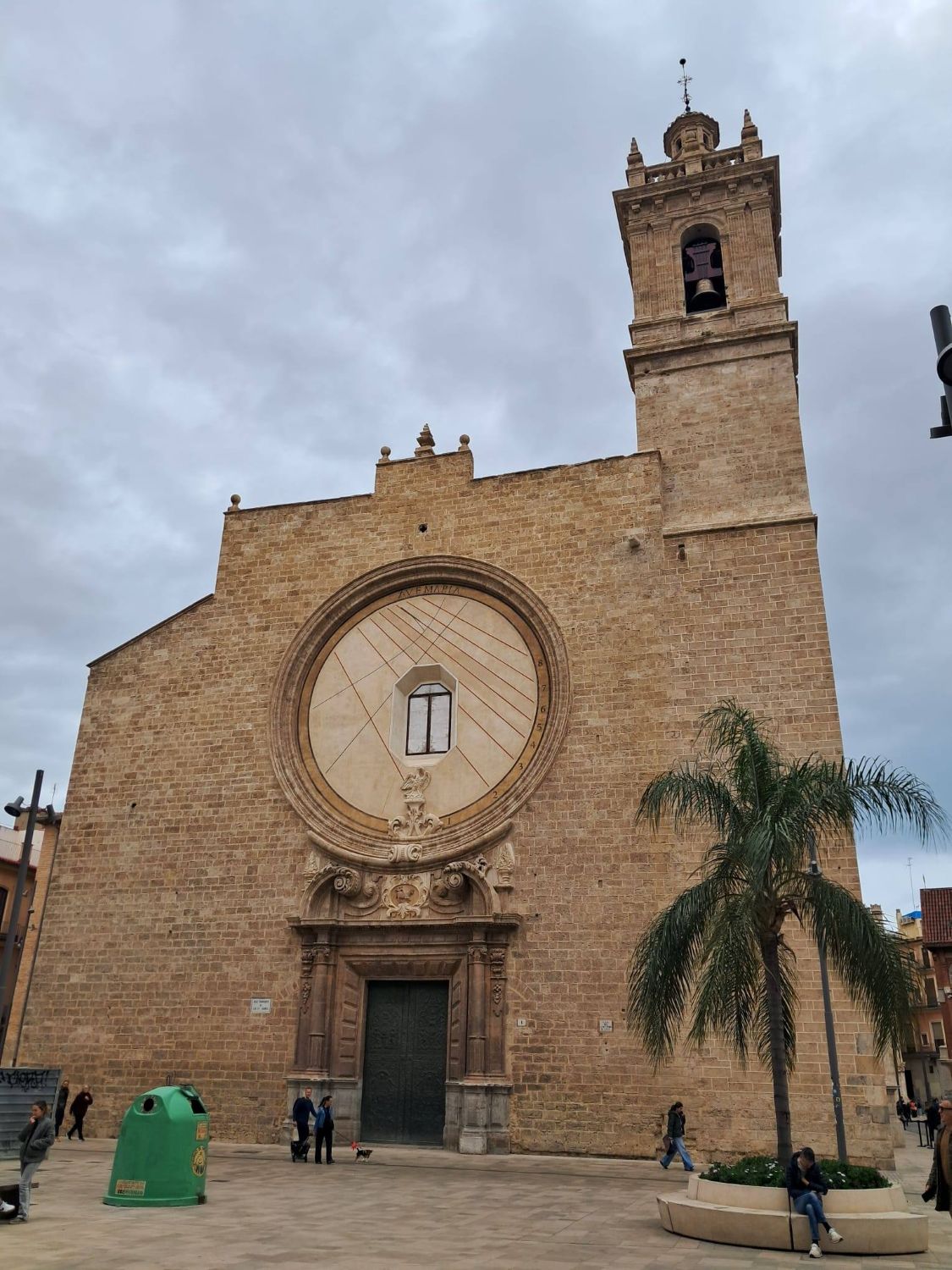
On the main façade, which faces the end of Avenida del Oeste, there is a doorway beneath a large stone oculus. This oculus, possibly of medieval origin, has always remained blocked and is notable for its enormous perimeter. On the same façade, we can see an eagle allegorical of the Evangelist and the Lamb of the Baptist. The apse of the church, which forms a small square with the Central Market and the Silk Exchange, is undoubtedly the most impressive part of the exterior. Above it stand the statues of Saint Francis Borgia with the crown of his dukedom, Saint John the Baptist, Saint Louis Bertrand, and Saint John the Evangelist .The facade is crowned by a triangular bell tower with a clock and three wrought-iron balconies, flanked by Solomonic columns. The bell tower is topped by statues of Saint Vincent Martyr, Saint Vincent Ferrer, and Saint Lawrence Martyr. In the center, atop a pyramid with a sphere, rests an eagle with an inkwell in its beak, symbolizing the Evangelist. This eagle, which also serves as a weathervane, is known as the “Pardalot de Sant Joan” (The Bird of Saint John). In the center, under a stone roof, is an image of the Virgin of the Rosary, flanked by two statues of the patron saints of the Parish.
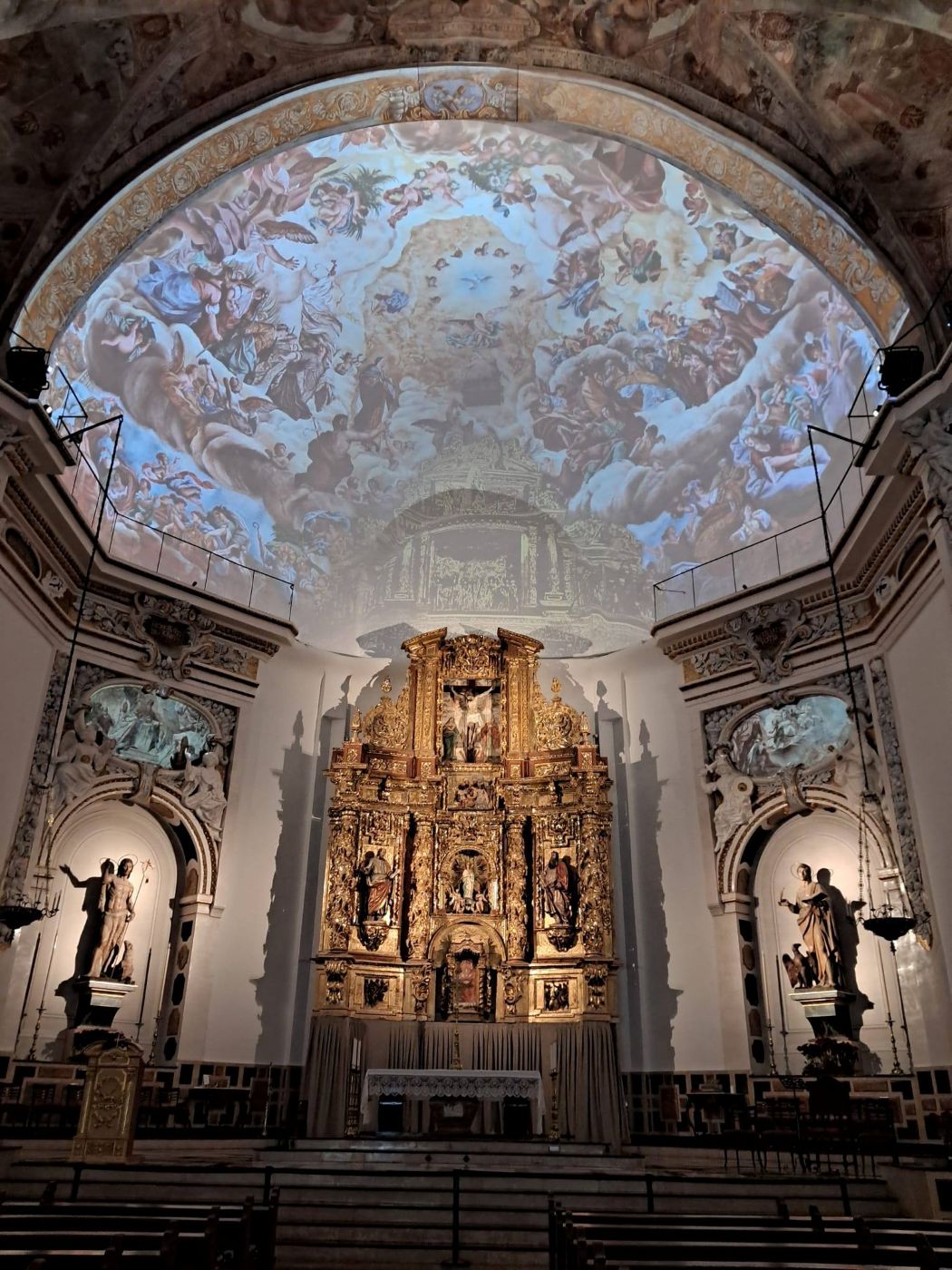
Inside, the vault was decorated by the artist Antonio Palomino, court painter to King Charles II. Palomino painted the entire vault in fresco, completing it on St. John’s Day in 1701. The frescoes depict: the Glory of the Holy Trinity, the Book of the Seven Seals with the Lamb, the Immaculate Conception with the Moon at her feet, the patron saints, choirs of Virgins, the Patriarchs, the Doctors and Angels, saints from the Book of Revelation, the battle of St. Michael with Lucifer and the demons; and, prominently featured, St. Vincent Ferrer. Elsewhere in the church, the Apostles appear seated on thrones and clouds, along with representations of Humility, Truth, Peace, and St. Jude Thaddeus.

The current main altarpiece is from the church of Betolaza in Álava. It consists of two sections in polychrome and gilded wood. In the central niche is the image of the Immaculate Conception, flanked by Saint Peter and Saint Paul. The upper section features an image of Christ on the Cross. Saint John the Baptist and Saint John the Evangelist, the church’s patron saints, are located on either side of the altarpiece.
Of its original Valencian Gothic structure, the nave and the large, now-blocked oculus, known as the O of Saint John, remain. This oculus was originally conceived as a large rose window on the west facade. Its exterior was renovated in 1700. The central sculpture of Our Lady of the Rosary stands out on the facade facing the Plaza del Mercado or Market Square. Above it stands the clock tower, flanked by the two Saint Johns and the weathervane atop the façade, known as the Bird of Saint John. The previous work was removed, and the chancel and all the church vaults were painted in the late 17C.
A bit of history tell us that its origins lie in an old mosque converted into a hermitage, a similar case to many other parishes in the city. The old hermitage was built before 1240 on top of the mosque. When the Christian wall was constructed, it was already incorporated within Valencia. The Church of San Juanes was a clear example of a Gothic parish, with a structure characteristic of Valencian architecture of the period: a large nave with chapels in the buttresses. In the 14C, a fire forced its complete reconstruction, replicating the original style. Saint Vincent Ferrer preached in the newly rebuilt church, and there he delivered his first sermon on the feast day of Saint John the Baptist. Another figure associated with the parish was Pope Alexander VI (Rodrigo Borgia). In 1592, another fire necessitated the repair of the chancel. The church retained its Gothic nave and the rebuilt Baroque apse, with a new altarpiece, a masterpiece of altarpiece architecture and sculpture comprising more than three thousand figures. In the mid-17C, the Chapel of Communion was added to the church, utilizing the land occupied by adjacent houses that were subsequently demolished. Between 1693 and 1702, the last major renovation took place, giving the parish church its current appearance. On July 19, 1936, during the Spanish Civil War, it was consumed by flames, and the effects of the fire are still visible.
The Valencia tourist office on the Church de los Santos Juanes :https://www.visitvalencia.com/en/what-to-do-valencia/valencian-culture/monuments-in-valencia/iglesia-santos-juanes-santos-juanes-church
The official Parish Church de los Santos Juanes : https://santosjuanesvalencia.com/
The Comunitat Valenciana region tourist office on the church : https://www.comunitatvalenciana.com/en/valencia/valencia/monuments/the-parish-church-of-los-santos-juanes
The City of Valencia on the City see Historia/History : https://www.valencia.es/cas/la-ciudad
There you go folks, another wonderful monument of wonderful Valencia, on a very nice area to walk as well, beautiful architecture is all around and history to boot. We always have come here by car, the most scenic route ; and always looking forward to be back, eventually. Again, hope you have enjoyed this post on the Church de los Santos Juanes of Valencia !! as I.
And remember, happy travels, good health, and many cheers to all !!!


