
And another dandy road warrior tour of my beloved Spain. This time came around Madrid and Toledo. In this area or community you have several important towns of historical significance as I have several posts in my blog. I am glad finding great pictures in my cd rom vault that should be in my blog for you and me, This time , I will tell you a bit on the wonderful town as this is Ocaña !!! Hope you enjoy it as I.
The City of Ocaña is located in the province of Toledo, in the autonomous community of Castilla-La Mancha, and in the kingdom of Spain. It is 16 km from Aranjuez , 14km from Yepes, 59 km from Toledo, 65 km from Madrid, and 16 km from Las Majadas (see posts), our home base we came from along the CM2105 road dir Cuenca to connect with the A40 Autovia de la Meseta del Sur dir Tarancon/Toledo on exit/salida 62 follow signs for A4 Ocaña continue and bear right onto the N400 road dir Ocaña at roundabout bear left onto Calle Pilarejo ,then bear right onto Calle Toledo continue for parking at Plaza Carlos Lopéz Bonilla and walk over to Plaza Mayor a few meters, The roads here which taken are the Autovia del Sur (A-4): Madrid-Aranjuez-Ocaña-Madridejos-Manzanares-Valdepeñas-Bailén-Andújar-Córdoba-Écija-Carmona-Seville-Jerez The Autovia Meseta del Sur or Castilla-La Mancha (A-40): Adanero-Maqueda-Toledo-Ocaña-Tarancón-Cuenca-Teruel, The toll Radial Highway 4 (R-4): Madrid-Pinto-Parla-Valdemoro-Seseña-Aranjuez-Ocaña, and the local N-400: Toledo-Ocaña-Tarancón-Cuenca,
The Plaza Mayor is a typical example of the Castilian town square typology. It is a public space of Neoclassical architecture, with construction began in 1782, with three of its four façades completed in 1791, during the reign of Carlos (Charles) III. During the Peninsular War (independance war in Spain), the French general Soult shelled the town hall located on the west façade. The galleries were paved between 1848 and 1849. In 1961, the Ministry of Housing completed the square, which was paved in 1969, and the bell tower spire was replaced in 1980. The square is rectangular with a large proportion and symmetry. Its sides measure 56 and 54 meters, and it was built on the ruins of an earlier, irregularly shaped square. It is a porticoed space on all sides, its galleries supported by sturdy Colmenar stone pillars, carved with rusticated ashlar masonry, which in turn support semicircular brick arches. The facades of the plaza, also brick, rise in stories, with balconies opening onto the axis of each portico arch. These balconies retain their simple ironwork. A molded cornice crowns all sides of the plaza, broken in the center of the main facade, where it opens into a semicircular arch to shelter the coat of arms of the town of Ocaña: a tower flanked by the letters O and C, beneath a ducal crown held by two lions. Finally, on the sloping roof, the dormer windows maintain the overall symmetry, their number coinciding with that of the balconies.

The Church de Santa María de la Asuncion or Saint Mary of the Assumption is the main church of Ocaña, and is notable for its two-tiered tower, which features different styles: the lower tier with Mudéjar influences and the upper tier with Renaissance characteristics. This is possibly due to the reuse of an old Islamic structure from the 12C, with the interior minaret remaining as the only surviving element. The Plateresque-style main façade, with its floral motifs, rosettes, volutes on pilasters, and allegorical figures above the alfiz (a rectangular frame around the arch), contrasts with the rest of the church. Inside, the Chapel of the Patron Saint of Ocaña, Nuestro Padre Jesús Nazareno or Our Father Jesus of Nazareth, stands out, and the Archconfraternity houses its renowned collection of armor in its sacristy.
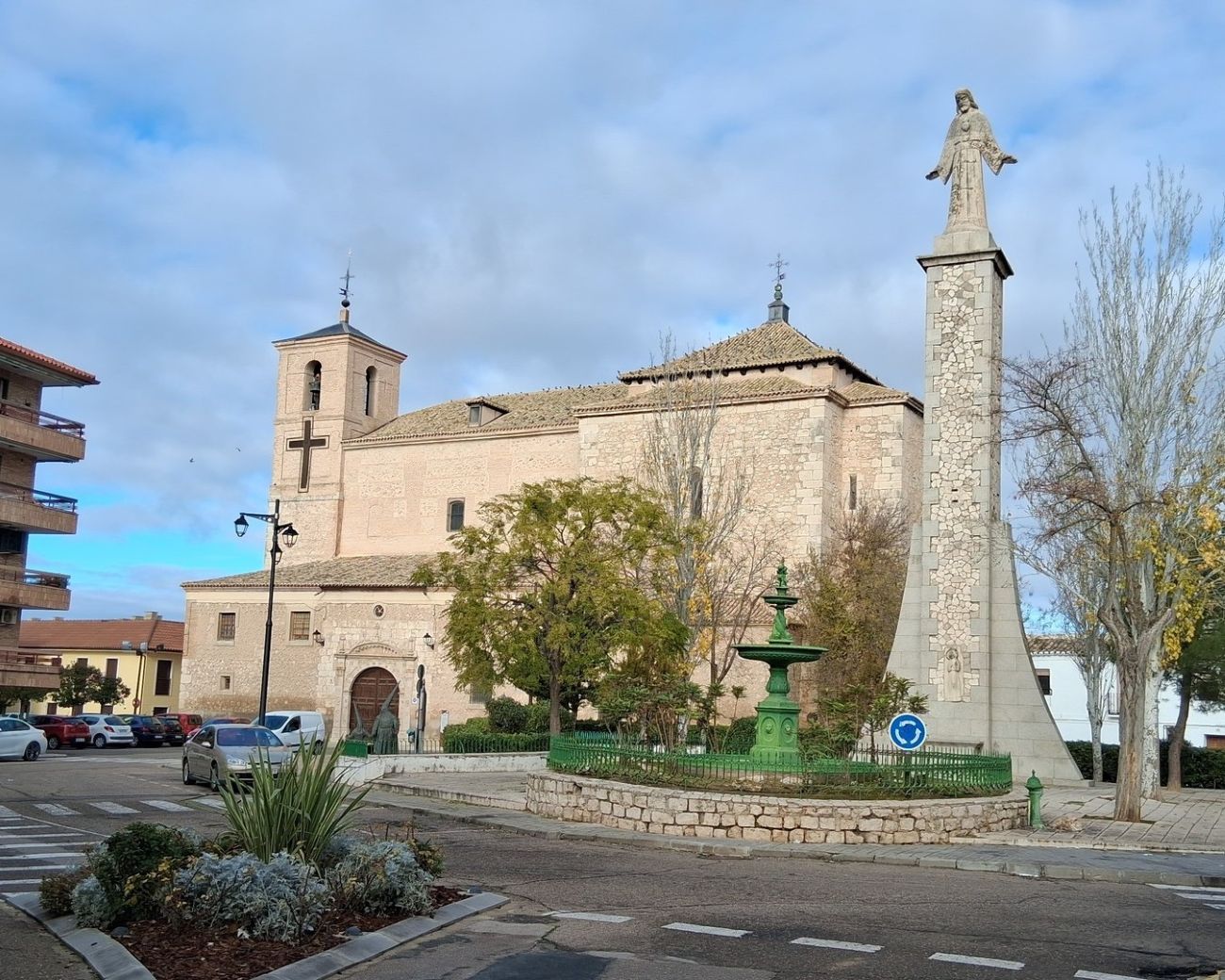
Large Fountain: probably built by Juan de Herrera in the 16C. (see pic above), Monumento Sagrado Corazón de Jesús or Monument to the Sacred Heart of Jesus, blessed on June 8, 1958 (see pic above)
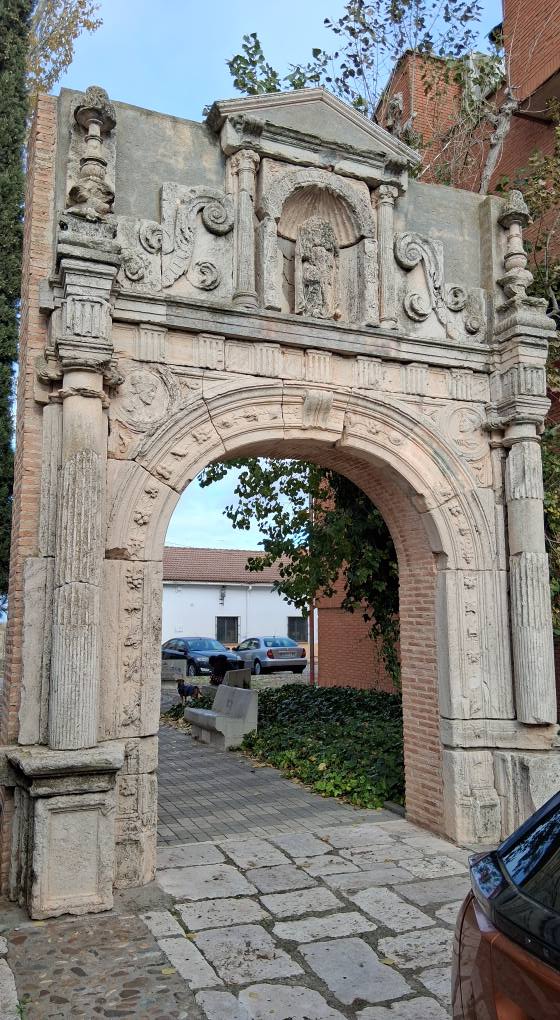
The tower not visible but is shown the Arch belonged to the old parish church of San Martín Obispo, one of the four parishes of Ocaña until the early 19C. The church in the Herrerian style, was constructed between 1562 and 1577. The portal is attributed to Covarrubias. It was erected on the site of the hermitage of San Martín del Monte, formerly surrounded by holm oaks and a popular pilgrimage destination. Construction of the new church began in 1562. It housed important family chapels and notable works of art, such as a painting by Tristán, which disappeared during the Spanish Civil War. It served as the parish church until 1828 and was subsequently demolished, leaving only its tower and the Plateresque portal, (see pic) which has been preserved.
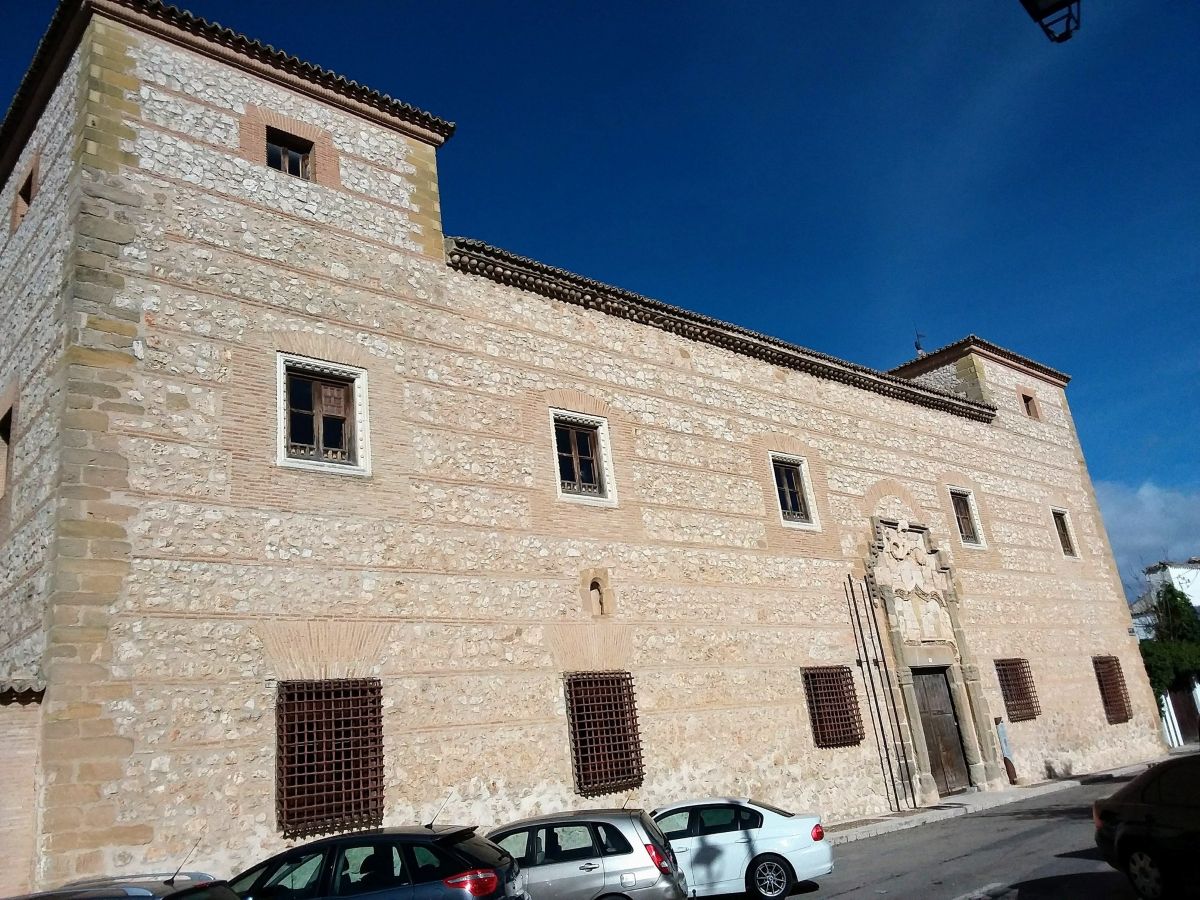
The Palacio de los Cárdenas Palace, aka Palacio de los Duques de Frías, was built in the late 15C, and its design shows elements of transition from Gothic to Renaissance. The building’s floor plan is organized around a rectangular courtyard with galleries opening onto it on all four sides. The entrance is Gothic in style and consists of a flat, lintelled portico flanked by two octagonal columns. The exterior walls are made of double-course masonry, while the interior uses rammed earth, brick, and plaster. There are several interesting polychrome, flat coffered ceilings. At the end of the 15C, Gutierre de Cárdenas,a native of the town, loyal friend of Princess Isabella, advisor to the Catholic Monarchs, Grand Commander of León in the Order of Santiago, and husband of Teresa Enríquez built this palace in the Gothic-Mudéjar style. This esteemed and renowned gentleman was the progenitor of the Duchy of Maqueda, from which the palace passed by succession to the Lords of Colmenar, later becoming the property of the Dukes of Frías.
Other monuments to see here with more time are the Parish Church of San Juan Bautista: from the 13C, built on the site of a former synagogue. Convent of Santo Domingo de Guzmán: Renaissance in style, construction began around 1530 and was completed in 1605. Convent of San José: from the 16C, Convent of Santa Clara: from the 16C, Convent of Santa Catalina de Siena: Renaissance in style. Lope de Vega Theatre: Renaissance in style, formerly a Jesuit college, 16C. Pillory from the 15C.
A bit of history tell us that Ocaña is among the various towns with which, according to legend, the Emir of Seville, Ibn Abed, endowed the beautiful Zaida in 1082, when he gave her in marriage to Alfonso VI in exchange for a military alliance. The Arabs reacquired the town, only for it to be conquered shortly afterward by Alfonso VI around 1106. Its settlement was initially based on the charter of Oreja, and in 1156 Alfonso VII granted it a charter. The town’s growth and importance were such that in 1184 Alfonso VIII granted Ocaña privileges that improved its charter, imitating that of Toledo, and there is documentation attesting that between 1188 and 1202 the town was part of the Brotherhood of the Banks of the Tagus, with the king’s approval and very likely instigated by him. This brotherhood was made up of: Ocaña, Huete, Cuenca, Cañamares, Cañete, Uclés, Almoguera and Zorita de los Canes. Together, they formed the border with the Muslim kingdoms at the end of the 12C. Ocaña, on the other hand, was the scene of important events such as the Cortes (parliament) held by Juan (John) II in 1422, and by his son Enrique (Henry) IV between 1468 and 1469. It also served as a refuge for queen Isabel I of Castile (the Catholic queen), exiled from the court of her half-brother Henry IV. In 1499, the Catholic Monarchs swore allegiance to their grandson Miguel in the now-demolished Church of San Pedro. As a royal residence, it hosted Joanna I of Castile and Felipe (Philip) the Handsome, and their grandson Philip, serving as a place of recuperation for him during his childhood. During the Spanish War of Independence (1809), the Battle of Ocaña took place, in which General Aréizaga’s troops were defeated by the French under Marshal Soult, leaving them with free passage into La Mancha.
The City of Ocaña on its heritage : https://ocana.es/lugares/ver
The Province of Toledo tourist office on Ocaña : https://turismoprovinciatoledo.es/localidades/ocana/
The Castilla La Mancha region tourist office on Ocaña : https://en.www.turismocastillalamancha.es/patrimonio/ocana-50631/descripcion/
There you go folks, another gem in the off the beaten path roads of my dear Castilla La Mancha, Ocaña, an easy ride by car all worth it for a pleasant afternoon away from the big city. Again, hope you enjoy this post on this is Ocaña !!! as I.
And remember, happy travels, good health, and many cheers to all !!!


