
And I am going back to a wonderful far away land in my beloved Spain. This was is going to the autonomous region of Extremadura in my road warrior trails to historic monumental Mérida, I have found me a picture in my cd rom vault that made me do this post for you and me. Therefore, here is my take on the Roman temples of Mérida !!! Hope you enjoy it as I.
The City of Mérida is located in the province of Badajoz, capital of the autonomous community of Extremadura, and in the kingdom of Spain, It is 62 km from Badajoz, 75 km from Càceres, 83 km from Trujillo, 126 km from Guadalupe, and 342 km from Madrid , The highways here are the A-5 and the A-66 , The Autovía del Suroeste or A-5 communicating with the city with Madrid and Badajoz. This highway circles the city by the north, comparing part of its route with the A-66. The municipal terminus of Mérida is reached by this autovia A-66 Gijón-Sevilla ; connect Mérida with cities like Cáceres, Sevilla, Almendralejo, Zafra, Plasencia, Salamanca, Zamora, León, Oviedo o Gijón, The N-430 Badajoz-Valencia goes between Badajoz and Torrefresnes along the A-5 highway. This road has been converted to the A-43 highway on its main part, so far only missing on the trace between Puertollano and Torrefresneda. I came here in my road warrior trails from Guadalupe along the local EX112/EX116 roads to connect past Obando with the N430 road which by Torrefresnada becomes the A5 highway by exit/salida 318 continue and by exit/salida 334 connect bearing left to the N-V road entering Merida on Avenida de Juan Carlos I same road becomes Avenue de Extremadura to end trafic circle bear left onto Calle Camilo José Céla same street becomes the Calle Félix Valverde Lillo and then bear left onto Calle Juan Pablo Forner continue came street becomes Calle Alonso Zamora Vicente, bear left onto Calle Romero Leal to the Templo de Diana ! Superbe !!!
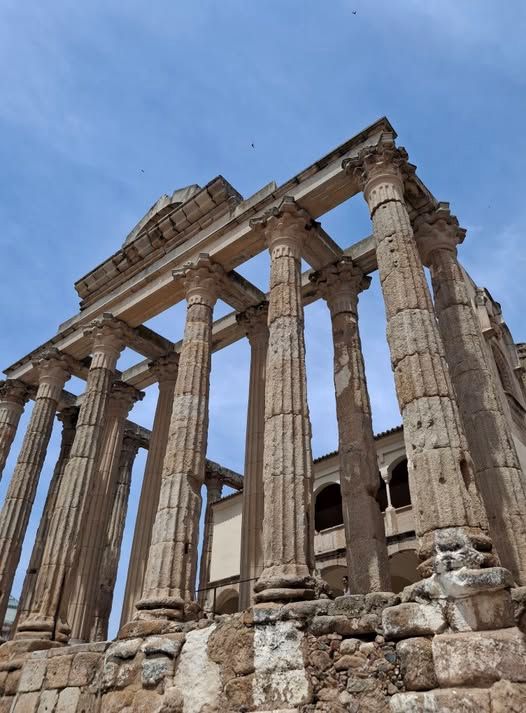
Cruising as usual coming from Guadalupe and back went as far as seeing the Templo de Diana , and glad found me a picture for the post, This is an Imperial Cult Temple located at the bottom of a big square which was partially leveled, as some areas house the remains of a cryptoportico. The Temple, rectangular in shape, stands on a high podium of granite that culminates in pieces of trim. Atop it rests the colonnade whose granite drums were plastered and painted. This colonnade surrounds the entire temple. Its front, has six columns over which the tympanum rested. A staircase, of which only the substructure remains, provided access to the cella. The altar may have been located on an exedra that divided the stairway. It was probably built while still under the power of Augustus. Its exceptional state of preservation is because, for centuries, the temple served as the foundation and shell of the renaissance palace of the Count of los Corbos, some parts of which are still preserved. The temple of Diana was wrongly named as such because in this place nothing related to the Goddess Diana was ever found, its name comes from the similarity existing with another temple in Italy from the 1C BC was located in a large public square. In Mérida, its structure was used by Visigoths, Arabs and more recently, in the 16C, the lords of Villamesías took advantage of its columns and materials to build a palace.
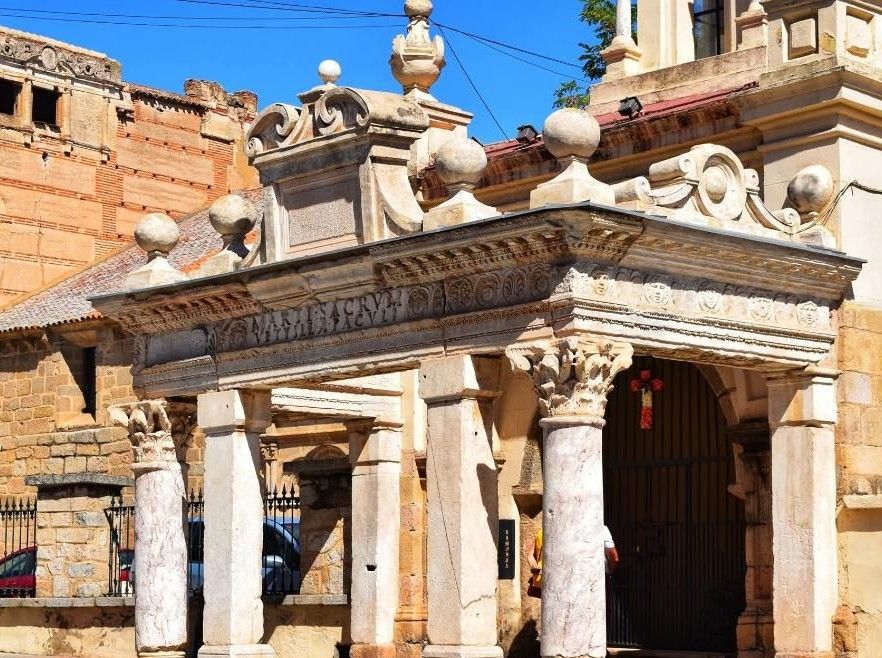
The Templo de Martes or Temple of Mars is an oratory dedicated to Eulalia, popularly known as “El Hornillo” or the Little Horn, and located at the entrance to the atrium of the Basilica of Santa Eulalia (cant find me pics!). Its portico is made of marble pieces extracted at the beginning of the 17C from an undetermined location in the city. All of them belonged to the Temple that the Roman colony dedicated to the god Mars. The primitive Roman Temple of Mars, which once stood outside the walled enclosure and near the Albarregas river ,has inscriptions, that we deduce its function as a place of worship to Mars, god of war. Today, along with the adjacent Basilica, it is a place of worship for the city’s patron saint, the Martyr Saint Eulalia. There are two marble columns, two Corinthian capitals, and reliefs depicting floral motifs and medallions with Medusa heads. It also features war scenes and two inscriptions on the frieze, one from the Roman period and another later, indicating that the chapel is dedicated to Saint Eulalia, patron saint of Mérida, and not to the god Mars.
The City of Mérida has a huge amount of monuments that should had more time and i will eventually as said so much to see and little time in my road warrior trails, Some of the other things to see here are an important architectural heritage, mainly from the Roman era during which the city was most splendid such as the Mausoleum of the Lintel de los Ríos, Roman theater among the ten most visited monuments in Spain , Amphitheater Roman ,circus Roman , bridge over the Guadiana River ; Roman bridge over the Albarregas River, Aqueduct of Miracles ; Aqueduct of San Lázaro ; Arch of Trajan ; House of the Mithraeum (luxury domus), House of the Amphitheatre, Portico of the Roman Forum, Provincial Roman Forum, Baths of San Lázaro, Baths of Reyes Huertas-Snow Well, A wonderful Visigothic and Arab legacy such as the Pilgrims’ Hospital (Xenodochium), Early Christian Basilica of Casa Herrera, Cathedral of Santa María de Ierusalem, Monastery of Cauliana or Cubillana, Arab Alcazaba, The religious architecture is huge such as the Co-Cathedral of Santa María, Basilica of Santa Eulalia, Church of Santa Clara, Convent of Santa Clara (17C), current headquarters of the Visigothic Collection of the MNAR, Church of Nuestra Señora de la Antigua, Church of Nuestra Señora del Carmen, Convent of the RR.MM. Franciscan Conceptionists (16C), Convent of Jesus of Nazareth, Convent of San Andres, Conventual of Santiago, (16C), today headquarters of the Presidency of the Junta of Extremadura, Convent of the Freylas de Santa Eulalia, Hospital of San Juan de Dios and Franciscan Convent of San Isidro de Loriana, Wonderful mansions such as the Hotel Emperatriz aka Palace of the Vera-Mendoza was ordered to be built by Luis de Mendoza in the 15C ; Palace of the Corbo, framed within the Temple of Diana, City/Town Hall, this is the headquarters of the Mérida City Council and is located in the Plaza de España. It was built in the second half of the 19C in the neoclassical style. The China Palace was built in 1928 at the expense of the famous textile merchant Bartolomé Gil to house a large warehouse. Royal Butcher Shop Building was built by the Mérida Council in the 16C to supply the local population. When the Calatrava Market was built at the end of the 19C, it fell into disuse and became a warehouse. In the mid-20C, the municipal library was built on this site. On the main façade, on Calle del Puente, you can see a granite arch crowned by the coat of arms of Charles V, the old coat of arms of Mérida and that of the magistrate Hernán Álvarez de Meneses. Hernán Cortés Artillery Barracks as the city of Mérida, due to its geographical location, was the place of study at the end of the 19C and beginning of the 20C to have a garrison of soldiers. National Museum of Roman Art, which is the most visited in Extremadura, Jesús Nazareno Hospital (18C), and the Hospital of San Juan de Dios (18C), current headquarters of the Assembly of Extremadura. Mérida also boasts other celebrations that have transcended borders. Its International Classical Theatre Festival, one of the most prestigious of its kind in the world, has been declared a Festival of International Tourist Interest and fills the Roman Theatre with art and the public every summer. Mérida’s Semana Santa (Holy Week), a Festival of International Tourist Interest, combines tradition and monumentality.
A bit of history I like (condense) tell us that Mérida, according to historiographical tradition, was founded as a Roman colony in 25 BC by order of the Emperor Octavian Augustus to serve as a retirement home for discharged veteran soldiers of the legions V Alaudae and X Gemina; hence its Roman name of Colonia Iulia Avgusta Emerita.The city, one of the most important in all of Hispania (Roma province as Spain today), was equipped with all the comforts of a great Roman city and served as capital of the Roman province of Lusitania (which included Portugal and the Roman name for the country) from shortly after its foundation and as capital of the diocese of Hispania from the end of the 3C. After the Germanic migrations, at the beginning of the 5C, and the fall of the Western Roman Empire, Mérida remained an important city of the Visigothic kingdom of Hispania in the 6C, as a fundamental political and religious center for the monarchy. In 713 the city passed into Muslim hands, who made it the capital of the Cora of Mérida and the Lower March. Berbers, Mozarabs and Muladis from Mérida repeatedly rebelled against the Emirati authorities in Córdoba during the 9C and the city began a slow decline after the last uprising in 868. Mérida was conquered by troops from the Kingdom of León, commanded by Alfonso IX of León in 1230. During the War of the Castilian Succession (1475–1479), the Order of Santiago sided with Isabel the Catholic (Isabel I). However, in 1476 the city was occupied by forces from the side of Juana la Beltraneja, backed by Beatriz Pacheco, Countess of Medellín and one of her main supporters in Extremadura. Later, in 1479, Portuguese troops reoccupied the city, and it was besieged by Alonso de Cárdenas, Master of the Order of Santiago. The siege was interrupted after the peace agreement reached in September of that same year, which allowed the definitive return of Mérida to Isabelline hands. Following the end of the Reconquest (1492), the Catholic Monarchs requested from Pope Alexander VI the direct administration of the military orders, citing the high costs of the war. The Pope agreed, and the administration of the military orders gradually passed into the hands of Fernando the Catholic (Fernando II). For their joint management, the Council of the Orders was created, which made it possible to centralize the administration and economy of the territories controlled by the orders of Santiago, Alcántara and Calatrava. The 16C to 18C were a period of demographic, economic and urban stagnation for Mérida. Its function was to support the cities of La Raya, especially Badajoz, the stronghold of the region. Mérida was affected by four conflicts in this context: the Portuguese Restoration War (1640–1688), the War of the Spanish Succession (1701–1715), the Fantastic War (1762), and the Peninsular War (1808–1812) (Independance War in Spain). After the Peninsular War, Mérida maintained a very deteriorated urban and economic panorama until the end of the first half of the 19C. The Second Republic (April 14 1931 to April 1st 1939), had to face major challenges accumulated since the Spain of the Restoration and the dictatorship of Primo de Rivera. Social and economic issues would take center stage in a city like Mérida, not very different from the rest of the Extremadura towns in terms of poverty and inequality. The proclamation of the Republic became a reality on April 14, 1931 at around 18h followed by a massive celebration in the Plaza de la Constitución (today Plaza de España), with the tricolor flag already waving on the City/Town Hall. Given the initial failure of the coup d’état in much of Extremadura that began on July 17, 1936, taking Madrid became a strategic objective for the coup generals. In this plan, passing through Mérida, a historic communications hub was vital for the rebel troops coming from the south to advance towards the capital of Madrid, and link up with the rebel forces in the north. The city was bombed on August 9 and, after intense fighting, the Battle of Mérida began. On the morning of August 11, the rebels took the city, assaulting it via the Roman bridge and the area of what is now the Plaza de Toros. In the following days, Republican troops unsuccessfully attempted to recapture the city. The first democratic elections since 1936 gave a sufficient majority of councilors for the socialist party in Mérida in 1979. The status of capital of the autonomous community of Extremadura, obtained in 1983, established the headquarters of the autonomous Executive and Legislative branches in Mérida.
The City of Merida on its history : https://merida.es/la-ciudad/breve-historia/
The Merida tourist office on the temple of Diana : https://turismomerida.org/what-to-see/temple-of-diana/
The Province of Badajoz tourist office on the Temple of Diana in Merida : https://www.turismobadajoz.es/que-ver-en-merida/#Templo_de_Diana_en_Merida
The Spain National Tourist Office on the temple of Diana : https://www.spain.info/en/places-of-interest/roman-temple-diana/
The Consorcio Monumental de Merida cultural site on the temple of Diana: https://www.consorciomerida.org/conjunto/monumentos/templodiana
The official Extremadura tourist office on the Roman sites of Merida : https://www.turismoextremadura.com/es/explora/Conjunto-romano-de-Merida-y-Termas-de-Alange/
There you go, another dandy in my beloved Spain, and the needs as usual to come back to these beautiful places, eventually, Mérida is worth the detour indeed. Again, hope you enjoy the post on the Roman temples of Mérida !!! as I
And remember, happy travels, good health, and many cheers to all !!!


