
I go to Madrid a lot, and lived there ,I go there by car once by plane and then walk or take the metro /bus/train in the city. Nevertheless, the Chamartin station was a couple time a curious stop and lucky to have found me a picture in my cd rom vault that made me do this post for you and me. I like to tell you a bit on the Chamartin train station of Madrid !!! Hope you enjoy the post as I.
The Cercanías of Madrid are a commuter train network operated by the Renfe on the infrastructure of Adif (Spain national transport network). The network extends throughout the Community of Madrid ,and even goes beyond it, as it reaches cities in the autonomous communities bordering Madrid such as Castilla La Mancha and Castilla y Léon, It serves the majority of Madrid’s population and has more than twenty connections with the Madrid Metro (see post).
The Cercanias train lines by Chamartin are the C-1 Princepe Pio – Atocha – Recoletos – Chamartín – Airport T4 , C2 : Guadalajara-Alcalà de Henares-Atocha-Chamartin. C3 : Aranjuez-Atocha-Sol-Chamartin. C3a : Aranjuez – Atocha – Sol- Chamartín – El Escorial. C4 : Parla-Atocha-Sol-Chamartin-Cantoblanco. C4a Parla-Atocha-Sol-Chamartin-Cantoblanco-Alcobendas/San Sebastian de los Reyes. C4b : Parla-Atocha-Sol-Chamartin-Cantoblanco-Colmenar Viejo.C7 : Alcalà de Henares-Atocha-Chamartin-Principe Pio. C8a :Guadalajara / Santa María de la Alameda, C8b : Guadalajara / Cercedilla C10 : Villalba – Príncipe Pío – Atocha – Recoletos – Chamartín – Airport T4 Mind you I have only visited Chamartin but have seen trains there.(see pic),
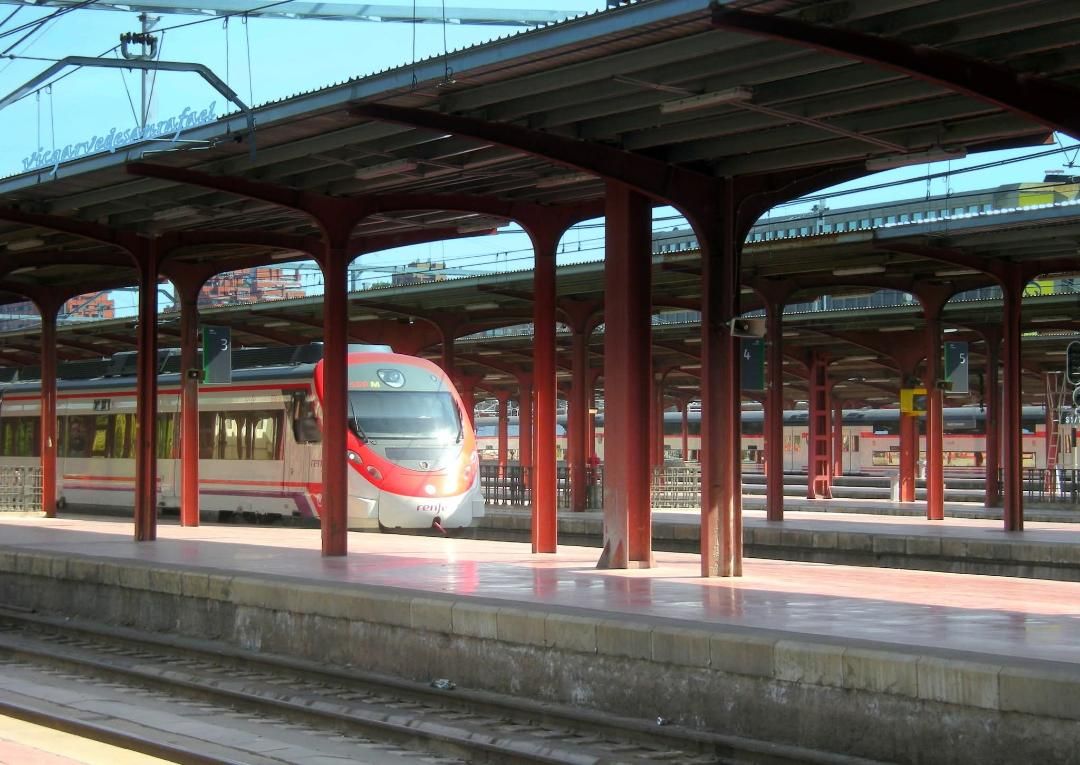
The new name for the Chamartin station is Chamartín Clara Campoamor, since December 23, 2020 the main entrance is at Calle Agustin de Foxa, s/n However, locally and me will always use the Chamartin name,,,,Access is done via the Chamartín Concourse: Chamartín, Calle Padre Francisco Palau y Quer, s/n. Elevator: Calle Padre Francisco Palau y Quer, s/n. Commuter Rail: Access corridor to commuter rail tracks. Renfe Concourse: Open from 4h30 to 00h30 by Agustín de Foxá: Calle Agustín de Foxá, 42 and Pío XII: Calle Hiedra, 7, The connection with other modes of transports : Bus Urban lines (EMT) are, 5: Sol – Sevilla, 27: Embajadores, 66: Fuencarral, 67: Plaza Castilla, 124: Lacoma, 129: Plaza Castilla, 134: Montecarmelo, 135: Hospital Ramón y Cajal, 147: Barrio del Pilar, 154: Plaza de Castilla, 174: Valdebebas, 178: Montecarmelo and night line N24: Las Tablas , Metro lines : 1 Pinar de Chamartín / Valdecarros and 10 Hospital Infanta Sofia / Puerta del Sur
Currently, it centralizes all rail communications from Madrid to the northwest quadrant of the Iberian Peninsula, from Salamanca to Irún, via the several main lines that depart from it: the 100 Madrid-Hendaye, the 200 Madrid-Barcelona, the 300 Madrid-Valencia, and the direct 102 Madrid-Burgos railway. and the high-speed lines O80 Madrid-North and O40 Madrid-Levante. It also has some Iberian-gauge services to the northeast (Medium Distance) using the Madrid rail ring road and to the south (Medium Distance and Intercity) thanks to the tunnels that connect it to Atocha station. As there is always construction going on need to check online to verify lines and schedules,
The Chamartín-Clara Campoamor is located in the Chamartín district from which it gets its name, In 1928, the population of Madrid was growing ,and there was the need for a communication infrastructure, it was decided to locate a station in what was then the village of Chamartín de la Rosa, to serve as the starting point for the new railway line that would connect Madrid with Burgos. The first works to prepare the land for a temporary station began in 1933, but the outbreak of the Spanish Civil War paralyzed the project for decades. Finally, in 1967, the tunnel was completed, bridging the 7.3 km between Atocha and the new temporary facilities in Chamartín. Work on the station itself began in 1970. It was in 1975 that the station we all know today was inaugurated. In February 2020, with the launch of an international competition for its complete transformation, Chamartín station took the first step towards its definitive transformation, which will make it the most advanced railway complex in Europe. With its two future terminals, 31 tracks, and 16 platforms, this ambitious project will fully integrate the station with its urban surroundings, link it to the new Madrid Nuevo Norte business district, and eliminate the gap created by the tracks that still divides the northern neighborhoods in two. One of the main objectives of the Chamartín railway complex renovation is to make the station the terminus for future high-speed rail lines to the north of the country (Galicia, Asturias, Cantabria, the Basque Country, and Burgos) and for the current lines between Madrid and the Levante region (Cuenca, Albacete, Valencia, Alicante, and Murcia), which currently terminate at Atocha. This plan involves expanding the number of high-speed rail tracks at Chamartín, increasing from the current six tracks and three platforms to 18 tracks and nine platforms. The Chamartín station project will be complemented by the new underground high-speed rail terminal planned for Puerta de Atocha. Both stations, north and south of the city, will be connected by a new tunnel that will allow high-speed trains to run between the two terminals.
Worth noting and one I need to stop by for more is the museum. Part of the Madrid Metro Museums, it is located inside the Chamartín metro station and houses a collection of classic and historic trains from the city’s metro system. It also features items and objects used during the period when these trains were in operation between 1919 and 1965, as well as photographs that give us an idea of what mobility was like not so long ago in Madrid.
The Spain ADIF transports org on Chamartin train station Madrid :https://www.adif.es/w/17000-madrid-chamart%C3%ADn
The Madrid tourist office on the Chamartin train station : https://www.esmadrid.com/en/tourist-information/estacion-de-chamartin
The RENFE Cercanias trains in Madrid: https://www.renfe.com/es/en/suburban/suburban-madrid/lines
The Madrid tourist office on Cercanias trains : https://www.esmadrid.com/en/madrid-cercanias-train
There you go folks , another wonderful nostalgic, sentimental spot in my dear Madrid , an always nostalgic sentimental words cannot describe it ! This is a vibrant cosmopolitan cities of friendly faces and smiles to share in long conversations about life and more ; I love it, And these places are part of my life forever ! We will be back ,eventually!, Again, hope you enjoy this post on the Chamartin train station of Madrid !!! as I
And remember, happy travels, good health, and many cheers to all !!!


🚂🇪🇸🇪🇸🇪🇸
LikeLiked by 1 person
Thanks for stopping by Cheers!
LikeLiked by 1 person