
I am coming back at you with Castilla La Mancha, just a lovely region of my dear Spain. This is thanks to finding me more pictures in my cd rom vault that should be in my blog for you and me. I finally came with the family and nice memories of my dear late wife Martine, the rest is history. Let me tell you about this is Almagro !!! Hope you enjoy it as I
The town of Almagro is located in the province of Ciudad Real ,in the Castilla La Mancha autonomous community of my kingdom of Spain. It is 28 km from Ciudad Real, 88 km from Alcazar de San Juan, 188 km from Albacete,250 km from Cuenca, and 203 km from Madrid, I came here from Cuenca on my road warrior trails of my dear Castilla La Mancha, along the Carretera de Alcàzar or N420 road on curvy mountaneous road then around the town of Almarcha bear left on the level of exit/salida 154 onto the Autovia A3 highway continue to exit/salida 177B onto the A43 or Autovia de Extremadura a la Comunidad Valenciana continue until going around bearing left of the town of Manzanares on exit/salida 176 continue bearing left onto the CM4124 road continue until just before reaching Almagro bear right onto the CM4174 road right into the Plaza Mayor of Almagro !
Its Plaza Mayor, originally a parade ground and later the center of a trade fair, is famous. It has an irregular rectangular layout and two floors, inspired by flamenco, and its famous Corral de Comedias from the 17C, the only one that remains intact from that period. The Corral de Comedias is located at 18 Plaza Mayor. It maintains the original structure of the 17C theatres and is the only complete one from that period, perhaps because it was also used as an inn. It is a courtyard of about 300 m² surrounded by 54 straight wooden pillars of ochre (rust red) color, which in turn rest on stone bases to protect them from humidity. In 1953, it was purchased by the City Council and restored to its original appearance. It is a rectangular building with two floors of galleries, plus a lower one with arcades. At one end is the stage ,where great masters of Spanish literature such as Lope de Vega, Mateo Alemán, and Tirso de Molina performed their works. The best preserved Corral de Comedias in all of Spain has been the venue for the International Classical Theatre Festival in the city since 1978, dedicated to the Baroque and especially the Golden Age. It is used for the performance of plays with a capacity of around three hundred people.
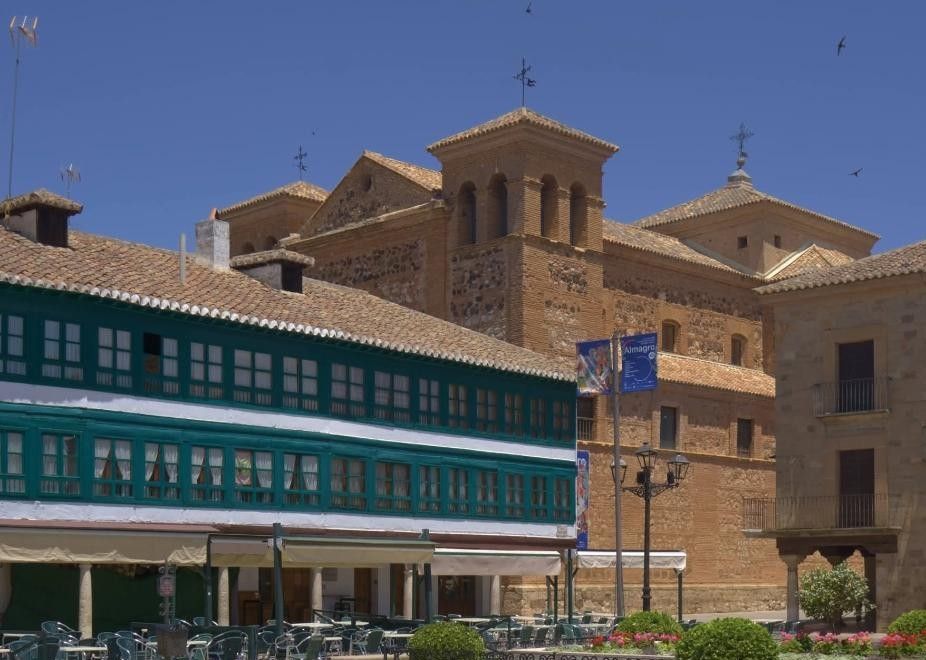
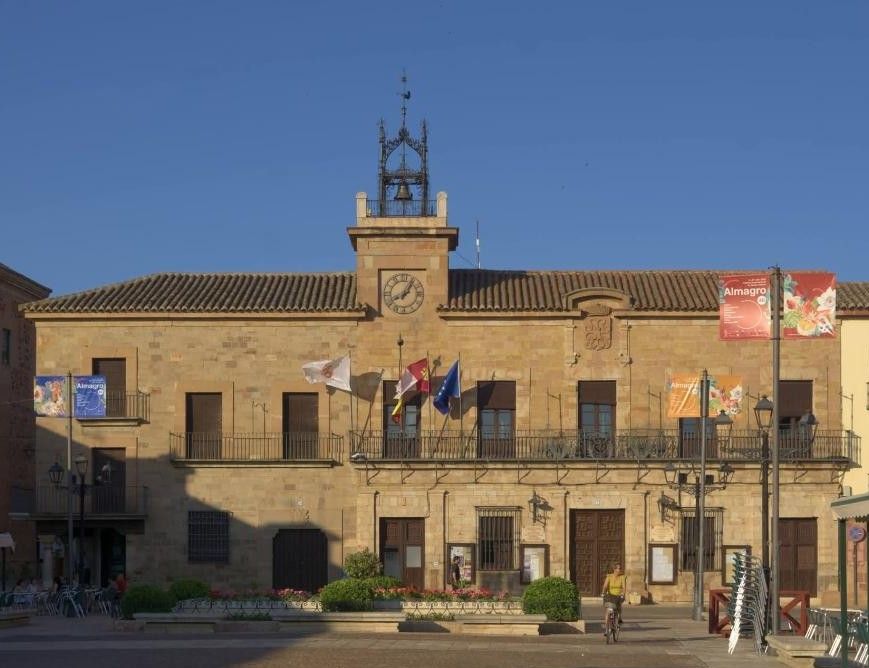
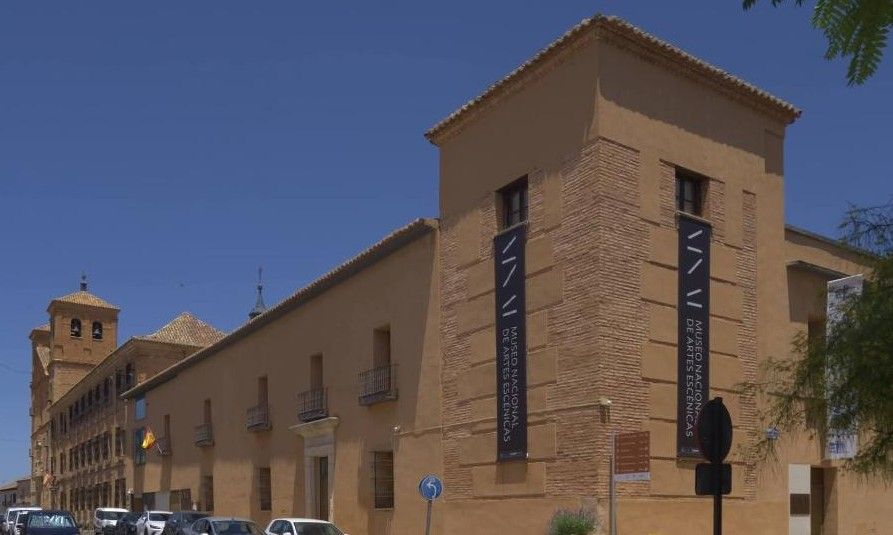
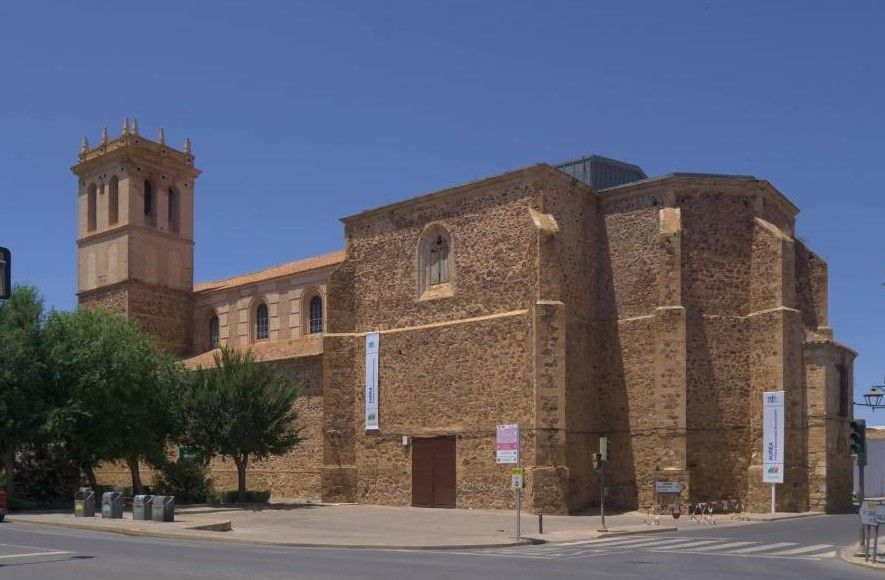
The Church of San Blas, originally called San Salvador until the 18C, when it was dedicated to Saint Blas, is still used today. The Almagro Theatre Festival began using this space in 2005, and it hosts a programme focused on music concerts. Its origin dates back to the 16C, there once stood a small chapel dedicated to Saint Salvador. When the Függers settled in Almagro, James decided to rebuild it to give thanks to God for the blessings he had received. to the arrival in Almagro of the Függers, German bankers of Charles V, in the first half of the 16C, when the Masterships of the Orders were leased to them by Charles V as payment for their banking services. The construction was carried out in two phases, the chancel and first section by Jacob Függer and the other section of the nave and the tower by his nephews Marco and Jacobo. The chapel has a single nave and, as it has no transept, is configured as a unitary space, divided into a polygonal chancel and two sections covered by ribbed vaults with discs at the keystones. The choir at the foot is formed by a wooden balustrade that would bear the founder’s coat of arms. The main entrance is of Plateresque style formed by the semicircular arch doorway flanked by recessed jambs formed by a semicircular arch with coffered jambs and a very marked line of imposts decorated with four-petaled flowers, with the arch’s ring decorated with plant motifs and the spandrels decorated with grotesques.
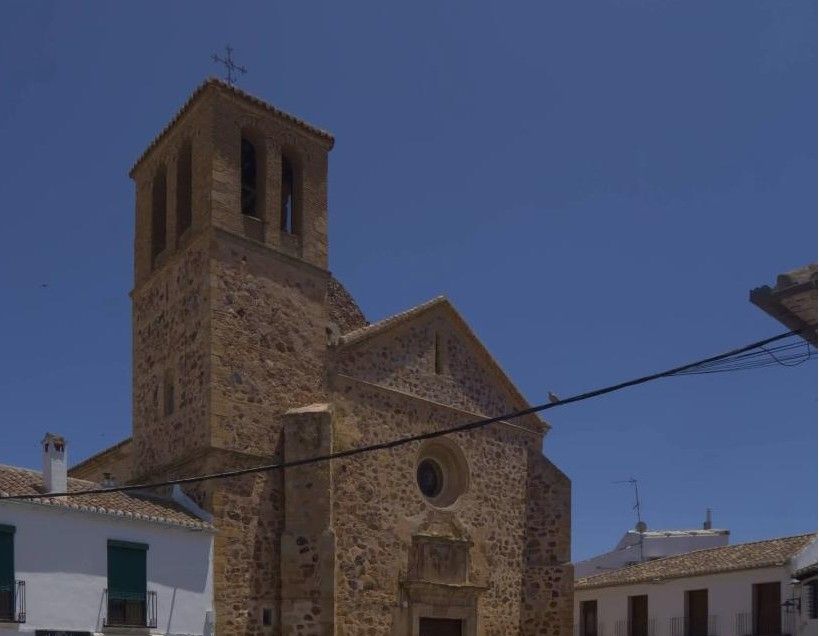
The foundation of the convento de Nuestra Señora del Rosario or convent of Our Lady of the Rosary, which became the old Renaissance University of Almagro, The church responds to the typology used by the mendicant orders of Franciscans and Dominicans during the 16C. It has a single nave, with a Latin cross plan, a polygonal transept and apse, communicating side chapels and a high choir at the foot. On the sides of the nave the new Renaissance currents are appreciable since its design is already carried out with semicircular arches, but above all in the choir stalls, in the mausoleum of the founder Frey Fernando Fernández de Córdova y Mendoza, and in the primitive main altar where the Renaissance is manifest. The University was built in 1538 and its final occupation took place in 1539. On October 18, 1574, classes began in the faculties of Theology, Art and Philosophy, when the works of the College-University were completed, the rest of the studies of Latin Language, Sacred Scriptures and Canons were implemented. It was closed and the Dominicans were expelled in 1835, from which point on it was progressively dismantled, falling into oblivion.
Other things to see here with more time are the noble manor houses; for example, in the main square, the Casa del Mayorazgo de los Molina and the Casa de los Rosales; on Calle de las Nieves, the doorways of the Casa de los Wessel and the Casa de los Xedler , both from the 16C; at the end of this street, the Casa del Prior and the Casa del Capellán de las Bernardas. The Palace of the Marquises of Torremejía located in Plaza Santo Domingo. It was built in the 16C by the Oviedo family and renovated in the 17C by Gaspar Mexia and Catalina de Oviedo. It is currently the boarding school of the Dominican Mothers. The Palace of the Counts of Valdeparaíso ,today property of the Provincial Council of Ciudad Real. This palace belonged to Juan de Gaona y Abad, 1st Count of Valdeparaíso, since 1705, a title granted by his marriage to Aldonza Portocarrero and Félix de Aranda, at the hands of king Felipe V. The Medrano Palace ,located on Calle de San Agustín, and built in the 16C by Jerónimo de Ávila. A three-story building distributed around a central courtyard with two towers in the main body, made of masonry. The Oviedo Palace was built by the Oviedo family in the 16C. Of what was once the palace, only the main body remains, which includes the entrance hall covered by a coffered ceiling, which leads to the rest of one of the courtyard galleries supported on columns with footings. The Fúcares Palace was built in the 16C by the Fúcares or Függer to manage and store the mercury from the mines of Almadén and the grain from the income of the Maestrazgos. The Palace of the Villarreal-Robles or the Marquis of Las Hormazas, was built in the 16C. It has two floors distributed around an interior courtyard. The Municipal Theatre, a coliseum whose construction began in 1861 sought to summarize the values of the 19C bourgeoisie in its appearance and ornamentation. Inaugurated in 1865, it is in the neoclassical style. The Hospital of San Juan de Dios is a modern, recently built open-air stage space where the most technically demanding plays can be performed. It is here that the National Classical Theatre Company normally performs. It dates from the 17C. The National Museum of Performing Arts with abundant pictorial theatrical iconography mainly portraits of actors, sculptures, figurines, stage sketches, posters, photographs, costumes and models, a library with editions and manuscripts from the 18-20C, and an important collection of musical scores. The Campo de Calatrava Ethnographic Museum is located in a restored 18C house in the town center of Almagro, close to the Plaza Mayor, at 6 Calle de Chile. The museum is divided into two floors and a cellar. These two floors house the collections of various trades that have been transformed over time, mainly by the advance of new technologies, and others that have disappeared due to lack of utility or low profitability.
The other religious monuments to see here are the Church of the Mother of God located in what was the Hospital of Our Lady of La Mayor, on land purchased by the Villa in 1546. It is late Gothic with timid Renaissance nuances. The convent of the Most Holy Sacrament of the Augustinians is one of the most important and where the Baroque worldview is best expressed, combining architecture and painting into a whole. It suffered the ravages of the Confiscation and currently only the church remains, called San Agustín, with some notable frescoes inside. The Church was ordered to be built in 1625 and was completed in 1719. The Convent of Santa Catalina de Siena, currently houses the Parador Nacional de Turismo (lodgings), and was founded by Jerónimo de Ávila in the 17C following the final wishes of his wife. The Franciscans lived there from 1612 onwards, and all that remains of the original, skillfully rebuilt complex is the church, with a Latin cross ;now the Ermita of San Francisco hermitage, the cloister known as the “Patio del Laurel”, and some outbuildings. The Convent of the Dominican Encarnación with the church, probably completed in 1597, consists of a nave with side chapels covered by a barrel vault with lunettes. The transept is covered with a groin vault. The main altar features an excellent Annunciation. The Convent of the Assumption of Calatrava , began built as a hospital in 1519. It later became a monastery. It was founded by Commander Gutiérrez de Padilla between 1519 and 1544 for the nuns of the Order of Calatrava under the patronage of the Virgin of the Assumption. Inhabited by the Calatravos between 1827 and 1836, when they were expelled by the disentailment laws of Mendizábal, it also served as barracks after its restoration in 1860, to be reoccupied by the Dominican fathers at the end of the century. The Church of San Bartolomé el Real or Church of the Society of Jesus It was founded by license of king Felipe III in 1602; its origin is very ancient and it was previously in the square, but it sank and was moved to a nearby location. The works, which began in 1625, would last for decades. The Jesuits were in charge of it and although it was finished in 1735, in 1777, the date of the expulsion of the Jesuits, the College had not yet been finished. The Ermita de San Juan Bautista or Hermitage of St John the Baptist was built in the 17C, as certified by the royal founding license in 1626, although there may have been a small previous construction that functioned as a religious enclosure. The most notable part is the one corresponding to the chapel of the Virgen de los Remedios. This extension was carried out in the 18C, in the part belonging to the nave of the gospel and responds to the type of chapel with a Greek cross plan with little developed arms. But the most remarkable thing about the chapel of the Virgen de los Remedios is the decoration of tempera painting and plasterwork, which present a great formal similarity with the paintings of the Church of San Agustín. The themes of this painting include decorative images, symbolic images related to Marian and paradise allegories, and passages from the life of the Virgin.
A bit of history I like tell us that the date of the first human settlement in Almagro is not known with certainty. From Visigoth times there are no vestiges except for some small columns decorated with beveled diamond shapes, scattered throughout the town. The town’s name itself comes from the Arab period, with the characteristic reddish clay of the place, the color ochre. Tradition holds that Master Don Gonzalo Yáñez granted the town a charter in 1213, confirmed by king Fernando III in 1222. In 1273, Alfonso X the Wise convened the Cortes in Almagro and in 1285 the deed of convenience was executed between Master Ruy Pérez Ponce and the people of Almagro regarding the ovens, the zocodover, and the tolls. By the 14C, the town already had a wall and a parish church. The advance of the Christians caused troops to gather here on their way to the border, and Pedro I the Cruel ordered the arrest of Master Juan Núñez de Prado in 1355 in the Maestrales palaces. In the 15C, the incorporation of the mastership into the Crown in 1487. The financial problems of Emperor Charles V made the German bankers Fugger beneficiaries of the income from the Almadén mines and linked them to Almagro, bringing with them their administrators Wessel, Xedler, among others, whose manor houses are still preserved.
In the 16-17C, the population prospered. The crisis of the late 16C and early 17C did not stop the construction boom in Almagro. The Franciscans built the convent of Santa Catalina. The Augustinians, the Jesuits, and the Brothers of San Juan de Dios moved in. The ancestors of the Count of Valdeparaíso built his palace. During the 18C, Almagro experienced a period of fleeting splendor, thanks to the city’s support for the Bourbon candidate, Felipe V, and the work of Juan Francisco Gaona y Portocarrero, Count of Valdeparaíso, Minister of Finance to the King. The town was designated the capital of the province of La Mancha from 1750–1761. During that time, the town suffered great damage due to the Lisbon earthquake of 1755. The confiscations undertaken by the governments of Carlos III led to the dismantling of the most important religious buildings, which considerably harmed the conservation of the town’s architectural heritage. In 1796, Carlos IV granted Almagro the title of city. The French invasion saw the establishment in Almagro, in 1810, of an active Bonapartist Masonic lodge in the house owned by José Antonio Ceballos on Calle Clavería, according to a long procedure followed by the Inquisition between 1814 and 1815. The town suffered the Carlist Wars; even some Carlist guerrillas were born in Almagro, such as the brothers Juan Vicente and Francisco Rugero, better known as “Palillos”. Los Palillos achieved international fame; Some of the horrors of their revenge are told by Théophile Gautier and the evangelical writer George Borrow in his work The Bible in Spain / La Biblia en España (1842). During the 1950s, the City/Town Hall and the Plaza Mayor complex were renovated. In 1972, Almagro was declared a Historic-Artistic Site, and became a theatrical and cultural reference point for the region: International Classical Theatre Festival, cultural and tourist activities. It is part of the association The Most Beautiful Villages in Spain.
The Almagro tourist office on its heritage : https://www.almagro.es/turismo/donde/patrimonio/patrimonio-monumental
The town of Almagro on its cultural offerings : https://www.almagro.es/cultura/
The province of Ciudad Lineal tourist office on Almagro : https://www.ciudad-real.es/provincia/almagro.php
The Castilla La Mancha regional tourist office on Almagro : https://en.www.turismocastillalamancha.es/patrimonio/almagro-10231/descripcion/
The Cultural site of Castilla La Mancha regional tourist office on heritage monuments of Almagro : https://cultura.castillalamancha.es/patrimonio/catalogo-patrimonio-cultural/conjunto-historico-de-almagro
The Spain National Tourist office on Almagro : https://www.spain.info/en/destination/almagro/
The most beautiful villages of Spain on Almagro : https://lospueblosmasbonitosdeespana.org/ficha-pueblo/?id_lugar=39
There you go folks, a dandy and a must to visit me think, We drove a bit south in my road warrior trails to be here and glad we did, There is plenty in Almagro and merits a return trip, eventually. Again, hope you enjoy this post on this is Almagro !!! as I
And remember, happy travels, good health, and many cheers to all !!!


