
A wonderful quant litle village ,we have passed by on our road warrior trails enough to have a couple pictures in my cd rom vault that should be in my blog for you and me, I drove once in and really with so much to see will have to come back ,eventually, For now, let me tell you on the Palacio Goyeneche of Nuevo Baztàn !!! Hope you enjoy the post as I.
The town of Nuevo Baztàn is 63 km from Tarancon, 62 km from Aranjuez, 38 km from Chinchon, and 49 km from Madrid from where we came from along the Retiro park into Calle O’Donnell over the M30 beltway of Madrid continue on the M23 road under the Tunnel of O’Donnell the road becomes the R3 radial road of Madrid to connect with the M300 at the roundabout avenida de Alcalà to bear left onto the M209 road or carretera de Madrid, which crosses over the R3 dir Campo Real and continue same road, becoming Avenida de Arganda and on the roundpoint Glorieta de San Sebastian bear left onto the M220 or Carretera de Loeches, continue to next bend bearing rigtht onto the M219 or Calle de Esparteros passing by Pozuelo del Rey continue right into Plaza de la Iglesia and complex in Nuevo Baztàn.
The Palacio Goyeneche Palace was built between 1709 and 1713 in the Baroque style, based on a design by the architect José de Churriguera. It was the central nucleus of an industrial complex conceived, promoted, and developed by the publisher, journalist, and politician Juan de Goyeneche, which later gave rise to the present-day town of Nuevo Baztán. One of the most representative works of Spanish Baroque architecture. It consists of two main buildings, the palace complex itself and the Church of San Francisco Javier, (see post) which, due to their contiguous location and harmonious layout, form an integrated structure. The complex is completed by a series of squares and smaller buildings, one and two stories high, arranged according to a Hippodamic urban plan. The palace has a rectangular layout and two floors, organized into two architectures and separated, on the facades, by a flat cornice. It is flanked by a quadrangular tower, arranged on four levels and topped by a stone balustrade with a projecting cornice, acroteria, and ball ornaments. The tower is the element that brings together the greatest ornamental motifs, along with the main entrance, dominated by the relief of a lion holding a checkered board in its jaws, an allusion to the heraldic shield of the Baztán Valley. At the top of the entrance is a wrought iron balcony and, above it, a coat of arms corresponding to the Count of Saceda, a title that Juan de Goyeneche obtained for his heirs. It was installed after the construction of the palace. The interior is distributed around a rectangular courtyard, with a well in its central part. It is delimited by two galleries of semicircular arches, which are connected by a staircase with characteristics similar to the one in the Goyeneche Palace in Madrid (home to the Royal Academy of Fine Arts of San Fernando), also designed by José de Churriguera. On the upper floor are the noble apartments, making up a palatial building. The wings of the Goyeneche Palace are so wide that a small theater was installed in one of its rooms in a later period like Romanticism. The palace communicates with the church internally through the rooms on the second floor. As was customary in noble residences, passageways were established to communicate with the galleries of nearby churches, and Don Juan de Goyeneche was not going to be any different, therefore, he also established a communication passage with the gallery located on the Gospel side from where the presbytery and its main altarpiece, the work of José Benito Churriguera, can be clearly seen and from which the main scene of said altarpiece would be seen, the relief medallion with the baptism by Saint Francis Xavier of the Filipino Indians. The cellars located under the Palace are noteworthy.
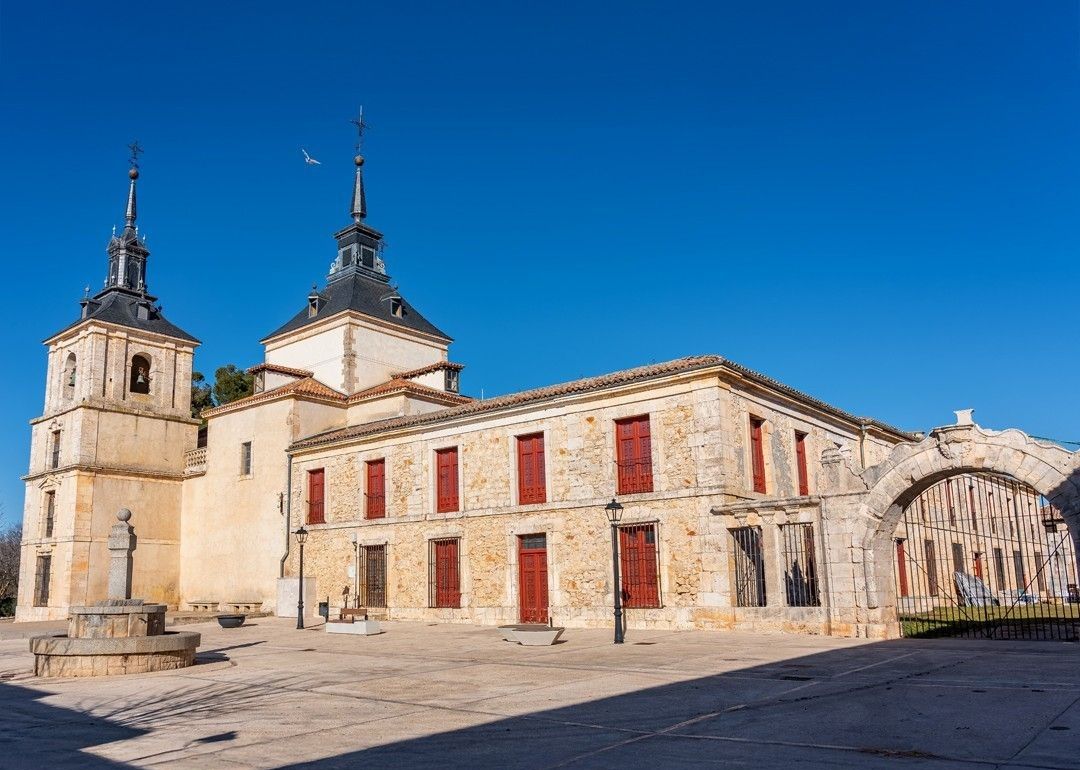
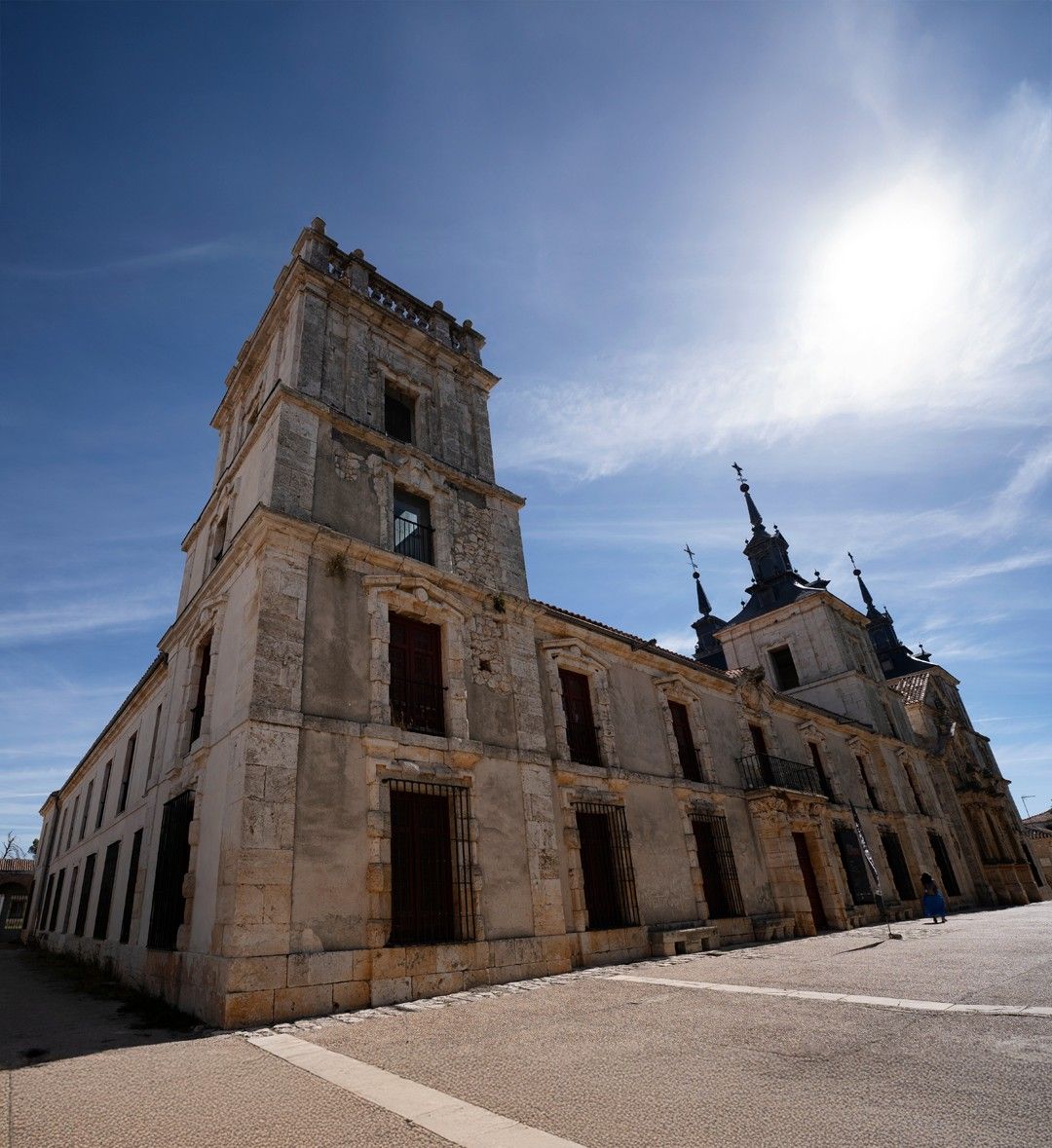
The history of this palace is linked to that of the Nuevo Baztán agricultural-industrial complex, launched by Goyeneche in 1709. It was a pioneering industrial initiative in Spain, largely following the currents of Colbertism, as the political and economic thought of Jean-Baptiste Colbert, minister of the French king Louis XIV, is called. The complex extended around a monumental central core, formed by two annexed buildings, the Goyeneche Palace ,where its founder and heirs resided, and the Church of San Francisco Javier.(see post), The factories were built in several phases. The first to open its doors was the cloth factory (1710), installed near the urban center of La Olmeda. In 1715, the hat, ammunition and textile factories began operating, already located within the Nuevo Baztán complex. Later, the liquor and water factories (1716) and the crystal and fine glass factories (1720) were inaugurated, achieving its own legal entity, achieved in 1723, when Nuevo Baztán became independent from La Olmeda. The complex began to decline in 1735, with the death of Juan de Goyeneche and the cessation of some contracts, including the one signed with the Spanish Army. In 1748, only the hat and cloth factories were operating, which closed permanently in 1778. During the Spanish Civil War, the palace remained in the Republican zone and housed prisoners of the Nationalist side who worked on the construction of the so-called “Forty Days’ Railway.” In October 2003, the first phase of the Madrid Interpretation Center and Ethnographic Museum was installed within premises near the palace grounds. In order to promote its reconstruction and subsequent use, the Nuevo Baztán Historical Heritage Association was created. It is carrying out important activities to ensure that its current owner, the Community of Madrid, and with the help of all interested public and private institutions, promptly put it into operation for the benefit of Spain’s historical heritage.
The town of Nuevo Baztàn on its heritage : https://turismo.ayto-nuevobaztan.es/que-visitar/conjunto-historico/
The Madrid tourist office on Nuevo Baztàn : https://www.esmadrid.com/nuevo-baztan
The Community of Madrid region tourist office on Nuevo Baztàn : https://www.visitmadrid.es/en/where-to-go/towns-of-madrid/nuevo-baztan
The Association of the historical heritage of Nuevo Baztàn ; https://www.nuevobaztan.org/00indice.html
The prettiest towns of Spain site on Nuevo Baztàn : https://lospueblosmasbonitosdeespana.org/ficha-pueblo/?id_lugar=120
There you go folks, another gem in my dear Spain, Nuevo Baztàn was a nice ride and great impression, all worth it on my road warrior trails. Again, hope you enjoy this post on the Palacio Goyeneche of Nuevo Baztàn !!! as I.
And remember, happy travels, good health, and many cheers to all !!!


