
I take you back to my dear Madrid !! love it !! I like to continue the saga of my dear Madrid with new pictures from my cd rom vault that should be in my blog for you and me, This is again my lost walking trails of wonderful sublime Madrid, Therefore, let me tell you about curiosities of Madrid, part XVI !!! Hope you enjoy the post as I.
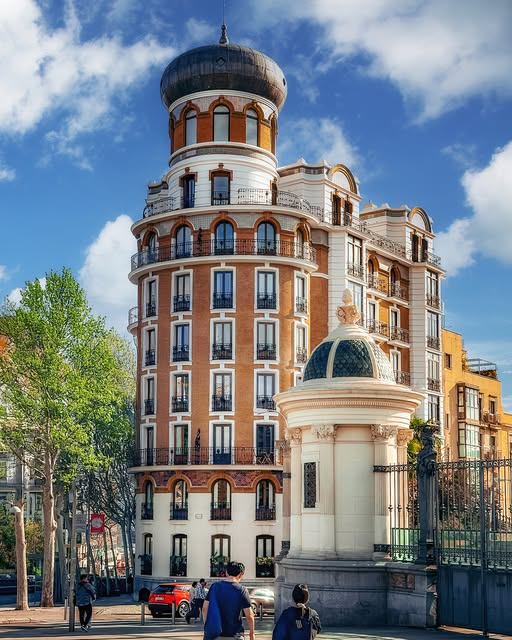
The Edificio Críspulo Moro or building is located between Calle Alfonso XII and Calle de Velasco , very close to the Royal Botanical Gardens ,and the Puerta del Ángel Caído in Retiro Park. It was designed as a residential building by the architect Críspulo Moro Cabeza, after whom the building is named. It is a modernist building with neo-Arabic elements, featuring a curved corner with a turret crowned by a bulbous dome. Críspulo Moro Cabeza was a modernist architect. He also worked as a writer and journalist, becoming director and co-owner of the newspaper El Diario Español. A representative of the modernist school of the first two decades of the 20C, he designed and built the Salón Doré or Cine Doré, now the home of the National Film Library since 1989, located on Calle Santa Isabel. The calle de Alfonso XII is located between the Plaza de la Independencia and the Paseo de la Infanta Isabel. It is the street that delimits, by means of a fence, with the Retiro Park, allowing access through four entrances: the Puerta del Ángel Caído, the Puerta de Murillo, the Puerta de Felipe IV and the Puerta de España. Close to the promenade, it gives access to the Cuesta de Moyano. When the street was flattened in 1869, on land in the Retiro Park it was named Granada. The Royal Observatory of Madrid was built in 1845 on the old San Blas hill. In 1878 the street was renamed King Alfonso XII. In 1931 it was named Alcalá Zamora, in memory of the lawyer and politician Niceto Alcalá Zamora, president of the Second Republic. In 1936 it was called Agrarian Reform and in 1941, after the post-war period, it recovered the name of Calle Alfonso XII. The Horcher restaurant was opened by the German Otto Horcher in 1943 at No 6 . At No 68,the National Museum of Anthropology. Between 1905 and 1918 the Jerónimos neighborhood was urbanistically configured, limited to the north by Calle Alfonso XII, and by the Paseo del Prado.
The Madrid tourist office on the Retiro district : https://www.esmadrid.com/en/madrid-neighbourhoods/retiro
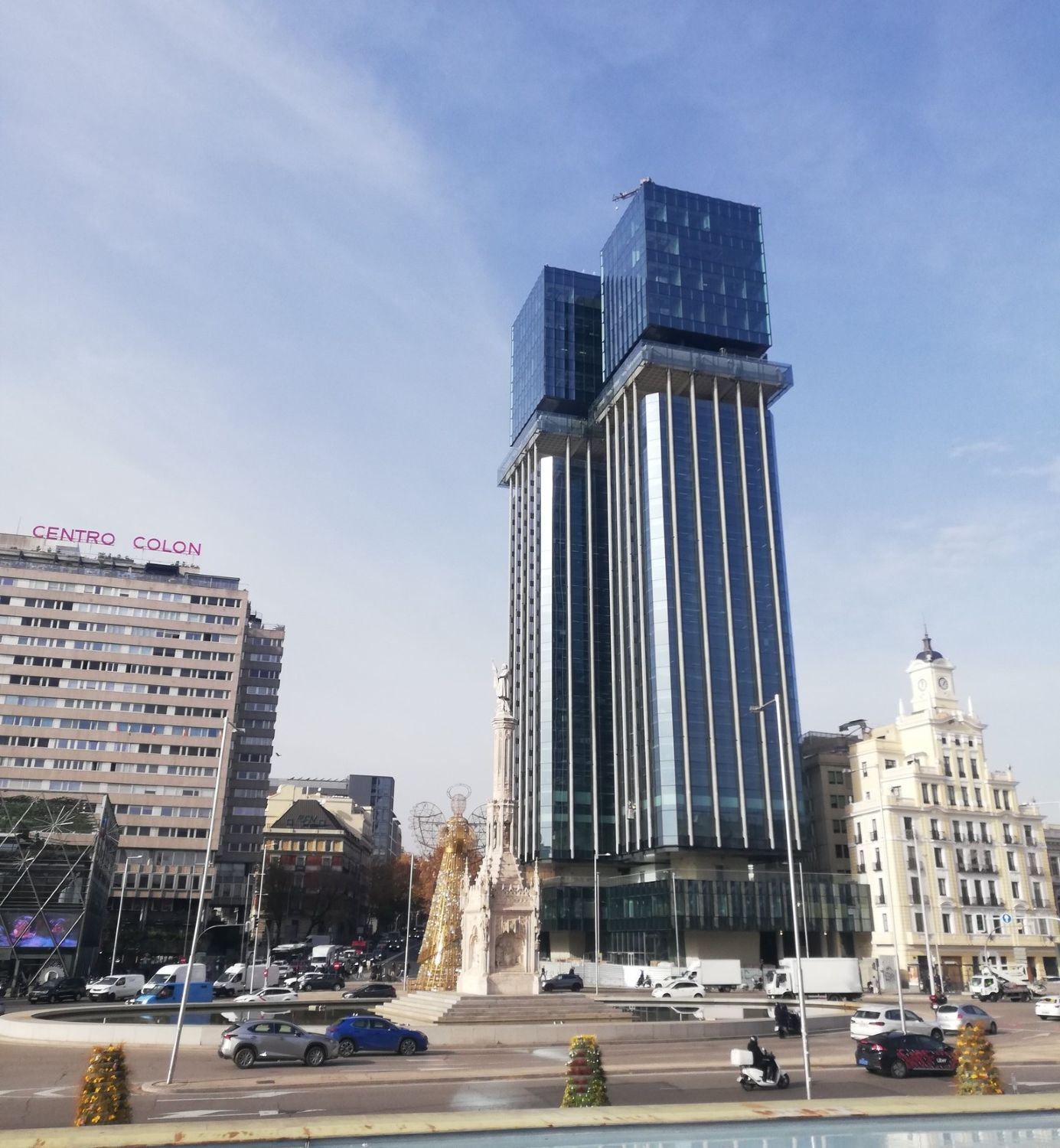
The Torres de Colón are skyscrapers located in Plaza de Colón.(see post) They stand 117 meters tall and consist of 27 floors. They were conceived as twin towers that shared the same base until the renovation carried out in 1990, which joined both structures by means of a suspended fire escape. It is the 11th tallest building in Madrid today, and was the tallest office building in Madrid until the completion of Torre Picasso in 1989. The towers were built between 1967 and 1976. The towers are located at 31 Calle Génova, on the corner of Paseo de la Castellana and overlooking Plaza de Colón, in the Almagro neighborhood of the Chamberí district. In the aforementioned square, Calle Goya and Paseo de Recoletos ,also converge, and directly opposite are the Discovery Gardens, inaugurated in 1977. See , also,the neo-Gothic-style monument consists of a column surmounted by the statue of Columbus (Colon) erected between 1881 and 1885.
The Madrid tourist office on the Torres de Colon : https://www.esmadrid.com/en/tourist-information/torres-colon
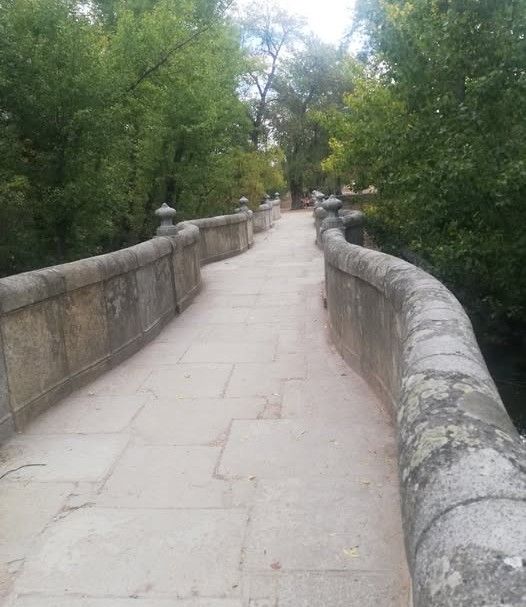
The Puente de Culebra or Snake Bridge is an 18C architectural work. It was built in the Casa de Campo (see post), over the Meaques stream, a tributary of the Manzanares River, which in turn flows into the Jarama River. The bridge is located in the area known as El Zarzón. It is located near the Batán Gatehouse in the Rodajos Barracks. At its foot is the estanque de la culebra or snake pond, formed by the dammed waters of the Meaques stream. The bridge was built in 1723 on orders of king Carlos III and is the most representative of the remaining works of art in the Casa de Campo ,and a curious example of Italian Baroque architecture in Madrid. Built in the Baroque style, with a clear Italian influence, the bridge combines red brick, present in its arches, with granite, which dominates its upper section, starting from the overhang installed above the impost line. Its parapets are adorned with ten stone pinnacles added during the 1983 renovation. The Puente de Culebra aka puente del Estrecho or strait bridge due to its insufficient width for carriages. Most of the Casa de Campo is surrounded by a stone wall with 70 cm thick and done with brick and cement and chalk. The upper section is covered with granite stone with some parts rebuilt or reduced; and you can still see the ones given access to the Casa de Campo that were the old gates of Aravaca, and Castilla. They had small gates to allow pedestrians to go thru such as the ones of Agachadiza, Casa Quemada, Los Pinos , and Zarzón, all rebuilt.
The Madrid tourist office on Casa de Campo : https://www.esmadrid.com/en/madrid-neighbourhoods/casa-campo
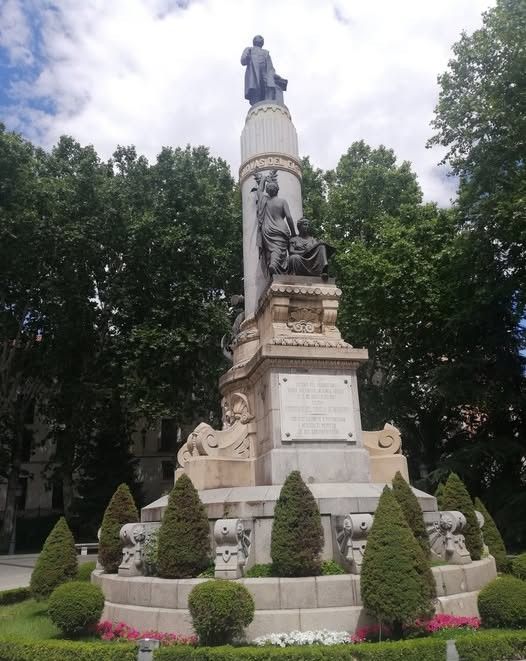
The Monumento Cánovas del Castillo (monument) is a commemorative sculptural group consisting of a bronze statue of Antonio Cánovas del Castillo, a conservative politician and one of the main architects of the monarchical restoration of Alfonso XII. He was assassinated in 1897 by an Italian anarchist in the spa town of Santa Águeda (Mondragón, Guipúzcoa). The sculpture pays tribute to one of the leading statesmen of the 19C, and is located in the Plaza de la Marina Española, next to the Senate Palace. In the middle body of the monument, two bronze sculptural groups are placed on two projections: in the front projection there is a seated figure ,an allegory of History, writing the notable events of Cánovas’s life in a book and another seated statue, an allegory of Glory, that leans with one hand on History and with the other holds a laurel wreath that makes contact with the name of Cánovas, sculpted on the column that emerges from the central body; in the sculptural group of the rear projection there is a bronze trophy composed of a lion, a version of the coat of arms of Spain and a flag. The truncated column is topped with the bronze statue of Cánovas in the attitude of an orator, advancing his right arm while resting his left hand on a book placed on a pedestal. The monument was inaugurated on January 1, 1901, The Plaza de la Marina Española is located between Torija, Guillermo Rolland, Encarnación, Bailén, and Reloj streets. It is close to the Jardines de Sabatini, the historical cerca de Felipe II, built in the 16C as customs doors to enter the city, It was originally called Vistillas del Río, due to the view from here. It was later renamed Plaza de Doña María de Aragón, as it faces the entrance to the Colegio de Doña María de Aragón, located where the Senate building now stands, which has occupied the former college after successive renovations. In 1835, it was renamed Plaza de los Ministerios , because various organizations were located there. Since 1943, it has been called the Plaza de Marina Española (Spanish Navy Square), in memory of the exploits of the navy off the coasts of Chile and Peru in 1865.
The Madrid tourist office on the Senate palace: https://www.esmadrid.com/en/tourist-information/palacio-del-senado
The Basilica Minor of San Francisco El Grande (see posts) is in the district of Palacio, within the historic center of Madrid. It presides over the western face of Plaza San Francisco , set by the intersection of Calle Bailen and the Carrera de San Francisco street just walking right from the Palacio Real. It is part of the Franciscan convent of Jesús y María, founded at the beginning of the 13C, on a now gone hermitage dedicated to Saint Mary. The current Basilica was built in neoclassical style in the second half of the 18C. The Basilica stands out for its dome, considered as the third largest diameter circular plant in Christendom. For its sumptuous interior decoration, made in eclectic style at the end of the 19C, and for its art gallery, representative of the Spanish painting from the 17C to 19C, with paintings by Zurbarán and Goya.
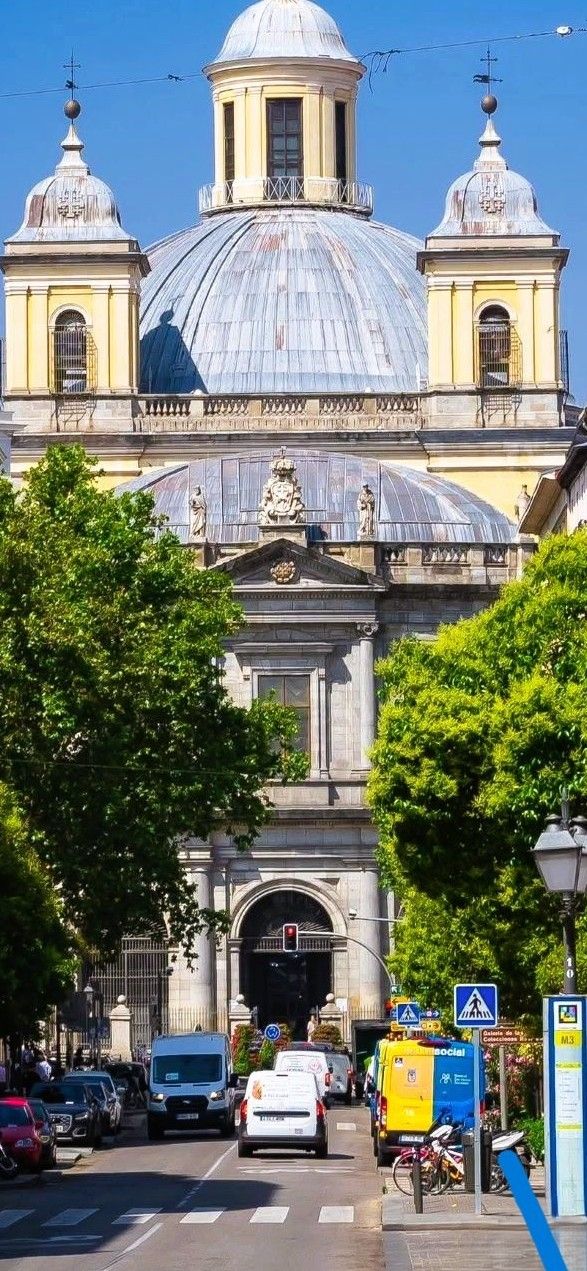
The Madrid tourist office on the Basilica: https://www.esmadrid.com/en/tourist-information/san-francisco-el-grande
There you go folks , another wonderful nostalgic, sentimental trip to my dear Spain, A love affairs with my Madrid, as do not know when we will be back, we sure will have this trip in our hearts forever, Again, hope you enjoy this post on curiosities of Madrid, part XVI !!! as I
And remember, happy travels, good health, and many cheers to all !!!

 Paris1972-Versailles2003