
Always a pleasure to tell you about my dear Spain again !! love it !! We came by car of course and took time to see different places or old repeat, I like to continue the saga of our new road warrior experiences even if now with less in our family, This post is due to new pictures found in my cd rom vaults that should be in my blog for you and me. Therefore, let me tell you about this is Coca !!! Hope you enjoy the post as I.
The village of Coca is in the province of Segovia, in the autonomous community of Castilla y Léon, and in the kingdom of Spain. It has a population of 1,703 inhabitants (INE 2024), The village is 55 km from Segovia, 54 km from Tordesillas, 148 km from Madrid, and 66 km from Valladolid, We were a few years back on our way to Madrid and as usual we took the road warrior trails to see a bit more coming to Coca for its castle, This was on the A6 autovia to Medina del Campo (see post) to hook up with the CL602 road dir Olmedo (see post) ,and then Coca.
The reason that is worth the detour here is the castle of course, An impressive fortress to boot ! The castillo of Coca castle is a fortification built in the 15C and is considered one of the finest architectural works of Spanish Gothic-Mudejar. Owned by the House of Alba, it has been ceded to the Spanish Ministry of Agriculture since 1954. The castle is located on the outskirts of the village of Coca from which it takes its name. It rises over the meander of the Voltoya river, a tributary of the Eresma river. A wide and deep moat surrounds the castle. The lower enclosure is square in plan and is flanked at its corners by four towers, the largest of which is the torre del homenaje or tribute tower, which is traversed inside by a narrow brick spiral staircase that gives access to various floors used as a chapel, weapons room and other rooms. The sala de armas or weapons room is covered with a Gothic ribbed vault decorated with mosaics based on geometric motifs in various colors. The torre de Pedro Mata tower is the second largest tower in size to the tribute tower, probably because it protects the entrance to the parade ground. The other two are the torre de la Muralla or wall tower and the torre de los Peces or Fish tower. Within the enclosure, there are also other rooms decorated with stucco and murals, as well as a dungeon.
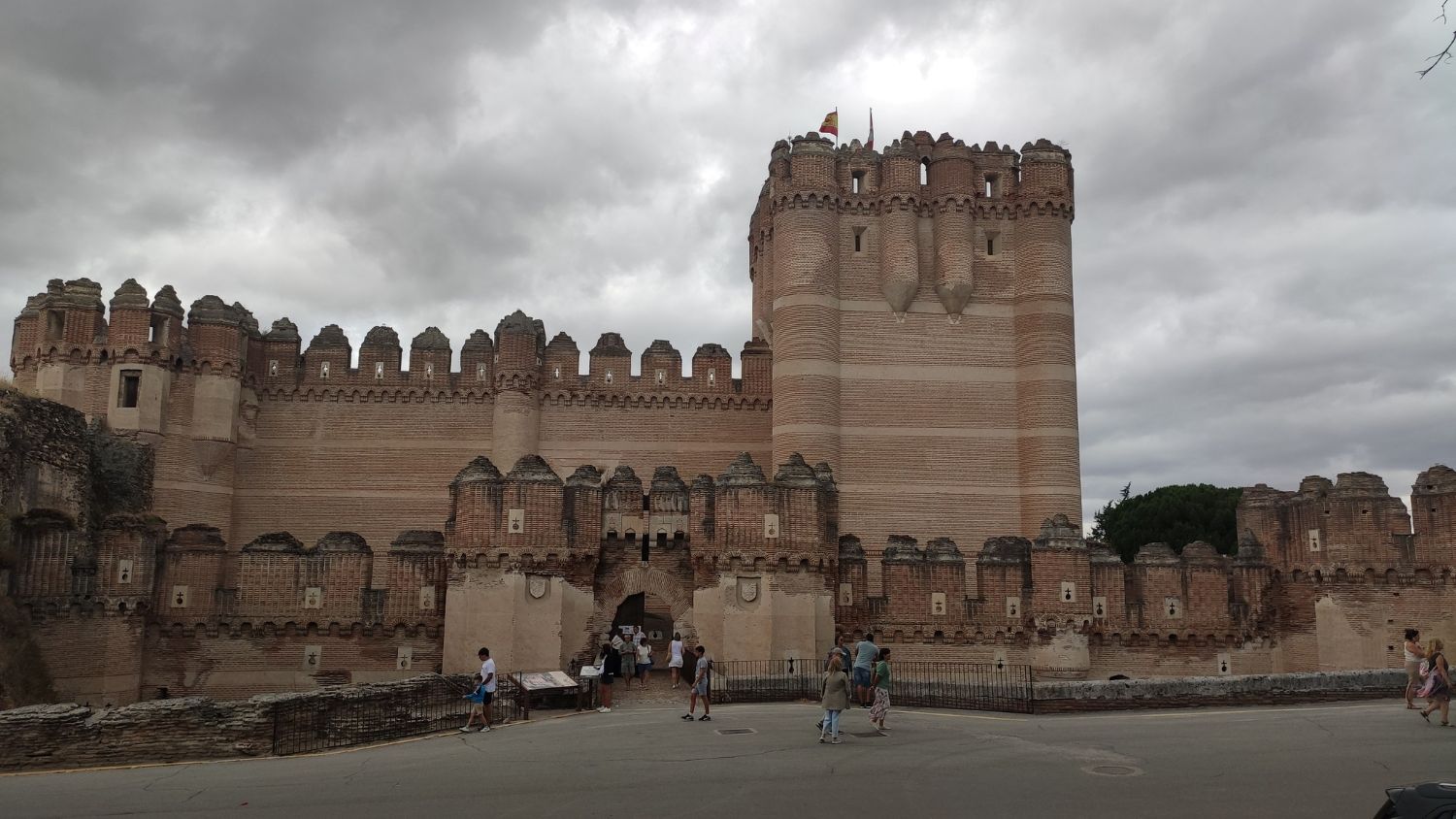
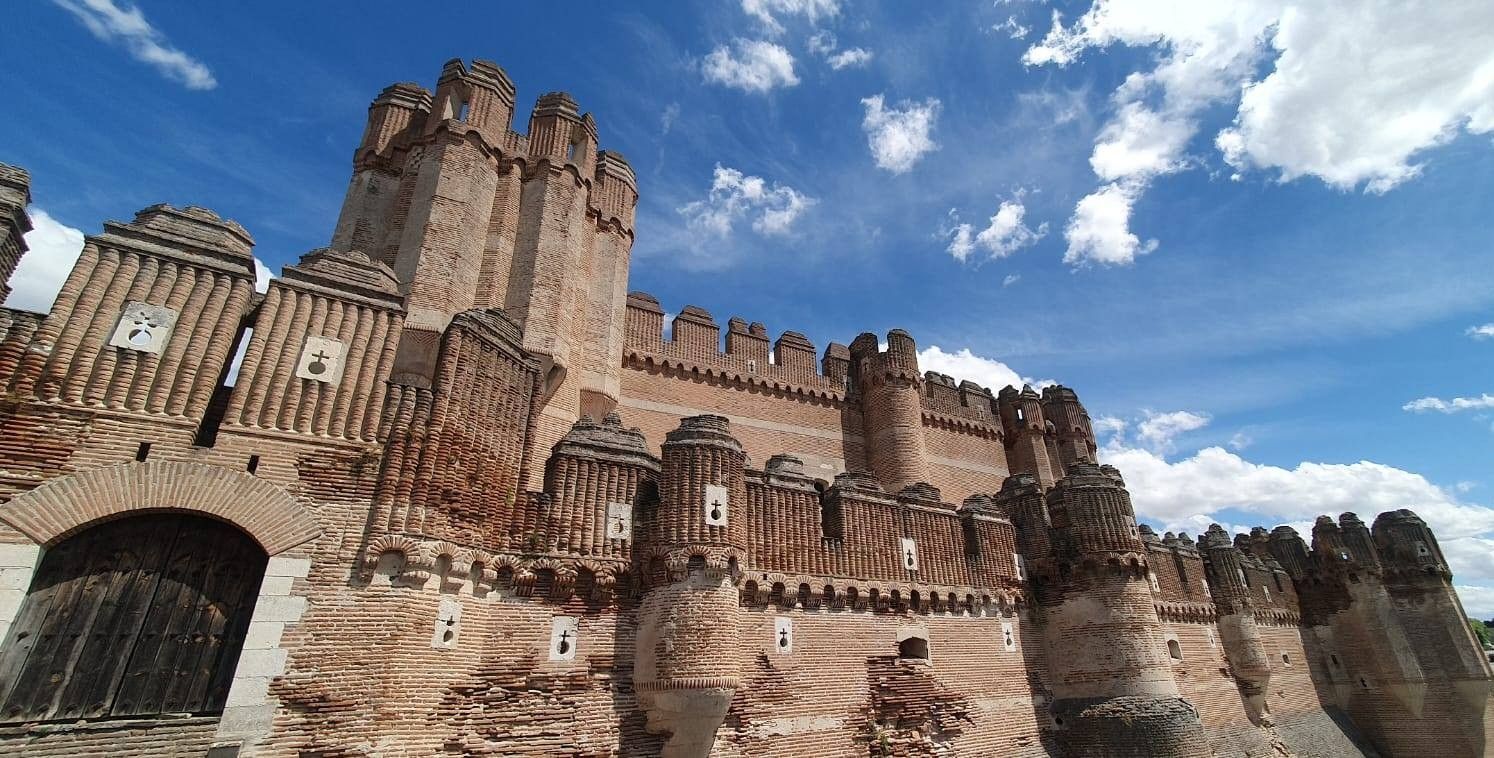
A bit of history I like on the castle tell us that Alonso de Fonseca y Acevedo, who ordered the castle to be built in 1473 and turned it into a stately home, where he held grand parties frequented by various personalities, including the French cardinal Jean Jouffroi, who came to Castile with the marriage proposal between Infanta Isabel (later queen Isabel I the Catholic) and the Duke of Berry in Guyenne, brother of Louis XI of France. Beatriz de Bobadilla, Marquise of Moya, also visited the castle. In 1502, the Catholic Monarchs ensured that in the event of Alonso’s death, the castle would pass to his brother Antonio Fonseca. The following year, Queen Isabel decreed that the heirs to the town of Coca could only be male, thus eliminating the possibility of the castle being inherited by one of its owner’s only two daughters. For this reason, in 1504, Coca passed to his brother, Antonio de Fonseca, captain of the Catholic Monarchs, who expanded the defensive elements of the castle, which later had to defend itself from the unfortunate attack of the Marquis of Cenete, who intended to rescue his fiancée, María de Fonseca, who was being held by his uncle. In 1521 it was attacked by the Comunero troops in retaliation for the fire in Medina del Campo carried out by Antonio de Fonseca himself; when they failed to access the castle, they destroyed the nearby fortress of Alaejos. In 1645, it was the prison of the Duke of Medina Sidonia, accused of having wanted to proclaim himself King of Andalusia. And later, through marriages, the castle became the property of the House of Alba. From 1730, its archives were moved to Madrid, and the castle fell into disrepair and plunder. In 1808, during the Peninsular War (independance war in Spain), the French occupied the town of Coca and their troops settled in the castle, causing great damage. When they abandoned it in 1812, it was left in ruins. In 1954, it was ceded to the Ministry of Agriculture for 100 years less 1 day, and was restored between 1956 and 1958 to house the Forestry Training School. Since 1958, 39 groups of Forestry Foremen have passed through its classrooms.
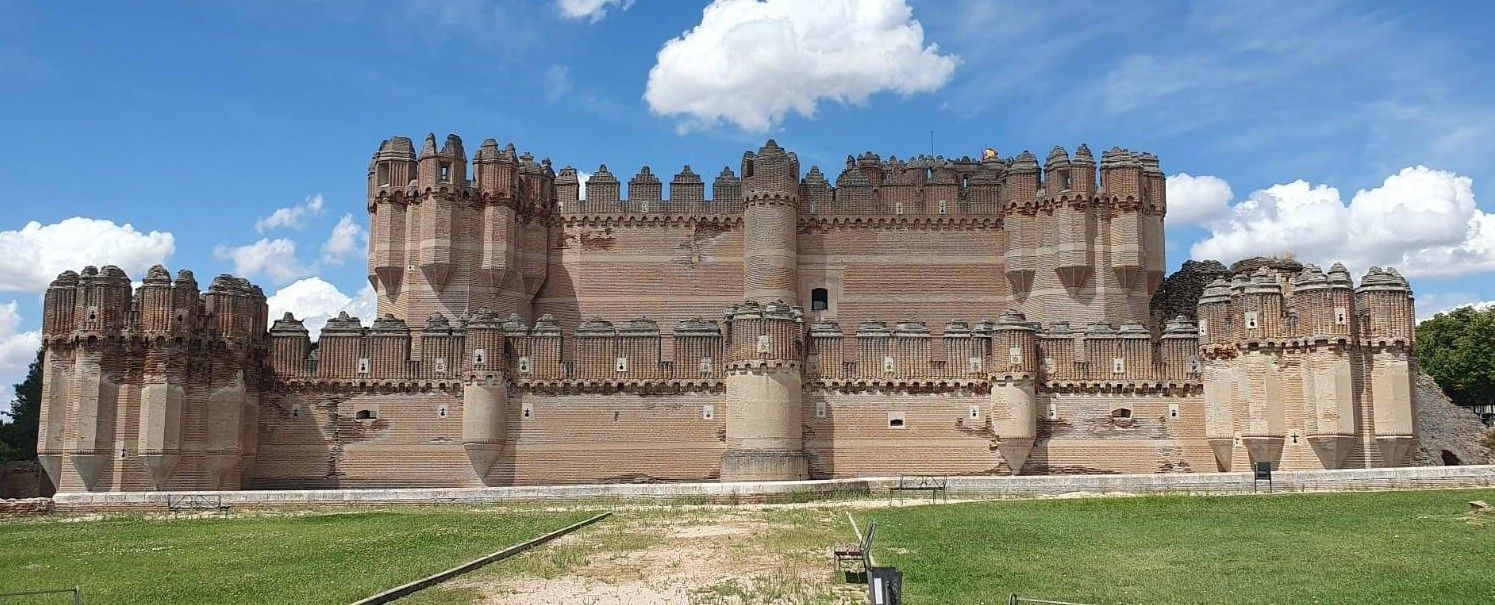
Other things to see here are the medieval wall, built in the 12C, currently preserves about 200 meters of wall. The Vaccean wall (5C BC-2C BC), discovered in the 21C. Tower of San Nicolás, the only material evidence of the old church of San Nicolás in the 12C. received Islamic influence. Church of Santa María La Mayor, Gothic temple built on the previous Romanesque temple. Inside it preserves the tomb of the Fonseca family.
A bit of history of the village of Coca tell us that after the Visigoth settlement in the city, little news exists of Coca. Later it belonged to both Muslims and Christians, it was conquered by Almanzor and later by Alfonso VI of León in 1086. In the 15C, it belonged to Íñigo López de Mendoza, Marquis of Santillana. Through an exchange between him and Alonso I de Fonseca, Coca became the property of the latter who began the construction of the castle, which began in 1453. Napoleon Ier took Coca in 1808, establishing his troops in the castle. They sacked the town, burning the municipal archive, the glass factory, the Franciscan Convent and leaving the castle in ruins upon their departure. During the Spanish Civil War (1936-1939) Coca remained in the hands of the Nationalists troops, with no armed combat taking place, but political prisoners were taken.
The official Castillo de Coca : http://www.castillodecoca.com/
The village of Coca on its heritage : https://www.coca.es/patrimonio
The Castilla y Léon regional tourist office on the Coca castle : https://www.turismocastillayleon.com/en/heritage-culture/castle-coca
The Segovia province tourist info on the Coca castle : https://www.segoviaunbuenplan.com/monumentos/castillo-coca/
There you go folks, another wonderful nostalgic, sentimental trip to my dear Spain, Do not know when we will be back, we sure will look forward to be back, eventually, Again, hope you enjoy this post on this is Coca !!! as I.
And remember, happy travels, good health, and many cheers to all !!!

 Paris1972-Versailles2003
💙
LikeLiked by 1 person
Thanks for stopping by Cheers
LikeLiked by 1 person