
One of my favorite cities of my beloved Spain, and very sentimental for me is visiting Cuenca, in the Province of Cuenca, Autonomous region of Castilla La Mancha, and the Kingdom of Spain! I need to remind all of the wonderful Casas Colgadas or hanging houses of Cuenca! Once again looking into my cd rom vaults found me a picture that should be in my blog for you and me, Therefore, here is my take again on the casas colgadas of Cuenca, part II !!! Hope you enjoy the post as I .
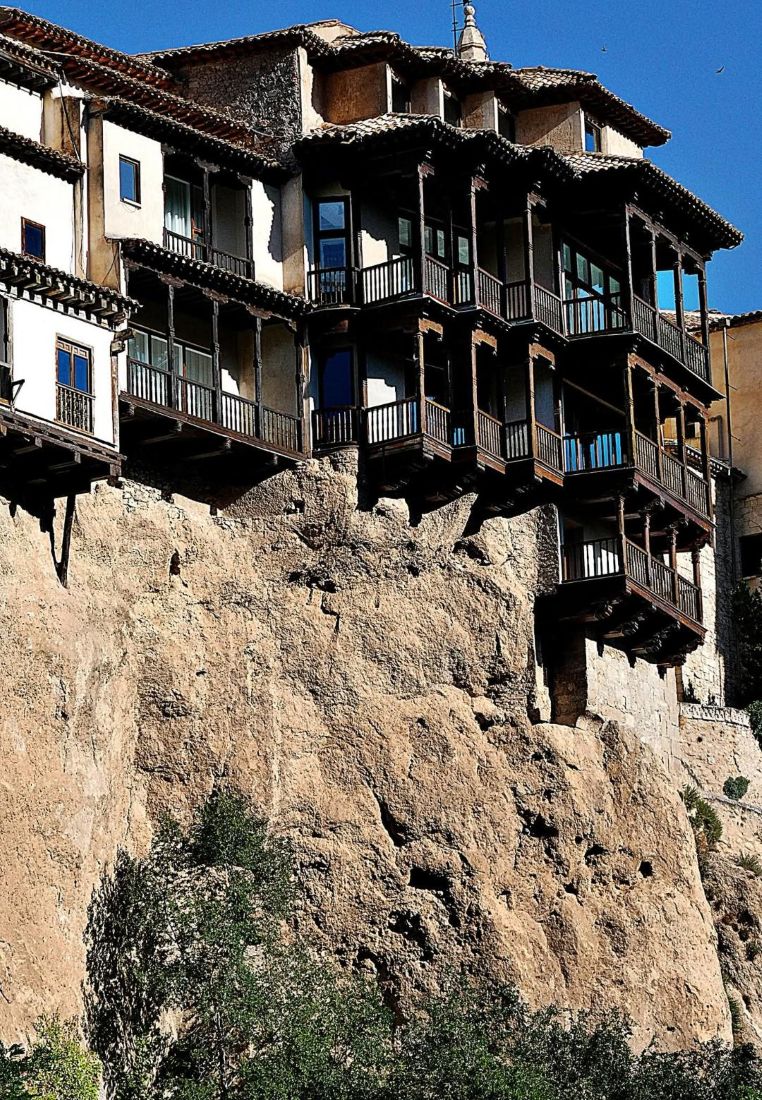
the Casas Colgadas (Hanging Houses), also known as Casas del Rey, (houses of the king) ; they are a group of civil construction in the cliffs of the Huécar river, and are name as such because they had huge balconies over size on the cliff given to the canyon of the Huécar river. The first documentary evidence of the Hanging Houses dates back to 1481, indicating that they already existed in the 15C. The denomination of Colgadas or Hanging was a late title and only came to be known as such by 1920. The graphic story of these houses begain in 1565, the year that the Flemish painter Anton van den Wyngaerde included them together with the curve along the cliff of San Martin in a wonderful panorama of his work ” Cuenca desde el este” or Cuenca from the East. The oldest photos of the place are from the last third of the 19C showing a group of houses that remained intact for several centuries even if unfortunately there are only one remaining of the architecture of old Cuenca.
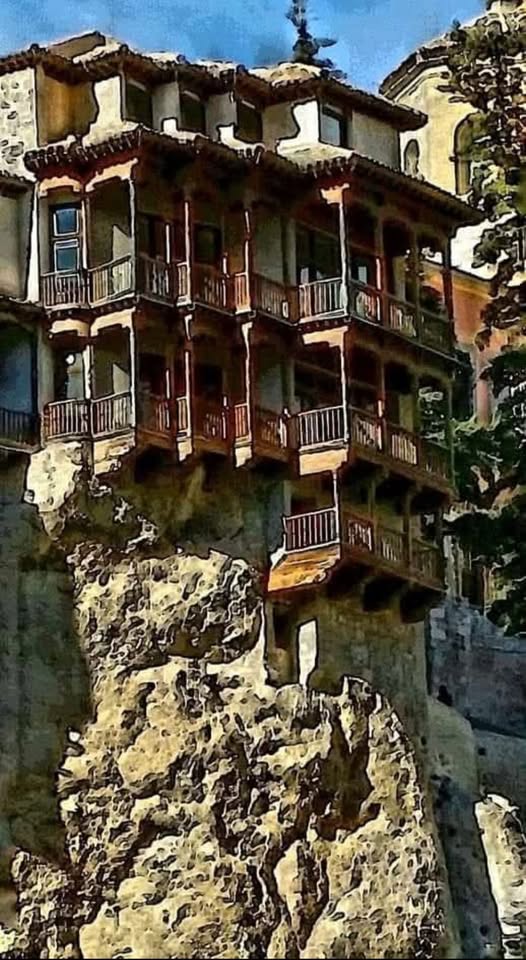
These were popular houses composed of several half-timbered, solid buildings connected internally, located in the old part of the city, on the urban edge offered by the Hoz del Huecar (see post). They were so named because part of them is cantilevered, with large balconies overlooking the vertical wall formed by the Huécar river. The houses are narrow and tall, with two or three rooms on each floor. The uneven ground was used to arrange the cellar and, once the street level was reached, the construction of the different floors began, the number of which varied, although they could reach three or four. In these houses, the lower parts and the foundations were made of strong masonry, and the rest of the walls were built in a more rudimentary manner with a wooden framework, generally juniper. The facades were whitewashed, and the openings, which were opened according to the building’s internal layout, were closed with grilles. All floors were connected by a narrow staircase with wooden steps and tiles. French fireplaces were also common, one on each floor.
In the main casa there is now a museum Spanish abstract arts by the Foundation Juan March (see post).
The Cuenca tourist office on the Casas Colgadas: https://www.visitacuenca.es/es/content/descubre-ciudad-y-paisaje-urbano/casas-colgadas
The Castilla La Mancha region on the hanging houses of Cuenca: https://en.www.turismocastillalamancha.es/patrimonio/casas-colgadas-27664/descripcion/
There you have it , another jewel of my beloved Spain in historical beautiful Cuenca. Again, hope you have enjoyed this post on the Casas Colgadas of Cuenca, part II as I.
And remember, happy travels, good health, and many cheers to all !!!

 Paris1972-Versailles2003
one of my favorite cities in Spain, as well. great post
LikeLiked by 1 person
Me too always stayed nearby, Plenty on it in my blog. thanks for stopping by Cheers
LikeLike
It’s on my list. I’ve been to Ronda, but I understand that Cuenca is even more spectacular. Maggie
LikeLiked by 1 person
Both are good, but I take Cuenca any time. Hope you can make it there. Thanks for stopping by Cheers
LikeLike
I much enjoyed visiting these
LikeLiked by 1 person
Good for you its a wonderful town of many great memories for my family. Thanks for stopping by Cheers
LikeLiked by 1 person