
This off the beaten path reminds me of so much of good memories from a boy to a men and marriage ,and fatherhood. It is impossible for me to tell you otherwise, Madrid is it for many reasons already mentioned in my blog, Again found me a picture in my cd rom vault that should be in my blog for you and me, Therefore, let me tell you on the Palacio de la finca de Vista Alegre of Madrid !!! Hope you enjoy the post as I.
The palacio de Vista Alegre is located near the Vista Alegre farm in the Carabanchel district of Madrid. It is also known as the Palacio Nuevo de la Finca de Vista Alegre, the Palacio del Marqués de Salamanca and the Palacio del Duque de Riánsares. To come here we came by car from our parking in Avenida de Menendez Pelayo next to Retiro park bearing right on Paseo de la Reina Cristina continue same road to Paseo de la Infanta Isabel to the round point front of Atocha train station ,bear left to Plaza del Emperador Carlos V which becomes same road Paseo de Santa Maria de la Cabeza passed Madrid Rio to get on the A42 highway to the round point of Plaza Eliptica bear right into Calle de la Via same road becomes Calle de Valle de Oro to connect left on the Calle del General Ricardos continue and bear right to the palacio de Vista Alegre, This is about 8 km and cann be done in public transports taking 3X more time.
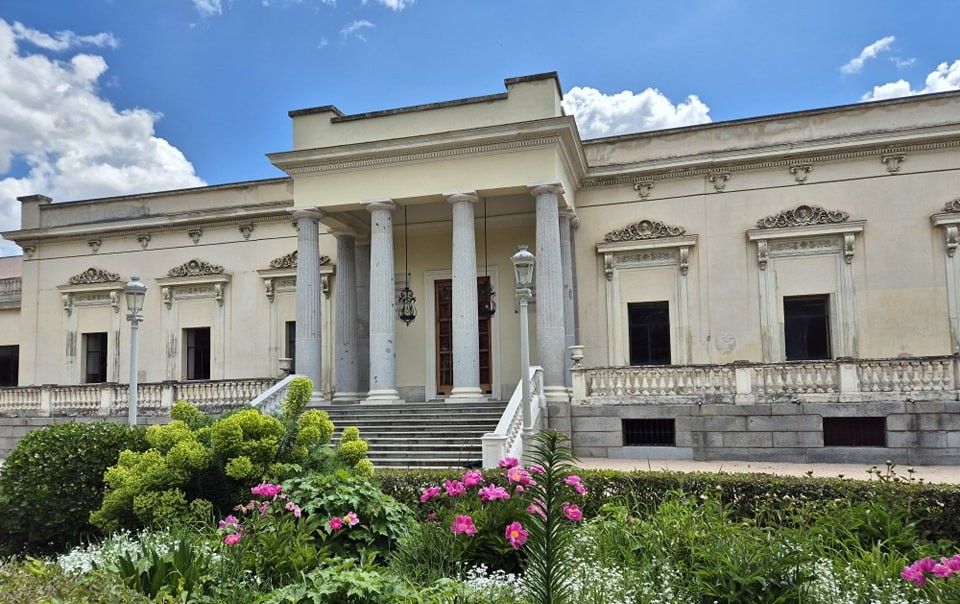
The Palacio de Vista Alegre is a rectangular and symmetrical plant building, with small terraces on its main western side, and organized around three patios. The border is characterized by its great horizontality, including the relationship between its unique height and its length, and its fragmentation into five columns arranged simultaneously, adjacent to the center with a tetrastyle, whose six granite columns were taken from the gallery that surrounded the Plaza de Oriente and demolished at the time for the construction of the Teatro Real. Between 1844 and 1846 the great central hall, designed as a rotunda and covered by a half-sphere dome, inspired by that of the Pantheon in Rome, as well as the magnificent chapel, consisting of a double-height nave, with Corinthian pilasters and lowered arches, and a semicircular apse. Likewise, the main front crowned with a stone parapet, blind in the central and end bodies and with balusters between pedestals in the intermediate ones, topped these and the first with eleven marble busts, plus six life-size statues, with clear references to the Italian Renaissance.
Let me briefly tell you of its main parts starting with the garden most hidden behind a 19C fence at no 179 Calle General Ricardos. The stoves were heated spaces used for growing exotic plants, the great passion of Romantic gardening. The Royal Estate had three: the Great Stove and two smaller ones, as well as a circular orangery, which sheltered the large pots of citrus fruits in winter. It also had two greenhouses that achieved a temperate environment with a glass wall facing south and mat protection. The Queen’s Bath is accessed from one end of the Great Stove. It is a unique circular piece with concentric steps, made of caramel-colored marble. It was fed by the same heat and steam circuit that recreated the tropical climate for exotic plants from other latitudes and the queen used it for her recreation and relaxation… The Old Palace is the building adjacent to the stove and the founding nucleus of Vista Alegre. It was built on the site of the original Bath House, a recreational establishment that, following the fashion of London and Paris, became popular as a leisure spot among Madrid residents. It featured bathing rooms, a casino, lounges, and a rear garden where people could enjoy music and open-air shows. La Estufa Grande (Great Stove) was annexed to the Old Palace, forming a screen that protected the garden from the gaze of passersby. In the mid-20C, the Old Palace was expanded, with the Bella Vista building being added and a gallery being built to connect the two structures. The gallery is made up of two angled corridors raised on a portico of paired columns. The turret on the corner bridges the gap between the two buildings. During the period of the Royal Possession, La Casa de Bella Vista (Bella Vista House) served as a library and science studio with herbariums, collections of stuffed animals, a laboratory, and its own greenhouse. After the estate was transferred to the State, it was transformed to house the Santa Catalina School for the Blind. It currently houses the Vista Alegre Adult Education Center. The stables were built to house draft animals and other work animals, such as the mules for the blood-powered waterwheels. Open-air carriages used for promenades were also kept here. The Statue Square Garden was a varied collection of shade gardens, geometric gardens, exotic plants, and ornamental or rustic gardens. The Romantic Garden, between the Old Palace and the stove, was crossed from east to west by a navigable artificial river almost a kilometer long. Its banks could also be traversed on foot. It ran for 700 meters along a winding path that led to a pond with a star-shaped bastion island, accessible from falúas or pleasure boats. Currently, 400 meters of the estuary are owned by the Community of Madrid, and 300 meters are on the State land occupied by the former Army Orphanage. The New Palace marks two important milestones in the evolution of the farm. The first, in 1832, when Queen María Cristina purchased the land and built it, using the foundations and walls of the warehouses and boiler rooms of a soap factory. And second, in 1859, when the Marquis of Salamanca acquired the Royal Estate, the works were unfinished, and he commissioned the creation of a new façade facing the rear garden and a grand staircase leading from the path leading from the new gate, the famous Puerta Bonita.
A bit of history I like tell us the origin of the Palacio de Vista Alegre is in the estate with a country house of the man who was the doctor of King Charles IV, Higinio Antonio Llorente, who configured it from 1802. After the French invasion, the estate was sold. In 1823 the estate was sold again, which is why the complex was transformed into a public recreational estate and also its baptism with the name of Vista Alegre. Its inauguration took place in 1824 and had a casino, bathhouse and a large orchard and garden, with different games and whims, but soon the business became ruinous, which led its owners to sell it in 1832 to Queen Maria Cristina de Borbon, fourth wife of Fernando VII, who immediately began its enlargement, buying the adjacent estates until reaching 44 in 1836 and 50 fenced hectares. The casino was transformed into a representative palace, complemented by other buildings, most of them scattered throughout the Royal Estate, such as the adjacent Estufa Grande, the once magnificent house of Bella Vista used as an exhibition of stuffed birds and a library, as well as the houses of Dependents, Administration, Trades, Stables, Cows, Silkworms, the Chapel, the Orangery with its aviary in the center, the Games, the Quail, the Pheasant, the Castle Old hidden in the forest, the navigable estuary with its island and the country house of the former Marquis of Negrón called Navarro for an oratory and viewpoint.
Later, the construction of a new palace would begin, known as the Palacio de Vista Alegre. In 1846, the Queen Mother María Cristina de Borbón donated the Royal Estate to her daughters Isabel II and the Infanta Luisa Fernanda, although as its division was impossible, it remained in the hands of the Infanta Luisa Fernanda and her husband the Duke of Montpensier, who decided to sell it in 1859. Thus, in 1859, the famous and powerful lawyer and banker from Malaga, José de Salamanca (after whom the district of Salamanca in Madrid is named), bought it, bringing it to its maximum splendor and creating the Vista Alegre Palace that we know today. He died in 1883 on his Vista Alegre estate. When the Vista Alegre Estate passed to the State, Queen María Cristina de Habsburg decided to 1887, the Vista Alegre palace was used as an Asylum for Work Disabled People, initially under the direction of the Sisters of Charity of Saint Vincent de Paul. Over time, the institution underwent a transformation. It went from the Asylum for Work Disabled People (1889) to the Institute for the Vocational Re-education of Work Disabled People (1922), later to the Institute for Vocational Re-education (1928), and finally to the National Institute for the Re-education of Disabled People (INRI) in 1933. Following this,a new renovation of the building that housed the INRI between 1934 and 1935. Between 1940 and 1943, new renovation and reconstruction of the Vista Alegre palace, the building continued to be used as an INRI, although it was significantly improved. The last major renovation was carried out in 1982, which was intended to give it a new lease of life. Thus, by Royal Decree of April 11, 1982, the INRI became the Public Center for Special Education and Re-education of the Disabled. The palace currently houses the “Las Acacias” Regional Center for Innovation and Training, an agency of the Community of Madrid dedicated to educational innovation and continuing education for non-university teachers.
The Madrid tourist office on the Vista Alegre estate/palace : https://www.esmadrid.com/en/tourist-information/vista-alegre-estate
The Comunidad de Madrid tourist office on the gardens of Vista Alegre palace : https://www.comunidad.madrid/en/cultura/patrimonio-cultural/jardines-palacios-finca-vista-alegre
There you go folks, the enormous memorable sentimental , my dear Madrid. This is as said an off the beaten path site but worth the detour, me think, Again, hope you enjoy the post on the Palacio de la finca de Vista Alegre of Madrid !!! as I
And remember, happy travels, good health, and many cheers to all !!!

 Paris1972-Versailles2003
I’m off to Madrid for a re-visit in March, hopefully I’ll get to see this.
LikeLiked by 1 person
Good for you! me in March will be in London lol !!!
LikeLiked by 1 person
Enjoy!
LikeLiked by 1 person
Thanks you too ::)
LikeLiked by 1 person