
I came across this one picture in my laberynth cd roms vault that should be in my blog for you and me. The tour of Castilla La Mancha is very sentimental and always will remain so, just see the posts. I came upon Tarazona de la Mancha on my road warrior trails and glad have a picture to show the town in my blog, I like again to thank you for reading me over these last 15 years! Therefore, this is my take on this is Tarazona de la Mancha !!! Hope you enjoy the post as I.
The town of Tarazona de la Mancha is in the province of Albacete, in the autonomous community of Castilla-La Mancha of my dear kingdom of Spain, It is 22 km from Villanueva de la Jara, 37 km from Albacete, 55 km from Alarcón, 104 km from Cuenca, and 234 km from Madrid. The town is crossed by the regional highways CM-220 (Cuenca-Albacete), CM-3106 (Munera-Mahora), CM-3116 (Tarazona de la Mancha-Iniesta), and by the local road AB-103, which connects with Villalgordo del Júcar. We came here from Cuenca on the CM 220 road all the way, Time to tell you a bit so here is my take on this is Tarazona de la Mancha !!! Hope ypu enjoy the post as I.
The parish Church San Bartolomé, a Valdeviresque-style doorway and a square bell tower topped by a beautiful slate spire. The church construction began in 1549 and was completed ind 1649. It is covered by a ribbed vault, with ties and slipped, Its construction period spans from 1549 finished in 1694. It is a Renaissance-style temple, which responds to the prototype of the so-called columnar-type Hall Churches, with three naves in five sections, separated by Ionic-style columns, and several attached chapels, and an abundance of arches and groin vaults. The main facade was built in the shape of a triumphal arch. The oval lantern ome with eight openings stands out in the complex, which illuminate the church. It has a varied repertoire of Chapels built at different times. Of greater interest are those built later in the Baroque period, as a result of the construction impulse that arose in the 18C. Highlighting that of San Antonio, of notable dimensions, with a large dome on pendentives, very well organized, and richly decorated. Of particular artistic value is that of Santo Cristo, with a semicircular arch that provides access to the two spaces it is divided into. On the exterior, completed in 1694, the tall tower stands out, topped with a slate spire, well proportioned, with ashlar at the corners and in the arches of its bell tower. The cylindrical spiral staircase starts from its feet. It has two portals, the one facing north, and the one to the south, of a better workmanship. It is inspired by the Classical Triumphal Arches, with pairs of Tuscan columns on both sides. The Chapel of San Antonio, also called the Communion Chapel is of large dimensions and was completed in 1758. It consists of three sections, the central one square and the other two rectangular. The central section is crowned by a dome on pendentives decorated with Baroque rocailles, inside which are paintings of Saint Ambrose, Saint Augustine, Saint Gregory, and Saint Jerome. In 1931, a fire destroyed the old Baroque-style altarpiece and the original images of Saint Bartholomew, the Great Queen, and Christ of Mercy.
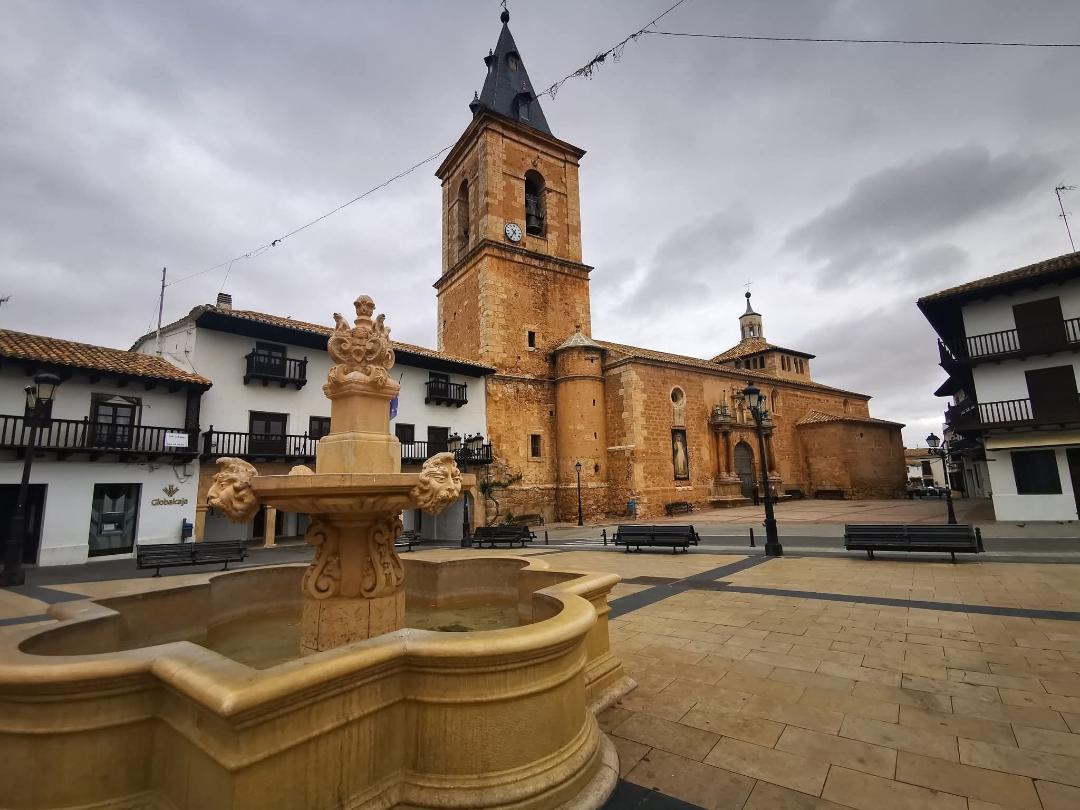
The above church is found in the Plaza Mayor is an architectural complex dating from the 17C and built in the colonial style. It is a rectangular plaza with wooden balconies and wide eaves. It is accessed through four Romanesque-style arches: the Castañicas, Juan y Medio, Chicharras, and the City/Town Hall arches. In one of its corners, the only one where two arches meet, there is a coat of arms of Pope Innocent XI. It was traditional for bulls to enter the plaza through one of these arches, when it was formerly used as a bullring for bullfighting on festival days. In front of the City/Town Hall, it has a monumental fountain made of stone in the Classical style, built in 1928 to commemorate the arrival of drinking water to the town. It also houses the aforementioned City/Town Hall, built in 1692 in the Renaissance style, and is the only building in this square with stone arched arcades.
Other things to see here, me think ,are to take a walk through its streets reveals houses with coats of arms, the hermitage of San Antonio Abad (17C), the curious bullring, dug into a hill.
A bit of history tell us that remains found in a Roman villa located in the place known as “Casa de los Guardas”. In this villa some mosaics have been found that are currently exhibited in the Archaeological Museum of Albacete . There is also a Roman bridge over the Valdemembra River as it passes through the town. It seems that it was part of an ancient road that crossed the town. The bridge is currently in use and is quite well preserved. During the Late Middle Ages, the lands of the Tarazona were part of the Council of Alarcón,(see posts), until in 1476 they became part of the Marquisate of Villena . The current town was founded by residents of Villanueva de la Jara (see posts) on an old hamlet called “Casas de Cuarto Alto” in the mid-15C. It was Felipe II who granted it the privilege of a town on October 11, 1564, giving it jurisdiction up to the Júcar River. In 1779 it was granted the privilege of holding a tax-free weekly market. After the Peninsular War,(aka independance) provinces were created, and Tarazona de la Mancha became dependent on the bishopric of Cuenca. In 1833, an administrative reorganization took place and the town was integrated into the province of Albacete. Until the reform of municipal nomenclature in 1916, the town was simply called Tarazona. On that date, its name was changed to Tarazona de la Mancha. During the Spanish Civil War, the town was home to one of the bases of the Abraham Lincoln Battalion of American volunteers who fought alongside the Republican side. On October 16, 1937, the barracks received a visit from U.S. Congressmen Jerry J. O’Connell and John Toussaint Bernard, (both of leftist orientation) who were received with a parade of brigade members through the town square and, in turn, gave speeches.
The town of Tarazona de la Mancha on the Church San Bartolomé : https://tarazonadelamancha.es/iglesia-de-san-bartolome/
The Castilla La Mancha regional tourist office on Tarazona de la Mancha : https://en.www.turismocastillalamancha.es/patrimonio/tarazona-de-la-mancha-90931/descripcion/
There you go folks, a wonderful deep town in the wonderful Castilla La Mancha region, , this is quant, historical Tarazona de la Mancha. Again, hope you enjoy the post on this is Tarazona de la Mancha !!! as I.
And remember, happy travels, good health, and many cheers to all !!!

 Paris1972-Versailles2003
so gorgeours! ♥
LikeLiked by 1 person
Yes thank you for stopping by. Cheers
LikeLiked by 1 person