
I like to tell you more of this wonderful district of my dear Madrid, I found one picture in my cd rom vault and combine with others in my blog will like to tell you about my 2nd most favorite district of Madrid!!!This is the northern section of the city and the district of Chamberi. My dear Madrid has 21 districts that in turn are grouped into 129 barrios or neighborhoods. Therefore, let me tell you about this is Chamberi of Madrid !!! Hope you enjoy the post as I,
Chamberí is one of the twenty-one districts of the city of Madrid. It comprises the six barrios or neighbourhoods of Gaztambide, Arapiles, Trafalgar, Almagro, Ríos Rosas and Vallehermoso. Located in the center of the city, it is bordered by the following streets and squares: to the west: Calle de la Princesa, Calle Juan Meléndez Valdés, Calle Archpriest de Hita and Calle Isaac Peral, the Plaza de la Isla de Alborán and the Avenida Juan XXIII; to the south, the Calle Alberto Aguilera, calle Carranza and calle Sagasta, the Plaza Alonso Martínez, the Calle de Genoa and the Plaza Colón; to the east, the Paseo de la Castellana; and to the north, Avenida de Moncloa and Avenida de la Reina Victoria, the glorieta de Cuatro Caminos intersection and Calle Raimundo Fernández Villaverde.


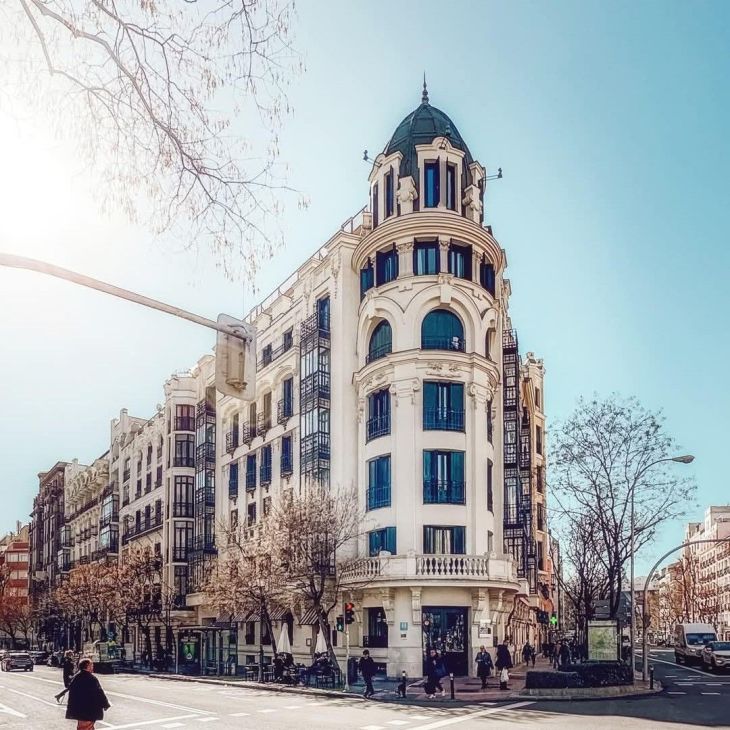
Some of the landmarks here are the old Residencia de Señoritas is an university institution and the first official institution to promote university education for women in Madrid. Created in 1915, the Residence ceased to function at the end of the Spanish Civil War in 1939. The José Ortega y Gasset-Gregorio Marañón Foundation is a private institution dedicated to the Social Sciences and Letters. The foundation was created in 1978 by Soledad Ortega Spottorno, daughter of the philosopher José Ortega y Gasset. Its objective is to disseminate culture, education and research. Its headquarters are located at 53 calle Fortuny; the building is the former Residencia de Señoritas But his district has a lot more I give you a rundown for you and me, The picture to show this post is at Calle de Luchana no 22 corner with Calle de Francisco de Rojas,the One Shot Hotel buidling, across street to metro Bilbao line 1 and 4, and bus no 147.
The name of Chamberi has some hypothesis ,according to some historians, during the Dos de Mayo uprising (May 2, 1808), the French troops of the Chambery regiment of Napoleon I had established a cantonment in the current location of the Plaza de Chamberí (which gave its name to the district). Another version is that Maria Luisa Gabriella of Savoy, wife of King Philip V of Spain, who had grown up in Chambery, liked to stroll in this place, outside the Puerta Santa Barbara gate, which reminded her of the Savoyard ducal city. Finally, the name of Chamberí can also be associated with Maria Barbara of Portugal, wife of Ferdinand VI of Spain, who was the promoter of the creation of the Convent of the Visitation, known as the Convent of the Royal Salesians, today the seat of the Supreme Court of Spain and located just outside the limit of the district of Chamberí. This convent was originally occupied by Salesian sisters from Chambéry (France).
Chamberi is one of the most typical districts in Madrid, as evidenced by numerous plays, sainets and zarzuelas, but it is also one of the most prestigious, having hosted writers and artists since the beginning of the 20C. Its lively squares, monuments and picturesque corners invite us to discover it. the Plaza de Olavide, in the heart of the barrio Trafalgar or neighbourhood, the Quevedo roundabout, where a statue of the famous writer of the Golden Age stands. The Plaza de Chamberí itself, in addition to a bandstand, we can see the bust of the comic actress Loreto Prado, which is a replica of the last public sculpture by the sculptor Mariano Benlliure. The monument that presides over the Plaza de los Chisperos is a tribute to the authors of playlets. It is topped by a chispero, a manola and a typical couple of 19C Madrid, below which are the busts of Ramón de la Cruz, Chueca, Ricardo de la Vega and Barbieri. The red cabin that is a replica that pays homage to a mythical film, filmed in a private courtyard between Calle Rodríguez San Pedro and Calle Arapiles, the spot where this very particular cabin is now located. A few steps away is the Plaza del Conde del Valle de Súchil, where a sculpture of the last conscripts of the Philippines stands, a detachment of soldiers who resisted the siege of Baler, on the island of Luzón, an event that marked the definitive loss of the Spanish colonies in 1898.
Some of the names that lived here were Benito Pérez Galdós lived on Calle Hilarión Eslava , while Pablo Neruda resided in the famous Casa de las Flores on Calle Rodríguez San Pedro. Chamberí has also hosted other great figures of Spanish literature, such as Vicente Aleixandre, Luis Cernuda, Gerardo Diego, Carmen de Burgos, Camilo José Cela, and even the young Fernando Fernán Gómez Joaquín Sorolla, the master of light and one of the great names in 20C painters, also lived there. What is now his museum was his last home (see posts). Closed until 2026 for a long renovation, it is the Geominero Museum (Calle Ríos Rosas, 23) that today serves as the neighborhood’s main cultural center. This museum is housed in a magnificent building, with a central room filled with carved wooden display cases and decorated with a large glass roof that rests on a wrought iron and lead structure. Minerals, rocks and fossils remind us of Spain’s precious geological and paleontological heritage. The building that houses the Sala Canal de Isabel II (Calle Santa Engracia, 125) is also imposing. Built between 1907 and 1911, it was the first elevated water reservoir in Madrid. A former neoclassical palace houses the María Cristina Masaveu Peterson Foundation ( Calle Alcalá Galiano Street, 6), which has an impressive art collection, especially contemporary art with works by established artists and up-and-coming creators. Another establishment that never fails to amaze visitors with its exhibitions is the Casa de México en España Foundation (calle Alberto Aguilera 20), which offers everyone the chance to learn a little more about Mexican culture and traditions, The Almagro neighborhood, between Paseo de la Castellana and Las Salesas, is one of the most beautiful in Madrid, with mansions with majestic façades, old palaces, some of which have been converted into hotels, such as the Santo Mauro, a Luxury Collection Hotel (Calle Zurbano 36) lush garden, or mansions with a glorious past, such as the Beti Jai (Calle Marqués de Riscal 7). A journey through time also takes us to the Chamberí train station at Plaza de Chamberi opened in 1919, it was part of Metro Line 1, but was closed in 1966 due to the impossibility of extending its platforms, as required by the customs of the time. Going down the stairs, you enter a historic tunnel whose interior, walled up on the outside, has been preserved almost intact. The Maudes Palace (Calle Raimundo Fernandez Villaverde 18), a hospital for day laborers. Its turrets and masonry are reminiscent of the Cibeles Palace, but the clarity of the construction of the facades evokes the major influence of the Vienna Secession. the Teatros del Canal (Calle Cea Bermudez. 1), in a modern monument, the Teatro de La Abadía (Calle Fernandez de los Rios 42) housed in a former church, the Teatro Amaya (Paseo del General Martínez Campos,9), the Teatros Luchana (Calle Luchana 38) and the Teatro Quique San Francisco (Calle Galileo 39), named after a much-loved comedian, Parque Santander park comes alive after dark with live concert venues such as Galileo Galilei (Calle Galileo, 100) or Clamores (Calle Alburquerque. 14).
The Madrid tourist office on Chamberi: https://www.esmadrid.com/en/madrid-neighbourhoods/chamberi
There you go folks, now you got you covered on this wonderful area of Madrid, You know me, this is from Madrid to Heaven, and a hole in the sky to look down on it every day , Again, hope you enjoy this post on this is Chamberi of Madrid !!! as I.
And, remember, happy travels, good health, and many cheers to all !!!

 Paris1972-Versailles2003