
We were back to my dearSpainagain !! love it !! We came by car of course and took time to see old repeat as could not be in Spain without stopping in my Madrid! I came again with my boys and dog Rex, and it was a thrill as usual! I like to tell you more of Madrid, Therefore, let me take you more of the Church de las Calatravas of Madrid !!! Hope you enjoy the post as I.
The Church of the Calatravas responds to the convent typology of the Spanish Baroque, characterized by volumetric and decorative simplicity. On the ground floor, the church presents an intermediate solution between the basilica and the central layout. The preference of military orders for centralized spaces is striking, perhaps as a demand or need for certain rites or ceremonies that are known, such as the investiture of new knights. In the 19C, the king consort Francisco de Asís ordered the entire exterior of the church to be decorated in a romantic fashion, In this way, the façade main one, recalling Calle de Alcalá, presents today an ornate appearance, with grouped pilaster strips, scallops, cushioning, graffito, and a curious cornice with stiff taps, all in a Neo- Plateresque style that contrasts strikingly with the architecture. Omnipresent both outside and inside the church is the Cruz de Calatrava, very visible in the rose window that crowns the entrance, formed by a semicircular arch flanked by very flat pilasters with grottoes, the ensemble ending with a niche with a statue of the Virgin.
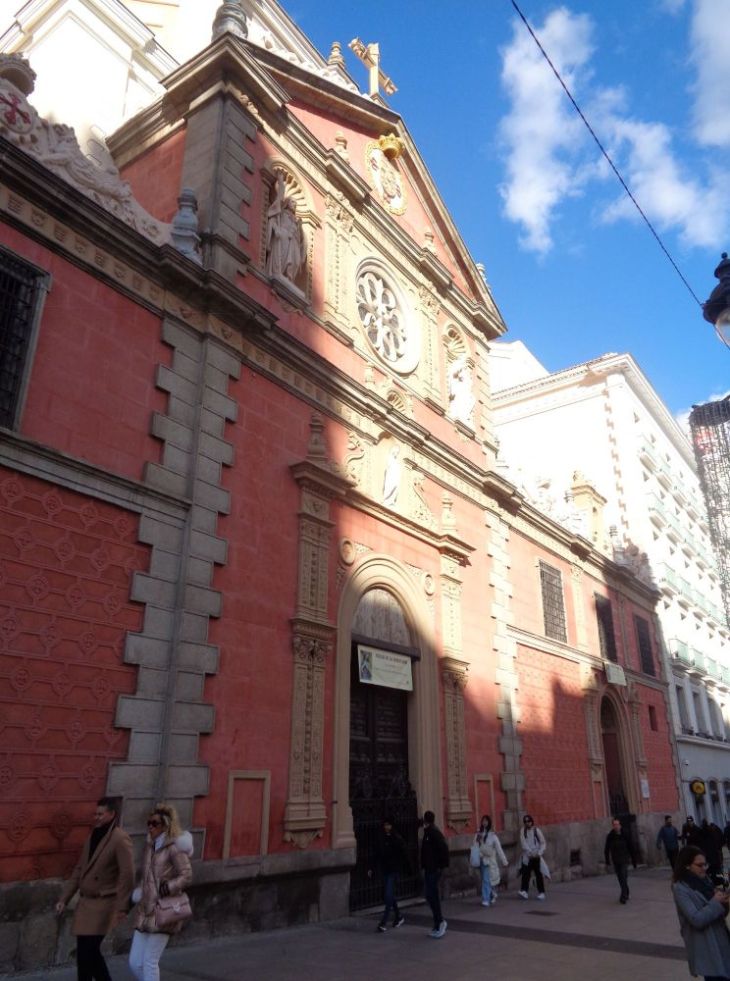

The Iglesia de la Concepcion Real de Calatravasor simply Iglesia de las Calatravas or the Church of the Calatravasis the only surviving part of the old Concepción Real convent, of the commander nuns of the Order of Calatrava, located at the beginning of one of the most important streets in Madrid, Calle de Alcalá, a short distance from Puerta del Sol. Omnipresent both outside and inside the church is the Cruz de Calatrava, very visible in the rose window that crowns the entrance, formed by a semicircular arch flanked by very flat pilasters with grottoes, the ensemble ending with a niche with a statue of the Virgin.
The interior of the Church de las Calatravas is characterized by its luminosity and decorative exuberance The space of the main chapel is perhaps the most outstanding part of the church. The front of the same occupies a spectacular altarpiece made of gilded and polychrome wood, which makes a pendant with two smaller ones. There is a wonderful retable master altar as well. Inside the church a ceremony of the military order of the same name takes place. Its knights, dressed in their distinctive habits, file past the main altar, illuminated by candles that an altar boy hastily lights. Behind them are the priests and the crowd witnessing the event. The main altar, designed by Churriguera, is clearly visible, featuring sculptures of Saint Diego Velázquez, Saint Benedict, and Saint Bernard. The altarpiece is crowned by the Immaculate Conception and the Savior in glory, flanked by angels. Also visible are the paintings in the pendentives, painted during the reign of Carlos (Charles) II, depicting the Evangelists and the coat of arms of the order held by cherubs, and in the nave, with a Coronation of the Virgin set into one of its sections. The side altar is dedicated to Saint Joseph.

A bit of history I like tell us that the convent is inseparably linked to that of the Calatrava Military Order, founded in the 12C to defend the Christian possessions in the south of the peninsula from Muslim attacks, within the framework of the Reconquest. They soon had female equivalents, of a monastic character, in order to welcome the wives and daughters of those who went to war in the monasteries, and the vocation to help the mission of the Christian knights through prayer and penance. In this way the religious commendators of Calatrava arose, as a feminine branch of the Order of the same name. The nuns of Calatrava in Madrid had first occupied a convent in Almonacid de Zorita province of Guadalajara, a town closely linked to the history of the Order, but in 1623, seeking proximity to the Court, they moved the house to Madrid by order of king Felipe IV . The convent and church buildings were built at that time, soon becoming one of the most popular and crowded religious centers in Madrid. All that splendor lasted just two centuries. Finally, although the convent building was destroyed, Queen Isabel II had it rebuilt in 1872. Already converted the convent church into a parish, luck wanted it not to suffer too much from the vicissitudes of the Spanish Civil War, keeping its interior almost intact. However, lack of maintenance led the monument to a state of serious deterioration during the last decades of the 20C. Finally, at the beginning of the 21C, an ambitious program was undertaken that included intervention both on the external and internal parts of the Church de las Calatravas. Currently, the church is open to visitors outside the hours of liturgical celebrations.
The official Church de las Calatravas: https://iglesiacalatravas.com/
The Madrid tourist office on the Church de las Calatravas : https://www.esmadrid.com/en/tourist-information/iglesia-de-las-calatravas
There you go folks , another wonderful nostalgic, sentimental trip to my dear Madrid , always nostalgic sentimental words cannot describe it ! This is a vibrant cosmopolitan cities of friendly faces and smiles to share in long conversations about life and more ; I love it, We will be back ,eventually!, Again, hope you enjoy this post on the Church de las Calatravas of Madrid !!! as I
And remember, happy travels, good health, and many cheers to all !!!


