
I like to tell you again about my road warrior trails in my dear Spain. Again, found me some older paper pictures of nice Vitoria-Gasteiz in the Basque country, glad I did find it and will need to show it to the world, I like to do justice to the place and give you an introduction, Therefore, here is my take on this is Vitoria-Gasteiz !!! Hope you enjoy the post as I.
The City of Vitoria-Gasteiz is the capital of the province of Alava and the Autonomous Community of the Basque Country (Euskadi), There are plenty of roads around here and in the last years, my route to my dear Spain, The old Ni 1 Madrid -Irun was taken once early on. The A-620 Vitoria-Gasteiz-Altube and its connection with the A-68 Logroño-Bilbao; And the new AP-1 highway taken lately between Vitoria-Gasteiz and Eibar ,The city is connected to Bilbao, Saint-Sébastien, Pamplona, other regions of northern Spain and Madrid by this highway, The Madrid-Irun line train passing through Vitoria-Gasteiz is one of its most important stops. Half a dozen trains connect the city every day with the capital of Spain, by the Alvia service which, via Valladolid, uses the infrastructure of the Alta Velocidad Española or AVE (for info never taken).
The Plaza España or Nueva is a large square made up of porches done in 1791 and designed to connect the Casco Antiguo (old district) with the new Ensanche (new extension), then under construction. One of the most important elements of the whole is the Casa Consistorial (City/town hall), of neoclassical decoration. it is one of the most outstanding works in the history of Spanish main squares. It was designed as a perfect square where its sides measure 61 meters and which forms part of the neoclassical expansion of the city away from the almond-shaped medieval quarter. Come along on a Sunday morning to have a look at the stalls of collectibles or to swap collectible cards.
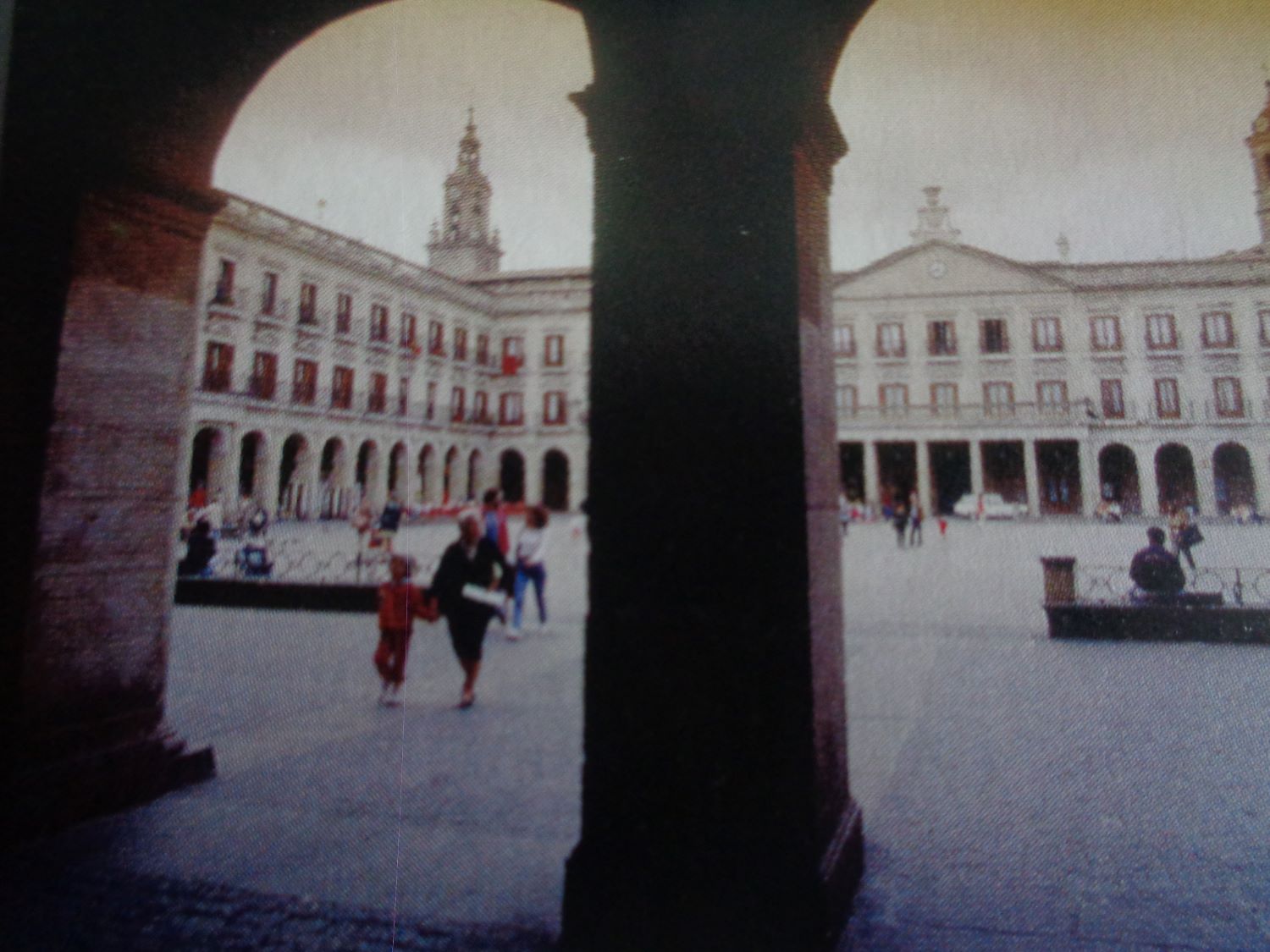
The Plaza de la Virgen Blanca is the city’s nerve center. There confluence one of the most typical streets as the Casco Antiguo and the Ensanche and it is surrounded by old houses with glass belvederes. The monument to the Battle of Vitoria in its center, is a large sculptural set made of stone and bronze, Commemorating that on June 21, 1813, the victory in Vitoria-Gasteiz of the allied troops (composed of Spaniards , English and Portuguese), commanded by General Miguel Ricardo de Álava and the Duke of Wellington, was the beginning of the final withdrawal of the French troops of Spain and the return of the crown to Fernando VII, confirmed after the treaty of Valençay of 1813.
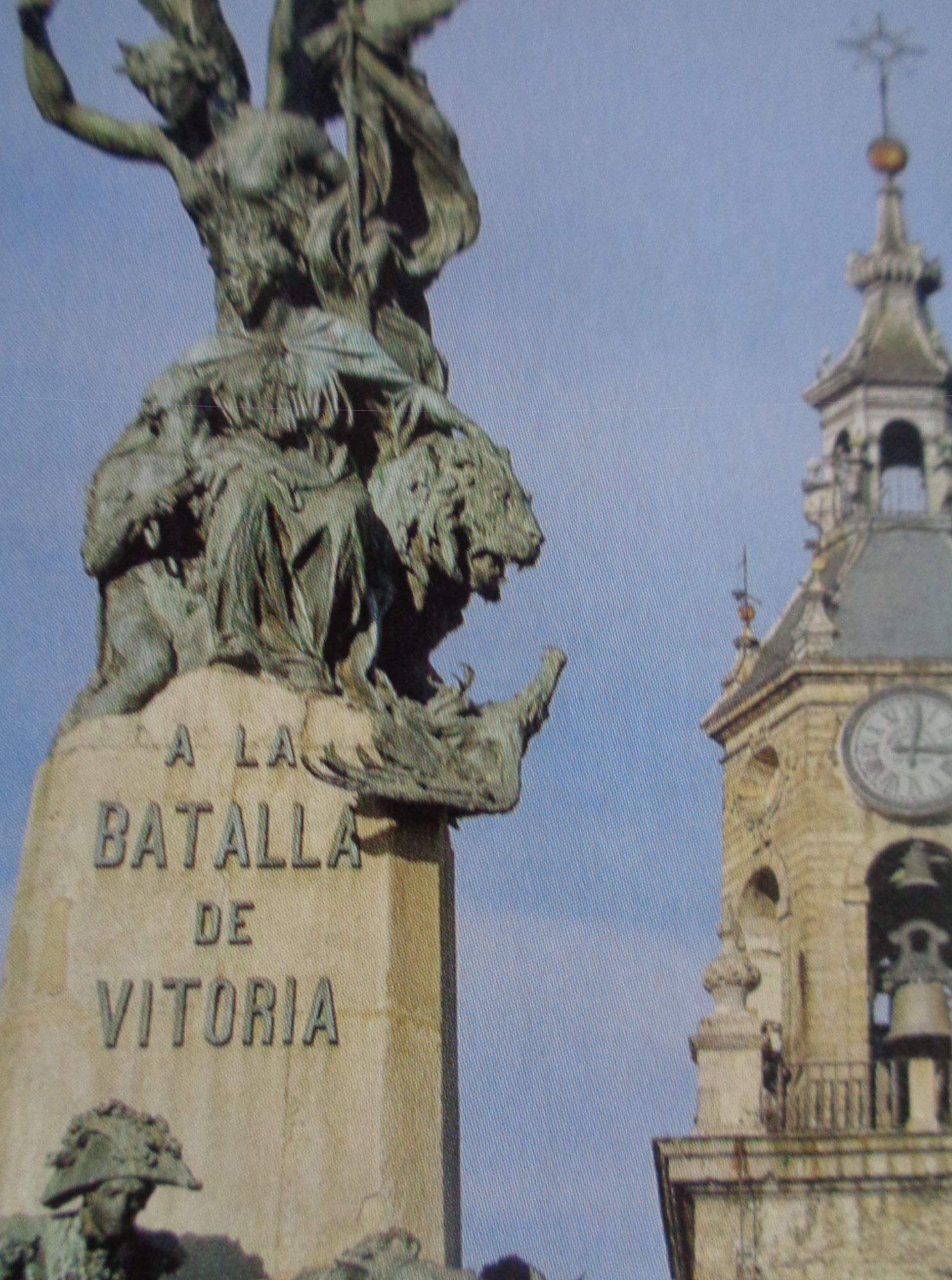
Other things to see here, me think, are : the Cathedral of Santa Maria (old cathedral). 14C Gothic cathedral with a 17C tower. Under the porch are three portals decorated with statues and reliefs. Inside, the chapels contain Gothic, Flemish and Italian Renaissance statues. In the chapels of the left you can see paintings from Rubens and Van Dyck. The Cathedral of María Inmaculada de Vitoria (New Cathedral) built and devoted to the 20C, of neogothic style. The Casa del Cordón ,located in calle Cuchillería is a fine example of Civil Gothic architecture. It was built in the 15C and has a 13C tower. In this house, the Catholic kings were accommodated, and Adrien VI was named Pope when he was in the latter. Its permanent collection is considered one of the best and most important in contemporary Basque and Spanish art. It was inaugurated on April 26, 2002 and is an open and dynamic museum. The Diocesan Museum of Sacred Art of Alava. It is located in the strolling space of the New Cathedral, offers samples of the religious artistic heritage of the province, divided into sections of stone sculpture, wooden sculpture, wood painting, canvas, goldsmithery and liturgical furniture. The Alava Armory Museum, in which we can see weapons of all eras, from prehistoric axes to the pistols of the 20C. There is a large collection of medieval armaments and the reconstruction of the battle fought in Vitoria in 1813 during the War of Independence.
A bit of history tell us that in a document from the San Millán monastery of Cogolla dating from 1025, we find the form “Gastehiz” for a name of this city after the fall of the Roman Empire, several tribes of northern Europe settle in the Central plateau area. It is then an area at the margin of the Visigoth domains in the south and Francs to the north. Tradition affirms that the city called “Victoriacum”, founded by the Visigoth Léovigild King in 581, would correspond to the current city ,but the Wisigothe or Frankish influence is not significant in this area. The toponymy of all this region rather demonstrates the presence of Basque tribes, In 1181, King Sancho VI of Navarre, known as the Sage, rebuilt the city in the village of Gasteiz, changing the old name by that of “Nueva Victoria” In 1200 , Vitoria is incorporated into the Castile crown, taken by the troops of King Alfonso VIII, which endowed it with its first Gothic extension to the west.Alfonso X The Sage extended it in 1256 to the east with new streets. In 1431, King John II of Castile granted it the title of city. On January 22, 1522, Adriaan Florensz, who was at that time in the city, hosted in Casa del Cordón, had been elected as a new pope 13 days earlier. The future Adrien VI will remain in the city a little more than a month, exercising the Regency of Spain and preparing Navarre in defense against the French invasion. In 1615, on the occasion of royal marriages, were hosted In the city, Anne of Austria, Queen of France, and Élisabeth de France, spouse of the future Philippe IV. During the Roussillon War (1793-1795), Vitoria-Gasteiz, as well as a large part of the Basque Country, was occupied for a short period by French troops, which went to Miranda de Ebro. This occupation ends with the Treaty of Basel which puts an end to the conflict. On April 13, 1808, Fernando VII is housed in Casa Consistorial while he was heading for Bayonne, where the famous interviews will take place. (The abdication of Bayonne or interview took place on April 30, 1808 between Napoleon I, Charles IV of Spain, Ferdinand VII and Manuel Godoy, Choosing his own candidate, Joseph Bonaparte, his older brother, for the Spanish throne.) The Battle of Vitoria on June 21, 1813, during which French troops, withdrawing, were defeated by the Duke of Wellington, losing on the road to Altsasu (Navarre), almost all the booty stolen from the Spanish. This battle practically ended the Spanish War of Independence. At the end of July of the same year, in Vienna, Johann Nepomuk Mälzel charged Ludwig Van Beethoven to write the composition of a symphony on this battle. This is opus no 91 Wellingtons Sieg or Die Schlacht Bei Vitoria or Siegessymphony.
The City of Vitoria-Gasteiz on its heritage : https://www.vitoria-gasteiz.org/we001/was/we001Action.do?idioma=en&accionWe001=ficha&accion=turismo
The Basque country (Euskadi) tourist office on Vitoria-Gasteiz : https://tourism.euskadi.eus/en/top10/towns/vitoria-gasteiz/webtur00-recursostop/en/
There you go folks, another wonderful spot in my road warrior trails of my dear Spain, This is architecture, history and a lot more ;the quant, gem of Vitoria-Gasteiz, worth the detour , me think, Again, hope you enjoy this unique post on this is Vitoria-Gasteiz !!! as I
And remember, happy travels , good health and many cheers to all !!!

 Paris1972-Versailles2003
Another of my favourite places
LikeLiked by 2 people
Yes I know and a lot of other people for me was just passing. I go just outside again next month. cheers
LikeLiked by 2 people
Lucky you
LikeLiked by 2 people
Just knowledge of the roads of Spain ::)
LikeLiked by 2 people