
Another wonderful experience in my beloved Spain. Driven by it so many times eventually several years back decided to come in and it has been a stop ever since. Jaca in the heart of Aragon! This is a post done out of other older ones which I combine into one with new text and links for you and me, Of course, plenty more written on Jaca in my blog. The City is in the province of Huesca, and autonomous community of Aragon ,kingdom of Spain Therefore, here is my new take on curiosities of Jaca !!! Hope you enjoy this post as I.
The Seminario Diocesano or Diocesan Seminary was built during the third decade of the 20C, at an important moment for urban planning in Jaca. The story goes that from 1610 different seminaries followed one another in the city of Jaca, but it was not until 1860 when the old Conciliar Seminary of the Immaculate Conception was officially inaugurated. This building was located on Calle del Carmen and was destroyed by a great fire in May 1924. That same year,a project for the construction of a new seminary, in the western area of the Ensanche, in a place that it allowed the Diocese to acquire large plots of land in a place close to the old city center.

The layout of the Seminario Diocesano is made up of a ground floor and two floors in height. Its façade is divided into three large forward and raised bodies, between which two small transition elements are located, which provide the ensemble with continuity. The entire main façade is articulated on the basis of large openings framed by rectangular section pilasters, which run through the building in height. These openings are culminated by arches of very different making and proportions: lintels, semicircular, edging, panels, lowered and pointed, in mitre or pediment. This compositional alternation manages to give said façade a mobility and variety that contrasts powerfully with the uniformity of materials used in it. The new building was finally inaugurated in February 1926.

Unfortunately now has permanently closed, here for the memories of our visit, In its place is planned a first -class tourist complex that will include a high luxury hotel ,a hospitality school of the highest international level and a check -up clinic with recognition at the forefront of world medical technology. All this is pending approvals and burocratic red tape since 2022,
The city of Jaca on the Seminario Diocesano: https://www.jaca.es/turismo/monumentosymuseos/seminario-diocesano.html
And I continue my journey with the Monasterio de Santa Cruz, with a bit of history I like tell us that in 1555 the nuns of the Monasterio de Santa Cruz de la Serós (Sorores) moved to Jaca, at the behest of king Felipe II, building the monastery commonly called “de las Benitas”. The underground Church of Santa María was known as that of San Salvador and is a room covered with a vault and which was decorated with Romanesque paintings. The Church of San Ginés, was ceded to the nuns by the brotherhood of San Ginés in 1579. Only the Romanesque door remains of its origins, the whole inside it has remained, for 450 years, the best full Romanesque tomb that has been preserved in the Iberian Peninsula. The famous sarcophagus of the Countess Doña Sancha, daughter of King Ramiro I of Aragon, brought to Jaca from Santa Cruz de los Serós in 1622 ; been the best preserve romanesque tomb in Spain , The order of Benitas of sisters were in charge of the place before the reformation of 1730; the ceilings were painted al fresco in 1862.

Currently the sarcophagus has been moved to one of the rooms of the Colegio de las Benedictinas, suitable to create a small museum in which in addition to being able to admire the tomb in all its splendor, it will be accompanied by eight panels of the Romanesque paintings of the Church of San Ginés, which until now were in the monastery’s private oratory and photos of the Renaissance cloister, closed to the public.The tomb is made of stone and on its sides it presents respectively a chrisom and a pair of opposite taps. On the back, chivalrous scenes are represented that look different. On the front is an allegory of the Countess’s soul represented by a naked girl carried by two angels to heaven. Two scenes of the deceased are presented on the sides as seated abbess and in a pontifical ceremony. The Monasterio de Santa Cruz is located at the eastern end of the old town, attached to the only section of the old city wall, demolished at the beginning of the 20C.

The city of Jaca on the Monasterio de Santa Cruz: https://www.jaca.es/turismo/romanico/monasterio-de-santa-cruz-monjas-benedictinas.html
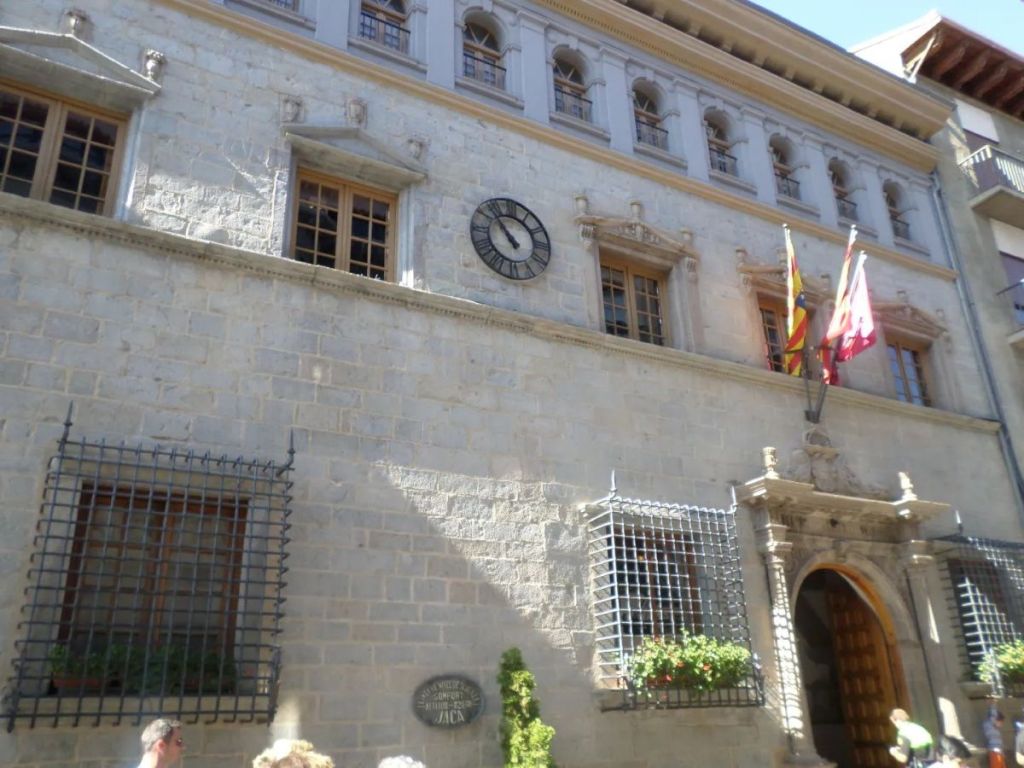
The City/Town Hall of Jaca has a history since 1486, there is evidence that in this urban route the civil power was located since at that time the Council acquired the necessary lots for building the primitive City Council. Inside that building, the municipal historical archive is preserved today, where documents are stored from 1042.Paraciorally, in full rebirth, in 1544, it was agreed to expand the old headquarters of the Council with the construction of the building that is seen today in day. Renaissance style inside. In the lower body opens the magnificent cover that shows the splendor of the stallsman presided by the city shield. In the second body, the noble plant opens five windows whose frontons contain the Aragon bars. In this plant, one of its interior rooms remembers with its name the council of one hundred, formed by one hundred good men who helped govern the city since 1238. The third body, which was added to the beginning of the 20C, when the old Alero, forms a typically Aragonese gallery of windows. The City Council, in addition to being the headquarters of the local government, also guard an important cultural heritage: the sculpted eardrum coming from the Romanesque hermitage of Sarsa and dated in the 12C, the famous book of The 13C chain, the bells of the clock tower made by Bartolomé de la Rosada in 1595 and some solid silver parade maces of the 16C.
There is a street of the old jewish quarters such as Calle de Ferrenal and Calle de Cambras panels show you the history as you walked.
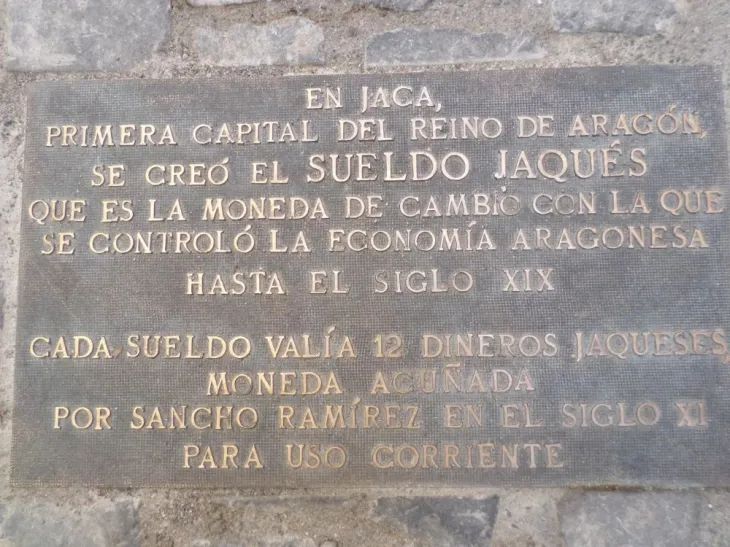
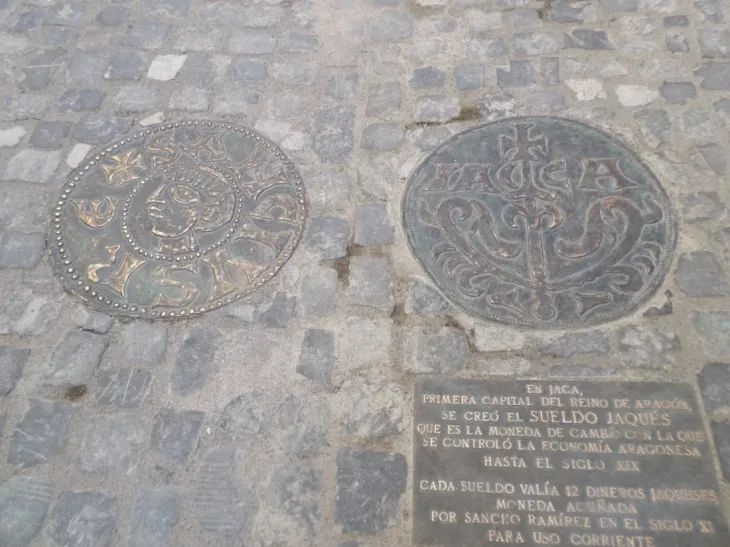
The old coins and money of Aragon is shown on the pavement of Calle Mayor with a plaque to explained it in Spanish.
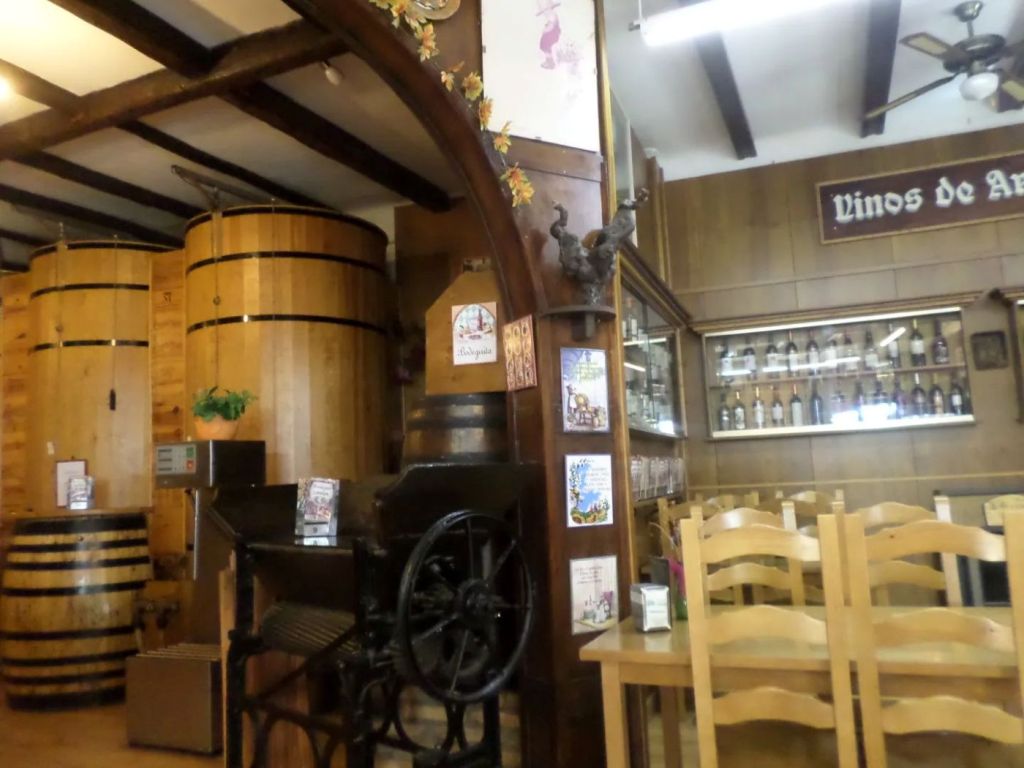
We had some goodies for later and wines from Somontano like the Enate again at Bodegas Langa, Plaza de San Pedro, no 5. Lots of canned gourmet goodies like ham Teruel, cheeses of Roncal, and wines of Lalanne as well. Great, happy ::) The Bodegas Langa is located in the historic center of Jaca, in front of the Cathedral and on the ground floor of a building from the end of the 19C; in this old warehouse dedicated to selling bulk wines since 1930, which has evolved according to current demand and that all kinds of spirits can be purchased, both national and imported and artisans from the area. However, the family is all over and indeed have a great winery in Calatayud near Zaragoza.
It all began in 1867 when the family of Mariano Langa Gallego after returning from the war in Cuba in 1898 (that led to Cuban independance) developed the business but it was after the follow up of the family in Juan Langa Mariscal that a winery business often from others took place. In 1940 Sebastian Langa Langa conserving wineries in Morata de Jiloca,Calatayud and Jaca with a big business with France. By 1967 Juan Jose Langa Fuentes and sister Maria Teresa Langa Fuentes gave the most important push to the business in its history installing the bottling company in 1954 and founding in 1989 the DOP Calatayud (Denominacion de origen protegida) ,and recognised as historic bodega by DOCAVA (the regulatory org of sparkling wines). Today Juan and Cesar Langa Gonzalez fifth generation of the family keeps along the 150 years of history of Bodegas Langa. The official Bodegas Langa : https://www.bodegas-langa.com/
A bit of history of Jaca tell us that Iacca was inhabited by the Iberian people of the Iceta, was the first fortress conquered by the Romans in Hispania. Jaca was the first capital of the Kingdom of Aragon, the first city that acclaimed King to Ramiro II the monk, the first city that revolted in favor of the Republic in 1930. Jaca is for all this a unique city, sung by own and strangers, an exciting world visited by kings and pilgrims, an engine of progress to which the Spanish monarchy ended up awarding – in the 17C with the titles of very noble, very loyal and very winning city of Jaca.
The Jaca tourist office:https://www.turismojacetania.com/oficina_turismo.php
A good unofficial tourist site on Jaca : https://www.jaca.com/turismo.php
The Huesca Province tourist office on Jaca: https://web.huescalamagia.uk/medieval-villages/i/71790013/jaca
The metro area Jacetania on Jaca history/heritage: https://www.turismojacetania.com/lugares.php?idio=en&Id=120
The Aragon region tourist office on Jaca:https://www.turismodearagon.com/en/ficha/jaca/
There you go folks, a wonderful, terrific, no words combination to see in Jaca. There are many others do see my blog ! Again;hope you enjoy this post on the curiosities of Jaca !!! as I
And remember, happy travels, good health and many cheers to all !!!


