
This is a memorable post that I enjoy to revive many events in my life while living and visiting my dear Madrid. This is using new text and links with older pictures from my vault. Many beautiful years and many returns, and still again back this year twice ! Love it ! I have written on different transports but this is just on the metro, Therefore, here is my take on the metro of Madrid, part I !!! Hope you enjoy it as I.
The ticketing choices are endless but will just do the basic here, if questions , ask me ! Until 31 December 2024, inclusive, a reduction of 50% is applied to 10-trip tickets and and 60% for the 30-day Transport Season Ticket. A Single Ticket, once loaded on any card, must be used on the day of purchase. For 10-Journey Tickets, one Public Transport Card can hold up to two 10-journey tickets with a maximum of 20 journeys of the same ticket type. They are ,also good for the bus, For visitors with children, this bit of info : the Children’s Public Transport Card is free of charge and is intended for children aged between 4 and 6 years old. With this Card, children can use all the public transport services of the Community of Madrid free of charge during the validity period of the card, which expires on the day when they turn 7. Children under the age of four may travel without a ticket. The card must be validated by the readers on the operator’s equipment.
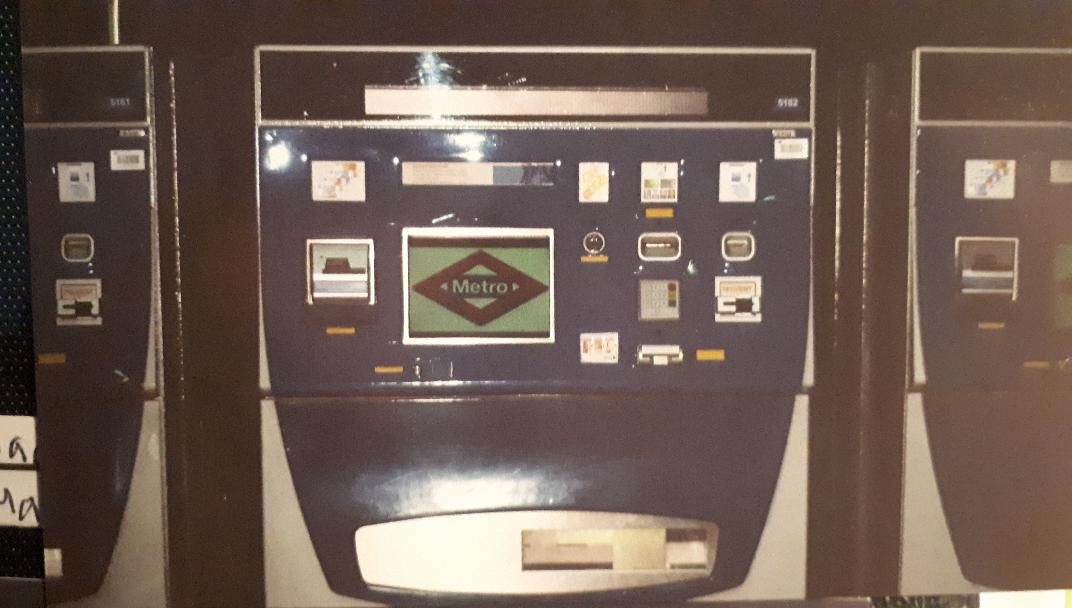
And a bit on those from the airport as already done a post on it but goes along with this post too, The Adolfo Suárez Madrid-Barajas International Airport currently has four terminals. Metro de Madrid is conveniently accessible from any of them using the two stations located at the airport: Aeropuerto T1-T2-T3 Station and Aeropuerto T4 Station, both on Line 8, To travel on Metro de Madrid, you must have a Public Transport Card (TTP) loaded with a valid ticket type for the journey you wish to make. Multi Public Transport Card. This card can be purchased from the ticket machines at any Metro station. The price of the card is 2.50€.The Multi card is a multi-personal, reloadable, contactless public transport card which is valid for ten years that can be used in conjunction with different types of tickets. Several persons can use the card as we do less costly, me think.

Metro de Madrid has a Customer Service Centre at the Sol metro station that also sells official Metro products, where you can purchase different gift items with designs related to the Metro. It has another store in the Customer Service Centre of the Plaza de Castilla metro station, located on Paseo de la Castellana, 189. There are 12 Metro lines with the most useful for the visitors are line 1 ,2,3,4,5,6,8 (airport), and 10.

Some artsy works in the Metro de Madrid just nice are : the Atocha, considered to be the Estacion del Arte or Art station as its corridors, platforms and foyers display 36 works from the leading museums in Madrid: the Prado, the Reina Sofia, and the Thyssen-Bornemisza museums. By means of large format vinyls, you can discover and enjoy the work of some of the leading artists in history. At Sevilla station, the remains of an old commercial panel were uncovered, which have been maintained for the enjoyment of visitors. An advert for Carabaña soaps dating back to the time when the station was built, in 1924, The Gran Via metro station has been refurbished in 2021 with a replica of the original entrance built at the start of the 20C, providing access to the first line of Madrid’s new metropolitan network, North – South. In Gran Via station, on the second intermediate level, there is also a small museum exhibiting the archaeological remains uncovered during the excavation and expansion of the station. The Rubén Darío station pays tribute to the cartoonist, humorist, writer and academic Antonio Mingote. The platforms and corridors contain large vinyls containing a series of vignettes and illustrations related to this means of transport that come from the Abc Museum of Drawing and Illustration, and the Antonio Mingote Foundation. The station chosen is the closest to the historic ABC newsroom in Calle de Serrano, where Mingote would publish from 1953 until his death in 2012. The Madrid-Chamartin-Clara Campoamor Station , organised to mark the Centenary of the Metro, displays the trains that were used on the Metro a century ago. Those trains,at the Principe Pio station, home to remains dating back more than 15 million years, which were found in the remodelling works of the Príncipe Pío interchange, carried out between 2005 and 2007. No less than 3,000 paleontological remains were recorded. Most of this paleontological treasure can be found in the Natural Museum of Natural Sciences, but some of them are here for the enjoyment of travellers, who can also contemplate replicas of fossilised skulls. Walking along the platforms of Goya station is entering part of the work of one of the geniuses of Spanish painting. We are talking about Francisco Goya. Here, the traveller can wander through the images painted by the artist, ranging from “The Caprichos” to “The Follies”, as well as “Bullfighting”. Strangely enough, some of the prints of “The Caprichos” are called: “They’ve already got a seat ”, “Rising and Falling” or “It’s Time”.
And the readers in all of us, there is the Bibliometro, a free book lending service available at 12 stations of the Metro de Madrid network. All you need to do in order to receive the Carnet Único de Bibliotecas Públicas de la Comunidad de Madrid (Madrid Public Libraries Single Card) is show your national ID/passport at any of these Metro Libraries. The library card is issued straight away and may be used in all public libraries within the city of Madrid, as well as in over 90 public libraries within the region. As we have a dog , unfortunately they cannot get on the metro so we plan ahead jumping with the car to see section of the City each day, The dog comes with us no questions about it, As a general rule, no animals are allowed on the Metro de Madrid, except in the following cases: Access with small pets in containers, Access with dogs for personal assistance, Guide dogs ;Training guide dogs, Dogs should be properly identified with a chip as is required by the current regulations governing the identification of domestic pets. Only one dog per passenger will be allowed. The access of dogs may be restricted due to crowding or the safety both of users or of the animals themselves. Metro journeys should be made in the rear car of each train and dogs may not occupy seats under any circumstances, They should be provided with a muzzle, and its accompanier will have to keep them secured on a lead, whether extendable or not, of a length not exceeding 50 centimetres The lifts may be used providing that their doors are not obstructed, the level of occupancy so permits, and no nuisance is caused to other users. Escalators and rolling walkways may not be used under any circumstance. Dog access times shall be from Monday to Friday throughout normal service hours, except from 7h30 to 9h30 a.m. and from 14-16h, and from 18-20h, During the months of July and August, every weekend all year round and on public holidays, access will be permitted without restriction in service hours at any time.
For the curious in mind and wordly traveler there are some interesting stations to visit in my Madrid, These are the spaces of an unquestionable historical value, the Nave de Motores ( engines hangar), Vestíbulo Histórico de Pacífico (historic lobby of the Pacific), Los Caños del Peral, the Exposición de Trenes Clásicos de Chamartín and the Estación de Chamberí ,For the Caños del Peral, Chamartín and Pacific lobby is essential a transport ticket. The Vestibulo Historico de Pacifico at Calle Valderribas, 49, built between 1922 and 1923 and restored in 2008, the Pacific engines hangar retains its original appearance. In this impressive hangar there are three huge diesel engines and the rest of the machinery (alternators, transformers, etc.) that at the time served to generate and transform the energy with which trains worked. The Chamberí Station, at Plaza Chamberí with Calle Santa Engracia, entering the Chamberí station is to return to Madrid in the 50s and 60s just going down some steps. The old Chamberí station belongs to the first Metro line inaugurated in Madrid in 1919. Estacion Chamartín Station with an exhibition of historical trains of Metro, Chamartín Station (lines 1 and 10) at Calle Agustín de Foxá s/n. This sample, located inside the Chamartín Metro station, is a detailed route of the birth and evolution of the suburban mobile material. The Los Caños del Peral, opera station ,lines 2, 5 and branch at Plaza Isabel II, 1, ten meters under the Plaza de Isabel II, the Opera Metro station (L2, L5 and North Branch) houses the museum recreation of the historic source of the Caños del Peral.The visit allows us to know the source that collected the spring water next to the Arenal Arroyo during the second half of the 16C, and that was originally 34 meters long; the supply gallery in cannon vault and the sewer of the area; And the aqueduct that, saving the Barranco del Arroyo del Arenal, supplied water to the royal palace from the 17C to practically the 20C. Estacion Pacifico or Pacific lobby, lines 1 and 6 Calle del Dr. Esquerdo with Av. de la Ciudad de Barcelona. Access by Calle Sánchez Barcaiztegui, 2, the old Pacific lobby has been rehabilitated and retains the same aspect in which it was in 1923, at which time the station was inaugurated, until its definitive closure in 1966. The decoration of the space It has been restored retaining each and every one of the original architectural elements that the architect Antonio Palacios arranged for the design of the station.
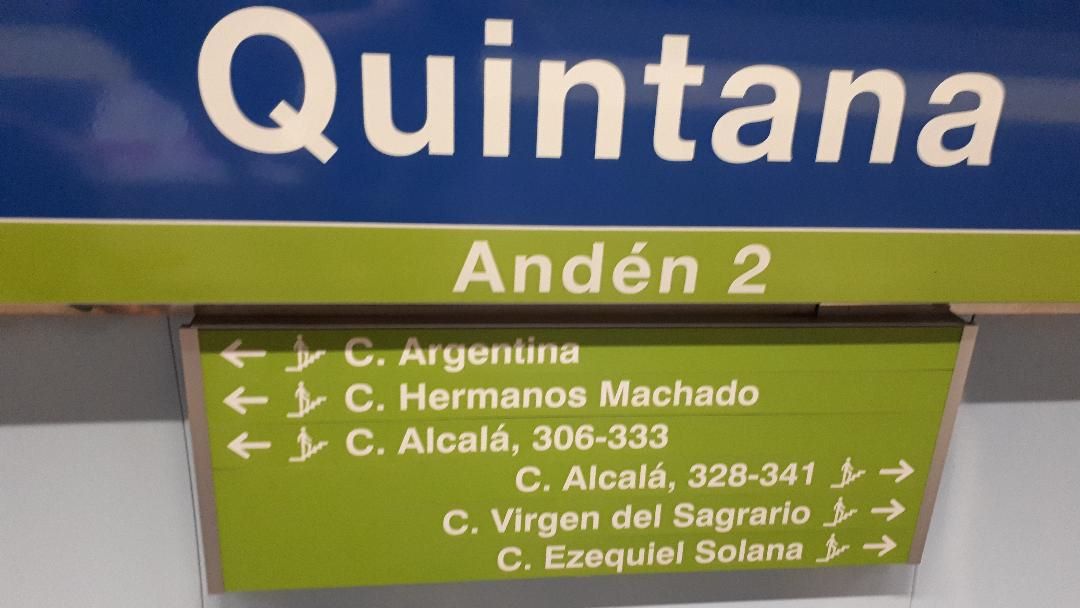
And to remind me of my nostalgic Madrid, a bit more on my line, The Metro line 5 crosses the city ,and consists of 32 stations which make up a 23.2 km route between the Alameda de Osuna and Casa de Campo stations. The line as such was inaugurated on June 6, 1968 between the stations of Callao and Carabanchel, although they are part of its current network two sections previously inaugurated and belonging in its day to other lines, such as my section between Ventas and Ciudad Lineal was inaugurated on May 28, 1964 as part of joining with Line 2. In 1980 the line went east to Canillejas, (here lived my aunt and then in the early 1970 ‘s was going by electric tram from Ciudad Lineal!) and was extended under the Calle de Alcalá (I lived right on it!!! on metro Quintana station) until its end next to the road to Barcelona (A2).
A bit of history tell us that it was King Alfonso XIII who inaugurated the Metro of Madrid on October 17, 1919, the route of the current line 1 between Sol and Cuatro Caminos. The network currently has an extension of 294 km or about 182 miles ; and 12 lines, It is the seventh longest in the world in number of kilometers, and in number of stations, with 302, is the fifth in the world, as well as the third network in Europe in number of kilometers,This year it is celebrating 105 years of Metro in Madrid !
The official Metro de Madrid on itineraries : https://www.metromadrid.es/en
The Madrid tourist office on getting around by metro : https://www.esmadrid.com/en/getting-around-madrid-metro
The Madrid tourist office on a tourist map (pdf)for guide and printing : https://www.esmadrid.com/en/madrid-metro-tourist-map-pdf
There you go folks, a brief ,general overview of the Metro de Madrid of my dear Madrid, Again, if need more explanation, directions etc feel free to let me know here, Until soon from Madrid as is never far away for me, Again, hope you enjoy this post on the Metro of Madrid, part I as I.
And remember, happy travels , good health, and many cheers to all !!!

 Paris1972-Versailles2003