
I have said my blog is about travel and anecdotes, well it’s time to come back to a bit of a story on my past. We write about beautiful interesting places we visit and or live/d and I recount my every day travels in my blog. I have even told you plenty on my university ERAU, Daytona Beach. Also, about my extra curriculum activities, but did not told you enough about an icon of the university and my life, Many times in it in various club activities , I found me a lot more info on the artist’s blog which I am condensing ,and adapting as more relating to my story, Memories forever indeed !! Therefore, let me tell you about the battleship of Ormond Beach !!! read on ,,, Hope you enjoy the post as I.
I need to go way back to tell the story of a men, Frederick Dana Marsh ,if you are into painting, sculptures, arts then you should know this men, At an early age as the best artists; he went to Paris oh là là là!!!This was the Belle Époque Paris. Not only the cultural center of the Universe, it was an enormous celebration of life. The Art Nouveau architecture was splendid, sensual, and ever-present. And there was so much Art, one didn’t know which way to turn to experience it all. Even between the Impressionists and the Modernists. Between the Barbizon School and the Paris School. It was time for Expressionism. With shades of Fauvism and a touch of Symbolism. Wedged in between Impressionism and Post-Impressionism or even Neo-Impressionism. It was the new Avant Garde. More than just an artistic label, it was a cultural movement, as a frenzy of artists, poets, and others went to Paris, seeking to express the meaning of being alive, It was the greatest Art event in the Western world. High up in the 18éme Arrondissement, in the shadow of Sacré-Cœur, Montmartre was the epicenter of all things Arty and Absinthe since the mid-19C. The definition of Bohemian lifestyle. Home of: Camille Pissarro, Henri Matisse, André Derain, Pierre-Auguste Renoir, Edgar Degas, Maurice Utrillo , Salvatore Dali, Amedeo Modigliani, Henri de Toulouse-Lautrec, Claude Monet, and Vincent Van Gogh. Oh yes, and Édouard Manet, Camille Corot, Paul Cézanne, Auguste Rodin, Jean-Jacques Rousseau, and others. The interaction among artists was extraordinary. For example, it was here that Picasso met George Braque and gave birth to Cubism. And while Toulouse-Lautrec and a few reluctant Bohemians continued to haunt Montmartre, this next wave of artistic fervor was centered on the other side of the Seine in Montparnasse of the14éme Arrondissement as Pablo Picasso frequented both Montmartre and Montparnasse, along with Guillaume Apollinaire, Jean Cocteau, Erik Satie, Marc Chagall, Fernand Leger, Gertrude Stein, Jacques Lipchitz, Max Jacob Chaim Soutine, Jacques Villon, Ezra Pound, Max Ernst, Marcel Duchamp, Henri Rousseau, Constantin Brancusi, Juan Gris, Diego Rivera, Alberto Giacometti, Salvador Dali, Henry Miller, Samuel Becket, Joan Miro and Edgar Degas. The above are just a few. There is a story that says when Tsuguharu Foujita arrived in Montparnasse from Japan in 1913 not knowing a soul, he met Soutine, Modigliani, Pascin and Leger virtually the same night and within a week became friends with Juan Gris, Pablo Picasso and Henri Matisse.
After convincing his father to let him stay on, young Fred Dana Marsh was eager to leap into the artistic fray. It has been said that his independent attitude toward the pursuit of Art led him to avoid workshop study, but he did study with Jean Paul Laurens. Other than painting portraits of wealthy Americans in Paris, we do not know in fact, what he did in Paris, except he married Alice Randall from Coldwater, Michigan. A miniaturist who also studied at Art Institute of Chicago, she was then studying with James MacNeill Whistler, Luc Olivier Merson, and Fred MacMonnies. Alice showed a painting at Le Salon of 1895. It was entitled, Interior of Chapel at Crecy-en-Brie. Fred also exhibited at Le Salon. His first entry, which to the astonishment of his friends, had murder as its theme. But his A Lady in Scarlet, was accepted. The painting was a full-length portrait of his new wife in vivid and luminous red. He also showed it at the Paris Exposition where he received a Bronze Medal. Another piece was entered as a decorative composition called Fantaisie, representing a group of six women. He and Alice gave birth to three sons, James Randall in 1897, Reginald on March 14, 1898, and Dana, the youngest at an unknown date, at 108 Boulevard du Montparnasse, above Le Café du Dôme. Alice died suddenly while in Italy. Fred married Mabel Van Alstyne, who lived at 504 Pelham Road in New Rochelle, on November 29, 1930 at the Little Chapel Around the Corner. They were said to have developed an “artistic relationship.”
The other thing we know, is that Fred Dana Marsh and family returned to New York in 1900. They settled in Nutley, New Jersey, just 13 miles from Manhattan. It had already become a Mecca for artists. They moved into No.16, The Enclosure, previously inhabited by the painter Frank Fowler. The house would later be the home of the WPA muralist Michael Lenson. He also made pictorial maps and small murals for John D. Rockefeller, Jr., William Rockefeller, E. H. Hutton, Herbert Pratt, and other millionaires. The Marshes moved to New Rochelle, in New York’s State affluent Westchester County, the following year. He had a house built at 56 Avon Road in Wykagyl Park, next to the country club. New Rochelle was no stranger to resident artists having had neighbors such as: Norman Rockwell and Frederic Remington, so the Marshes fit right in. The February 1918 issue of House & Garden magazine featured their home. During WWI, Fred produced patriotic posters for the publicity department of the Navy. The troopship U.S.S. President Lincoln sank on May 31, 1918, just months before the end of the war. Fred Marsh painted The Sinking of the USS President Lincoln on 31st May 1918 in 1920. Then in 1928 Fred Marsh retired from commercial art, though there is no evidence of an active business, perse. His parents had retired from Chicago, finding Deland, Florida to their liking. They had a house on Marsh Street. Fred visited and was soon taken with the area and its history. He did drawings of Timucua Indian chief Macaya in 1928.
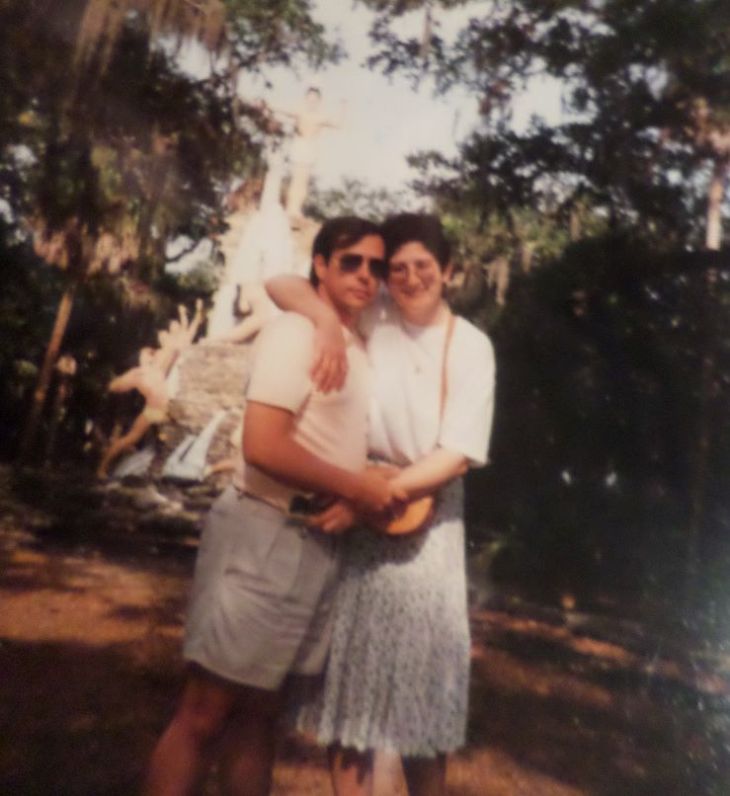
In 1930 he sold his parents house and moved to Ormond Beach, Florida (where eventually I came to know his story) .A playground for wintering society since John D. Rockefeller first began going in 1914,(see his house Casements now a museum see post), the wide, hard-packed beaches were the site of some of the first car races in the USA, Thus Ormond Beach acquired the nickname, “Birthplace of Speed.” Marsh hired an open cockpit bi-plane, with pilot, to fly him low over the Ormond Beach dunes until he chose the site for his future home: 307 Ocean Boulevard (A1A). It became known as the “Battleship,” and was considered the first modernistic house in Florida. And my anecdote of the story is that I was a visitor to the house on several occasions and very nice vivid memories of the fun time there with the President of the Univ Jack Hunt and teachers, students etc ; memories forever, and the reason to write this post, The low profile of the 4,500 square-foot concrete structure helped evoke the image of a great warship. The flat roof of the first floor making the main deck, the second floor, rising in the center like a bridge. Huge and streamlined in the best Art Deco style. Its soaring turret-tower became a local landmark leading guests into an entry that Marsh decorated with murals and low-relief sculptures of Florida natives. A floor-to-ceiling mural in entry hall, The Conquest of Florida, greeted visitors to the Marsh home, which was designed to display his artwork. There was also a black dining room and an open-air atrium with a stunning floor. There were fourteen rooms on the ground floor. A narrow stairway lined with artwork of Native Americans spearing alligators and of a gold dolphin led to the second story. A mural map of Florida encompassed the entire south wall of the foyer. Against the back wall of the patio were two tall wooden sculptures, The Snakes and the Wildcat and The Shrimp and the Mermaid. On the south end of the patio was Marsh’s 20 x 30 foot studio. And there are several references to the carousel horses that the Marshes pulled from the local dump. They were painted white, and set up in the backyard. Designs came from the sea, the air, the land, the legends. Rising from the point where the Halifax river meets theTomoka River in Ormond Beach; where fishermen using nets or poles catch a variety of fish; is Fred Dana Marsh’s 40-foot tall sculpture, Chief Tomokie. Built in 1955 using cement, bamboo, and other materials, the monumental artwork represented the climatic moment of a legend. Marsh bonded porous rock with cement to capture this moment. The skin was made with burnt red clay from the Tomoka River. Bamboo was used at points of stress and strain. He donated all his work and the state park put up for materials. A reflecting pool was added in 1956 and it was officially dedicated in 1957. He also did sculptures of Native Americans for the Peabody Auditorium (where my univ graduation was held see post) in Daytona Beach. And then, Frederick Dana Marsh died on December 20, 1961. Picture of sculpture of Chief Tomokie with me and dear late wife Martine ,and the Battleship house!
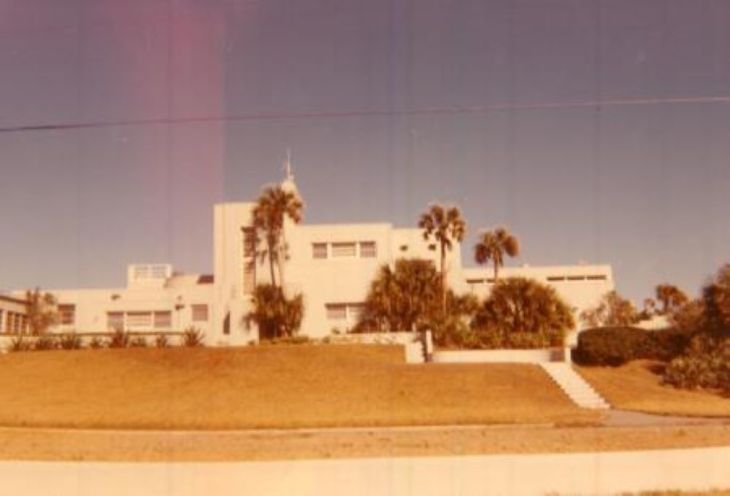
Upon his death, a museum for some of his works was established in Tomoka State Park, near the Chief. It contained paintings, drawings, sculptures, and artifacts from The Battleship house that were donated by his late wife. The museum was listed in tourism guides around the world, leading Art Lovers to Ormond Beach. There was, however, no air and humidity control nor quality lighting. So in 1996 a campaign to update and expand the museum was undertaken. It met with no success. The museum was closed due to lack of operating funds and the collection was sent to the Wolfsonian Museum in Miami.. Marsh’s home in Ormond Beach, The Battleship, was purchased by Embry-Riddle Aeronautical University in 1971 and used as the President’s home until 1995. As such, Marsh’s Art-Deco gallery/home hosted many celebrities. In the mid-90s it was sold again and then, sadly, demolished in 1996. Indeed a piece of history could not be save sad !!!
There you go folks, an adventure into golden period of my life ; college life is awesome. Those that tried should tell you, a thrill and an experience never to be forgotten. And more when you have the priviiledge to visit and see this marvelous memorable Battleship house, Again, hope you enjoy this post on the Battleship of Ormond Beach as I..
And remember, happy travels, good health, and many cheers to all !!!

 Paris1972-Versailles2003