
We are back to my dear Spain again !! love it !! We came by car of course and took time to see new areas and old repeat as could not be in Spain without stopping in my Madrid! I came again with my boys and dog Rex, and it was a thrill as usual! I like to tell you more of Madrid to heaven and a hole in the sky to look down on it everyday !!! Again condensing posts as many text repeated, this is an update with new text/links and older pictures. Therefore, let me take you by the Puerta de Alcalà of Madrid !!! Hope you enjoy the post as I.
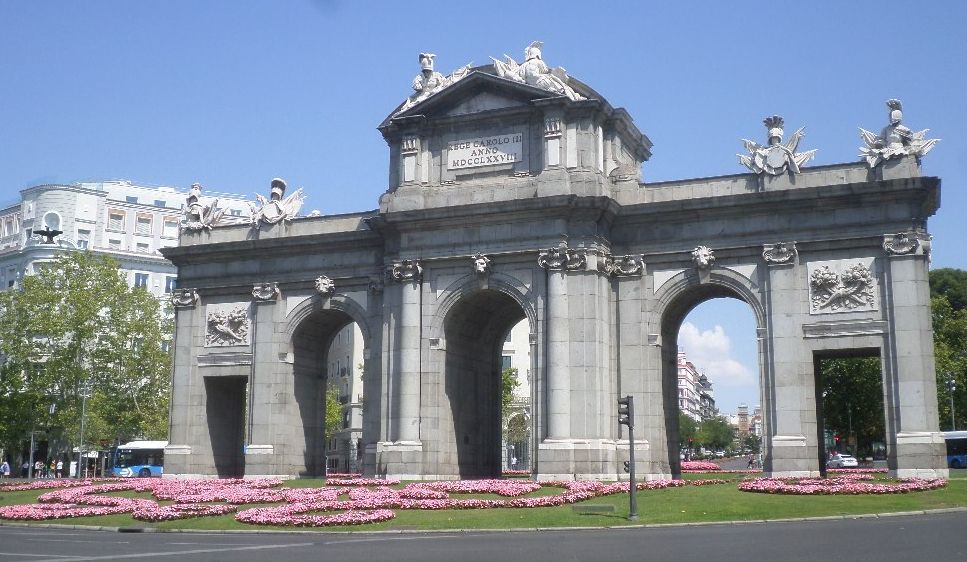
The city of Madrid is the capital of the kingdom of Spain, and located in the Comunidad de Madrid region From my latest escapes it is 198 km from our rental house in Velliza, We made long walks all over the City , and took the metro when necessary, three times. I love to tell you of our latest escape to the wonderful City, for the memories of always and return, eventually. This was my puerta or gate entering the center or centro of my Madrid when lived in the City, in the 1970’s ! The Puerta de Alcalà a monumental entrance to my Madrid and from which I always entered the city when living there. I have no words to describe it every time I see passing by it with my late dear Mom Gladys! and later my dear late wife Martine,and now the 3 boys, and our dog Rex: memories forever.
The Puerta de Alcalà is one of the five old gates for entry into Madrid. It is at the Plaza de la Independencia or independence square facing the Retiro Park (my old entry point to the center of Madrid in my days there) . The gate was built on the orders of King Charles III to replace an old gate that existed since the 16C. The Italian architect Francesco Sabatini was chosen by the king himself to do the gate. The work began in 1769 and continued until the inauguration in 1778. This is the first triumphal arc built in Europe since the fall of the Roman Empire, making it the forerunner of the Arc de Triomphe of Paris or the Brandenburg Gate of Berlin. The gate allowed the entrance in Madrid to travelers from Aragon, Catalonia and France. It is at the crossroads of the streets of Alcalá, Alfonso XII, Serrano and Salustiano Olózaga, next to the gates of the Retiro park such as the Puerta de España, Puerta de la Independencia and Puerta de Hernani. The outline of the enclosure is formed by buildings from the late 19C and early 20C, built during the widening of
Madrid.
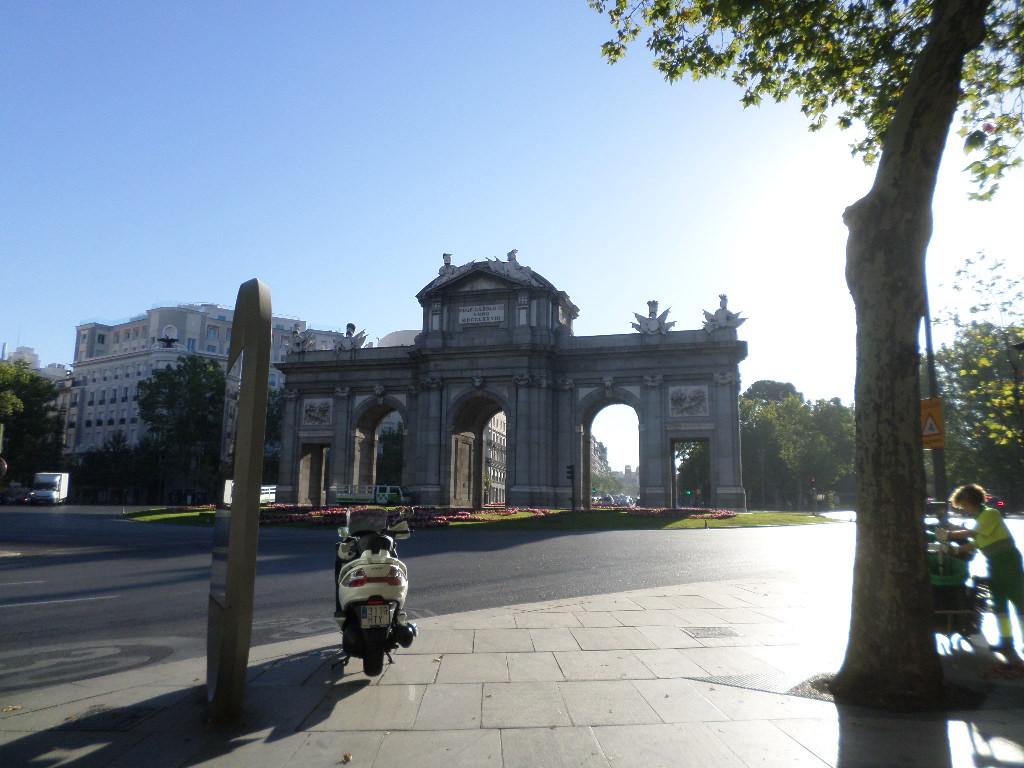
The neoclassical-style Puerta de Alcalà has a width of about 44 meters and culminates at 22 meters in height. The structure of the gate is made of granite from the quarries of Colmenar Viejo, Alpedrete and Hoyo de Manzanares. The decorative elements are made of limestone from Colmenar de Oreja. The sculptures of children who crown the Puerta de Alcalá represent the four cardinal virtues. Made by Francisco Gutiérrez Arribas, these sculptures are sometimes referred to as the Angels of Peace.
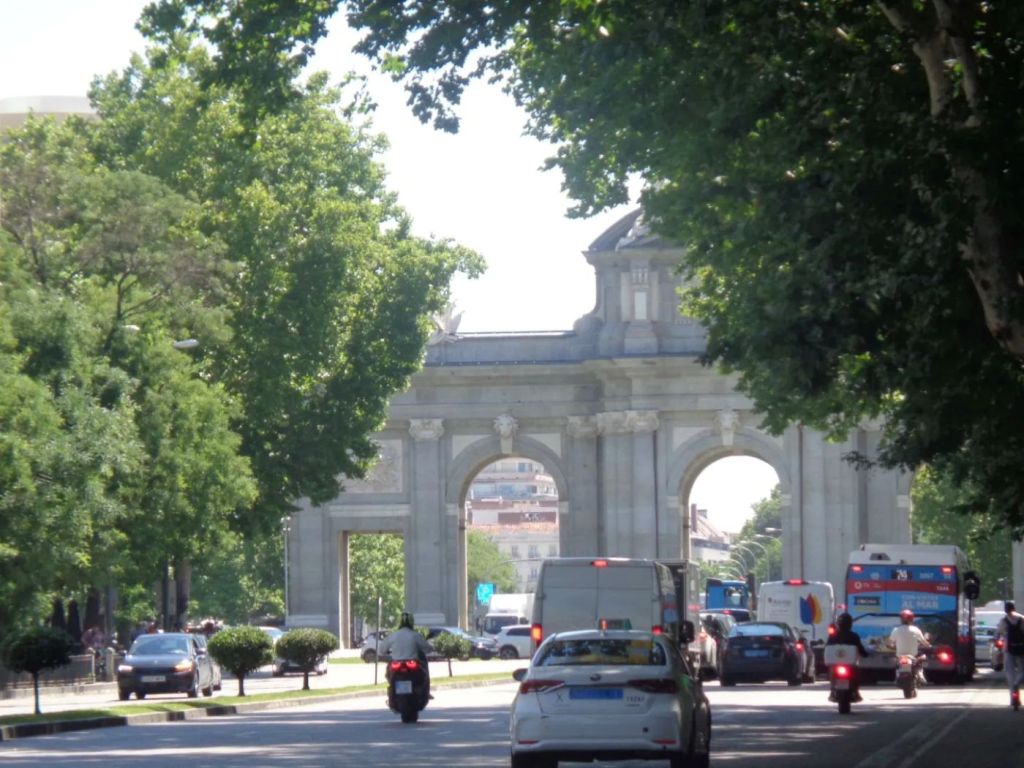
The Puerta de Alcalà was given a complete renovation which ended in 2023 covering all the aspect of the gate and now looks better than ever ! The main points of the renovation were the sculptoric groups , the cornice, and the lead cover, You can read all about it in Spanish on the offical renovation site here : https://www.restauracionpuertadealcala.es/
A bit of history I like tell us that the city of Madrid had, since its inception, numerous gates and access to the city through its wall. The walls and the gates had a character of fiscal control of merchandise, at the same time as defensive. The wall was re-built with a growing radius, the so-called Christian wall that marked new limits. The gates proliferated in the 17C, and among them was that of Alcala. The exits from Madrid were flanked by five royal or registration gates (that is, those in which taxes were paid) such as those of Segovia (also called the Segovia Bridge), Guadalajara, Toledo, Atocha, Alcalá and Bilbao (or of the Pozos de la Nieve), and fourteen minor or second order portholes that open on different dates such as Vega, Vistillas, Gilimón, Campillo del Mundo Nuevo, Ambassadors, Valencia, Campanilla, Recoletos, Santa Barbara, Maravillas, Santo Domingo (or Fuencarral), Count Duque, San Bernardino (or San Joaquin) and San Vicente. The main gates remained open until 22h (10PM) at night in the winter time, and in the summer one more hour due to the greater length of the day. After this time, and only if necessary, a checkpoint allowed the passage. However, the portholes opened in the early hours of the day and closed with the sunset, remaining closed all night. During the plague pandemic that occurred in Madrid in 1580, the Puerta de Alcalà was already mentioned as a point of closure to the population. It was in a much more advanced position than the current one, at the intersection of Calle Barquillo with
Calle de Alcalá. This gate was called Puerta de la Peste de la calle de Alcalá (or gate of the plague of the Alcala Street). A decade later, its position was advanced again so that in 1599, the celebration of the entry into the city of the wife of Felipe III, Margarita of Austria that were married in Valencia. At this time it was located somewhat further west than today, at the height of the Calle de Alcalá crossing with Calle Alfonso XI.
The Puerta de Alcalà had a structure divided into three parts, it was composed of a central arch and two lateral openings. The entire gate was erected in brick, with the exception of the pedestals and pilasters used for the vertical articulation of the construction for which stone was used. The decoration consisted of the Royal and City weapons, with two figures representing Manto and his son Ocno, both founders of the city according to the mythology Mantua Carpetana. The subsequent entry, already in 1615 by Isabel de Borbón in Madrid, generated new plans for remodeling the arch and its images. In 1636, part of the gate was demolished and a single-span brick structure came to replace the tripartite arch. The previously existing allegorical figures were replaced by other stone statues of Our Lady of Las Mercedes. On the side arches were two statues of San Pedro Nolasco and Blessed Mariana de Jesus. From the palace del Buen Retiro the facade of the Royal site that was adjacent to the Alcalá road was literally glued to one of the ends of the gate, while the other at the beginning of the Recoletos meadow had been practically embedded in the walls of the well deposit established since 1667 in the immediate grounds. The old gate or Puerta de Alcalà was demolished in 1770 when the Calle de Alcalá was expanded, then called the Royal road of Aragon and Catalonia, with land taken from what is now the Retiro Park, belonging to the Buen Retiro Palace. This gate, which served as access to the city by the royal road of Aragon and Catalonia, was one of the five main ones that had the wall surrounding the town, along with those of Toledo, Segovia, Bilbao and Atocha. In 1754, king Fernando VI, through the Hospital Board of the capital, inaugurated the bullring of the Puerta de Alcalá, installed in front of the Jardines del Buen Retiro, and it would remain active until its closure in 1874, date on which it gave the alternative to a new square built next to the Aragón road, in the Madrid enclave known much later as the Goya neighborhood. That bullring of the Puerta de Alcalá would be for 120 years the bullring of the town of Madrid, between 1754 and 1874. It was replaced by the bullring of the Fuente del Berro, an installation that in turn would be relieved by the
Monumental of Ventas in 1934, the current arena.
On December 9, 1759, Carlos III (son of Felipe V) entered Madrid, from Naples to succeed his brother, the late Fernando VI, on the throne. Disembarked in Barcelona, he made from there his first trip to Madrid and entered through the old Puerta de Alcalá, which was not to his liking so he decided to tear it down to erect a new one. The gate would be the first modern triumphal arch erected in Europe after the fall of the Roman Empire. In 1769 Carlos III decides that the Sabatini garden by the Royal Palace project is the one to be carried out. After the election by Carlos III of the combined design of the gate, a few days later on May 27, 1769, the contracting of works and services for what will be the New Puerta de Alcalá began. This Puerta de Alcalà was inaugurated in 1778 as an authentic gate and access to Madrid, since on both sides of it there was still the wall that delimited the city from the east and that would remain standing until 1869, when the square was remodeled. It became the main entrance of the city and one of the most representative monuments of his reign, axis of the reforms he later carried out throughout the city that included the Botanical Garden, Paseo del Prado, Cibeles and Neptune fountains , among others. The Puerta de Alcalá is modernized, and a more suitable environment and designed in the form of a square around it. This was decided to be call the
Plaza de la Independencia square in honor of Spanish independence (against dictator Napoleon) ,and specifically the defenders of Zaragoza. It intends to decongest the growing traffic of vehicles (apparently there was already a lot of traffic then lol!) at the Puerta del Sol creating various congestions to Aragon. For this, it was decided to have eight streets leave the new Plaza de la Independencia radially and calls them as Sagunto, Numancia, Covadonga, Granada, Padilla, Bravo, Maldonado and Lanuza. The demolitions for the construction of the Gran Vía were contemplated from the Puerta de Alcalá as the increase in road traffic was beginning to be felt throughout the city.
In the Spanish Civil War Madrid was loyal to the Republic and made the gate suffer the effects of the rearguard in the so-called defense of Madrid. The Puerta de Alcalà was an ideal space for propaganda, it is for this reason that they hung up posters with portraits of various leaders of the Soviet Union. After the Civil War it served as an altar of masses for the celebration of the liberation of Madrid. In the eighties, Bernardo Fuster and Luis Mendo, together with Francisco Villar, composed a song called La Puerta de Alcalá in which they tell the story of the monument. Recorded in 1986 by singers Víctor Manuel and Ana Belén in their album “Para la ternura siempre hay tiempo” or for tenderness there is always time. This song became a great popular success. In 1993 the Puerta de Alcalà was subjected to the most important restoration in its history. In the summer of 2006 the Plaza de la Independencia was subjected to some improvement works to become a roundabout. In August 2011, the Puerta de Alcalá was the scene of the act of welcoming Pope Benedict XVI on the occasion of the XXVI World Youth Day Madrid 2011. The Pope crossed the gate accompanied by young people from the five continents.
The Madrid tourist office on the Puerta de Alcalà: https://www.esmadrid.com/en/tourist-information/puerta-de-alcala
The Comunidad de Madrid tourist office on Madrid :https://www.visitmadrid.es/en/places-to-visit-in-madrid/best-places-to-visit-in-madrid-spain
There you go folks , another wonderful nostalgic, sentimental trip to my dear Spain, Madrid is always nostalgic sentimental words cannot describe it ! This is a vibrant cosmopolitan cities of friendly faces and smiles to share in long conversations about life and more ; I love it, And these places are part of my life forever ! We will be back ,eventually!, Again, hope you enjoy this post on the Puerta de Alcalà of Madrid !!! as I
And remember, happy travels, good health, and many cheers to all !!!


