
We are back to my dear Spain again !! love it !! We came by car of course and took time to see new areas and old repeat as could not be in Spain without stopping in my Madrid! I came again with my boys and dog Rex, and it was a thrill as usual! I like to tell you more of Madrid to heaven and a hole in the sky to look down on it everyday !!! Let me take you to the arts and culture of my Madrid !!! Sit back and enjoy with me the next several posts ; and hope you enjoy it as I,
The city of Madrid is the capital of the kingdom of Spain, and located in the Comunidad de Madrid region From my latest escapes it is 211 km from Valladolid City , 198 km from our rental house in Velliza, 183 km from Tordesillas, 172 km from Rueda, 159 km from Medina del Campo, 199 km from Simancas, We made long walks all over the City , and took the metro when necessary, three times. I love to tell you of our latest escape to the wonderful City, for the memories of always and return, eventually. These places are dear been to all of them over the years and part of my life!
The Cines Callao cinema located in the Plaza del Callao,3 built in 1926. It is next to the Carrión building, separated from it by the Calle Jacometrezo street. The building was inaugurated as a movie theater on December 11, 1926, broadcasting the movie « Luis Candelas o El bandido de Madrid « (also a well known restaurant see post) On June 13, 1929, the first sound and spoken film released in Spain was screened in this cinema: « The jazz singer « . Together with the cinemas of the Palacio de la Prensa they form Callao City Lights. These cinemas host numerous premieres, and other events. The building presents academic tendencies with a certain Spanish neo-baroque aftertaste and in its interior decoration Viennese and Art Deco suggestions. Its terrace is designed to broadcast outdoor film sessions. The basement of the building was thought to house a Café or Cabaret, although later it was adapted to the old Xenon nightclub, now closed. Currently two large digital screens hide elements of its facades, such as three large windows and some oculus. Some sculptures and other original decorative elements, which can be seen in old photographs, have also disappeared. Its corner is crowned by a tower as a lighthouse.
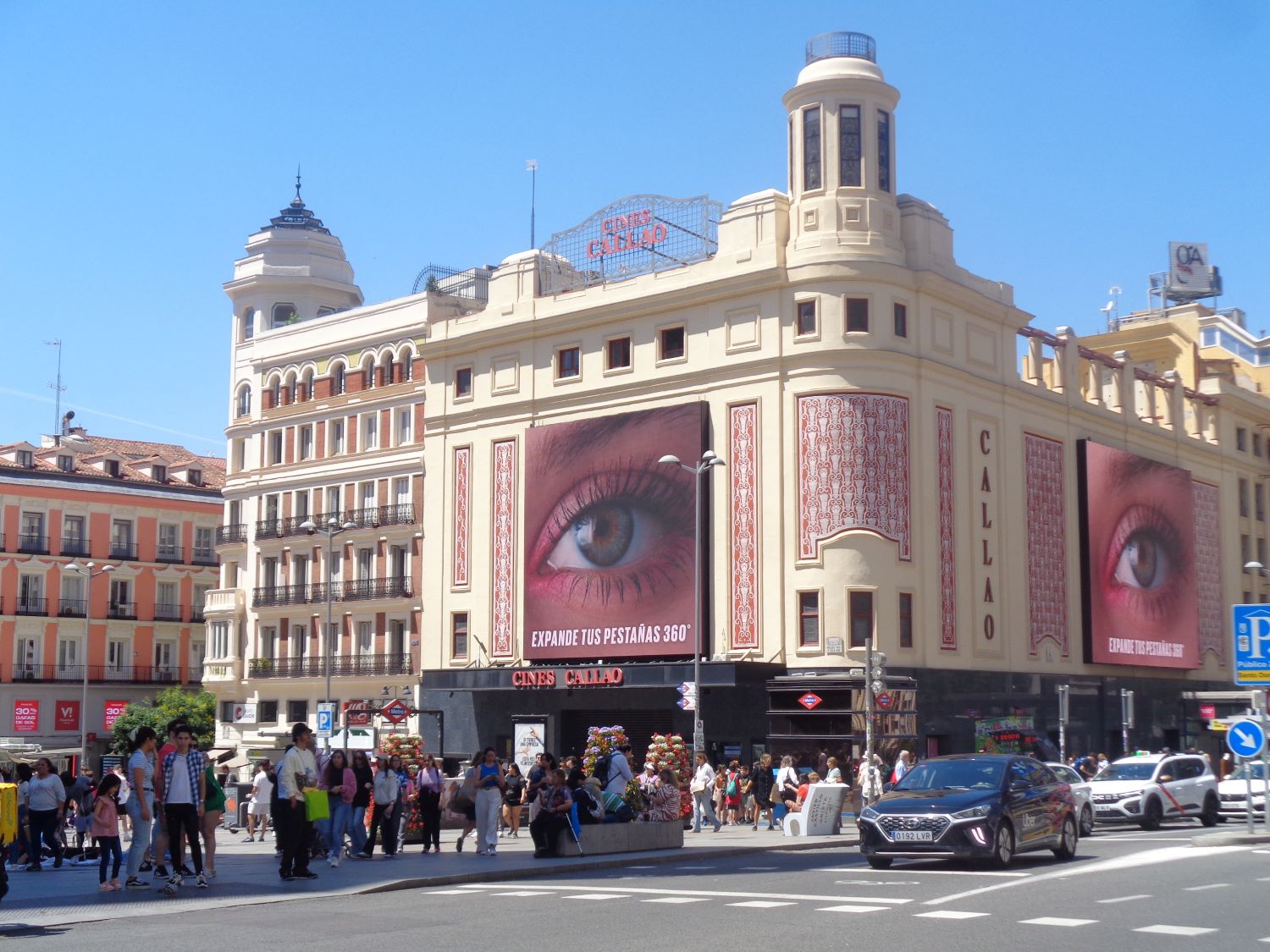
The official Cines Callao : https://cinescallao.es/
The Cine Capitol cinema ,a movie theater located on Gran Vía nº 41, in the Carrión building (sometimes called the Capitol building). It was inaugurated on December 2, 1933. Inside, the marble elements stood out. Outside, the marble, the polished granite, the blue stone of Murcia are combined at the entrance. During the Spanish Civil War, Soviet films were distributed,(the Republicans control it) the first Russian film distributed by Film Popular was The Sailors of Kronstadt (1936) by Russian director Yefim Dzigan, which was released in the rooms of the Capitol cinema on October 18, 1936.
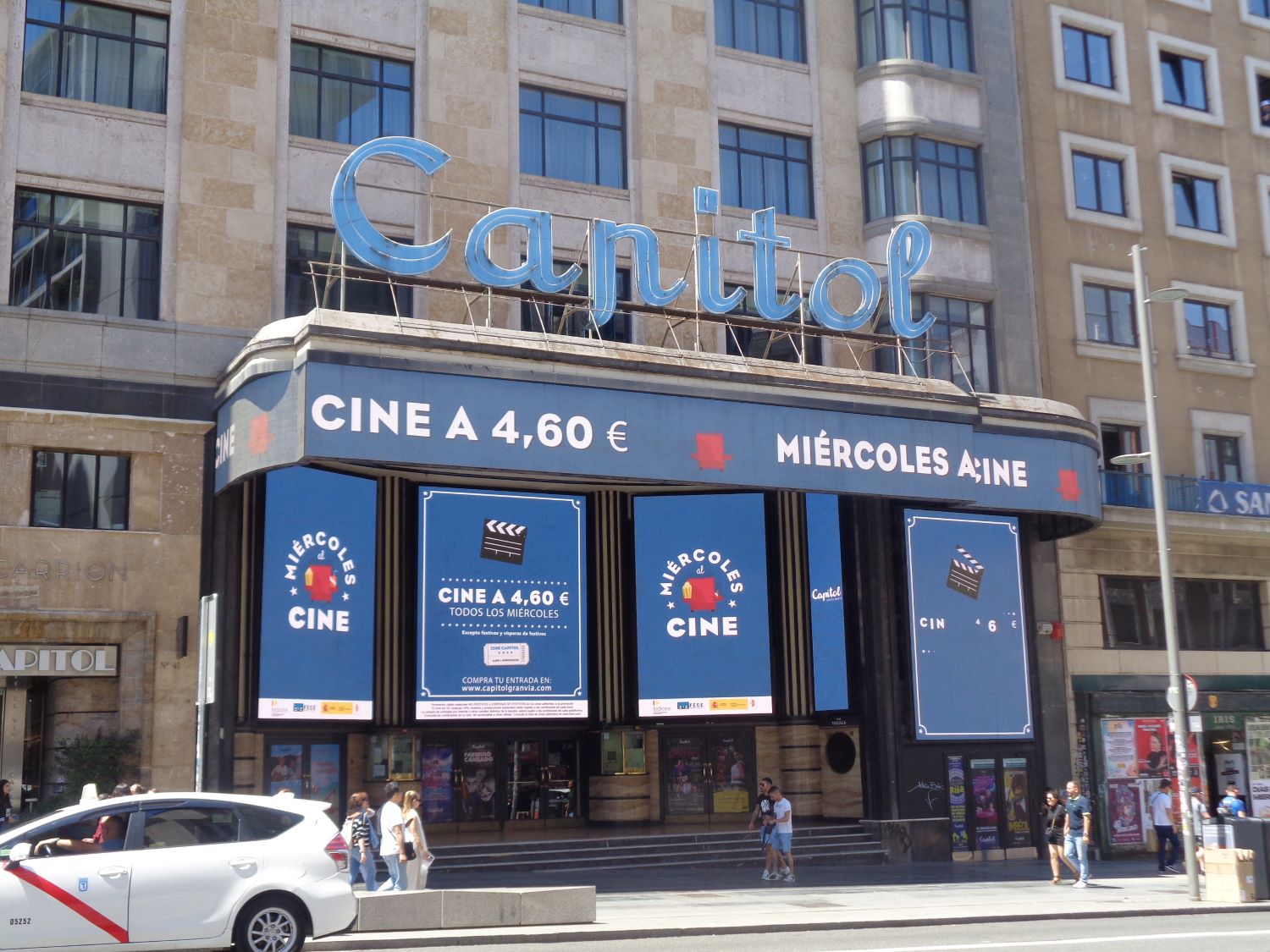
The official Cine Capitol Gran Via : https://www.capitolgranvia.com/
The gorgeous Real Academia de Bellas Artes San Fernando, built in 1724-1725 is an institution integrated in the Institute of Spain. It was created by Royal Decree of April 12, 1752 , as the Real Academia de las Tres Nobles Artes de San Fernando or Royal Academy of the Three noble Arts of San Fernando, The activities were based on painting, architecture, sculpture and engraving. Its purpose was to convert artistic subject into regulated studies, exceeding the previous learning model in the workshop. To do this, the Academy would have “teachers” of the different subjects and models of all kinds, both molds and works of art and “rental” men and women. Creation would be stimulated by the granting of awards and pensions of studies in Rome for the most prominent artists. In 1846 it received its current denomination without the Real or Royal ; Real Academia de Bellas Artes San Fernando, and opened a new music section. It recovered its royal name in 1881, and the same time started publishing the magazine Academia , which continues to edit today, after an interruption between the years 1933 and 1951. Throughout its history the Royal Academy of Fine Arts of San Fernando has occupied in Madrid three different headquarters. Since 1773 it has been located in the Palacio Goyeneche Palace ,Calle de Alcalá, 13, Apart from its teaching and advisory activity, the Royal Academy is famous for its important art collections, which are exhibited in its Headquarters of Calle de Alcalá. They cover more than four centuries, from Luis de Morales to Juan Gris and still later authors.

The Sala Alcalá 31 exhibition hall is located in an emblematic building which was built between 1935 and 1943 and was initially the headquarters of the Mercantile and Industrial Bank and which today belongs to the Comunidad de Madrid regional govt. Later , it was refurbished to house the offices of what was formerly the Department for Arts and the exhibition hall. The exhibition hall, covered by an immense stone dome, occupies the great central nave that used to be the bank’s trading floor. It offers a programme which places emphasis on today’s creation within international visual and plastic arts. Throughout the year, it puts on individual and collective exhibitions, focusing on middle-career artists, reviews of consolidated artists who have suffered diverse critical fortunes, and the presentation of important art collections from Latin America coinciding with the Arco de Madrid Fair, with pieces created in a variety of media and formats, including new technologies as a form of artistic expression.
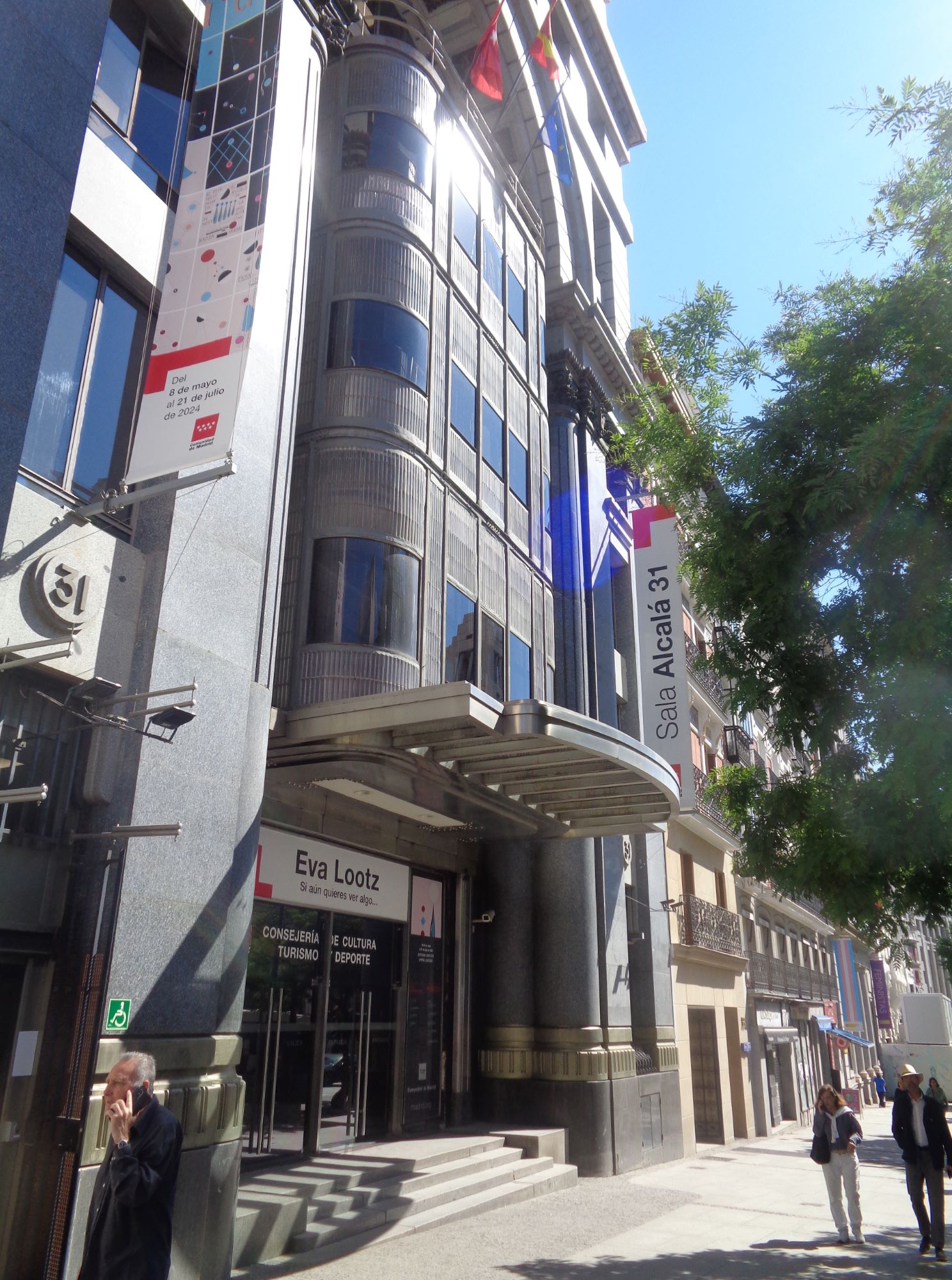
The official Comunidad de Madrid on the Sala Alcazar 31 of Madrid :https://www.comunidad.madrid/centros/sala-alcala-31
And now to end this post, let me tell you about my most sentimental personal story on the cinemas and theaters of Madrid
, When living in Madrid, my mother would scrap some money , »pesetas », to take me to the movies. We did not have much money then in the old regime, and were very happy to go to the movies once a month. As we live off metro Quintana line 5 exit on Calle de Alcalà 331, the closest to us even on foot was the Cine Aragon at Calle de Alcalà 334! This was a very modern cinema for the times , and we were very happy to be there. I went in several times ,really enjoy this time with my dear late mom
Gladys. They close long ago, but enough to bring my dear late wife Martine and our boys to it once from France. The memories will lingered forever as one of the warmest nicest places that attach me forever to my dear Madrid, Cine Aragon was it!
I like to expand here for the memories of always on Cine Aragon, sadly no pictures too poor at the time, A bit of history I like tell us that on February 8, 1954, a cinema with the name of Cine Aragon opened in the Ctra. De Aragon 124 ; this street will later became, Calle de Alcalà 334 in honor of its location, with the program in continuous session that brings lots of nice memories, the “Al diablo la celebridad” (to hell the celebrity), and Mundos Opuestos (opposite worlds). It was inserted in a residential building and had a wide facade where they placed their billboards. The entrance was preceded by steps that gave way to a high hall with two stairs, one at each end, under one of which were the lockers. Four entrances gave way to the cinema room, with a slope towards the screen and a high plaster ceiling. It was decorated in reddish tones and had a capacity of 1500 seats distributed between the patio and the amphitheater. In the upper part a large loge and the bar, next to which the toilets were installed, in front of these, two corridors led us to the amphitheater that developed vertiginously until reaching the projection windows. In 1997, during the screening of the movie “Rescate” (Rescue) a fire filled the cinema room with smoke and caused it to be evicted. The material damages were substantial. The place remained closed until August 1998, when it reopened completely renovated with a single room with capacity for 550 spectators, with several seats convertible into a single special for couples. In August of 2005 after the screening of “Ninnete” the Cine Aragon closed forever. Then came the change over to a toys store Poly toys , that heard was in liquidation.
There you go folks , another wonderful nostalgic, sentimental trip to my dear Spain, Madrid is always nostalgic sentimental words cannot describe it ! This is a vibrant cosmopolitan cities of friendly faces and smiles to share in long conversations about life and more ; I love it, And these places are part of my life forever ! We will be back ,eventually!, Again, hope you enjoy this post on the arts and culture of my Madrid !!! as I
And remember, happy travels, good health, and many cheers to all !!!


