
We are back to my dear Spain again !! love it !! We came by car of course and took time to see new areas and old repeat as could not be in Spain without stopping in my Madrid! I came again with my boys and dog Rex, and it was a thrill as usual! I like to tell you more of Madrid to heaven and a hole in the sky to look down on it everyday !!! Let me take you to Cibeles and CentroCentro of Madrid , part I !!! Do read my other post on it in my blog, Sit back and enjoy with me the next several posts ; and hope you enjoy it as I.
The city of Madrid is the capital of the kingdom of Spain, and located in the Comunidad de Madrid region From my latest escapes it is 211 km from Valladolid City , 198 km from our rental house in Velliza, 183 km from Tordesillas, 172 km from Rueda, 159 km from Medina del Campo, 199 km from Simancas, We made long walks all over the City , and took the metro when necessary, three times. I love to tell you of our latest escape to the wonderful City, for the memories of always and return, eventually.
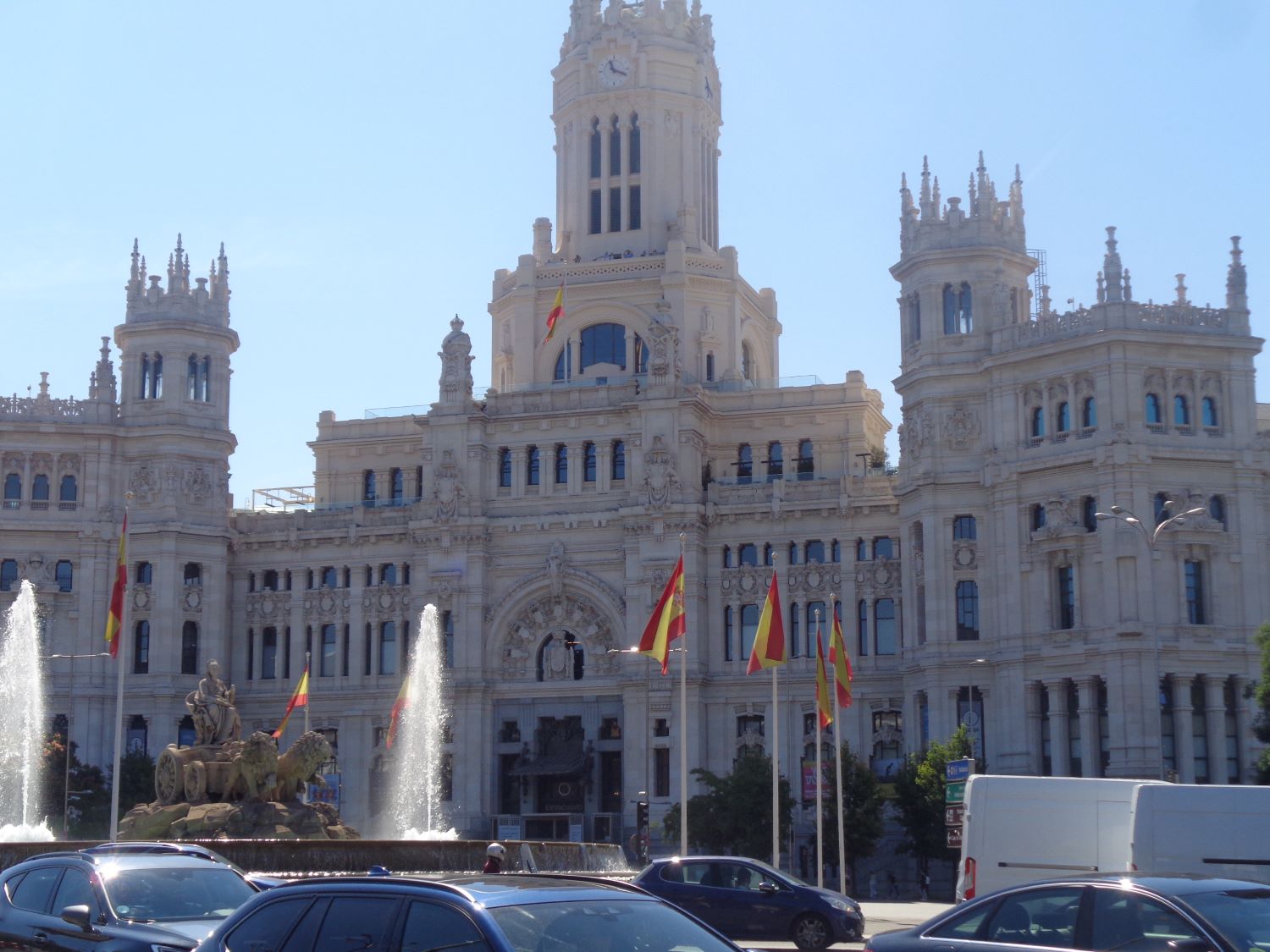
The Palacio de Cibeles (also called in my time in the City the Telecommunications Palace or telephone and post office) or the newer CentroCentro is a complex consisting of two white-fronted buildings. They stand on one side of the Plaza de Cibeles in the Jerónimos neighborhood , district of Retiro, and occupy around 30,000 square meters of what were the former Jardines del Buen Retiro. The building consists of five floors in total. The block in which the palace building is located is limited to the North with Calle de Alcalá (my street !),to the South by Calle Montalbán , to the East by Calle Alfonso XII and to the West by Paseo del Prado. You get here on metro line 2 Banco de Espana !

Since my time there have been lots of reforms as from my time was the main post office building ! Now, is the home of the Mayor of the City of Madrid as well as the cultural area called “CentroCentro”. The main access gives rise to the Hall Principal or main hall, a large space in the heart of the Cibeles building in the form of a lobby. The set is divided into two buildings separated by the Pasaje de Alarcón passage , which is currently covered by glass vaults. The best here now is accessing the central tower or Mirador of about 70 meters on floor no 8 that is opened to the public , and use it as a mirador or lookout of the city for a small fee. In the courtyard, at both ends, two social areas have been created, dedicated to citizen information and a reading room. There is now an exhibition space called CentroCentro, this space is incorporated with a couple of exhibition halls and an auditorium with capacity for a little more than three hundred people. In the central tower there is a huge electric clock face of about three meters in diameter that lights up at night ,and officially replacing the Puerta del Sol clock. There continuos exhibitions been held here even one lately until july 2024 on Notre Dame Cathedral of Paris !
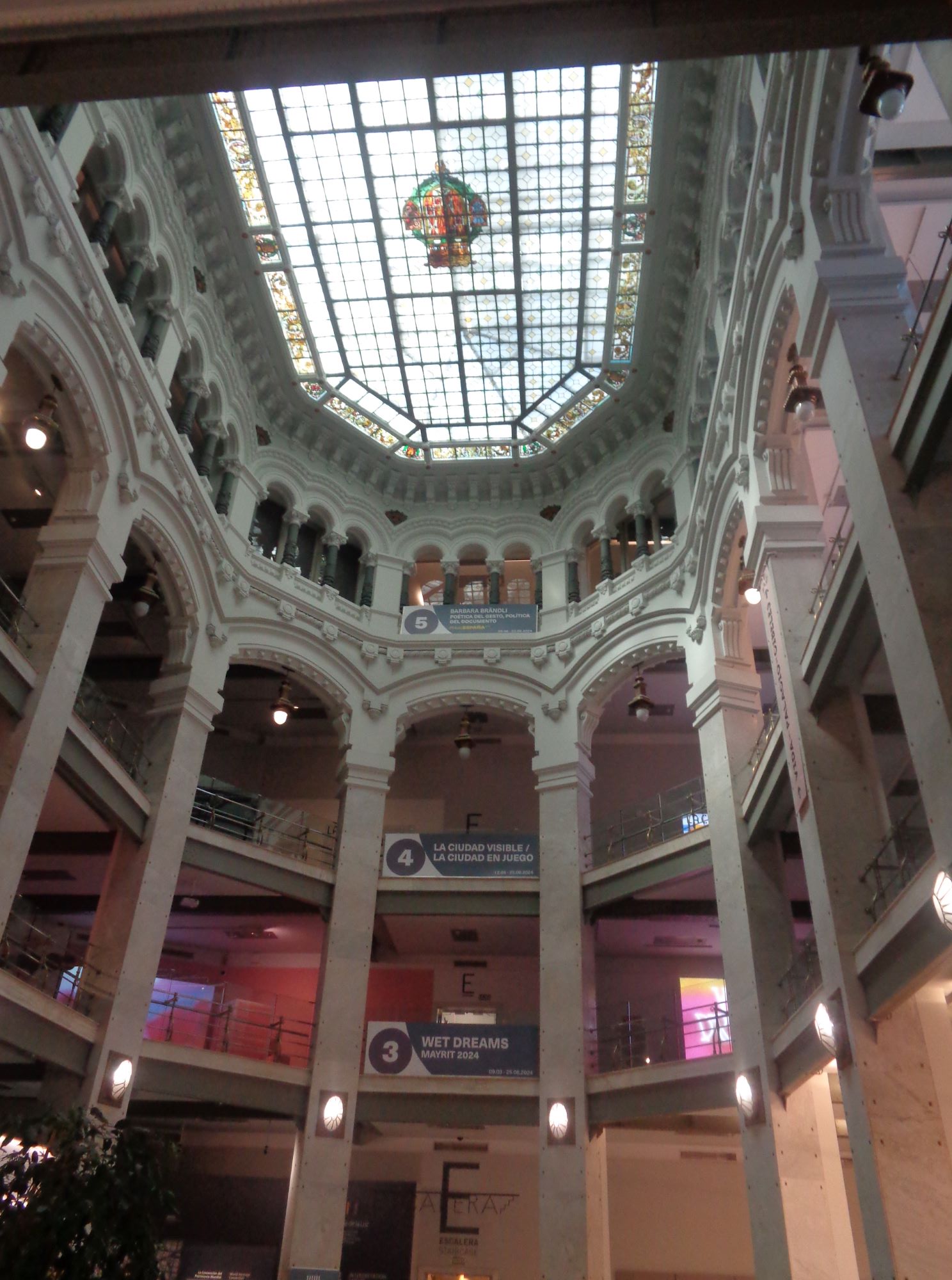
The Palace of Cibeles has three restaurants but unless you are dying hunger they are too touristic and overprice, we do not go to them, For info, they are the Café Cibeles, Cornamusa Cibeles , and on the rooftop the Azotea Cibeles.

A bit of history I like tell us that the building’s first stone was laid in 1907 and it would be officially inaugurated on March 14, 1919, beginning its operation as a modern distribution center for mails, telegraphs and telephones. The one officially called “Cathedral of Communications” is officially inaugurated. The royal couple attends the celebration king Alfonso XIII and his wife Victoria Eugenia, accompanied by various components of the government. One of the characteristic elements of the environment was the installation of the Cibeles fountain in 1794 designed of Ventura Rodríguez right in front !. The current Plaza de Cibeles was called Plaza de Madrid, which was renamed Plaza de Castelar. The Buen Retiro gardens reached their extension to the Paseo del Prado. The inaugurations of the Jardines del Buen Retiro in 1876 and the Hippodrome de la Castellana two years later caused the traffic to travel to the confluence of the street of or Calle de Alcalá with the Paseo del Prado.
In 2007, it began to house the municipal offices of the Madrid City Council, moving its units from the Casa de la Villa and Casa de Cisneros, both located in the Plaza de la Villa (see post). This reform of the early 21C in the building also included a cultural area called “CentroCentro”. The main access gives rise to the Hall Principal or main hall, a large space in the heart of the Cibeles building in the form of a lobby. In this Hall Principal the three communications services were arranged, distributed radially trilobite from the central dome, integrated in the Hall Principal illuminated by the exterior windows. To the right of the entrance are the postal services, in the telegraph entry and in the left one, the telephone service. All services were in the same space: the Hall Principal. The set is divided into two buildings separated by the Pasaje de Alarcón passage , which is currently covered by glass vaults. The building that overlooks the Plaza de Cibeles is the Post Office, Telegraph and Telephone Central. The other building after the passage of Alarcon is the General Directorate. The mailboxes are arranged in a section located to the right of the Central Post Office, behind a porch. In this building a large mail room aka Sala de Batalla or battle room with space for 400 postmen was arranged. In the Pasaje de Alarcón there was a distribution truck parking lot. The radial structure of telegraphic communications and its operation during 24 hours allows its use at any time. The telephone service area had twelve telephone booths for public service that allowed sufficient independence and isolation. In the General Directorate building, the administration of Telegraphs by Calle de Alcalá and Correos or post office by the Paseo del Prado is distributed.
The new era of the Palacio de Cibeles as CentroCentro! The Palacio de Comunicaciones or Communication palace becomes at the beginning of the 21C the new headquarters of the Madrid City Council and, in doing so, changes its name to Palacio de Cibeles. In 2003 it was decided that some functional areas of the building be transformed. This is the case of the sala de batallas or battle room, which is modified as in the Plenary Hall. On November 5, 2007, hosts the headquarters of the Mayor’s Office of Madrid . On November 29, 2011, the inauguration of the Plenary Hall of the building takes place with the presence of King Juan Carlos I and Mayor Alberto Ruiz- Gallardón. Now it opens the possibility of accessing the central tower of about 70 meters on floor no 8 that is opened to the public , and use it as a mirador or lookout of the city for a small fee.In the courtyard, at both ends, two social areas have been created, dedicated to citizen information and a reading room. There is now an exhibition space called CentroCentro, this space is incorporated with a couple of exhibition halls and an auditorium with capacity for a little more than three hundred people. In the central tower there is a huge electric clock face of about three meters in diameter that lights up at night ,and officially replacing the Puerta del Sol clock.
The official CentroCentro cultural center : https://www.centrocentro.org/en/exhibitions
The Madrid tourist office on CentroCentro : https://www.esmadrid.com/en/tourist-information/centrocentro
There you go folks , another wonderful nostalgic, sentimental trip to my dear Spain, Madrid is always nostalgic sentimental words cannot describe it ! This is a vibrant cosmopolitan cities of friendly faces and smiles to share in long conversations about life and more ; I love it, We will be back ,eventually!, Again, hope you enjoy this post on the Cibeles and CentroCentro of Madrid, part I !!! as I
And remember, happy travels, good health, and many cheers to all !!!


