
I have several posts on the streets of Madrid in my blog and even if cannot cover them all, I try to give you all of my nostalgic favorites. This time will show some very well known streets and some less; hope you enjoy the post as I. Therefore, here are more of the streets of Madrid ,part II !!! Hope you enjoy it as I.
The Paseo del Prado, from Plaza de Cibeles, you’ll catch one of Madrid’s best-known boulevards ,Paseo del Prado, which shares the same name as the world-famous art museum. Other than the prominent Prado, the boulevard stretches past Museo Thyssen Bornemisza, almost reaching Museo Reina Sofia in an area known as “The Golden Triangle of Art”. Other notable highlights along the way include the vertical garden at the Caixa Forum, the Royal Botanical Garden and the Fountain of Neptune, and Cibeles. Paseo del Prado ends at the Atocha train station, which is famous for its interior rainforest. a few of Madrid’s most famous hotels, including the Ritz-Carlton Madrid and Westin Palace Madrid. When walking, make sure to stay in the green area in the middle, where you’ll spot plenty of monuments, statues, fountains and people walking their dogs or enjoying an afternoon stroll. The Paseo del Prado is the oldest historical urban street in Madrid It runs north-south between the Plaza de Cibeles and the Plaza del Emperador Carlos V (also known as Plaza de Atocha), with the Plaza de Cánovas del Castillo (the location of the Fuente de Neptuno, and of the Ritz and Palace five-star hotels) lying approximately in the middle. The Paseo del Prado forms the southern end of the city’s central axis (which continues to the north of Cibeles as the Paseo de Recoletos, and further north as the Paseo de la Castellana).
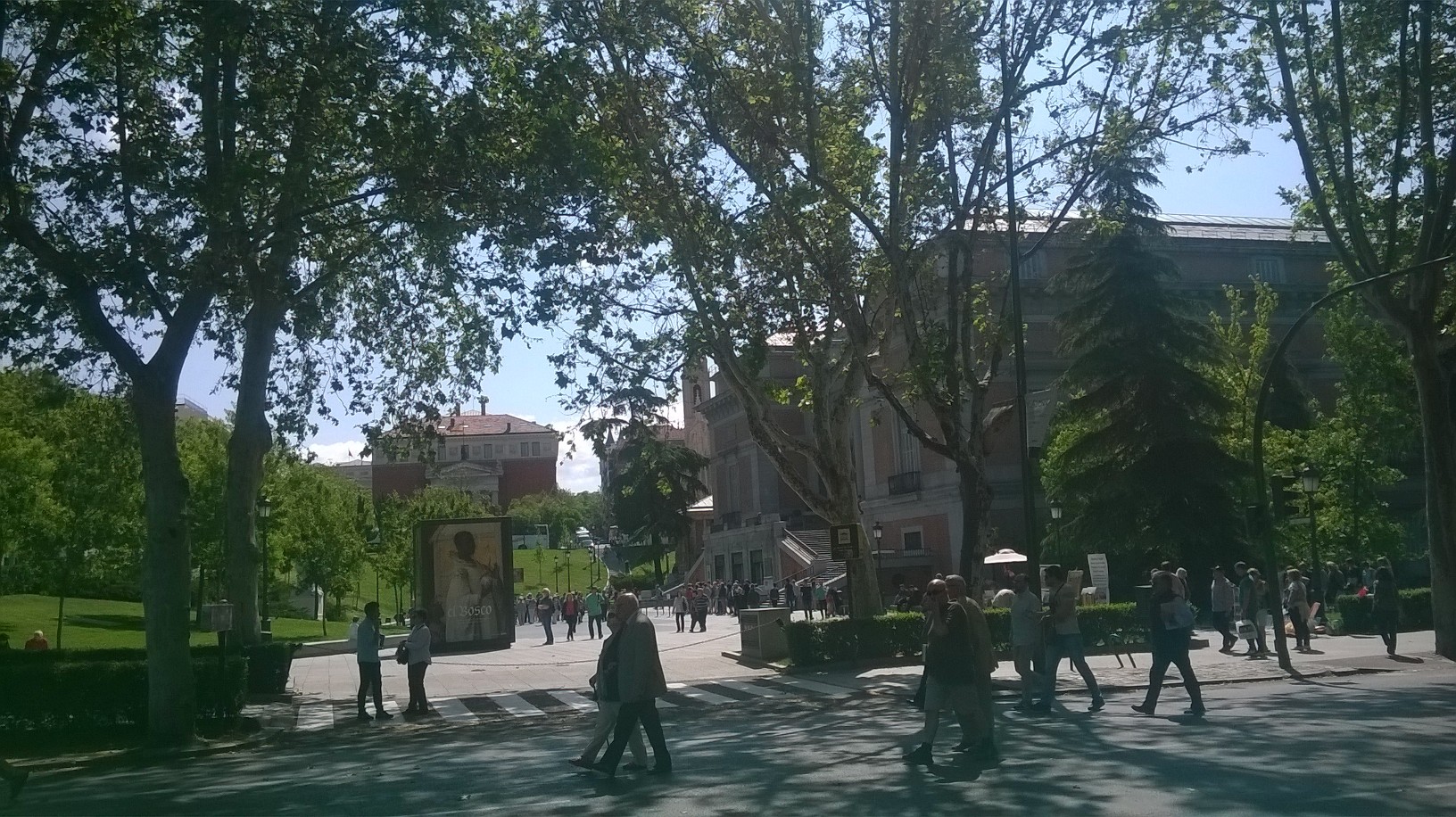
The Madrid tourist office on Paseo del Prado : https://www.esmadrid.com/en/tourist-information/paseo-prado
The Paseo de Recoletos is a wide boulevard leading from Plaza de Cibeles to Plaza de Colón. The center part of the boulevard is a pedestrian walk, lined with gardens, trees, statues, fountains and varied street furniture. The first and largest stretch of the boulevard (from Plaza Cibeles to Calle de Prim) has a row of eight ponds lined with white double doric columns;an equatorial sundial are nearby. The second and shortest stretch (from Calle Prim to Calle Almirante/Recoletos) contains the Café Gijón (number 21), an historic literary café founded in 1888 with an outdoor terraza on the boulevard. On the fourth and last stretch (from Calle Bárbara de Braganza/Villanueva to Plaza de Colón) is the Café El Espejo (number 31), another quant café with an impressive glass pavilion influenced by Art Nouveau.

The Madrid tourist office on the Paseo de Recoletos : https://www.esmadrid.com/en/tourist-information/paseo-de-recoletos
The Paseo de la Castellana , commonly known as La Castellana, is one of the longest and widest avenues of Madrid with 6 km of palaces and towers. It is named after an old Castellana fountain that used to exist in Plaza de Castilla from a stream starting in the Plaza Gregorio Marañon. It starts at Plaza de Colón, passes through the Nuevos Ministerios, Plaza de Lima, Plaza de Cuzco, Plaza de Castilla, and ends near the Nudo Norte (North Junction), connecting with the M-30 and the road to Colmenar Viejo. The Paseo de la Castellana is the continuation of Paseo de Recoletos and Paseo del Prado, and these three avenues vertebrate the north-south axis of the city. Here you have the supreme Estadio Santiago Bernabeu,home of the best of all times, Real Madrid CF! It entered service at the beginning of the 20C, and by early 21C consisted of 6 central lanes or main road, and 4 lateral service roads, Its extension to the north to Fuencarral is planned, within the urban project known as “Madrid Nuevo Norte”. The Paseo de la Castellana , commonly known as La Castellana , is one of the longest and widest avenues of Madrid. It is named after an old fountain that used to exist in Plaza de Castilla.
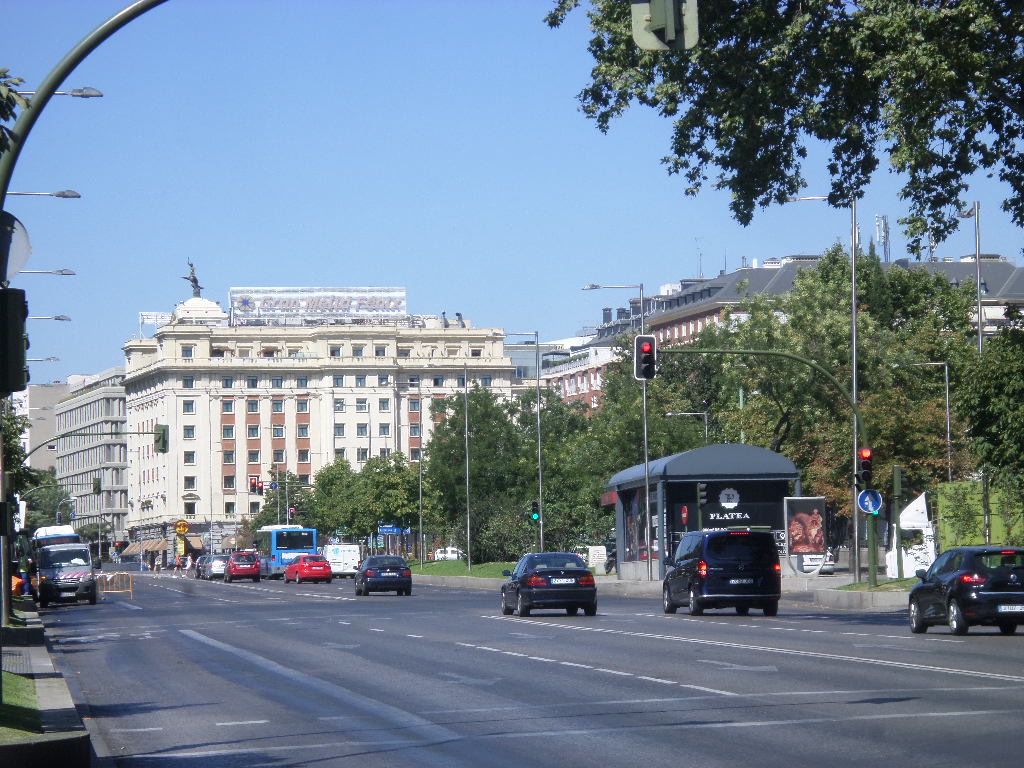
The Madrid tourist office on the Castellana neighborhood:https://www.esmadrid.com/en/madrid-neighbourhoods/castellana
The official Madrid Nuevo Norte project : https://creamadridnuevonorte.com/en/home-en/
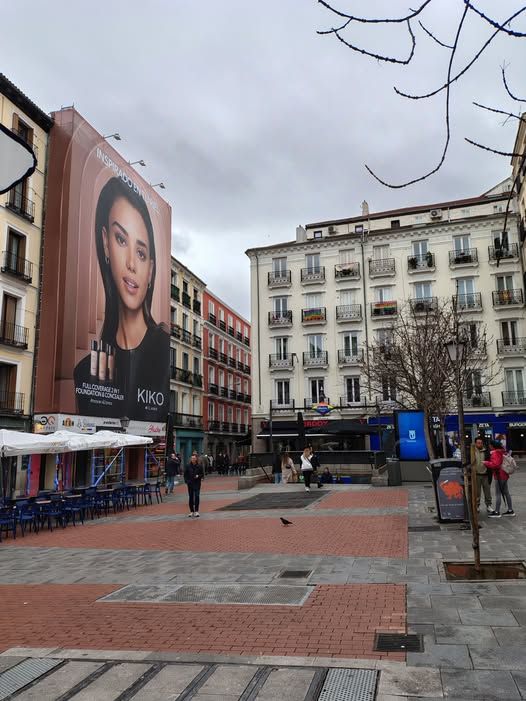
The plaza de Chueca square, formerly called San Gregorio Magno Square, is a small pedestrian area in the Justicia neighborhood, Centro district of Madrid, It is framed by Calle Gravina and Calle Augusto Figueroa , on one side of the start of Gran Vía. Dedicated since 1943 to the Madrid composer Federico Chueca, it gives its name to the entire neighborhood. This talented composer composed several valuable musical works, including zarzuelas and operas. Born in 1846, he was 100% Madrileño or locals ; just by reading the titles of his compositions, you’ll understand why In the first half of the 19C and part of the previous century, the space occupied by the buildings that enclose the square and its surroundings were occupied by La Galera, a women’s prison brought to this area from previous locations, and the orchards of the Dukes of Frías. They made them the streets very suitable for the immoral and treacherous scenes that Don Ramón de la Cruz and Don Francisco Gregorio de Salas aspired to poetize in their farce. The Plaza de Chueca is a short walk from the Mercado San Antón market, is located in the heart of the neighborhood it takes its name from, the Barrio de Chueca, now known in the city as the “gay district.” The square blends perfectly into the neighborhood’s atmosphere: in addition to the metro exit, there are several tapas bars, a couple of small shops, and a few restaurants with outdoor seating… Easy by metro Chueca Line 5, Between Plaza de Chueca and Fuencarral and Hortaleza streets, there is a sprawling neighborhood of quiet little streets whose commercial activity surprises visitors. The epicenter of the gay scene, the neighborhood has opened up to all kinds of offerings, becoming one of the most visited areas, both by locals and visitors from elsewhere.
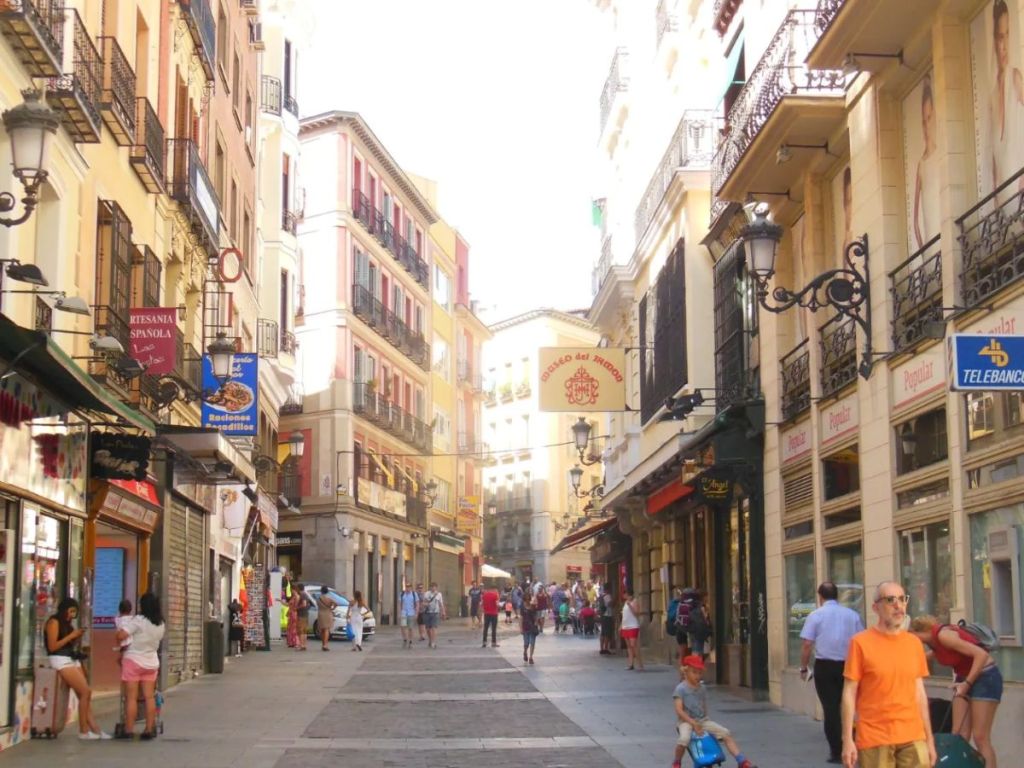
The Calle de Postas is located in the Sol neighborhood of the Centro district of Madrid. It runs Calle Esparteros to its beginning at Calle Mayor to calle Zaragoza , next to the Plaza Mayor. It owes its name to the fact that in ancient times it was the traditional meeting and departure point for the post coaches leaving the Court for different points of Spain, as the original Post Office was located here in the 16C. You can reach this street by many means such as bus Lines 001, 002, 1, 2, 3, 46, 74, as the ones I have used ,and Metro lines 1,2,and 3 Sol station, Also, Cercanías trains C3, C3a and C4 at Sol station, We love to come here as we found the Amorino Gelato italian ice cream at No 3, had indulge in the Flamenco Madrid | Cardamom at No. 4. Its past is documented in 1620 with a building permit to widen the street. At No 31 (new no, 32) stood the Casa de Postas, which had on its portico the painting legendary in miracles and whims of an image of the Virgin of Solitude. At No 17, on the corner of Calle Marqués Viudo de Pontejos, is the traditional Posada del Peine, one of the oldest examples of polychrome tilework in Madrid. The hotel it houses, completely renovated inside, is heir to a long tradition that dates back to 1610, and to the union of three properties over the centuries. The inn also featured in the acceptance speech of Nobel Prize winner Camilo José Cela to the Spanish Academy. In the midst of this picturesque commercial melting pot, the Cine Postas was located at Nos 7 and 9 since 1948, considered by chroniclers as one of the most shady in Madrid, which after degenerating into “Sala X” for a few decades ended up converted into the inevitable souvenir shop for tourists. Even at the beginning of the 21C, more or less old shops survive, such as “Joyería y Relojería Santos”, installed since 1956 at No 21. More traditional is the blanket store “La Camerana” at No 16, founded by Basilio Sánchez Pérez from La Rioja in 1854. But the jewel in the crown is the unique store “El Ángel” (Sobrinos de Pérez or Perez ‘s nephews),at No 6 dedicated to sacred art since 1867 and founded by two other Riojans, Basilio and Leoncio Pérez. Its façade measures just 3 meters and 11 centimeters, making it the third narrowest building in the center of Madrid. For Galdosists, it is one of the emblematic streets of Madrid that Benito Pérez Galdós universalized in his Contemporary Spanish Novels. The Calle de Postas, due to its presence and influence on Galdós’ work, has merited the attention and study of renowned Galdosists. In this commercial hub, the cradle of the 19C Madrid bourgeoisie, Galdós forged the universal history of Fortunata and Jacinta.
The Calle Carretas , it is said that, in order to defend the watchtower of Puerta del Sol, the rebels built a barricade with carts. This street was one of the first streets in Madrid that had sidewalks in 1834. Later, at the end of the 19C, the street became famous for the number of shops specializing in orthopedic devices. Pedestrian since 2018, it is true that nowadays, the establishments on this street are more and more franchises from the world of fashion and textile and fewer traditional shops, but this is the irremediable trend that is pushing the world, The name came from the revolt that was unleashed, which is known as the War of the Communities. Toledo, Guadalajara, Valladolid, Zamora … the rebellious spirit spread like wildfire and that uprising ended up arriving in Madrid. In the case of this street, they used numerous carts to as barricades and, therefore, it began to be known as the “street of the carts”. Name that continues to be used to this day. Some historical anecdotes on businesses there tell us of a certain Café Pombo ,a Madrid café located at Calle Carretas 4. Meeting place for artists who would become famous when, from 1912, the writer Ramón Gómez de la Serna decided to hold his literary gathering on Saturday nights, called La Sagrada cripta del Pombo, and which remained until 1942. Another place, historical in its own way, was the Café La Juventud, opened in the early years of the 20C, and which had, like many similar places at that time, a stage; in it, comedians such as Loreto Prado and Enrique Chicote made themselves known. Later, the building became the Romea Theater, which was demolished shortly before the Spanish Civil War.

A pedestrian street, Calle de Preciados is located between Puerta del Sol and Plaza Callao. Department stores, brands of various standings, and above all a lively atmosphere! The locals rub shoulders with tourists, who come as much to shop as to stroll. One of my favorite streets even today we shop there a lot.
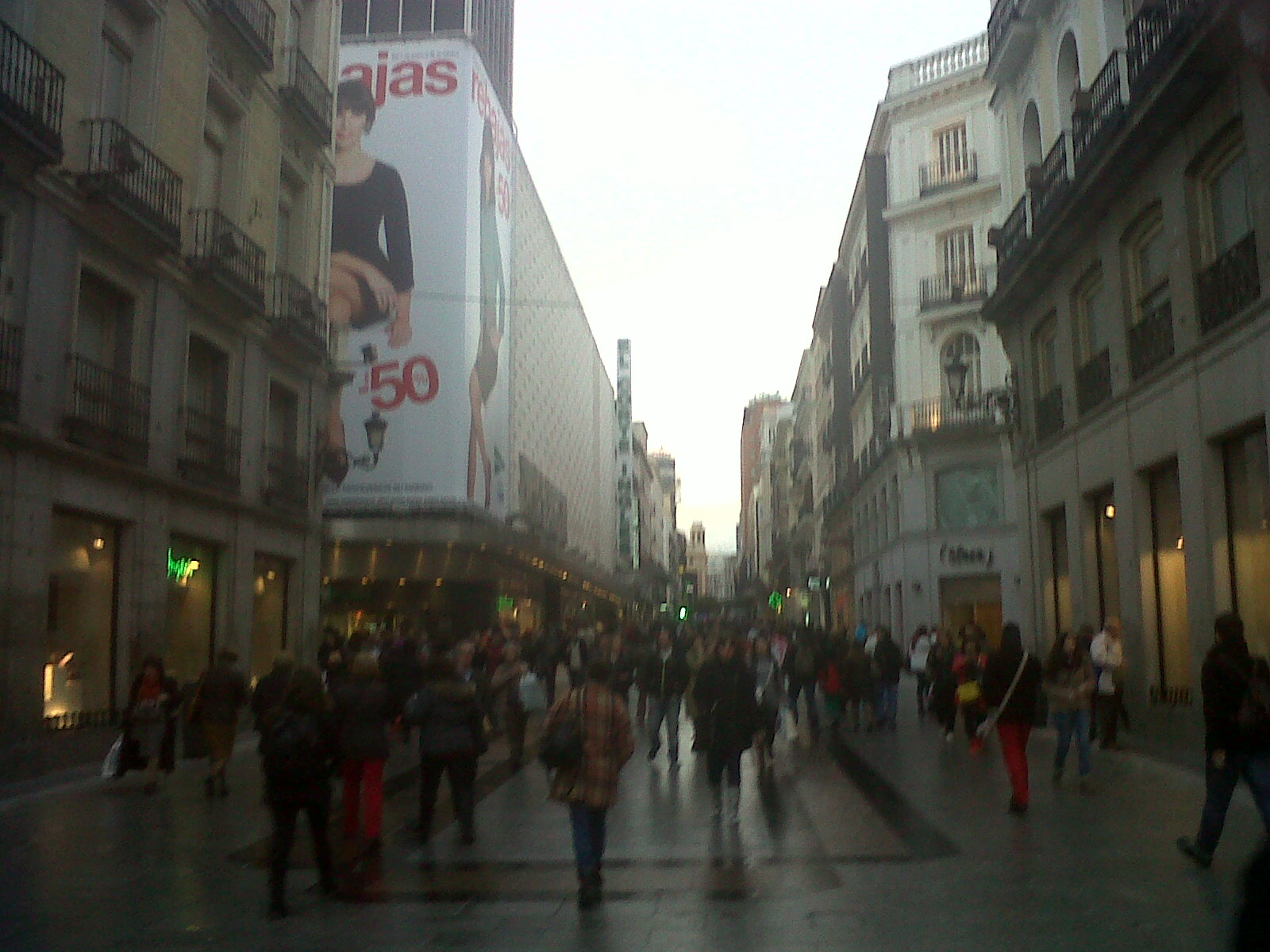
Calle de Preciados is named for two brothers who were civil servants in the 15C, working as almotacenes. That means they were in charge of monitoring the use of different measurements and coins by the different tradesmen operating in the neighbourhood. at the end of the 19C, the Centro Numismático Matritense, a bureau de change, was established here.
Calle de Preciados begins at Puerta del Sol and ends at Plaza de Santo Domingo, passing through Callao, where it makes a jog. It is a street with various commercial premises and it occupies the fifth position of the streets in the world where the rent is more expensive. It is famous for the presence of El Corte Inglés and other international franchises. However, with my Mom Gladys we came to know it first by this anecdote! In 1943 the businessman Pepín Fernández began his commercial activities in this central street by opening the Galerias Preciados, which took the name of the street. It’s considered to be Madrid’s first shopping center. It was eventually absorbed by El Corte Inglés, in 1995, but the building that was home to the galerías is still one of the most distinctive ones in the area. In fact, it’s served as a set for plenty of adverts and films, like ‘The Day of the Beast’ by Álex de la Iglesia.
On the Calle de Preciados was the Varela café, an emblematic place from the 19-20C, frequented by Miguel de Unamuno, Emilio Carrerè and the Machado brothers, among others. In 1973, it was one of the first pedestrian streets in the capital before the year 2000 and decided to open a hotel (Hotel Preciados) and recovers the Café Varela, which functions as a hotel cafeteria as well as for clients from outside. The Calle del Carmen is in the Centro district of Madrid. It begins at Puerta del Sol and ends at Plaza del Callao. Currently it is one of the most commercial streets of the capital, highlighting among its shops the famous lottery administration of Doña Manolita,at No 22,(see post) being a custom on the eve of the Christmas draw, its long queues to acquire a lottery ticket. It has intersections with Plaza del Callao ,Calle Salud, Calle Tetuán, Calle Galdo, Calle Rompelanzas, and Calle Mesonero Romanos.
The Madrid tourist office on Doña Manolita: https://www.esmadrid.com/en/shopping/dona-manolita
The official Real Madrid on the store in Calle del Carmen: https://www.realmadrid.com/en/santiago-bernabeu-stadium/stores/el-carmen-store?pid=139016521119
It is known the existence of a church of Carmen Calzado that would give the name to the street. The convent of Nuestra Señora del Carmen, calzado of San Dámaso, was located at the beginning of the street that intersects with Puerta del Sol is found the gate that gave rise to its name. The statue of the Bear and the Strawberry Tree was located at the entrance to this street, and in 2009 it was relocated at the entrance to Calle de Alcalá. The painter Juan Gris was born in 1887 in the building at number 4 facing Calle Tetuán. The street was peatonise in 1993.
You can get to these areas of Madrid easily, walking or public transports. For info. Metro: Sol (lines 1, 2 and 3), Callao (lines 3 and 5) and Santo Domingo (line 2) stations. By train: Cercanías (commuter lines) C3 and C4, Sol station. By bus: 1, 2, 46, 74, 75 146.
For info work has started on the Puerta del Sol where things will be moving around including the Madroño bear, the idea to make it more pedestrian sort of what they already did with the Plaza de España.
The Madrid tourist office on shopping Preciados :https://www.esmadrid.com/en/sol-preciados-carmen-compras
There you go folks, a wonderful tour of the sublime streets of my Madrid, on foot is better I said! Again, hope you enjoy this bit of a tour of different sections and the streets of Madrid ,part II !!! as I. And remember, happy travels, good health, and many cheers to all !!!


Excellent, thanks for the memory nudge.
LikeLiked by 1 person
Thanks for stopping by Cheers
LikeLike