
And so opportune that now when the going out is restricted I remember the glorious walks in my Madrid! Of course one of my favorite cities and the world and having lived there is sublime. i have written many posts on the city and its streets, this is another one. Let me show you more streets of my Madrid, always Madrid Fuerza Madrid!!! I must say not only walk but drove on this promenade many times and especially the last few years coming into my Madrid by car. Therefore, here is my take on the streets of Madrid, part I !!! Hope you enjoy the post as I.
The Paseo de la Reina Cristina is the segregation of the land of the Olivar de Atocha (olives field) carried out by creating a new avenue, named after Queen Cristina, tangentially drawn to the Basilica of Atocha and, then, already proposed as one of the main access roads to the city . In this urban operation, some historical and emblematic buildings of the city are located , such as the Basilica of Our Lady of Atocha, whose origin dates back to 1523 with the foundation of the convent dedicated to this virgin, although previously there was a hermitage in this place. where the Virgin of Atocha was venerated. In 1836, with the confiscation of Mendizábal, only the church was preserved from the primitive building and where the quarters of the convent were located, the Cuartel de Invalidos or barracks of invalids was built. In 1890, taking advantage of the fact that the basilica was going to be rebuilt, it was decided to locate a Pantheon of Illustrious Men on the site of the old barracks, with the intention that the mortal remains of the most famous Spaniards in history would rest there. Today you can visit the Basilica of Atocha, where the remains of Fray Bartolomé de las Casas, protector of the Indians (Americas), and the Pantheon of Illustrious Men, where, among others, are the remains of Canovas del Castillo, Sagasta and Canalejas in beautiful graves. Next to the Basilica is the Royal Tapestry Factory and its museum. The building where it is located was built between 1889 and 1891 but its antiquity dates back to 1720 and then it was in front of the Puerta de Santa Bárbara – today Plaza de Alonso Martínez-, hence the name of the Royal Tapestry Factory of Santa Bárbara. In this museum you can see the works that Francisco de Goya carried out commissioned by Cornelio Vandergoten, a collection of 41 invaluable tapestries, in addition to numerous cartons, sketches, carpets and tapestries by other great masters. This street continues as the Paseo de la Infanta Isabel and later the Avenida de la Ciudad de Barcelona leading to Atocha train station.
What is best here is the Basilica de Nuestra Señora de Atocha: Tourist office of Madrid on the Basilica
And the Royal Tapestry Factory: Tourist office of Madrid on the Royal Tapestry
And the Pantheon of Illustrious Men: Tourist office of Madrid on the Pantheon
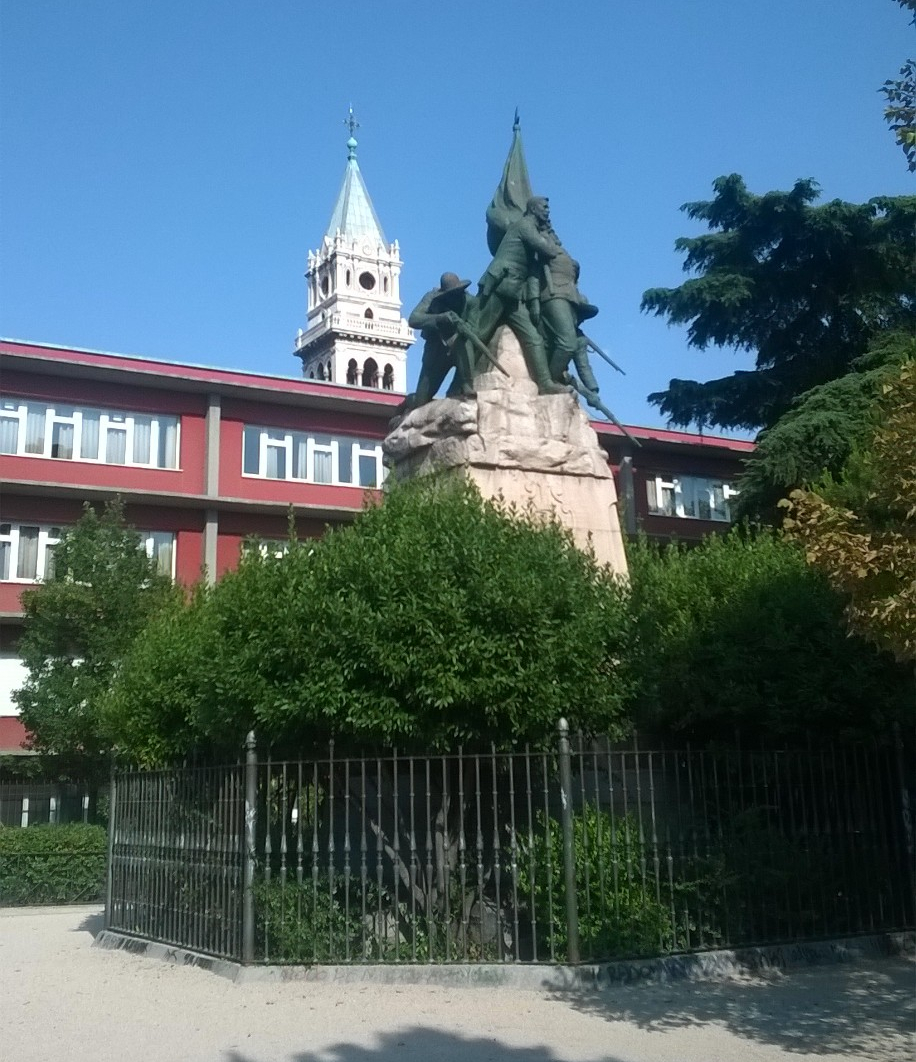
This one is in old Madrid, beautiful area for walks recommended. The Plaza de la Provincia (province square) is located in the Sol neighborhood, in the Centro district. From this square the ancient Calle Atocha starts towards the Plaza Jacinto Benavente square, while on the opposite side Calle Gerona , which enters the Plaza Mayor, and the Calle Imperial, which leaves towards the La Latina neighborhood. To the north, the square extends to the neighboring Plaza de Santa Cruz, and from there you can go down Calle Esparteros to Calle Mayor, a few steps from Puerta del Sol.
It is known by this name since the construction on its side of the Palace of Santa Cruz, built in 1636 and prison of the Court and headquarters of the Provincial Notaries. On the opposite side of the palace was the ancient parish of Santa Cruz, which disappeared in 1869, and which separated this square from that of La Leña, today the Plaza de Santa Cruz. The location of this square corresponds to the old Arrabal de Santa Cruz, in the Lagunas de Luján where the Plaza Mayor of the town finally settled. From this square, Calle Atocha, one of the most traditional in Madrid, starts. In the center of the square there is a fountain called the Orfeos or Orpheus fountain, which was built in the first third of the 17C and dismantled in the 19C. It was transferred to the National Archaeological Museum, where it remains. A reproduction made at the end of the 20C is currently on display. A monolith located a few meters from the fountain, in front of the Palacio de Santa Cruz, which commemorates Spain’s accession to the European Union on January 1, 1986. It is a large gratin stone, curved at the front and angled on the back, sitting directly on the ground and with the incised inscription occupying the main face.
The Orpheus fountain here at tourist office of Madrid: Tourist office of Madrid on Orpheus fountain
And the Palace of Santa Cruz: Toursit office of Madrid on the Palace Santa Cruz

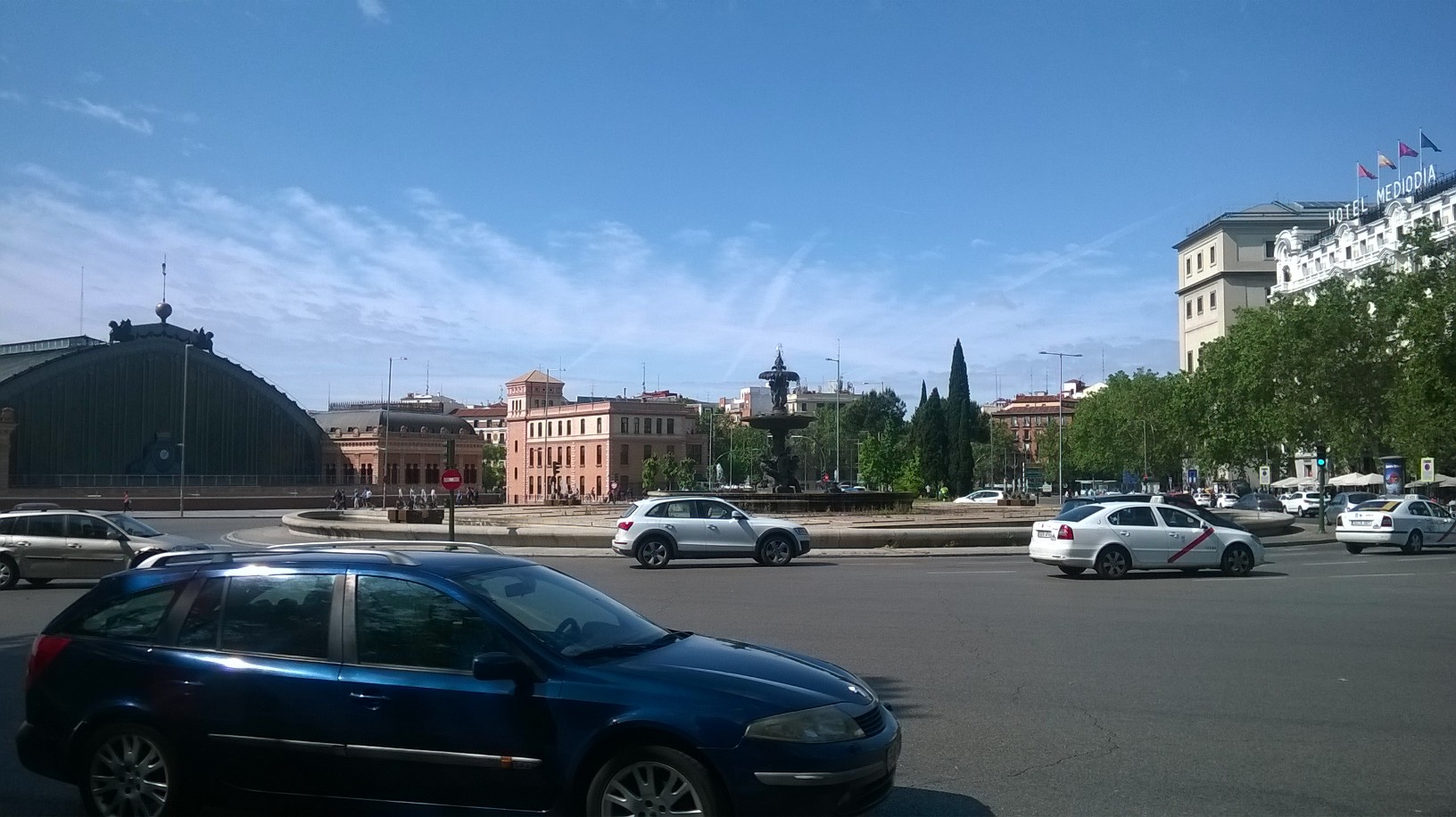
The Plaza del Emperador Carlos V (emperor Charles V square) is a roundabout where the Paseo del Prado, Calle de Atocha, Calle de Santa Isabel, Ronda de Atocha, Paseo de Santa María de la Cabeza, Paseo de las Delicias, Calle de Méndez Álvaro, Paseo de María Cristina and Avenida Ciudad de Barcelona connects. Until 1941 it had the name of Plaza de Atocha or roundabout of Atocha, names by which it is still known. It gave its name to the Mediodia (noon) or Atocha station, the main railway station in Madrid. In this square there is also the Reina Sofía National Art Center Museum , that is in the former General Hospital, and the Ministry of Agriculture (Palacio de Fomento).
It owes its name to the Puerta de Atocha demolished in 1850 ,which was located where a replica of the fuente de la Alcachofa (fountain of the Artichoke) was later placed at the Retiro park, where it is today at Plaza de Honduras. There is a replica at the square today see picture. In 1941 the roundabout was given the current name to avoid duplication or confusion with Calle de Atocha. On one side of the roundabout, the Atocha station has stood since 1892. In front of the Cuesta de Moyano (Madrid book fair and stands are today) hill is the statue of Claudio Moyano. As an alternative to the traffic problem, an underpass was built between the Ronda de Valencia and the Paseo de María Cristina, under the square and the cercanias train tracks of the Tunel de la Risa (laughter tunnel).
The Atocha train station at Madrid tourist office: Tourist office of Madrid on Atocha train station at Carlos V
And the Reina Sofia museum: Tourist office of Madrid on the Reina Sofia
And the Palacio de Fomento: Tourist office of Madrid on the Ministry of Agriculture
The Carrera de San Jerónimo runs between Puerta del Sol and Plaza de las Cortes (Palace of the Spanish Parliament or Congreso de Diputados- see post). It was once called the calle Camino del Sol. The street has two distinct sections, the first runs from the Puerta del Sol, almost parallel to Calle de Alcalá until it reaches Plaza Canalejas, and from there it heads towards San Jerónimo el Real (see post), with the street ending at Plaza de las Cortes. You see the pic at end the Casa de Don Tomás de Allende. It is an ancient road leading to the Jenónimos Monastery, on the other side of the orchards known as the Prado de los Jerónimos. The first buildings were documented as early as the 16C, and a sewer was built in 1618. The inn, La Fontana de Oro, became popular as a meeting place and political gathering, as reflected by Benito Pérez Galdós in his novel La Fontana de Oro. On the corner of the neighboring Calle de la Victoria, the Hotel Embajadores prospered. The Lhardy restaurant (see post), located at no 8 on Carrera de San Jerónimo, was opened in 1839 by the Frenchman Emilio Huguenin Lhardy. It is considered one of the first and oldest restaurants in Madrid, at least as it is known today, that is: a menu with a price for each dish. In 1855, the Jijona confectioner, Luis Mira (see post), opened Casa Mira (see post) at no 30. On the second stretch of the street, there were several noble homes and mansions, including that of the Marquis of Santiago (where the Casino de Madrid resided for some time), the house of the Duke of Tamames, and that of the Marquis of Valdegena. At no 24, the Cerveceria Inglesa or English Brewery stood in a building that would be demolished to build the Reina Victoria Theatre (see post). Directly opposite was the Café de la Iberia. At no 35 is the Palace of the Marquis of Miraflores. The first public screening took place on the ground floor of the Hotel Rusia on this street in the Lumière brothers’ cinema , as a screening was given for the press and special guests, Perhaps the most illustrious residents was Francisco de Goya, who lived in a house belonging to the Marchioness of Campollano, between 1778 and 1779.

The Calle del Pez descends from Corredera Baja de San Pablo to Calle San Bernardo, creating a fundamental axis in the heart of Malasaña. This vibrant Madrid neighborhood is roughly bordered by the streets of Princesa, Gran Vía, Fuencarral, Carranza, and Alberto Aguilera. Calle del Pez is in the Universidad neighborhood strategically located between the Chueca and Conde Duque neighborhoods, forming part of what was formerly known as Barrio de Maravillas. Its privileged location places it within walking distance of several emblematic sites, such as Plaza del Dos de Mayo, considered one of Malasaña’s centers of social and cultural activity. Furthermore, its central location places it just a few minutes’ walk from Gran Vía, Madrid’s main artery, making it easily accessible from anywhere in the city. Between the legend of its name and the last chapters of its past on the edge of the traditional and the underground, some chroniclers have wanted to see it as one of the streets with the most flavor of the old Barrio de Maravillas ,which became Malasaña because of the Movida Madrileña (1980’s). Its brief journey has been recorded in the pages of Galdós and Baroja Madrid, the cinema of Alejandro Amenábar, and some scores of the “seismic” music of 20C.
The Calle del Pez hides a fascinating legend that dates back to a girl named Blanca Coronel and a mysterious fish pond, a story that gave its name to this iconic 400-meter long street in the heart of Madrid. From its origins as one of the most aristocratic streets of the 19C to becoming the epicenter of Madrid’s movida, The origin of this first name is Don Diego Henríquez, a priest of noble lineage who owned a large estate here. His grounds featured five pools and a fountain of exquisite water with various jets. According to various chronicles, when Felipe II moved the court to Madrid, the city council purchased part of the estate from Father Henríquez for the purpose of building homes. However, the other part of the property was acquired by Juan Coronel, who would have been entitled to the land containing one of the ponds. During the construction of Juan Coronel’s new residence, the builders began using the water from the pond for the works. Consequently, the water became increasingly cloudy and depleted, causing the death of most of the fish that lived there. Blanca Coronel, Juan’s daughter, sadly watched as only one fish remained in the increasingly dirty waters. Moved by her love for the animal, she decided to rescue it and place it in a glass fish tank where she lovingly cared for it for some time. Despite her efforts, the last fish also died, causing the young woman deep grief. To console his grieving daughter, Juan Coronel ordered a stone fish carved on the facade of his house, which stood on the corner of what is now Calle del Pez and Calle del Marqués de Santa Ana. He also had a sign placed there reading “Casa del Pez.” This symbol has been respected over time, gaining such importance that the entire street eventually took on its current name. Today, the figure of the fish can still be seen carved on the facade of the building located at No 30 Calle del Pez ; and is one of the most sought-after photographic spots by visitors. Despite this, Blanca Coronel became a nun in the convent of San Plácido, later becoming involved in the mysterious events that occurred there.
At the end of the Calle del Pez on the corner of Calle de San Bernardo, stands the majestic Palacio Bauer, one of the finest examples of a 19C palace in Madrid. Built in the 18C for the Marquises of Guadalcázar, it was acquired in the mid-19C by the Bauer banking family, of Hungarian origin. After being declared a Historic-Artistic Monument, the Escuela Superior de Canto was installed there in 1872 ,a singing school. Leaning against the façade of the Bauer Palace, you’ll discover Julia, a charming life-size bronze sculpture installed on April 12, 2003. The statue represents a student carrying books in her arm, paying homage to those women who in the 19C had to disguise themselves as men to enter the Central University, which was located in this same building. The sculpture, officially titled “Tras Julia,” has become a symbol of the neighborhood. The building at No 3 Calle del Pez acquired legendary charisma thanks to Sergio Oksman’s documentary “A Story for the Modlins,” which won a Goya Award in 2013. This film tells the extraordinary story of the Modlin family, an American family who settled in Spain fleeing the Vietnam War, lived in one of its upper floors between the beginning of the 1970s and 2003 until the death of its last member. At No 10 Calle del Pez on the corner of Calle de la Madera, is the Teatro Alfil. This iconic cultural space opened in 1948 as a morning movie theater (Cine Pez) and was converted into a theater in 1971. Since 1996, it has been managed by the Yllana company, which has positioned it as a benchmark for comedy and humor in Madrid. It is the only theater in Madrid with a bar inside the theater. The Palacio del Marqués de Escalona y de Bornos located at No 12 Calle del Pez on the corner of Calle de la Madera. It was built between 1860 and 1862 for the Countess of Bornos by one of the most elegant architects of Isabelline in the late-neoclassical tradition of the mid-19C,it was renovated and converted into a residential building between 1986 and 1987. Also nearby is the Teatro Victoria at No 17, another space that enriches the cultural offerings of this lively street. Another romantic building that still exists at Nos 38-40 Calle del Pez, on the corner of Calle Pozas, is the former palacio del duque de Baena,1860.
In the chapter on the ancient cartography of Ramón de Mesonero Romanos it can be added that it already appears in the Teixeira map of 1656, although at that time two sections with different names are shown, that of Pez, from its beginning in the Corredera to the intersection with the Calle de las Pozas, and with the sign of Calle de la Fuente del Cura from Pozas to the “wide street of San Bernardo” Almost at the beginning of the street, in the widening formed by Calle del Pez with Calle del Molino de Viento (a space that from the second decade of the 20C took the name of Plaza de Carlos Cambronero, stood the mansion that housed the Royal Pestalozzian Institution, whose creation is attributed to Manuel Godoy. Some 19C newspapers, such as La Prensa and the Carlist newspaper La Esperanza (published between 1844 and 1874), had their editorial offices in this same house. The Convent of San Plácido is of the Benedictine order located on Calle del Pez, between Calle San Roque and Calle Madera. Its main entrance is at No 9 Calle de San Roque. Between 1628 and 1808, Velázquez’s Christ, painted by the master for this church, was in the sacristy. It then passed into the private collection of Manuel Godoy. After passing through many owners, it was bequeathed to the Prado Museum. A finely crafted copy is found in the lower choir stalls of the church.

The Madrid tourist office on the Barrio Malasañas or neighborhood : https://www.esmadrid.com/en/madrid-neighbourhoods/malasana
The Calle Cava Baja is a street in old Madrid, right in the La Latina neighborhood, that runs between the Puerta Cerrada square and the Humilladero square and has about 50 bars. Throughout history, countless establishments have been opened and closed on this street, almost all related to eating and drinking. For example, the Posada de la Villa dates from 1642, and in the place where Casa Lucio now opens its doors was the Posada de San Pedro, which already existed in 1720, and then the historic Mesón del Segoviano. The word cava com , hence its name. When the moat was filled, the road was renamed Cava Baja de San Francisco (in this area there are many references to this saint, such as the Basilica of San Francisco el Grande), and from 1835 simply Cava Baja. At the quant Calle Cava Baja,if you’re hoping for an authentic Spanish street, this is it. The small, curved pathway (part cobblestone too) of Cava Baja is lined with some of Madrid’s most typical Spanish restaurants and bars. The street was once a jumping off point for postmen to take the mail from Madrid to the smaller villages outside the city back in the 17C. Today, it does retain a certain old-city charm, where you’ll find plenty of tapas bars, some with caves down below where you can eat and drink.

The Cava de San Miguel is a short and old urban street in the Madrid of the Austrias in the Palacio barrio or neighborhood. It leaves Calle Mayor and, leaving Plaza Mayor to one side, descends to Calle de Cuchilleros. It concentrates part of the most typical local colour of the area of the Cuchilleros arch, with establishments such as Las Cuevas de Luis Candelas (see post) or the Mesón del Verdugo, installed in the basements of the retaining walls of the square and the primitive network of medieval undergrounds. Before, in the medieval period, the defensive ditch of the wall that came down from the Puerta de Guadalajara passed through it, until the cave or mine was filled in 1567, and the new street was given the name of the archangel after the neighbouring church dedicated to San Miguel de los Octoes and demolished by Joseph Bonaparte. There could not be missing references in the work of Benito Pérez Galdós, who immortalized the street in works such as “Fortunata and Jacinta” with special prominence in this nocturnal episode of the character Plácido Estupiñá. At no11, Calle Cava de San Miguel, stands the building which the novelist, Benito Pérez Galdós, used to set the home of his character, Fortunata, from the novel, Fortunata y Jacinta (1886-1887)

The Madrid tourist office on Galdos’ Madrid: https://www.esmadrid.com/en/galdos-madrid-map
And asi asi de bonita es mi Madrid, like that pretty is my Madrid! Sublime walks who wants to be underground! See the beautiful architecture and history abound in all these streets of yesteryear ,today ,and hopefully forever in Madrid. Bear in mind , many of these monuments already have a separate blog post for them. Again, hope you have enjoy this post on the streets of Madrid, part I !!! as I.
For info the Madrid tourist office on neighborhoods: https://www.esmadrid.com/en/madrid-neighbourhoods
And remember, happy travels, good health, and many cheers to all !!!


We just loved Madrid during our recent visit. The people were great, the food was fantastic, and the parties were out of the world.
LikeLiked by 1 person
hahaha yes indeed glad you like, thanks for stopping by. As we said, From Madrid to heavens and a hole in the sky to look down on it everyday! Cheers
LikeLiked by 1 person