
Again ,looking back into my albums, I found me new old paper pictures not yet in my blog, These tell of a memorable time in my life and full family, which enjoyed much coming to Saint Augustine, Florida !!! Happy to find me this picture to tell you personally about this wonderful sight in the City, The Castillo de San Marcos is a wonderful place we have enjoyed here over the years living not far south. Therefore, let me give you my take on the Castillo de San Marcos of Saint Augustine, Florida !!! Hope you enjoy the post as I
The Castillo de San Marcos 1 South Castillo Drive: The oldest masonry fort in the continental U.S., the castle fortress is the focal point of historical St. Augustine. The Castillo de San Marcos built by the Spanish, is the oldest fort built between 1672-1695. It changed its name several times: it was called Fort St. Mark during the British period (1763-1784) then Fort Marion between 1821 and 1942. The Castillo de San Marcos site spans 8.3 hectares. The fort’s architecture is characteristic of fortresses built in Europe during the early modern period. It is surrounded by water-filled moats, with water levels regulated by a gate according to the tides. Several bastions and turrets are positioned to eliminate blind spots. The fort follows a square layout, with a diamond-shaped bastion extending from each corner. Each bastion is equipped with at least one cannon. At the center of the structure lies the plaza de armas or parade ground, around which the various rooms are arranged. Among the fort’s 20 main chambers, five were reserved for the storage of provisions (corn, rice, beans, wheat, etc.). There was also a chapel, the doorway of which was designed in 1785.
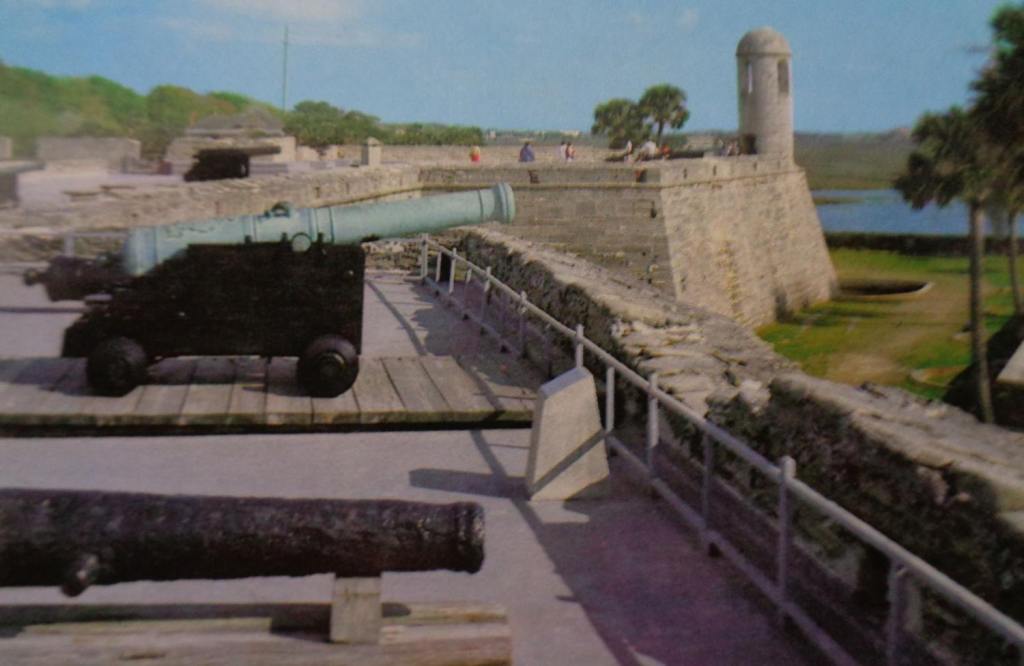
In the 16C, the Spanish became the first Europeans to explore and colonize Florida. They founded the city of St. Augustine in 1565 and erected a succession of nine wooden forts to protect it from Native Americans, pirates, and other colonial powers. Following an attack by the English pirate Robert Searle in 1668, the Spanish regent, Mariana, ordered the construction of a stone fort to ensure the defense of St. Augustine.The manpower that is lacking on site comes partly from Havana (Cuba), as does the military engineer in charge of the work, Ignacio Daza. Native Americans are also involved. Due to the sandy nature of the soil, storms, disease, and supply chain challenges, construction lasted until 1696. In 1738, the Spanish engineer Pedro Ruiz de Olano renovated the fort, notably redesigning its interior. He replaced the wooden ceilings with stone vaults, which allowed for the placement of cannons on the terrace above. The outer wall was also raised. The work was completed around 1740.
The Seven Years’ War (1756–1763) once again pitted Spain against Great Britain. Under the Treaty of Paris of 1763, Britain acquired Florida in exchange for Cuba ! On July 21, 1763, the Spanish governor handed over the Castillo de San Marcos to the English authorities, who renamed it Fort St. Mark. During the American Revolutionary War (1775–1783), St. Augustine became the capital of East Florida, and further work was undertaken at the fort: the gates and walls were repaired, and the interior chambers were partitioned to increase capacity. The castle served as a prison for combatants captured in Charleston. In 1779, Spain entered the war on the side of the American insurgents and the French. The governor of Spanish Louisiana, Bernardo de Gálvez, seized several English colonial settlements.(est Galveston TX), The Treaty of Paris, which ended the American Revolutionary War, returned Florida to the Spanish. On July 12, 1784, Spanish troops reoccupied St. Augustine, and the fort reclaimed its name, Castillo de San Marcos. In 1819, Spain ultimately ceded Florida to the United States under the Adams-Onís Treaty. The fort was renamed “Fort Marion,” in honor of the American general Francis Marion. In January 1861, at the start of the American Civil War, Florida joined the Confederate States of America. Fort Marion was abandoned by Union soldiers, and the Confederates relocated its artillery pieces to other forts. The fort was reclaimed by Union forces on March 11, 1862, when the USS Wabash entered the bay and found the city of St. Augustine deserted by Confederate troops. Subsequently, it served as a military prison, notably for Native Americans. In 1898, more than 200 deserters from the Spanish-American War were imprisoned at the fort. Two years later, the fort was finally decommissioned. It was renamed Castillo de San Marcos in 1942.
The National Parks Service on the Castillo San Marcos : https://www.nps.gov/casa/index.htm
The City of St Augustine on tourist services : https://www.citystaug.com/618/Visitor-Information-Center
The Florida historic coast on St Augustine and the castillo de San Marcos: https://historiccoastculture.com/venue/castillo-de-san-marcos/
The St Augustine tourist office on the castillo de San Marcos: https://www.visitstaugustine.com/thing-to-do/castillo-de-san-marcos
The State of Florida tourist office on St Augustine: https://www.visitflorida.com/places-to-go/northeast/st-augustine/
There you go folks, ths is an unique sight that should be on top of the list when visiting Saint Augustine, as I always had, and looking forward one day eventually to revisit. Again, hope you enjoy this post on the Castillo de San Marcos of Saint Augustine, Florida !!! as I,
And remember, happy travels, good health, and many cheers to all !!!


