
Ok so this is pull from my vault and realise not in my blog yet so here are new pictures to the blog, older of my nostalgic Artemisa, This is a post from faded memories but still in my heart as if you have read my blog which is my life’s history,you would know this is where we came to see family back in 1998. Therefore, let me tell you a bit on this is Artemisa, near Havana !! Hope you enjoy the post as I.
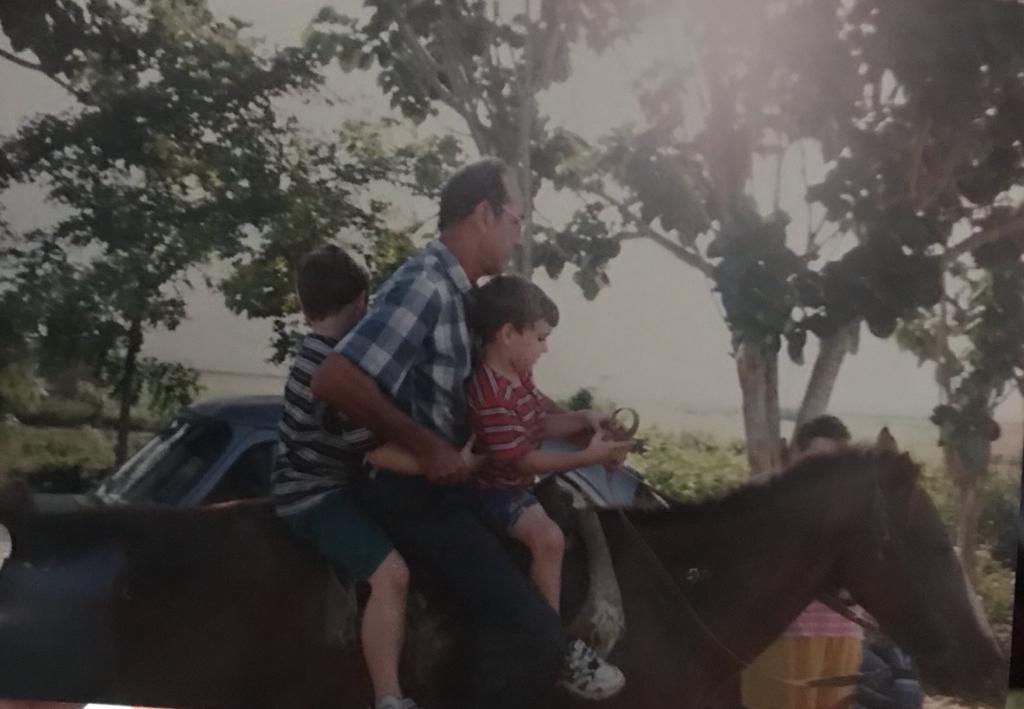
A place dear to me in my infancy that had not mentioned before but now with pictures to follow the town of Artemisa in the new province of Artemisa since its creation in August 2010. Formerly was part of the province of Havana, It is about 60 km from Havana, Many visits here as a child and was able to get my sons to ride a horse in our visit of 1998 (see pics)!
The town of Artemisa is located about 60 km from Havana, it borders the towns of Mariel and Guanajay; the Gulf of Batabanó in the Caribbean Sea; and the towns of Caimito, Alquízar, and Candelaria. Due to its history of coffee cultivation and its bucolic local landscape, it has earned the nickname Jardin de Cuba or Garden of Cuba, and is also known as the Red Town or Villa Roja because of the color of its soil. The city was founded in 1818 , One major development here is the old coffee estates, home to old coffee plantations and factories that have shaped Cuba’s economy and history for centuries. The town was founded in 1818. That same year, thanks to a donation from Francisco de Arango y Peñalver, construction began on the church, which was inaugurated on December 22, 1825. The patron saint of Artemisa is Saint Mark the Evangelist.
Discover the ruins of the island’s most famous property, the Antiguo Cafetal Angerona, The area had a statue at the entrance to the town of Artemis, the goddess of wilderness, hunting and childbirth, and one reason for the name of the town, The ruins of the Angerona coffee plantation bear witness to the splendor of the coffee culture that earned the region the nickname Garden of Cuba. Surviving elements of the former plantation include parts of the main residence, the overseer’s house, a well system for water storage, walls used to confine enslaved people, and a watchtower. The complex is one of the most complete and authentic examples from that era. Angerona was considered the second-largest coffee plantation in Cuba, with approximately 750,000 coffee trees and a workforce of about 450 enslaved people. The estate is named after the Roman goddess of silence; a statue of her stood at the entrance to the property, which belonged to its founder, Don Cornelio Souchay. Souchay made his initial land acquisitions totaling 16 1/5 caballerías or about 1503 acres (217 hectare) in 1813, followed by further acquisitions in 1818, eventually expanding the estate to a total of 41 caballerías or 3914 acres (515 hectare). During the first four decades of the 19C, there were more than 130 coffee plantations in Artemisa. Among these were two that functioned as both coffee plantations and sugar mills Angerona and La Gabriela during their final phase as coffee estates lasting until 1879. There were also four sugar mills: Providencia, Concepción (or Chapottín), Diminuto, and Dos Adelas later known as El Pilar, formerly Dolores. Also, in the late 1940s, when the small coffee plantation known as “Diminuto” ceased operations, its owner, Duarte, installed a small sugar mill there and named it “Candanga.” Located across three towns in the province of Artemisa, this area traces the route taken by the mortal remains of General Antonio Maceo and his aide, Francisco Gómez Toro following their recovery by Colonel Juan Delgado to their final resting place at El Cacahual San Pedro farm near my native town of Punta Brava. The route is marked by various plaques and commemorative monuments. The area is also known for housing the idyllic eco-village of Las Terrazas, a vast natural expanse within the Sierra del Rosario Biosphere Reserve, rich in historical sites, lakes, rivers, and waterfalls.
The below is ona partial farm belonging to a brother of my uncle’s wife and the men riding was the husband of my cousin with my older boy and one of our twins and my dear late wife Martine looking on the other side! The car you see behind the horse is a 1954 Ford of his! Memories forever!
A bit of history I like tell us that the town of Artemisa was established on June 9, 1878, by royal decree, which designated the town as its administrative seat. The first meeting of the town council or Ayuntamiento or City hall took place on January 1, 1879. Although Artemisa did not participate in the first War of Liberation against Spain (1868–1878) known as the Ten Years’ War or Grito de Yara, because the conflict did not reach the western part of the country, it did play a role in the War of Independance that began in 1895 or Grito de Baire. Notable among its figures is General Alberto Nodarse Bacallao, who served on the general staff of Antonio Maceo when the latter fell in San Pedro, near Punta Brava my own hometown. The town’s significance during the War of Independence is underscored by the construction of the Mariel-Majana Trocha or a fortified military line (see post moron), for which this town served as the headquarters of the general command. It was also the site of actions led by General Antonio Maceo, such as the one that took place on October 22, 1896, when the mambí general attacked the very command post of this military line.
In Artemisa, a cell of the Cuban Revolutionary Party was established, with Magdalena Peñarredonda Dolley and the priest Guillermo González Arocha playing leading roles; they earned the mambí general’s trust through their discipline and dedication to the revolutionary struggle. Both were members of the Liberation Army, and during the conflict, they served as Maceo’s delegate and deputy delegate for the Pinar del Río region. The General Command of the Mariel-Majana trocha or military line, as the Spanish called it was located in Artemisa. Under the command of General Juan Arolas y Espugles, it housed a headquarters and a garrison of 345 men, comprising units of infantry, cavalry, artillery, engineers, guards, civilians, and volunteers. Artemisa suffered the devastating effects of Weyler’s Reconcentración* policy.
Again, this is a memorable lane post and no webpages. Hope you enjoy with me these wonderful places of our lives always remembered as much as possible as it is 56 years that I left it! ,and only back in 1998. As said , the time passes by and all we have is blurred memories of always. A time, a place, a dot in my world map, that is in another world. Again, hope you enjoy this personal post on this is Artemisa, near Havana !! as I.
And remember, happy travels, good health, and many cheers to all !!!


