
I take you and me back into memory lane to our wonderful home for several years traveling in the area. I know I sound nostalgic and I am, always looking forward to be back, eventually. The family came here together and we love it! We rented house at 1400 meters in the mountains or Serrania de Cuenca (see post). From our base in Las Majadas (see posts) ,we saw the deep Spain I love so much ,and the family enjoyed it much; we came back several times. As I gather this pic from another post that think should have a post of its own in my blog, Therefore, here is my take on this is Fuentes in the Serrania de Cuenca !! Hope you enjoy the post as I
We passed by Fuentes in the province of Cuenca, in the autonomous community of Castilla-La Mancha, and my dear kingdom of Spain. The village is integrated in the Serranía Media area, it is located 19 km from the center of Cuenca, and 57 km from our base in Las Majadas, The town is crossed by the national highway N-420 , and it crosses the port of Rocho (1150 meters), in addition to the regional highway CM-220 that connects Cuenca with Albacete. We came going further from Cuenca along the N320a road to connect with the N-420 road dir Teruel continue then take dir La Almarcha into Fuentes making right on Calle Las Huertas and a quick left onto Calle de la Iglesia and the church,and we continue past Cañete (see post) and back to Cuenca,
The Church Nuestra Señora de la Asuncion or Our Lady of the Assomption ,from the 13C, The church with a single nave, the head formed by the main chapel and the presbytery, separated from the nave by means of a triumphal arch, covered with groin vaults, at the foot a simple elevated choir. Outwardly, it is worth highlighting the entrance portal with a semicircular arch of ashlar voussoirs, covered with a porch formed by two square-section pillars with chamfered shafts on the edges and covered with a three-sided wooden structure; the western wall is topped by the belfry formed by a pinion wall of ashlar masonry topped with two semicircular holes for the bell tower. Originally, it was a charitable hospital whose owner intended it as a shelter for pilgrims, travelers, and the poor. Upon her death, she bequeathed her assets to the Church and the Town Council of Fuentes, so that they could jointly manage them.
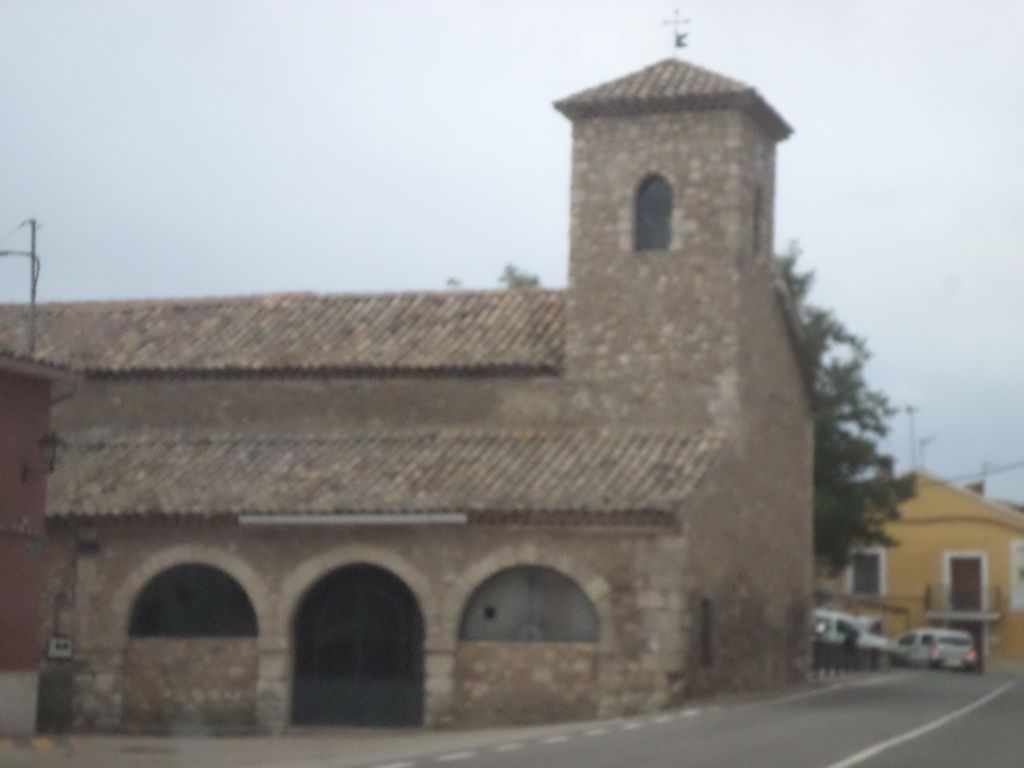
The yours truly translation from the village’s site tell us that in the 16C, the two side aisles were added, the entire church was raised, and the bell gable was remodeled, transforming it from a square tower similar to that of the current hermitage into a bell tower with a semicircular top, two sections separated by molding, and a blocked doorway at its base with two slightly pointed, superimposed arches framed by molding. A late Gothic doorway was also opened on the south side. In the 17C, the interior decorations were added with modern paintings based on Romanesque drawings by Artes Granda. The exterior features a semicircular apse with a splayed arrow slit with a scotia molding between fine moldings supported by small columns with plain capitals. Another arrow slit was recently discovered on the south side of the apse. On the south side of the same apse, a beautiful Romanesque window was discovered years later, considered the most sumptuously decorated of all those in the Diocese. Framing a narrow, elongated arrow slit, the wall’s splay extends, formed by two parallel columns on each side. These columns, along with sharp-edged intermediate jambs, support a continuous impost decorated with vegetal motifs. From the cornice or impost, a series of sloping bands with vegetal decoration spring in the form of archivolts. At the edge, a fine sawtooth molding is followed, also in a splayed pattern, by a series of moldings. Inside the apse, below the aforementioned window, at the level of the plinth, a hollow space was discovered, resembling a cupboard. Its entrance is a beautiful mullioned window with an arch that can be described as semicircular, shaped like an inverted vertex, positioned well above the center of the arch.
Other thing to see here me think is the Puente Viejo or old bridge, dated between the 13C and 14C, is 17.5 km long and was used to cross the Moscas river. Also, The Río Moscas lagoon complex,unique on the Iberian Peninsula and practically in Europe thanks to the type of soil on which it sits and the variety of species that inhabit it. The village of Fuentes lives up to its name, (fountains) as it boasts numerous springs, including the source of the Río Moscas. All this underground water circulation has dissolved the gypsum terrain, creating eleven sinkholes, nine of which hold water permanently. The Río Moscas originates in the village of Fuentes, and flows peacefully until it joins the Júcar River (see post) very close to Cuenca. Along its course, these hollows form in the ground on both sides of the river, caused by groundwater, producing this lagoon complex on the surface. It consists of several lagoons connected to each other underground, forming curious wetlands, some deeper than others. In the northern area, we’ll see the Mohorte Lagoon and the Las Zomas Lagoon. To the south, we’ll find the Ojo de la Corva Lagoons, a group of five in total, the Black Lagoon, and the Cedazos Lagoon, which is the largest of them all. The Río Moscas Lagoon Complex covers approximately 125 hectares.
A bit of history I like tell us that the origins of the present-day town of Fuentes can be traced back to the conquest of the city of Cuenca (see posts) by the troops of Alfonso VIII in 1177. Following his advance eastward, and after reaching Moya (see post), he ordered the repopulation of the conquered lands with the primary objective of reinforcing and defending the territory taken from the Moors. The Christian settlers, mostly from Extremadura, were drawn to this location and settled at the very source of the Moscas River. A bridge was built over the river’s source. The village grew and prospered until it was declared an independent town , It was under Felipe (Philip) II who, following the instructions of his predecessor Carlos (Charles) V, granted it the title of Town on December 2, 1557. In 2007, during earthworks for the construction of the Madrid-Cuenca-Valencia high-speed rail line, the Upper Cretaceous paleontological site of Lo Hueco was discovered. Estimated to be 70 million years old, it has already yielded more than 8,000 fossils. This is the most important Upper Cretaceous dinosaur site in Europe. In this respect, Lo Hueco provides information about a Cretaceous environment that was previously little known in Western Europe.
The village of Fuentes on the Church : https://fuentes.dipucuenca.es/index.php/layout-three/iglesia
The Castilla La Mancha region tourist office on the province of Cuenca things to see: https://www.turismocastillalamancha.es/es/destinos/cuenca
There you go folks, a dandy natural environment up in the Serrania de Cuenca mountains ! This is Fuentes a nice for all nature lovers in a medieval deep country for a change of pace. This is real country of my dear Spain still untouched by tourism in mass, and a wonderful spot to enjoy with the family. I know it brings lots of wonderful memories to me. Again, hope you enjoy this post on this is Fuentes in the Serrania de Cuenca !! as I
And remember, happy travels, good health, and many cheers to all !!!

 Paris1972-Versailles2003