
Again, finding treasures in my cd rom vault of pictures that need to be in my blog for you and me. This is a wonderful beautiful City of Toledo, that is a must to visit and glad came by several times with wonderful memorable moments of my family travels, and that is the essence of my blog. Therefore, let me tell you about the Plaza de Zocodover of Toledo !!! Hope you enjoy the post as I.
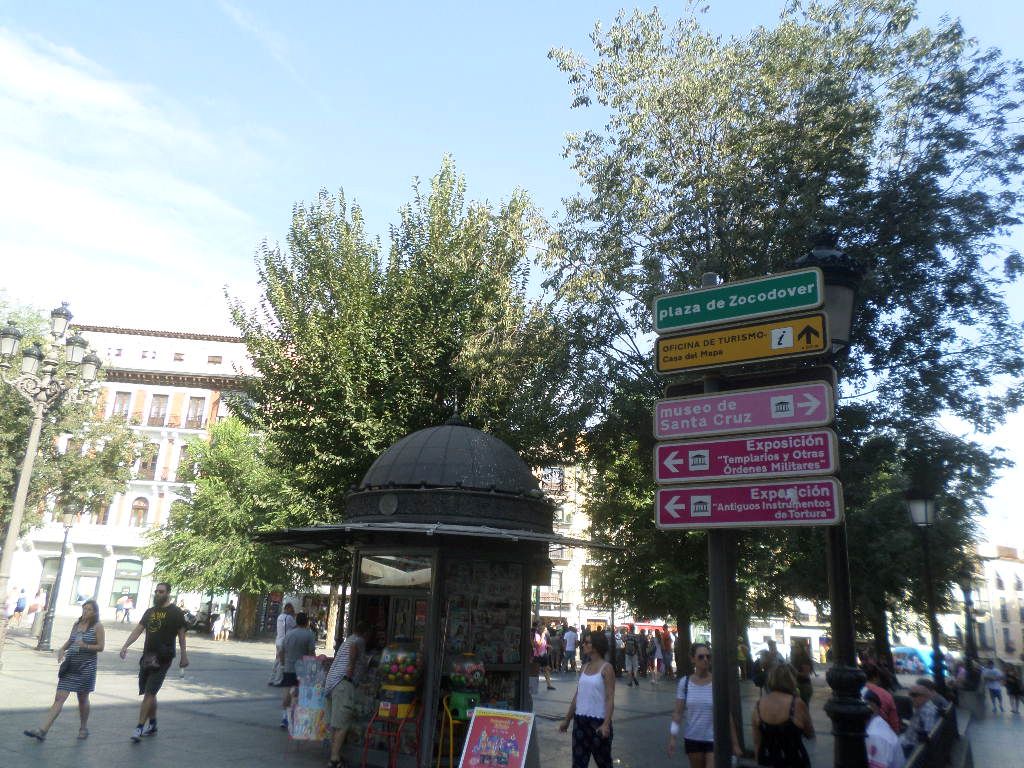
The plaza de Zocodover square was the city’s nerve center for most of its history and served as its main square. Juan de Herrera designed part of it during the reign of Felipe (Philip) II. Today, Zocodover is one of the city’s venues for numerous events and celebrations, and also serves as a popular meeting point and place of enjoyment for the people of Toledo and, above all, a must-see for the thousands of tourists who fill the streets of the historic center throughout the year. The name Zocodover comes from the Arabic *sūq ad-dawābb*, meaning “market of pack animals.” This square was also the site of bull runs and the greasy pole climbing contests held during local festivals. It was, therefore, the nerve center of the town’s social life since medieval times. Inquisition autos-da-fé and public executions of prisoners were also carried out in Zocodover. When a fire destroyed the old square on October 29, 1589, it was decided to build a new one. In 1854, an ambitious project was drawn up to reorganize the Plaza de Zocodover, transforming it into a rectangular portico square.
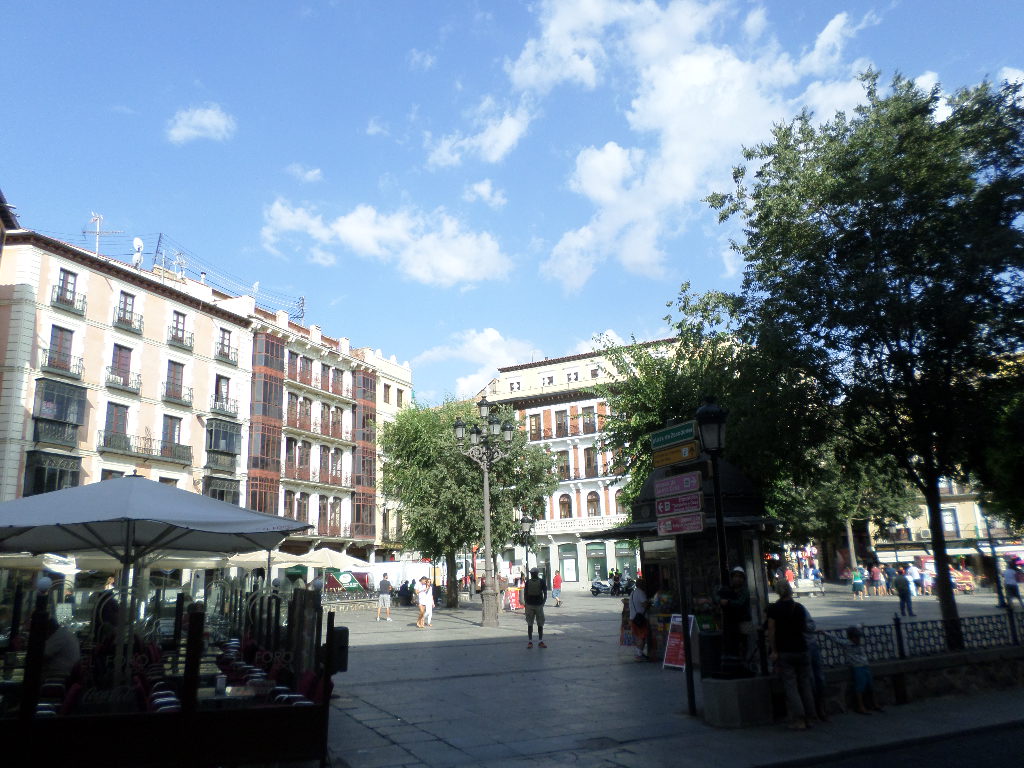
The Plaza de Zocodover was possibly laid out during the Roman period, it primarily preserves examples of Moorish architecture, which is also the origin of its name. As early as 1465, Henry IV granted Toledo the right to hold a weekly fair in this square, known to all as “Martes” (Tuesday). Its layout ,almost triangular, boundaries, and access points have changed little since the Middle Ages. Around 1616, the city council bought and demolished several houses to widen the entrance to Calle Ancha in Zocodover. The same was done in 1866 with the building that closed off the square at the beginning of Calle de las Armas, bordered by this street and the then-vanished Calle de la Lamparilla. The widening of the main access points will conclude around that time with the demolition of the arches that closed off the square at the beginning of the Alcázar slope or Charles V slope. It was then that the pedestrian area of the square was leveled, and the road near the Arco de la Sangre was incorporated as a promenade. This layout, we are told remained in place until 1926, when the design from the early decades of the 19C was restored. The square once again became a central roundabout bordered by a surrounding street. Underground latrines were also constructed. In 1933, a complete renovation of the pavement was undertaken, and stone benches were built. The brutal Spanish Civil War led to the destruction of some of the square’s buildings, especially the arcaded area framing the Arco de la Sangre (Arch of Blood), which was later rebuilt. The last major renovation of the pavement and traffic flow was in 1961. Years later, the public latrines were covered over. The square, which was entirely arcaded in the 16C, has gradually lost this characteristic over the centuries and with the renovation of some of its buildings. There were no large public buildings among them until the establishment of the Civil Government in the early 20C. The only notable features were the Chapel of the Arch of Blood, administered by a brotherhood, and the public clock.
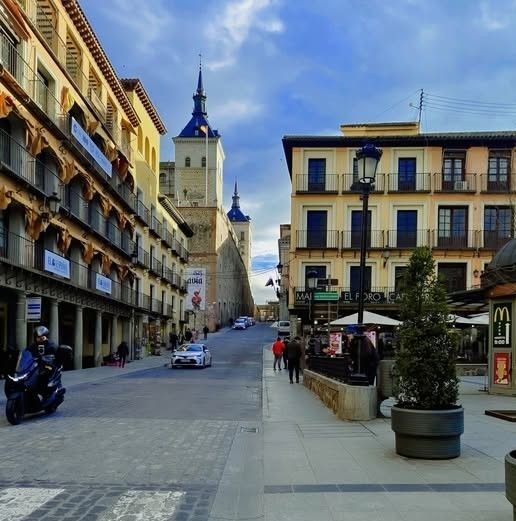
This is where all the city buses that connect to the rest of Toledo‘s neighborhoods arrive, including the train and bus stations. There is also a taxi rank, and a few meters away is the start of the escalators that lead to the Congress Palace, which connects to the bus station, the free Safont parking lot, and the Miradero escalators, which end a few meters from the square and have their own paid parking.
During Holy Week in Toledo, many of the processions pass through this square, and during Corpus Christi, the procession accompanying the jewel of Toledo Cathedral, the La Custodia de Arfe or Arfe Monstrance, passes through a floral triumphal arch into Plaza de Zocodover, where hundreds of chairs are set up for the faithful (available for rent), leaving a central walkway for the procession to proceed to the Arch of Blood, where the Archbishop addresses the crowd. Many writers have found inspiration in this square, where they held their literary gatherings and spent hours with friends. Miguel de Cervantes refers to Zocodover in his novel “La Ilustre Fregona,” in “Rinconete y Cortadillo,” and in Don Quixote, where he mentions the Plaza de Zocodover twice. Garcilaso de la Vega, Saint San Juan de la Cruz, Lope de Vega, Baltasar de Medinilla, Agustín Moreto, Tirso de Molina, Calderón, Gustavo Adolfo Bécquer, Baroja, Azorran, Galdós, and Zorrilla all strolled through Zocodover.
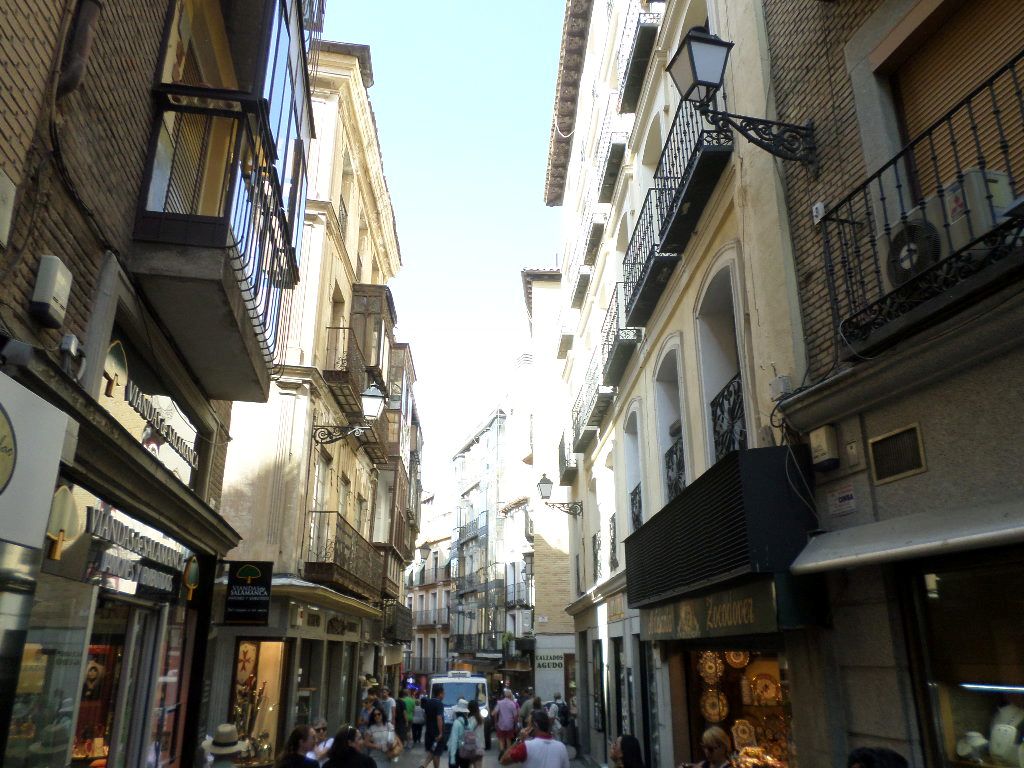
The Calle del Comercio aka Calle Ancha for the stretch between Plaza Zocodover Square and the beginning of the Cuesta de Belén The great commercial street of Toledo. In the shop windows, you’ll see Toledo’s two great specialties: knives and marzipan, almond-based confections. Shops and restos very colorful, we love it came by here many times sometimes in circles so be it ,it is wonderful. I can stay here all day ,you walk. This street takes you on the back of the Catedral Primada (see post) The Calle del Comercio is one of Toledo’s oldest streets, with over 800 years of history. It was once known as the “street of the merchants” due to the large number of traders who set up shop there to sell their wares. In 1502, the city’s streets were paved with cobblestones, which remained so until the early 20C, when they were repaved with round pebbles to facilitate the movement of animals through the narrow streets of the Old Town. The Calle del Comercio was the first in the city to have sidewalks along one of its sections, dating from between 1838 and 1840, and the next construction phase on this road was in 1958. A significant part of the service network, such as water supply and sanitation, also dates back to that time. Between the 16C and 19C, up to the four street intersection, this street was given various names by different guilds for different sections of its length. Names such as Calahorra Vieja , La Lencería, La Hostería , Sombrerería , Joyería, and Cintería are cited. It was in the 19C that the official name Calle del Comercio was adopted, although among the people of Toledo it continued to be called Calle Ancha. This name may be due to the demolition of some houses that stood at the beginning of the street, next to Zocodover Square. The demolition was carried out so that the procession of the image of the Virgen del Sagrario could pass through this area. Its commercial character explains the absence of coats of arms, doorways, courtyards, and palaces.
The City of Toledo on the Plaza de Zocodover : https://www.toledo.es/toledo-siempre/exposiciones-virtuales/plaza-de-zocodover/
The Toledo tourist office on its heritage : https://turismo.toledo.es/recursos/museos-y-monumentos.html
The Castilla La Mancha region tourist office on Toledo : https://www.turismocastillalamancha.es/es/destinos/toledo
There you go folks, something more in glorious Toledo, a city must to visit while in Spain at least. These places are part of its history with great architecture and we were glad to walked by them. Again, hope you enjoy the post on the Plaza Zocodover of Toledo !!! as I
And remember, happy travels, good health, and many cheers to all !!!

 Paris1972-Versailles2003