
And again taking out this town from other posts to give a post of its own, well deserving me think. Once upon a time my boys decided to go to Germany for some reason, and we were stuck with trying something different than our beloved Spain. We headed by car ,rented a house in Trier, and went out in our road warrior mode all over the western part of Germany. It was awesome! Therefore, let me tell you a bit on this is Schoden in Germany !!! Hope you enjoy the post as I
I am coming back at you to Germany to tell you about an interesting village , small town along my road warrior ways. We drove all over western Germany ,especially along the border with France and Luxembourg. Great rides!!! This is part of our story on visiting Germany ; do see my several posts on the country in my blog! These are the towns you yearned to visit off the beaten path country towns with nice monuments to boot.
The village of Schoden belongs to the town of Saarburg-Kell. The village is located directly on the lower Saar. Viticulture is practiced on the rising slopes. Schoden is part of the state of Rhineland-Palatinate. The village lies directly on the lower Saar River. Viticulture is practiced on the rising slopes. The hamlet of Weingut Geisberg also belongs to Schoden.
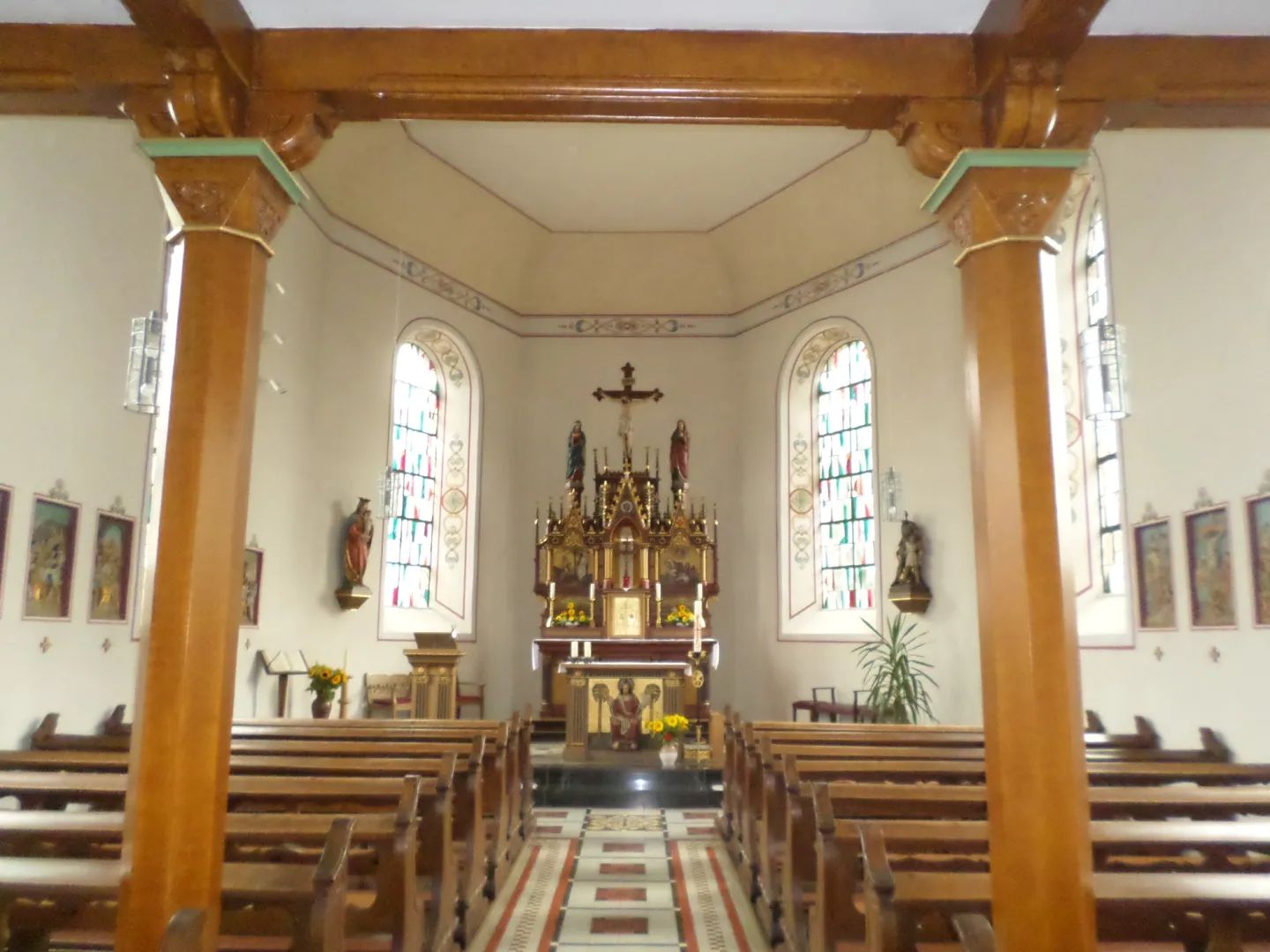
The Church Saint Paul and Saint Mary Magdalene built in 1842, is in the tradition of plain chapels in Trier. The three-sided choir end meets the Romanesque east tower of the Church. The two-story tower of the 12C under the roof of the tent set the eaves for the Church hall. The tower, which is visible from the choir tower and then included as a sacristy in the new Church, shows round-board sound windows. The new Church St Paul and Saint Mary Magdalene is done in classicist style, accentuated by a single-neat arched window. The neo-Gothic roofer, destroyed in 1945, replaces a simple, boxy structure. The wooden gallery is from around 1900. The neo-Gothic high altar with the paintings referring to the patron Saints of the Church work of art depicting Christ appearing to Mary Magdalene after His Resurrection and the leyend of St Paul. There is a crucifixion group from the neoclassical secondary altars of around 1900. The two-story tower of the 12C under the roof of the tent set the eaves for the church hall. The simple gable front is enriched on both sides of the portal by the monuments to the fallen of WWI and WWII. On the left, including the relief of a Cross, an arch artificial stone pedicel with contemporary ornamentation of 1923.
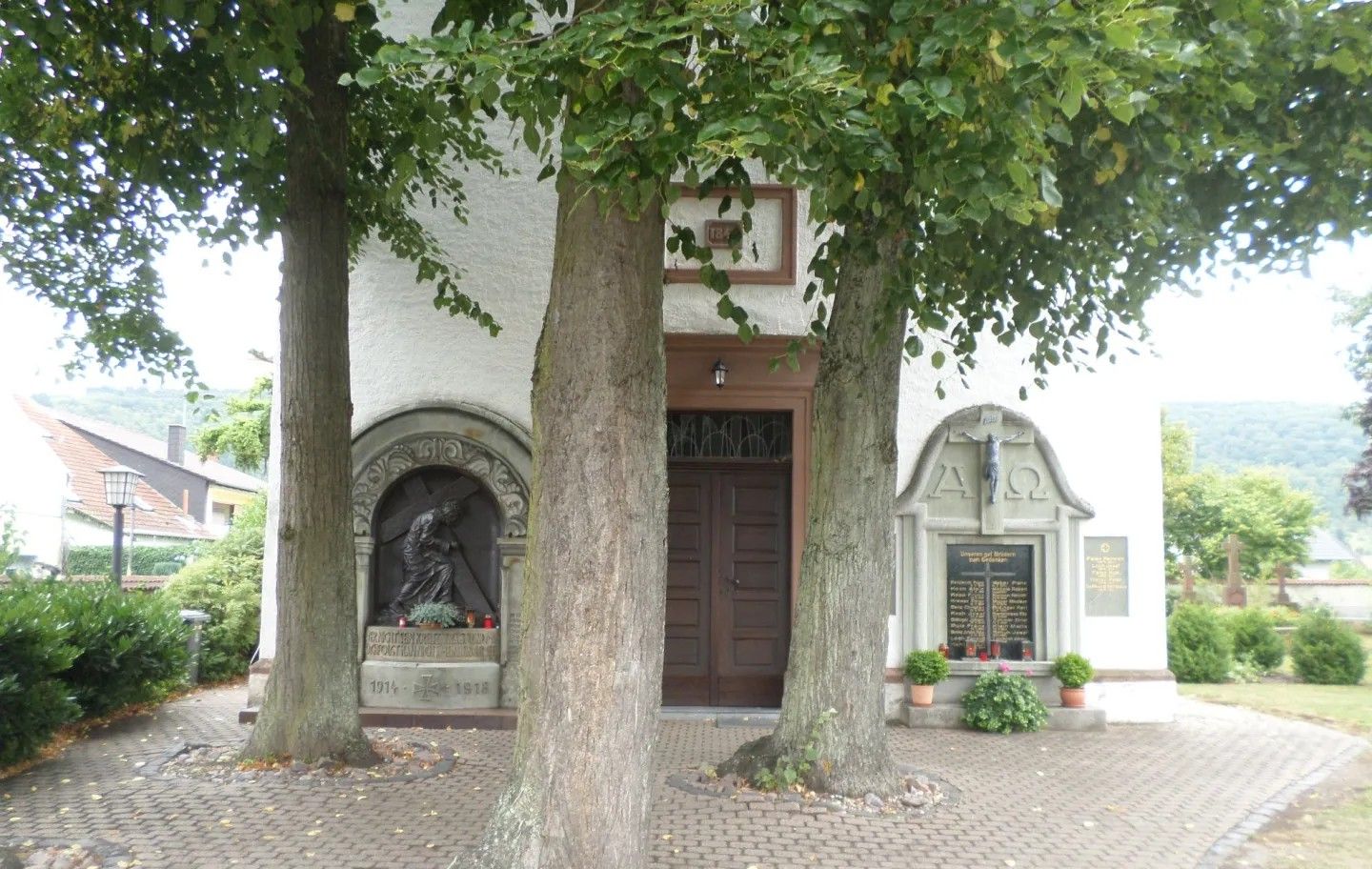
The predecessor of the current church is known to have been repaired again in 1822. In the visitation records of 1830, it is referred to as “capella antiqua” (old chapel).n 1842, the church in Schoden was rebuilt, and the old tower was retained. The tower’s hall serves as a sacristy. The shorter tower indicates that a church existed in Schoden very early on. The tower’s construction likely dates back to the 12C. This is also confirmed by the window in the east wall, which dates from the 13C. The simple gable front is enlivened on both sides of the portal by monuments to the fallen of WWI and WWII. On the left is a round-arched artificial stone aedicule enclosing a relief of the Carrying of the Cross, with period ornamentation
Other things to see here are the Bismarck Tower Schoden, the only Bismarck Tower in the Trier-Saarburg district, Recreational area on the banks of the Saar river with kiosk, miniature golf course, beach volleyball court, and boat landing, The Sculpture “Wave” of the sculpture arrangement “The Four Elements” Geological and natural history trail in the area of the towns of Ockfen and Schoden, The Chapel of St. Mary
A bit of history tell us that during the reign of Louis the Pious, the village was first mentioned as Scoda in 816, and in 953, Scodam was recorded as belonging to the Trier Abbey of St. Irminen (Oeren), which cultivated vines. The presence of the Irminen in Schoden is still reflected in the common name “Irminerwald” for the wooded area above the village. The “Schodener Saarfeilser Marienberg,” the “Schodener Geisberg,” and the “Schodener Herrenberg” are among the most important vineyard sites on the Saar. From 18 July 1946 to 6 June 1947 Schoden, formed part of the Saar Protectorate. Partitioned from Germany after its defeat in WWII; it was administered by the French Fourth Republic. On rejoining, West Germany in 1957, it became the smallest area state in the Saarland, not counting the city states of Berlin, Hamburg, and Bremen. It is named after the Saar River. In the 1970s, as part of the development of the Saar River into a major shipping route, a weir was constructed in Schoden. This weir provides a pedestrian and bicycle connection across the Saar to the opposite bank of the river, connecting to the village of Ayl-Biebelhausen. The weir separates the old Saar channel from the Saar Canal. While shipping traffic on the Saar Canal takes a shortcut northward, the natural Saar flows past Schoden and Wiltingen in its original bed before rejoining the Saar Canal beyond Kanzem.
The town of Schoden on the church in German : http://www.schoden.de/verzeichnis/visitenkarte.php?mandat=224845
The local Saar Obemosel tourist office on Schoden in German: https://www.saar-obermosel.de/suche?tx_solr%5Bq%5D=schoden
The Mosel tourist board on Schoden in German: https://www.mosel.de/index.php?id=212&tx_ttnews%5Bcat%5D=105&tx_ttnews%5Btt_news%5D=113&cHash=5efd168aecb29df5848d750480023673
There you go folks, splendid car ride or even by bike (more strenous) we rode all over these towns and it was lovely to go out and come back in each day. The picturesque small towns was great for the bread, the snack and the visit to small Schoden, Again, hope you enjoy this post on this is Schoden in Germany !!! as I
And remember, happy travels, good health, and many cheers to all !!!

 Paris1972-Versailles2003
Its Christmas time so everything is looking great 👍
LikeLiked by 1 person
Yes indeed Merry Christmas !
LikeLiked by 1 person
🙏
LikeLiked by 1 person