
One thing that escapes many is the sierras or mountain passes and outdoors available just outside the city of Madrid. In my youth I used to come with my dear late mom Gladys by many including Buitrago de Lozoya, Later years came with my dear late wife Martine and boys always many memorable moments, Once again, found me pictures in my cd rom vaults and they should be in my blog for you and me. Therefore, let me tell you my take on this is Buitrago de Lozoya !!! Hope you enjoy the post as I
The town of Buitrago de Lozoya was a fantasy trip when a child with my dear late mother Gladys and has continue throughout the years, Its a must to visit, It is one of the most unique and best preserved medieval complexes in the Community of Madrid, possibly the most beautiful town on the Lozoya River. The town of Buitrago de Lozoya has a walled perimeter, which is preserved in its entirety, is built on an old caliphal fortress. The best way to get here is by car on the highway A1 -Madrid-Burgos) out of Madrid direction Buitrago del Lozoya to the entrada 74, Also they mention a bus 191 from Plaza de Castilla in Madrid with 9 stops Buitrago is the 8th,
The Church Santa María del Castillo, built on an old mosque, is another of the site’s jewels, although it was devastated during the Spanish Civil War. It does, however, preserve a fabulous Neo-Mudejar coffered ceiling that was restored in the 1980s thanks to the tenacity of a local priest. The Church of Santa María del Castillo is the only parish church currently preserved of the four that existed in Buitrago del Lozoya in the 16C. It is open to the public, and visitors can climb the bell tower. The nave consists of three bays, with Gothic floor plans and elevations. The first contains two side chapels, the right serving as a sacristy; the second houses the Chapel of the Blessed Sacrament and the tower; in the third bay, we can identify an image of Saint Roch, the main portico, and the entrance to the church. The vault is currently covered with a modern coffered ceiling in the Neo-Mudejar style. The two chapels, also restored in the Neo-Mudejar style, are: Chapel of the Blessed Sacrament and Pardon: covered by a Mudejar coffered ceiling and the altar framed by a horseshoe arch resembling a triumphal arch. It houses oriental icons by the Bulgarian artist Silvia Borisova, a painter based in Buitrago del Lozoya. Chapel of the Virgin of the Flowers: recently restored and dedicated to this Virgin due to its long-standing tradition in Buitrago. It also features icons by the same artist. The Mudejar-style tower, located on the north façade, has a square floor plan and five levels. Tall and slender, it houses the bell tower and five bays framed by Mudejar elements. The entrance to the church is through a small opening in the third bay.
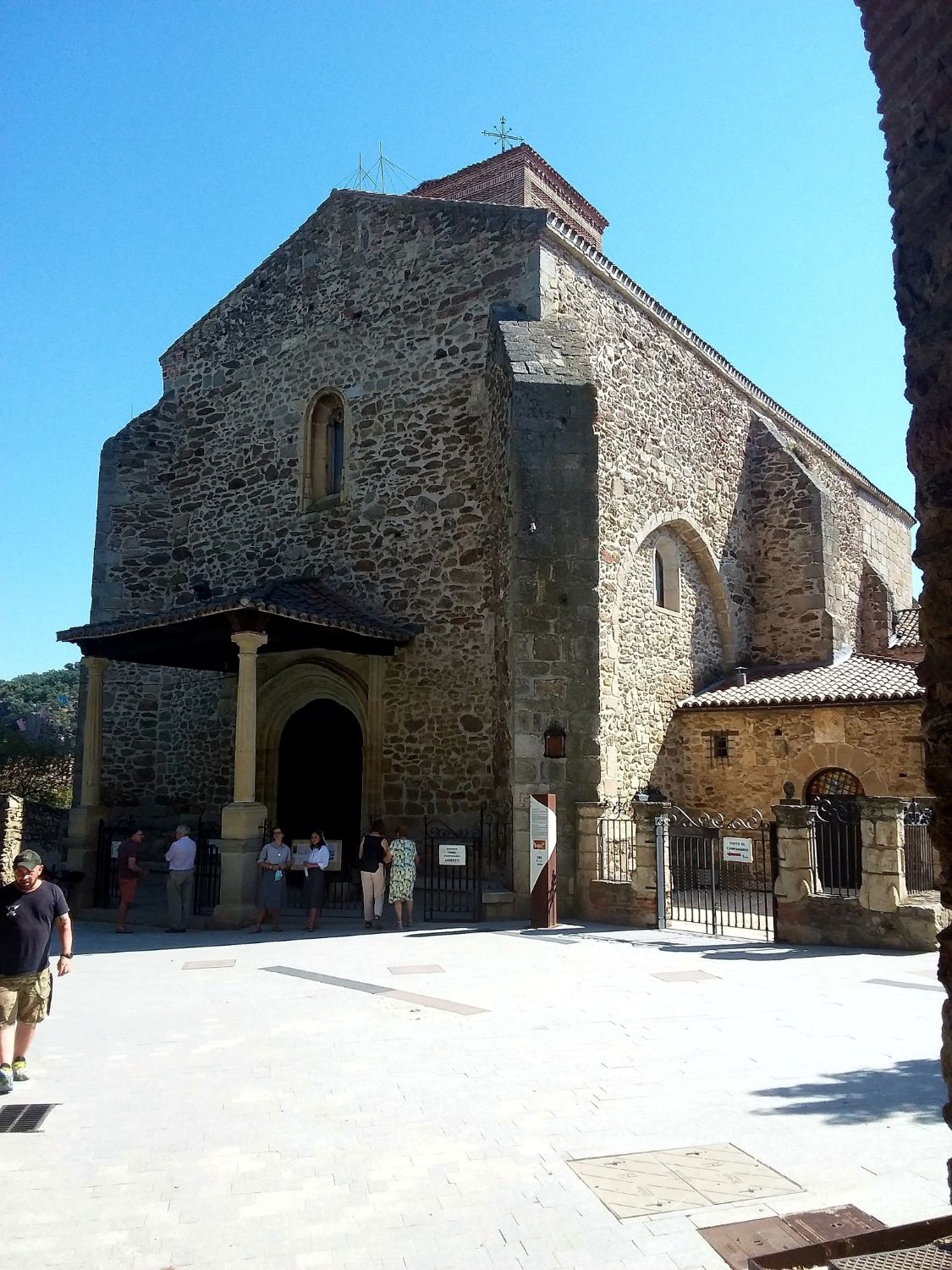
The construction of the Church Santa Maria del Castillo began in the early 14C, probably on the site of an old mosque within the walled enclosure, very close to the castle. It was completed in 1321, although it was restructured in the 15C, as evidenced by the windows and two doorways in the Hispano-Flemish style. The nave was originally Gothic in style, covered with a ribbed vault, the origins of which can still be seen today on the bare facades of its interior. The apse is polygonal and was built with well-worked granite ashlars, in contrast to the rest of the nave, which was made with unworked ashlar. In 1936, Republican commandos burned the entire complex, and the church’s altarpieces, paintings, and carvings were lost. The fire also caused the collapse of the Gothic roof, which was transformed into a Neo-Mudejar style after the restoration carried out in 1982. It is worth noting that the coffered ceiling covering the main altar dates back to the 15C as it comes from the old Hospital of San Salvador.
The castillo de Mendoza or Beltraneja castle was built in the 15C by the Mendozas. The Marquis of Santillana liked to spend a lot of time in Buitrago because here he met with fellow poet Juan de Mena. Another inhabitant of the fortress was Juana la Beltraneja, daughter of Enrique IV, whom the Mendozas protected behind those walls. The parade ground, today in ruins, was a bullring for 20 years. It has a snow well from which it is known that the ice was taken by donkey to Madrid for the San Isidro festivities. The enclosure also has a medieval garden. The Mendoza castle is a brick and masonry structure that shows Gothic-Mudejar architecture. Its shape is almost square and it was fortified by seven towers, all with a different structure, one of them having a pentagonal plan, where we find the entrance to the castle. The 14C fortress, linked to the Mendoza family, welcomed Queen Juana of Portugal and her daughter Juana la Beltraneja and the kings Juan II and Felipe III, regular guests of the Mendoza family. Due to the deterioration suffered during the 19-20C, there is hardly anything left inside. The parade ground has been greatly transformed since it was used as a bullring, and different cultural events, such as, for example, the Marqués de Santillana Festival of early music and classical music. It is not surprising that the oldest and most historic Living Nativity Scene in the Community of Madrid is celebrated here at Christmas.
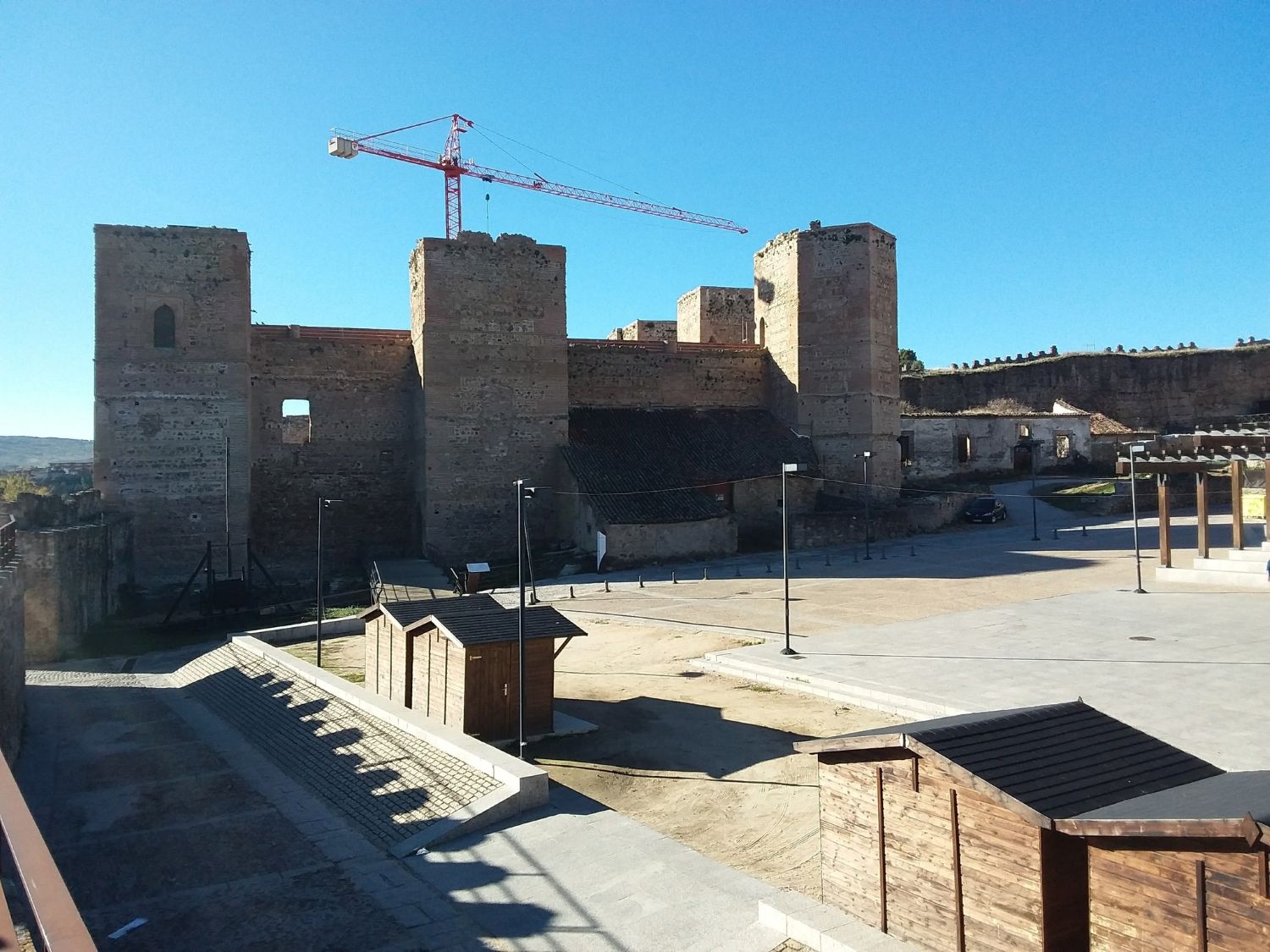
Other things to see here are the wall, of Muslim origin (11C), which protects its historic center with a perimeter of more than 800 meters. Some sections of the wall, which contains numerous defensive elements, such as towers, a barbican, a moat, a corach, an albarrana tower atop this 16-meters high pentagonal structure is a display of gruesome medieval weapons, plus, sure enough, the guts of the clock. and a fortress, the Clock Tower and the Picasso Museum, (another one !) in the square of the same name next to to City/Town Hall.
A bit of history I like tell us that the Muslims built a fortification on the site in the mid-10C. In 1085, it was conquered by Christian troops and ordered repopulated by Alfonso VI. There is evidence of this fortification’s existence in the 12C for the first time. The town was ceded to the bishops of Toledo. John I then ceded the town and fortress to the Mendoza family. Among its owners was Don Íñigo López de Mendoza, better known as the Marquis of Santillana, who transformed the castle into a palace. The current castle was built in the 15C by order of Don Diego Hurtado de Mendoza y Luna, Duke of Infantado. During her childhood, Juana “La Beltraneja,” niece of Isabel I,the Catholic, lived in the castle. The two fought a war for the succession to the crown of Castile won by the latter one, In the 17C, a snow well was built inside. At the beginning of the 19C, it passed into the hands of the city council of Buitrago de Lozoya. During the War of Independence against the French, it suffered severe damage.
The Buitrago de Lozoya tourist office on its heritage: https://turismo.buitrago.org/que-visitar
The Madrid tourist office on Buitrago de Lozoya : https://www.esmadrid.com/en/buitrago-lozoya
The Comunidad de Madrid region tourist office on Buitrago de Lozoya : https://www.visitmadrid.es/en/where-to-go/towns-of-madrid/buitrago-lozoya
The sierra Norte of Madrid on Buitrago de Lozoya : https://www.sierranortemadrid.org/pueblo/buitrago-del-lozoya/
There you go folks, hope you enjoy the openness and natural beauty of this region all now better than ever easily reach from my Madrid. One must stop is Buitrago de Lozoya, enjoy it is worth the detour, Again, hope you enjoy this post on this is Buitrago de Lozoya !!! as I.
And remember, happy travels, good health, and many cheers to all !!!

 Paris1972-Versailles2003