
I take you back to my dear Madrid !! love it !! I like to continue the saga of my dear Madrid with new pictures from my cd rom vault that should be in my blog for you and me, This is again my lost walking trails of wonderful sublime Madrid, Therefore, let me tell you about curiosities of Madrid, part XIV !!! Hope you enjoy the post as I.
The calle de Serrano is a well-known street in the city of Madrid, considered one of the most expensive and exclusive streets in the city, and the center of the “Madrid Golden Mile”, the corresponding luxury area. It begins at the Plaza de la Independencia, next to the Puerta de Alcalá and ends at the Plaza de la República de Ecuador, crossing the Salamanca and Chamartín neighborhoods. The street was initially called ” Boulevard Narvaez ” and after the revolution of 1868 it was named as it is known today. Its current name comes from the Spanish military man and politician Francisco Serrano, who held the Presidency of the Council of Ministers at different times and became Head of State twice (as regent and as President of the Republic), who lived and died at no, 14. At no, 27 (now number 31) lived the poet and politician Rubén Darío from 6 June 1908 to 24 February 1909, during his position as Nicaraguan ambassador. At no 38, Manuel Azaña lived during the Second Spanish Republic. At no 40, the politician Emilio Castelar lived. At no 72, Manuel de Falla lived. Notable buildings here are the National Archaeological Museum , Plaza de Colón , Lázaro Galdiano Museum (see below) , ABC Serrano Building – shopping and leisure complex currently called Centro Comercial ABC Serrano (very good 80 shops of all kinds, although accessories and fashion are the strong point with the sublime pastry shop Viena Capellanes ). House of the Marquis of Villora from 1928-1929, at no 130, Church of San Francisco de Borja, and Headquarters of the Embassy of the United States in Spain, which have been completely renovated while preserving the original ceilings and woodwork.
The Madrid tourist office on Shopping Salamanca neighborhood aka Calle Serrano : https://www.esmadrid.com/en/barrio-de-salamanca-compras
The Real Compañía Asturiana de Minas or the Royal Asturian Mining Company building is located with facades facing Plaza de España no 8 and Calle Bailén no, 1, and the rear facing Calle del Río no 24. It is 3,800 m² in the monumental or Alfonsine eclectic style (Alfonso XII) to the French taste of Louis XIII, and is one of the best examples of 19C architecture. The main part has 2,500 m² on three floors of approximately 770 m². The main door shows “1898” as the date of the building, but the mansion was built between 1891 and 1899 at the request of the Royal Asturian Mining Company, owned by the insurance company Mutua Madrileña since the end of the 20C. Between 1988 and 2009, it was the headquarters of the Department of Culture of the Community of Madrid, under a lease agreement. Exhibitions continue to be held here. The Madrid City Council has approved a renovation plan to convert the building into a social and cultural center, as well as the new headquarters of the Mutua Madrileña Foundation. The work is scheduled for completion in 2025.

The Madrid tourist office on the Royal Asturian Mining Company : https://www.esmadrid.com/en/tourist-information/real-compania-asturiana-de-minas
The El Pardo is a barrio or neighborhood located in the district of Fuencarral-El Pardo of Madrid, The Monte de El Pardo is a magical place where you can find corners steeped in history, natural landscapes, restaurants where you can taste the best cuisine, traditions… and above all, a town with its doors open to the visitor. The Monte de El Pardo is a natural area of extraordinary value, considered the most important Mediterranean forest in the Community of Madrid and one of the best-preserved in Europe. Located north of Madrid, it covers an area of 15,821 hectares.It is accessible via the M-605 highway (Madrid-El Pardo) and the M-612 highway (Fuencarral-El Pardo). Public transport is not available as far as I know,never taken it either, I have gone by car from Plaza Mayor get on the beltway M30 dir Carretera Somontes al Palacio de la Real Quinta get off at exit/salida 25 dir El Pardo/M-607/Colmenar Viejo continue and take the D605 road dir El Pardo at traffic circle continue on Carretera Madrid-El Pardo/M-605 ,follow direction Carretera Somontes al Palacio de la Real Quinta to destination but best parked by the restaurant La Quinta del Pardo ,and walk in, Through the beautiful arch of the Puerta de Madrid of this noble estate, we enter the Quinta del Duque del Arco, a national monument since 1935, ordered to be built by the Duke of El Arco in 1717, a close courtier and equerry to Felipe V. A few years after the death of the Duke of El Arco, the estate became part of the Royal Site of El Pardo, a donation from his widow to the monarch. The garden was designed by Claude Truchet, continuing the French influence of Felipe V, with Spanish and Italian features, and terraces, sculptures, and a pond. Large conifers, planted later, are striking. The Royal Palace of El Pardo, and the garden can be visited,In addition to its role as a museum, it has welcomed foreign heads of state during their visits to Spain since 1983.
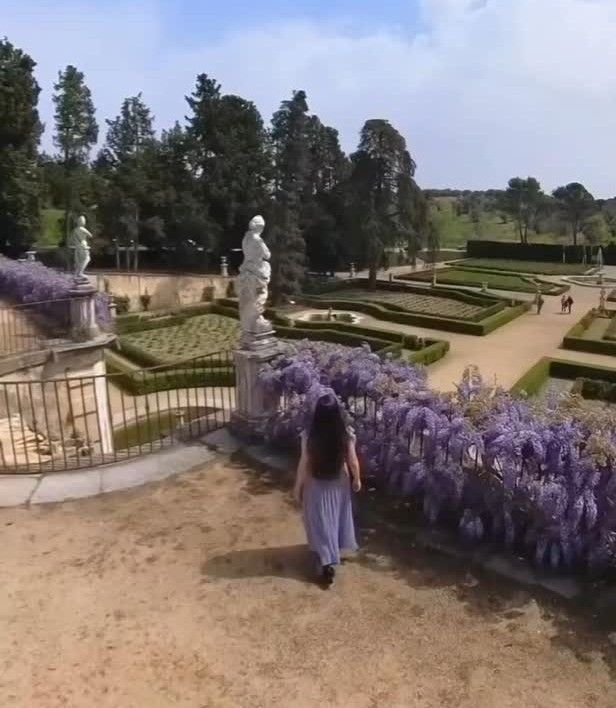
The town of El Pardo on the garden duque del arco: https://elpardo.es/quinta-del-duque-del-arco/
The Madrid tourist office on El Pardo: https://www.esmadrid.com/en/tourist-information/pardo
The Plaza Tirso de Molina square , formerly Plaza del Progreso is a triangular public space in central Madrid, extending towards calle Magdalena and the neighboring Plaza de Antón Martín. The urban complex forms the northern boundary of the Barrio de Lavapiés neighborhood. The square has existed since 1840, occupying the site left behind by the demolition of the Convent of Nuestra Señora de la Merced, also known as the Convent of La Merced. One side of the square provides access to the Teatro Nuevo Apolo that has stood since 1932., The square is remembered by Joaquín Calvo Sotelo in a play entitled Miracle in the Plaza del Progreso The Valencian painter Joaquín Sorolla had his first painting studio in this square in 1889. The Bécquer brothers (Gustavo and Valeriano) also had a home in the houses adjacent to the square, in the space left for them in their studio by the painter José Casado del Alisal. Most of the establishments offer tapas, pinchos, and a variety of dishes made with typical Spanish cuisine. See the wonderful bar taberna El 5 de Tirso, The square rend hommage to the greatest Spanish poets and playwrights who live in the 16-17C to whom a statue is dedicated.. He was named Gabriel Téllez, better known by his pseudonym Tirso de Molina. He was a monk in the convent that once existed on this site, but being a religious man did not prevent Tirso de Molina from inventing one of the most famous characters in erotic literature of all time: Don Juan. Yes indeed, and we still refer to these men as such, The Plaza de Tirso de Molina is part of the Lavapiés neighborhood. In the square find the metro station on Line 1 that opened to the public on December 26 1921 as Progreso, and buses stop here. EMT lines 002, 6, 17, 18, 23, 26, 32, 35, 50, and 65 stop here in the square itself or in the surrounding streets. Finally, although it’s a 10- to 15-minute walk away, you can also take Cercanías lines C3, C4, C4a, and C4b. They stop at Sol station. The most visible changes in the Plaza Tirso de Molina to come will be to its planters and benches: the current backless stone models have disappeared, replaced by wooden benches, as well as granite benches and granite seats. Stairs have been added to more quickly reach the west entrance of the Metro, and the children’s playground has been renovated with new accessible playground equipment. The fountain has also been improved to prevent tripping. In terms of mobility, one of the bus stops has been moved forward to calle Colegiata, and the only parking spaces left are those for loading and unloading. Uniform paving is proposed around the Plaza Tirso de Molina, and the areas currently paved with granite slabs will be preserved, replacing only those that are broken. 41 new trees will arrive in the square and, above all, in the surrounding streets. The works are expected to continue until spring 2026. It will be a new sight indeed by the time back there again,

The Madrid tourist office on the barrio or neighborhood of Lavapiés : https://www.esmadrid.com/en/madrid-neighbourhoods/lavapies
There you go folks , another wonderful nostalgic, sentimental trip to my dear Spain, A love affairs with my Madrid, as do not know when we will be back, we sure will have this trip in our hearts forever, Again, hope you enjoy this post on curiosities of Madrid, part XIV !!! as I
And remember, happy travels, good health, and many cheers to all !!!

 Paris1972-Versailles2003