
I take you back to my dear Madrid !! love it !! I like to continue the saga of my dear Madrid with new pictures from my cd rom vault that should be in my blog for you and me, This is again my lost walking trails of wonderful sublime Madrid, Therefore, let me tell you about curiosities of Madrid, part VI !!! Hope you enjoy the post as I.
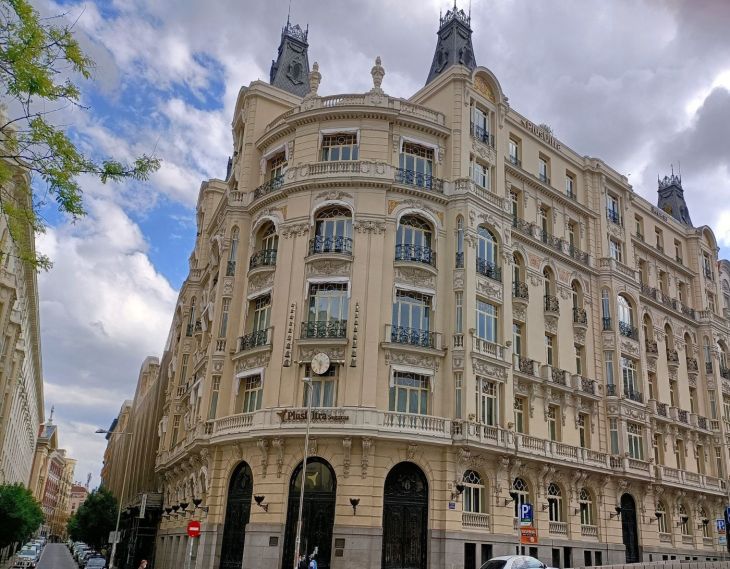
The Plus Ultra building was built in 1913, and is located in the Plaza de las Cortes 8, next to the Westin Palace hotel, in front of the Congress of Deputies and the Thyssen-Bornemisza Museum, closely watched by the Statue of Cervantes. It was acquired in 1941 by the insurance company Plus Ultra (formerly Groupama), 100% owned since 2015 by Catalana Occidente (one of my former business partners..). It occupies part of the site of the former palace of the Dukes of Medinaceli (most of the site is occupied by the Hotel Westin Palace-(see post) and was built as a rental house for the Marquis of Amboage. Although the Plus Ultra building dates from the early 20C c. 1913, ordered to be erected by the Marquis of Amboage, the Carillon was inaugurated on December 20, 1993 by the Infanta Pilar de Borbón, Duchess of Badajoz.
The official Grupo Catalana Occidente: https://www.gco.com/eng/who-we-are-gco
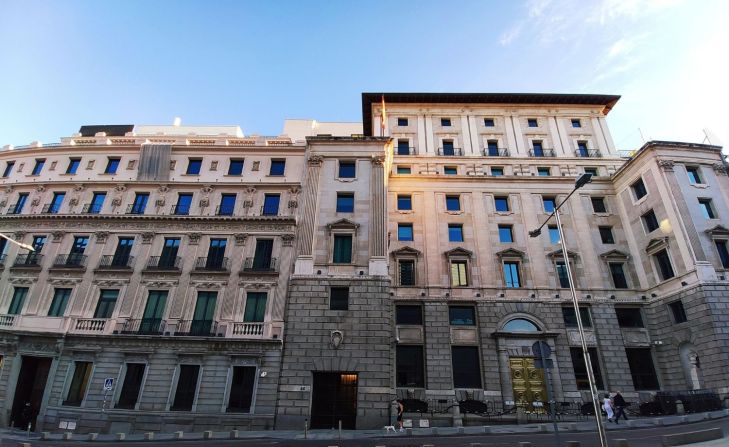
The building located at Carrera de San Jerónimo, 38, opposite the Palacio de las Cortes or Palace of the Congress of Deputies. It was the headquarters of the Banco Exterior de España. Currently, it is one of the dependencies of the Congress of Deputies. On June 1, 2006, the last extension was completed on the former headquarters of two banking entities, those of the Banco Exterior de España and the Banco de Crédito Industrial (Casa de Rivas). The Banco Exterior de España (BEX) was a Spanish banking entity that operated between 1928 and 1991. Throughout its history, the financial institution specialized in issues related to foreign trade. In 1991 it was integrated into the Argentaria banking corporation, after which it disappeared. The Banco de Crédito Industrial (BCI) was a Spanish financial institution that operated between 1920 and 1991. Throughout its existence, the bank’s activity specialized in promoting the Spanish industrial fabric by granting loans. In 1991 it merged with five other entities to form Argentaria. Argentaria was a Spanish public banking entity that existed between 1991 and 1999. Created from the union of several public banks and credit institutions, however, it was progressively privatized and in 1999 it would end up being integrated into the BBVA banking group.
The official Congreso de Diputados and its dependancies: https://www.congreso.es/es/cem/bienesinmuebles
The Madrid tourist office on the Congress of Deputies: https://www.esmadrid.com/en/tourist-information/congress-deputies
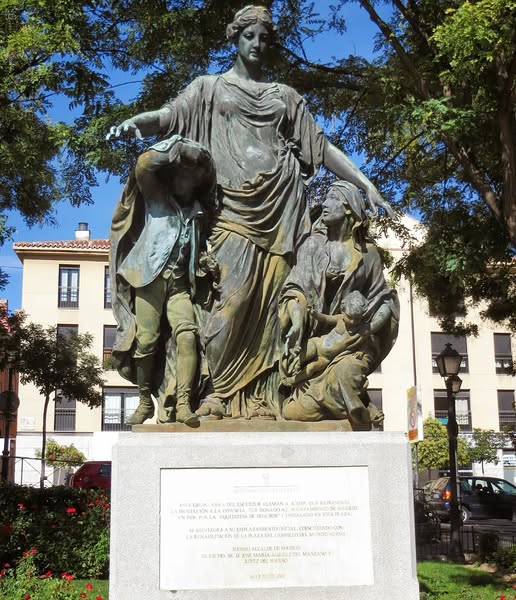
The Plaza del Campillo del Mundo Nuevo ,a square located in the Embajadores neighborhood of Madrid, very close to the Puerta de Toledo. The streets of Arganzuela, Mira el Río Baja, Carlos Arniches and Mira el Sol flow into it, and it is bordered to the south by the Ronda de Toledo. Historically, it can be considered the southern border of the Rastro market. Benito Pérez Galdós, in the first book of Fortunata and Jacinta: describes the place. In 2003, the Mundo Nuevo recovered the monument dedicated to La caridad se compadece de los pobres or charity takes pity on the poor, aka La protección de la orfandad y la viudez or the protection of orphanhood and widowhood, a work by the Austrian artist Viktor Tilgner, originally sculpted to decorate a niche in the chamfer of the building of the Insurance Company La Equitativa, The Equitable Life Assurance Company, founded in Manhattan in 1859 and today integrated into AXA, on calle de Alcalá , corner of Calle Sevilla, a chamfer cylindrical, tower-like, crowned by a body with a clock held by two gilt bronze figures and a wrought iron lookout crowned by a copper dome. Tilgner’s sculpture was there until 1920, when it was donated to Madrid City Council and installed in the Plaza del Campillo, from where it was again removed and taken in 1962 to the Fabiola de Mora y Aragón medical center, in the Dehesa de la Villa. The remodeling of the Plaza del Campillo del Mundo Nuevo in 2003 included the recovery of Tilgner’s sculptural group.
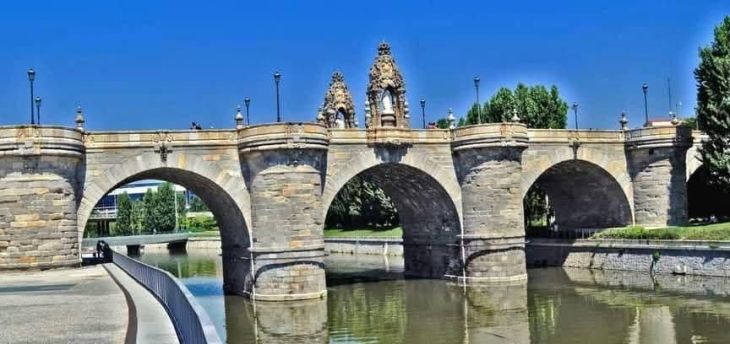
The puente de Toledo built on a barroque style between 1718 and 1732. It spans both banks of the Manzanares river crossing the Glorieta de Pirámides, on the east side and the Glorieta del Marqués de Vadillo,on the west side. The central frame has 5 meter wide and on it you find decorated templates in churrigueres elements having statues in chalk stone of the patron Saints of Madrid ,San Isidro Labrador ,and Santa María de la Cabeza, done in 1723. On each extreme of the frame you have ramps that connect on each side and on the Glorieta de Pirámides ,you have obelisks from the 19C on the north side as well as two fountains on the closest side to the city. The Puente de Toledo measures 180 meters long and consists of nine eyes, with its corresponding semicircular arches. Two fountains are added, on the north side, of the four that were initially designed. The fountains are also very decorated, although their forms, such as niches, are very worn by the passage of time.
The Madrid tourist office on the Puente de Toledo: https://www.esmadrid.com/en/tourist-information/puente-de-toledo
The Plaza de Oriente has a nice garden around it too. Located in front of the Palacio Real (see posts) or Royal Palace, these 1.60 hectares of garden are part of one of the most touristic ensembles in Madrid. These gardens were built on the initiative of Joseph Bonaparte, in order to enhance the Royal Palace and the Royal Theater. Since then they have experienced numerous and important renovations. The current design of the gardens, created in 1941, still takes as a reference point the equestrian statue of king Felipe IV in the middle of the square work in bronze done between 1634 and 1640 ,that distributes the gardens squarely. They are composed of seven parterres, populated by shrubs of boxwood, ,cypresses, and magnolias of small size, as well as floral plantations, of temporary character. They are bounded on both sides by rows of statues, popularly known as the Goths Kings, who act as the dividing line of the other two quadrants. The gardens follow geometric shapes that air and give visibility to the façade of the Royal Palace.
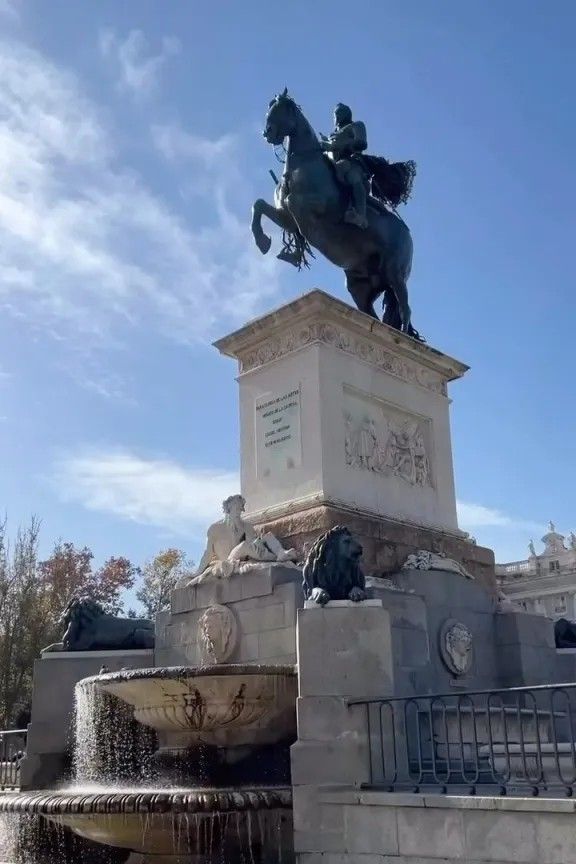
The Madrid Tourist office on the Plaza de Oriente: https://www.esmadrid.com/en/tourist-information/jardines-de-la-plaza-de-oriente
There you go folks , another wonderful nostalgic, sentimental trip to my dear Spain, A love affairs with my Madrid, as do not know when we will be back, we sure will have this trip in our hearts forever, Again, hope you enjoy this post on curiosities of Madrid, part VI !!! as I
And remember, happy travels, good health, and many cheers to all !!!

 Paris1972-Versailles2003