
I look back in my blog and saw a nice older pictures not in ,and one from my cd rom vault, that should be in my blog for you and me, I have taken nice walks on some of these wonderful streets of always in a wonderful city like Madrid, heavens! This is the city that I spread my wings sort of speak when at an early teen in town, and eager to learn all of it, took me to many places, Some more than others but all wonderful memories of youth that been lucky to relive for many years and introduce them to my family,friends, and now those following my blog, Therefore, here is my new take on the streets of Madrid , part IV !!! Hope you enjoy the post as I.
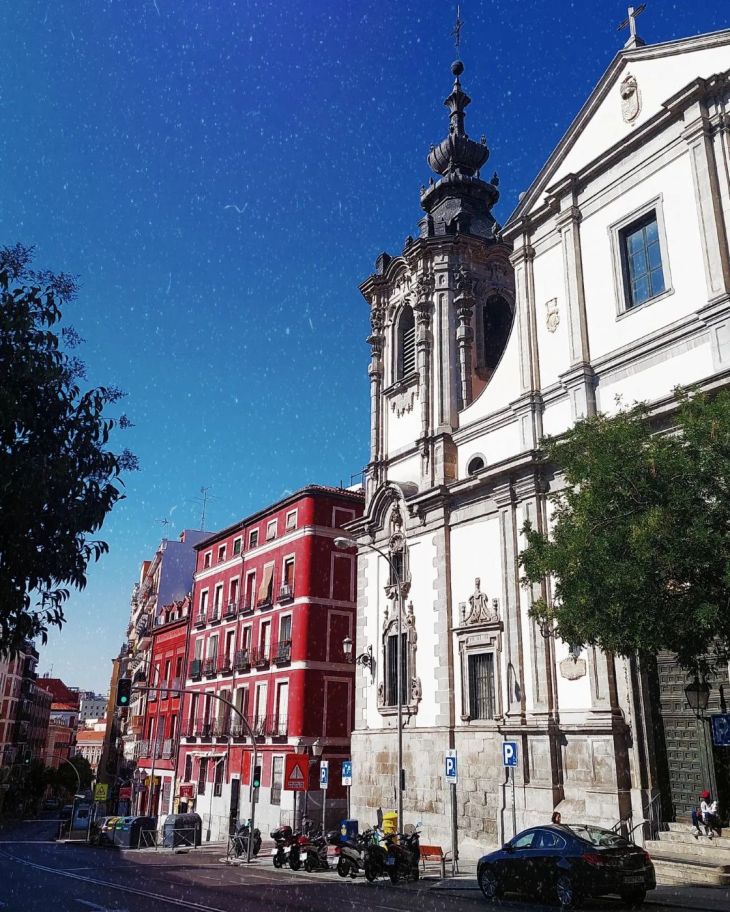
The Calle de San Bernardo runs from Plaza de Santo Domingo to Glorieta de Quevedo, in the Centro district, bordering the Universidad and Palacio neighborhoods or barrios, and Chamberí, the section that runs between Glorietas de Ruiz Jiménez and Quevedo. During the 19C, the final section of the street, between the aforementioned Plazas de Ruiz Jiménez and Quevedo, was named Calle de las Navas de Tolosa. It took its current name from Bernard of Clairvaux, a French saint of the 11C and reformer of the Cistercian order. Among the buildings that remain on this street are the Palace of Justice, an 18C mansion built by the Marchioness of Sonora, on the site occupied by the house of the Marquis of Regalía. At no, 80, the Escuela Normal Superior de Estudios Especiales, occupying the urban space that housed the convent of Santa Clara and the former Central University, which gives its name to the neighborhood, and was built to continue the work of Cardinal Cisneros in Alcalá de Henares. The house known as the Mansionero de San Bernardo occupied part of the primitive Jesuit seminary, founded in 1602. Opposite it, on the corner of Calle del Pez, is the Bauer Palace, which housed the National Conservatory of Music and Declamation and was later converted into the headquarters of the Escuela Superior de Canto. And at no 70 is the Lope de Vega Institute, created in 1933. At no 35 there is a plaque commemorating the stay of Emilia Pardo Bazán in what was her home between 1890 and 1915. Among the religious buildings, it is worth mentioning the Convent of the Salesas Nuevas, which was founded at the end of the 18C by María Luisa Centurión y Velasco, Marchioness of Villena. Another notable building is the Church of Our Lady of Montserrat (see pic). Among the pieces it contains, there is a copy of La Moreneta, patron saint of Catalonia.
The glorieta de Quevedo or roundabout is named after the Spanish writer of the Golden Age: Francisco Gómez de Quevedo Villegas. In the center there is a sculpture in honor of the writer carved by Agustín Querol in 1902. At the bottom of the block, referring to the themes dealt with by the writer in his works: lyric poetry, history, satirical novels and mysticism. In the front is Satire, intertwined with Poetry and on the back History and Prose. In the lower part there are reliefs of his works, with inscriptions of their titles, such as Vida de Santo Toás de Villanueva, Poderoso caballero, Don Dinero, Historia de Marco Bruto,and Vida del gran tacaño (miser). The fountain that serves as the base of the sculptural group was built in 1999. The Glorieta de Quevedo is located in Chamberí district, at the intersection of Fuencarral, San Bernardo, Arapiles, Bravo Murillo and Eloy Gonzalo streets. It is one of those places in Madrid that you enjoy passing by again and again. Its stately buildings, the wide and busy streets that surround it and alternate with other narrow, quieter ones full of charming businesses make any walk in the area pleasant.
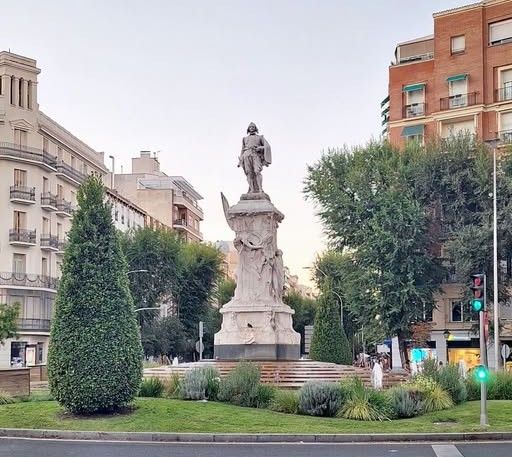
A bit of history tell us that since the 17C, the Trapillo pilgrimage was celebrated near the Puerta de Fuencarral (called the Puerta de los Pozos or wells). The space that the square currently occupies was located on the outskirts in the 17C. It was a crossroads to the town of Fuencarral and France. The name of the roundabout, using the surname of the writer, was assigned to this square for the first time in 1860. The Canal de Isabel II inaugurated its first water service facilities in this square, moving the waters of the Lozoya River through conduits to the first tanks. On December 27, 1925, the Quevedo metro station was opened to the public, connected to lines 1 and 2 . The roundabout was the site of the monument to the heroes of the 2nd of May (originally erected in the roundabout of San Bernardo), until, in the 1960s, it was moved to its current location next to the Plaza de España. It was in that decade when the eponymous monument was installed in its place in the glorieta de Quevedo in honor of the writer of the Golden Age, originally erected in the Plaza de Alonso Martínez, Francisco Gómez de Quevedo y Villegas (must say one of my favorites) was born in Madrid on September 17, 1580, he was deeply involved in the life and society of the Court. His father was secretary to Doña Ana, the fourth wife of king Felipe II. He was a parishioner at the Parish of San Ginés (church see post), studied at the Imperial College, and earned a degree in Arts in Alcalá de Henares (see posts). His life and work were characterized by satire and reflection, by bold and provocative ironies that led him into constant trouble and denial, to the point that, at times, it is difficult to distinguish whether many of the anecdotes told about him were legend or history. A master indeed.
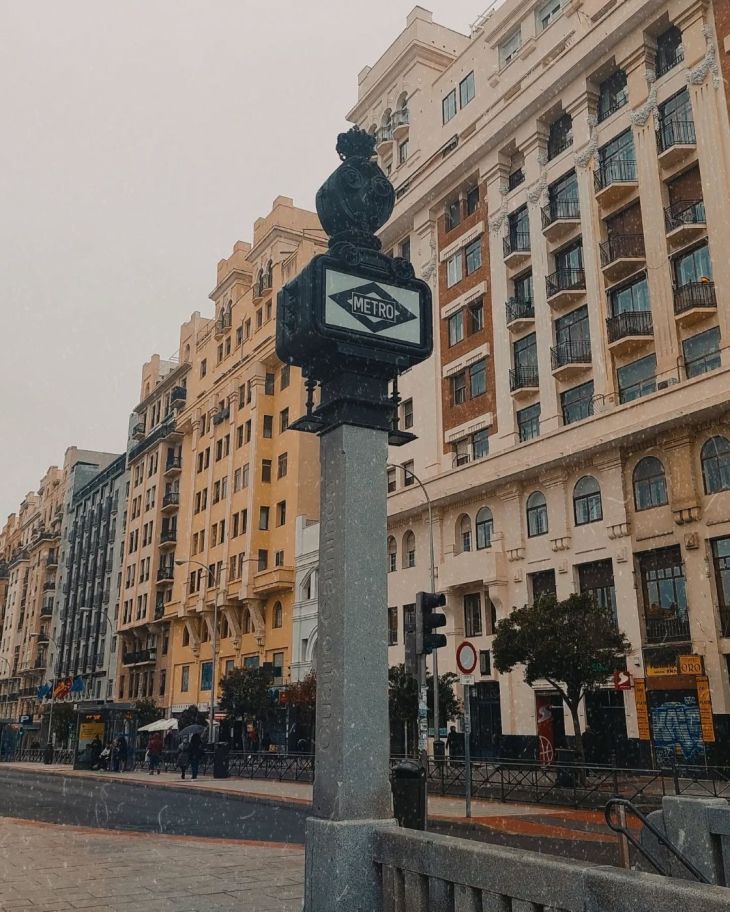
The Glorieta de Cuatro Caminos gets its name from having been a crossroads of four roads: Calle Bravo Murillo (called the Camino de Francia), Avenida Reina Victoria (called the Camino de Aceiteros), Paseo de Santa Engracia (laid out in 1859) and Calle Raimundo Fernández Villaverde (previously called Paseo de la Ronda). In 1880 the first tram line was opened, running from Sol to Glorieta. The Madrid Metropolitan Company laid its first metro line from Sol to the current Cuatro Caminos. You can reach it on Metro Cuatro Caminos,(see pic light of 1919) lines 1,2,and 6. The section was inaugurated on 17 October 1919 by Alfonso XIII. The Glorieta de Cuatro Caminos was the entry point for channelled water from the Canal de Isabel II. In 1902 it was decided to name the roundabout in honor of Bravo Murillo (Plaza de Bravo Murillo), in 1917 as the Joaquín Ruiz roundabout, in 1931 as the Fourteenth April roundabout, in commemoration of the proclamation of the Republic, and finally being called the Cuatro Caminos roundabout by Franco’s imposition in 1940. Several literary works are set in the Cuatro Caminos roundabout, especially many episodes in novels by Pío Baroja, and Benito Pérez Galdós’s Tristana sets part of its plot in Cuatro Caminos.
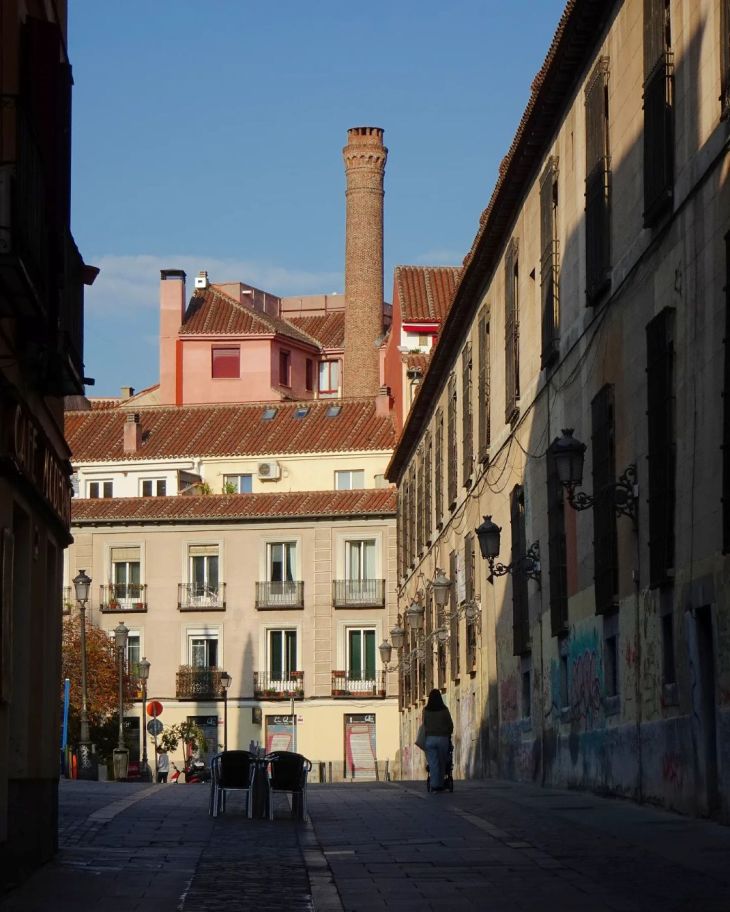
The Plaza de las Comendadoras is a pedestrian plaza located in the Universidad barrio or neighborhood, in the Centro district . It is connected to Amaniel and Quiñones streets, very close to the Conde-Duque barracks and Plaza de España. You can reach it on metro Noviciado lines 2 3 and 10), San Bernardo lines 2 and 4, and Ventura Rodríguez line 3. See the old chimney of the old Mahou Brewery (now the ABC Museum) at Calle Amaniel 29-31 (see pic). This plaza also hosts the Pottery Fair in mid-May, coinciding with the San Isidro festivities. Potters and ceramic workers from all over the country come to display their ceramic pieces. It owes its name to the Convent of the Comendadoras de Santiago, founded in 1650 by order of Felipe IV, whose main façade occupies one side of the square. The church, dating from 1697but the construction of the convent was later, in 1753. In 1774, Charles III commissioned Francesco Sabatini to build a new building, which completed the development of the block. It is a magnificent example of a convent complex in Madrid, the only one that has been preserved in its entirety, as it still occupies a complete block of the old town and none of its original elements have been demolished.
The Calle de los Mártires de Alcalá is located in the University neighborhood, Centro District. The street runs from Calle de la Princesa to Calle Alberto Aguilera. The title is due to a chapel dedicated to the holy martyrs Justo and Pastor, natives of Alcalá de Henares, which would have existed in the place until the 17C.

The calle del Barquillo is a street in the Justicia neighborhood of the Centro district of Madrid t runs between Calle de Alcalá and Calle Fernando VI . Popular tradition has it that it took its name from the small boat that the Marquise of Nieves had to entertain herself in the pond of her estate, in the upper part of the street, where the convent of the Salesas would later be built. Its importance as a road perhaps dates back to the 17C when it became the natural path of the Convent of San Hermenegildo, whose orchards occupied the space of the current Plaza del Rey and of which only the Church of San José (see post) remains with an entrance on Calle de Alcalá, 43.

On the corner with Calle Almirante, where the convent of San Vicente de Paúl once stood, a “Model Prison” was opened in April 1845 with capacity for approximately half a thousand prisoners from other prisons. At the end of Calle del Barquillo, on the corner of Calle Belén, is the Edificio de las Cariátides, on the corner of Calle Alcalá, the headquarters of a bank and later the Instituto Cervantes (see post), which was known as “the house of damn what a door!”, an expression caused by the aforementioned caryatids, statues that, like sentinels, were on each side of the enormous main door of the building On this street, is preserved at no 27, the Teatro Infanta Isabel, inaugurated on 9 February 1907 as the Cinema Nacional. At nps 5 and 7, there was the Circo Paul Theater destroyed by fire in 1888. On the site that was the garden of the old convent of Santa Teresa, on the corner of Calle Fernando VI ,and at the end of Calle del Barquillo, the Oriental Gardens theater was built in 1874, one of the popular summer theatres in Madrid. The Teatro Apolo also had an entrance to the stage or actors’ entrance, at the beginning of the street, on the corner of Calle de Alcalá, until its demolition in 1929. The painter Juan de la Corte, who is known to have lived Calle del Barquillo in 1637, married to Francisca de Salazar. In the 18C, founded by María del Pilar Teresa Cayetana de Silva y Álvarez de Toledo (a Goya muse), the Palacio Buenavista had a façade on this street. The Venetian painter Jacopo Amigoni, as recalled by a plaque on the façade of no 6. At the end of the street, at no 34, another municipal plaque informs that General Castaños, hero of Bailén during the Spanish War of Independence, was born in that house in 1758. The poet Ernestina de Champourcín, a member of the Generation of ’27, lived at no 23.
The Madrid tourist office on the barrio o neighborhood of Salesas near Calle del Barquillo: https://www.esmadrid.com/barrios-de-madrid/salesas
The Calle Felipe III is a small street of barely 30 meters, which leaves the Plaza Mayor, from one of its many arches, and leads to Calle Mayor. This is the old Calle de Boteros, name that it took from the guild that was established here. to the makers of wineskins and butts who had their establishments in this place. Because important feats were carried out in the Boteros arch on July 7, 1822, the street was renamed Calle de la Milicia Nacional, and later renamed Calle de Felipe III, at the initiative of Mesoneros Romanos, it was renamed, from 1851, in memory of the son of Felipe II, who, as his father had planned, allowed himself to be governed by his favorites, the Duke of Lerma and his son, the Duke of Uceda. The Calle de Felipe III, a name it retains today. Among the businesses that still have survived and once on this street are the La Favorita and Casa Yustas (see posts).

King Felipe III was the first monarch to be born in Madrid, in 1578. Son of Felipe II and Anne of Austria, he married his cousin Margaret of Austria. Under his reign, which began in 1598, Spain experienced a period of peace and expansion. It also marked the beginning of the heyday of the favourites, such as the Dukes of Lerma and Uceda, who misled Spanish politics in pursuit of their own gain. However, it was also a time of cultural splendor, the dawn of the Golden Age of literature, the arts, and theater. Felipe III died in 1621 of fever and erysipelas. The equestrian statue of the king, was initially placed in the Jardín del Reservado de la Casa de Campo , and in 1847, at the initiative of Mesonero Romanos, it was moved to the center of the Plaza Mayor (see post). It is striking that the first monarch of Madrid was not a good king for his hometown. Following the advice of his favorite, the Duke of Lerma, he briefly moved the court to Valladolid, returning it to Madrid in 1606. Despite all this, he is commemorated in Madrid, not only with the street that bears his name, but also with an equestrian statue that presides over the center of the Plaza Mayor. This statue holds a morbid history: on the occasion of the proclamation of the Second Republic in 1931, some fervent anti-monarchists smashed it to pieces, revealing that the horse’s mouth had been a lethal trap for thousands of sparrows for over three hundred years. After the Spanish Civil War, the statue was restored and the horse’s mouth sealed. It depicts the equestrian statue of the king from the viewer’s point of view, at a somewhat low angle due to the height granted by the Isabelline-era pedestal. Behind the sculpture, the emblematic buildings of the Plaza Mayor appear in the background. The sculpture was installed in the gardens of the Palace of the Casa de Campo and remained there until March 22, 1848, when, again at the initiative of Mesonero Romanos, Isabel II ordered its relocation to the center of the emblematic square, which at that time featured lush gardens.
The Madrid tourist office on the La Favorita shop : https://www.esmadrid.com/en/shopping/la-favorita_15
The Madrid tourist office on the Casa Yustas shop : https://www.esmadrid.com/en/shopping/casa-yustas
The Madrid tourist office on the Plaza Mayor : https://www.esmadrid.com/en/tourist-information/plaza-mayor-madrid
The Madrid tourist office on its districts: https://www.esmadrid.com/en/madrid-neighbourhoods
The Madrid tourist office on maps and guides for the City: https://www.esmadrid.com/en/maps-and-essential-guides
There you go folks , a bit more of architecture and history wonders on the streets of my dear Madrid. Walking any city is great and in Madrid it is sublime !!! Again, hope you enjoy the post on the streets of Madrid ,part IV !!! as I
And remember, happy travels , good health, and many cheers to all !!!


