
Well back to my dear Madrid again !! love it !! We came by car once by plane I like to continue the saga of our new road warrior experiences even if now with less in our family, This post is on my dear streets of Madrid of wonderful sublime Spain. I have these strays in my cd rom vault and even if older times feel they should be in my blog for you and me. Therefore, let me tell you about the streets of Madrid, part VIII !!! Hope you enjoy the post as I.
The calle del Barquillo is a street in the Justicia neighborhood of the Centro district of Madrid t runs between Calle de Alcalá and Calle Fernando VI . Popular tradition has it that it took its name from the small boat that the Marquise of Nieves had to entertain herself in the pond of her estate, in the upper part of the street, where the convent of the Salesas would later be built. Its importance as a road perhaps dates back to the 17C when it became the natural path of the Convent of San Hermenegildo, whose orchards occupied the space of the current Plaza del Rey and of which only the Church of San José (see post) remains with an entrance on Calle de Alcalá, 43.
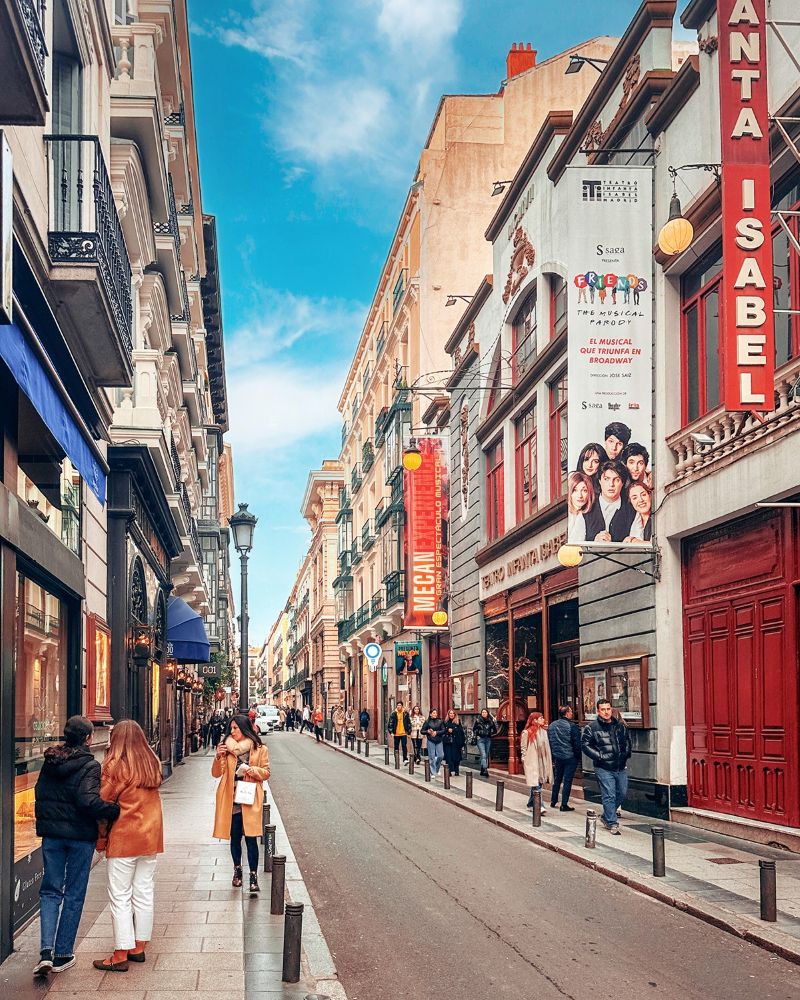
On the corner with Calle Almirante, where the convent of San Vicente de Paúl once stood, a “Model Prison” was opened in April 1845 with capacity for approximately half a thousand prisoners from other prisons. At the end of Calle del Barquillo, on the corner of Calle Belén, is the Edificio de las Cariátides, on the corner of Calle Alcalá, the headquarters of a bank and later the Instituto Cervantes (see post), which was known as “the house of damn what a door!”, an expression caused by the aforementioned caryatids, statues that, like sentinels, were on each side of the enormous main door of the building On this street, is preserved at no 27, the Teatro Infanta Isabel, inaugurated on 9 February 1907 as the Cinema Nacional. At nps 5 and 7, there was the Circo Paul Theater destroyed by fire in 1888. On the site that was the garden of the old convent of Santa Teresa, on the corner of Calle Fernando VI ,and at the end of Calle del Barquillo, the Oriental Gardens theater was built in 1874, one of the popular summer theatres in Madrid. The Teatro Apolo also had an entrance to the stage or actors’ entrance, at the beginning of the street, on the corner of Calle de Alcalá, until its demolition in 1929. The painter Juan de la Corte, who is known to have lived Calle del Barquillo in 1637, married to Francisca de Salazar. In the 18C, founded by María del Pilar Teresa Cayetana de Silva y Álvarez de Toledo (a Goya muse), the Palacio Buenavista had a façade on this street. The Venetian painter Jacopo Amigoni, as recalled by a plaque on the façade of no 6. At the end of the street, at no 34, another municipal plaque informs that General Castaños, hero of Bailén during the Spanish War of Independence, was born in that house in 1758. The poet Ernestina de Champourcín, a member of the Generation of ’27, lived at no 23.
The Madrid tourist office on the barrio o neighborhood of Salesas near Calle del Barquillo: https://www.esmadrid.com/barrios-de-madrid/salesas
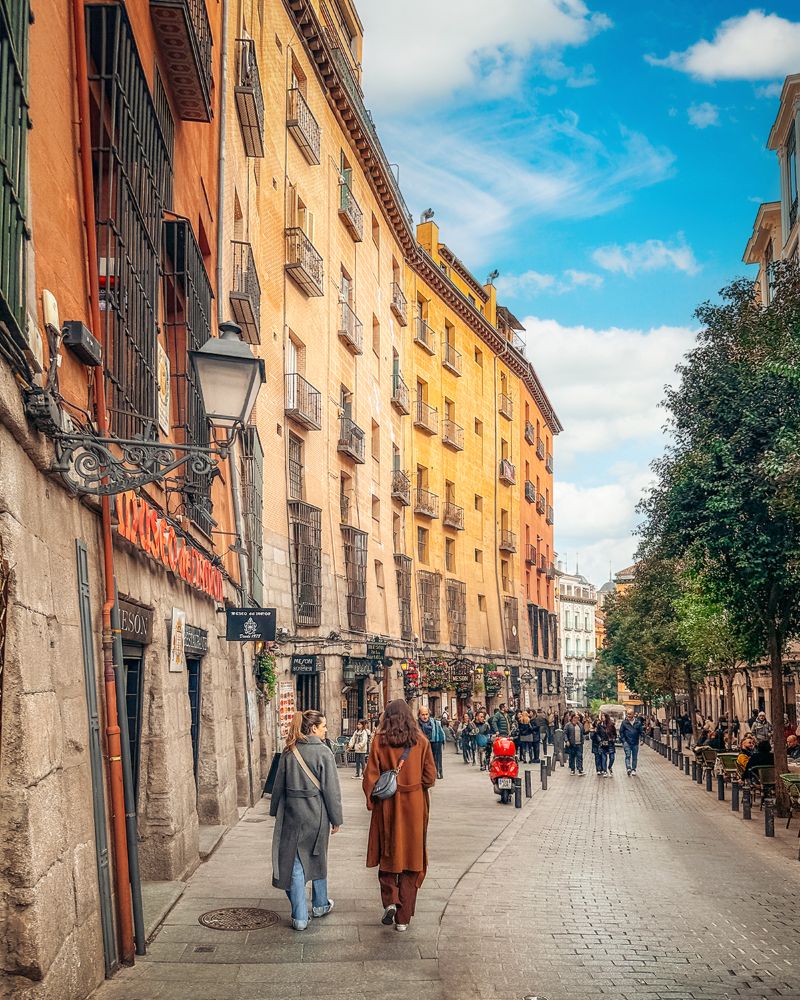
The Cava de San Miguel is a short and old urban street in the Madrid of the Austrias in the Palacio barrio or neighborhood. It leaves Calle Mayor and, leaving Plaza Mayor to one side, descends to Calle de Cuchilleros. It concentrates part of the most typical local colour of the area of the Cuchilleros arch, with establishments such as Las Cuevas de Luis Candelas (see post) or the Mesón del Verdugo, installed in the basements of the retaining walls of the square and the primitive network of medieval undergrounds. Before, in the medieval period, the defensive ditch of the wall that came down from the Puerta de Guadalajara passed through it, until the cave or mine was filled in 1567, and the new street was given the name of the archangel after the neighbouring church dedicated to San Miguel de los Octoes and demolished by Joseph Bonaparte. There could not be missing references in the work of Benito Pérez Galdós, who immortalized the street in works such as “Fortunata and Jacinta” with special prominence in this nocturnal episode of the character Plácido Estupiñá. At no11, Calle Cava de San Miguel, stands the building which the novelist, Benito Pérez Galdós, used to set the home of his character, Fortunata, from the novel, Fortunata y Jacinta (1886-1887)
The Madrid tourist office on Galdos’ Madrid: https://www.esmadrid.com/en/galdos-madrid-map
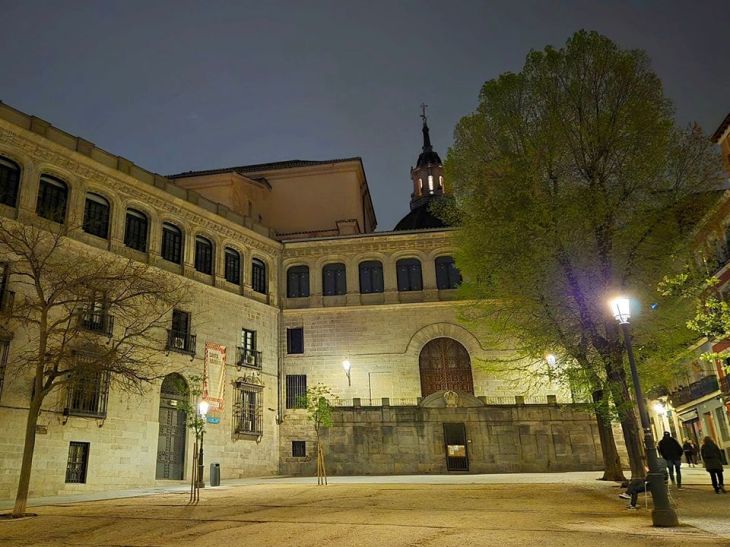
The Plaza de la Paja is located in the barrio or neighborhood of the Austrias, in the historic center of Madrid, and within the traditional district of La Latina. It is crossed from north to south by the Costanilla de San Andrés, close to Calle de Segovia , and different medieval roads converge here such as the Calle del Príncipe de Anglona and Calle Alamillo, Calle del Toro, Calle Alfonso VI and Calle de la Redondilla. The square takes its name from the obligation of the town’s residents to deliver straw (paja) to the chaplains and chapter of the Bishop’s Chapel for their mules. The best as narrow and one way streets with my car was a challenge is to take metro line 5 to La Latina stop. Or best take the bus, see more above ground on the EMT lines 3, 31, 50, 65 and 148 all have stops in the streets near the Plaza de la Paja. The Plaza de la Paja square was the great market during the 13-14C, and its true nerve center and agora. It fell into decline in the 15C, when King John II of Castile ordered the construction of the Plaza del Arrabal (the predecessor of the Plaza Mayor), to which the city’s commercial activity shifted. At the beginning of the 21C, this space was urbanized with a compacted earth park with a few trees arranged in quadrants and delimited by granite curbs, a combination that overcomes the uneven terrain. A few years earlier, the square was decorated with a bronze sculpture, following the fashion for life-size street figures, depicting a man reading a newspaper sitting on a stone bench attached to the façade of the Vargas Palace. Despite this, it maintained its importance as a residence for Madrid’s main noble families. In its surroundings were located different palaces, such as the palatial houses of the Lasso de Castilla and the Marquises of la Romana, among others, of which only the Vargas palace remains. The Bishop’s chapel appears attached to the parish complex of the Church of San Andrés (see post), although without direct access to it. It was built between 1520 and 1535, at the request of the House of Vargas, to house the mortal remains of San Isidro, who, in the 12C, was under the servitude of this family. Next to the chapel, on the eastern side of the enclosure, stands the Vargas Palace, from the 16C, but whose façade was transformed in the 20C, adopting a historicist solution and as an extension of the Bishop’s chapel, so that both complexes have the same façade. To the north of the square, the Prince of Anglona Garden is preserved, one of the few examples of 18C noble gardens in Madrid. Next to it, although now outside the Plaza de la Paja, stands the Prince of Anglona Palace, 16C. On Calle Redondilla , bottom of the square to the left,there is maybe the oldest standing building in Madrid at No 10 ; it’s from the 15C but remains from the Bronze Age have been discovered in this area.
The Madrid tourist office on the barrio or neighborhood of Austrias : https://www.esmadrid.com/en/madrid-neighbourhoods/austrias
There you go folks , another wonderful nostalgic, sentimental trip to my dear Spain, A love affairs with my Madrid, as do not know when we will be back, we sure will have it in our hearts foever Again, hope you enjoy this post on the streets of Madrid, part VIII !!! as I
And remember, happy travels, good health, and many cheers to all !!!

 Paris1972-Versailles2003