
I have written quite a bit on this area of my dear Spain and all its attractions before, but this one is different, I found me older paper picture of my earliest trip to the region and of course, need to show it in my blog. This is rather on the off the beaten path and worth the detour, me think for the architecture and especially the history, Therefore, let me tell you a bit on the Palacio Real de Riofrio !!! Hope you enjoy the post as I.
The village of Navas de Riofrío is in the province of Ségovia in the autonomous community of Castilla y León , It is 4 km from the Royal Palace of Riofrio on the SG-V-7210 road (carretera de Riofrio), 14 km from Real Sitio de San Ildefonso (La Granja), 11 km from Segovia, 81 km from Madrid, and 160 km from our rental house, It belongs from its foundation to the city of Segovia, in the Sexmo de San Millán. It was an independent village until its incorporation in 1844 to Revenga, that later gave it to La Losa in 1900. In 1982 the procedures was started to unite Navas de Riofrio to La Losa and, on February 21, 1983, it was approved. It has an area of 14.86 km² and with a population of 413 inhabitants (2023).
What took me here was the Palacio Real de Riofrio or the Royal Palace of Riofrío , a renovated palace of the 18C, originally built between 1752 and 1759 for the widow of Felipe V, Queen Isabel de Farnèse, it is today part of the residences available to the Spanish royal family, whose management is entrusted to the Patrimonio Nacional,or National Heritage, the national administration at the service of the Crown.
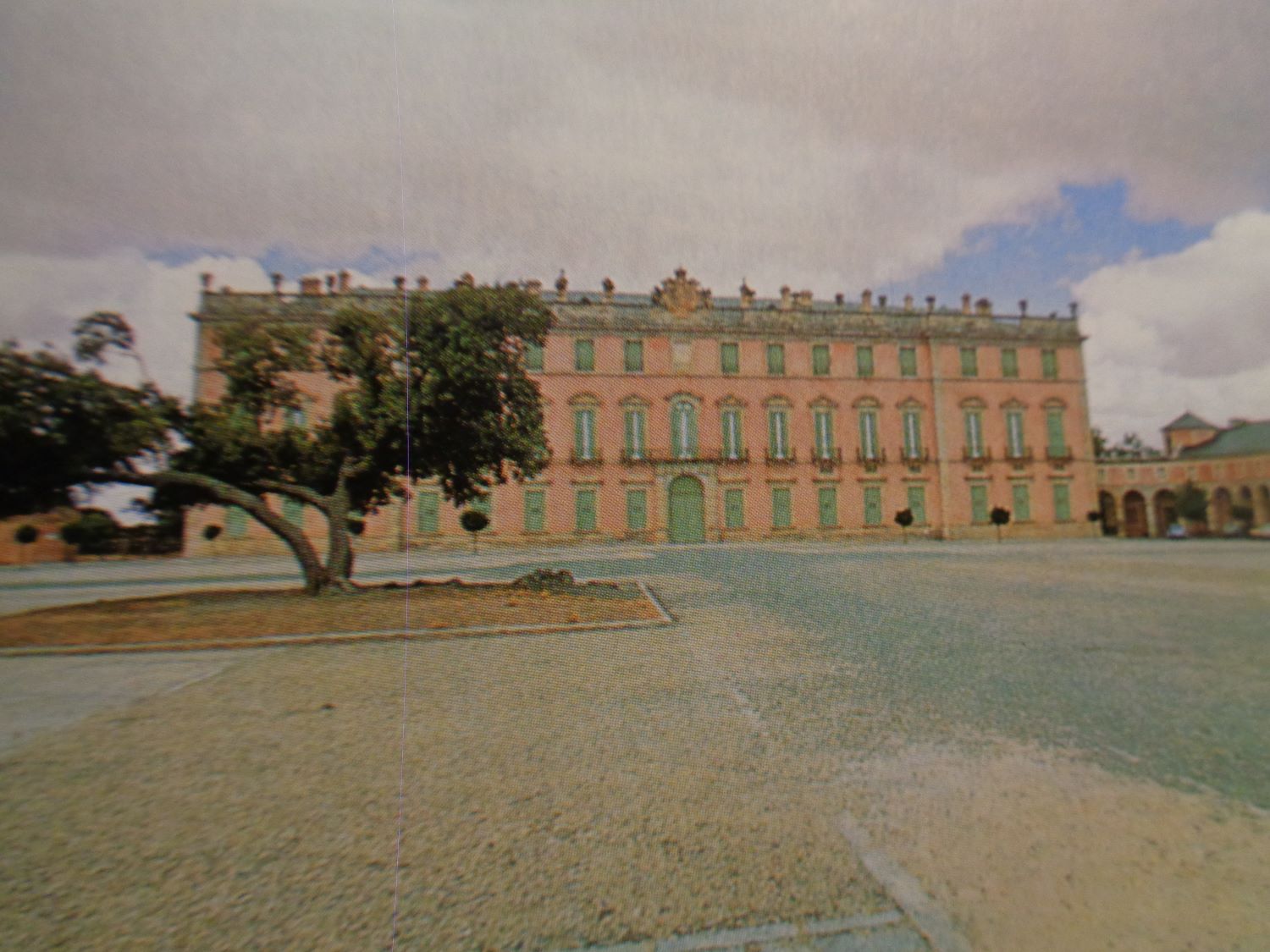
The story/history tell us that she was widowed in 1746, Queen Isabel (Elisabeth) Farnese saw her stepson, born from the first marriage of Felipe (Phillips) V, climbing the throne. The new king, Fernando VI, prefers to keep his ambitious mother-in-law away from the court and political affairs, and therefore gives his agreement to make her build a palace in Riofrío. The site was launched in 1752 while the dowager queen continued to live in La Granja during the works. These are not completed when King Fernando (Ferdinand) VI died without heir, in August 1759. Then succeeded his half-brother Carlos (Charles), hitherto king of Naples and Sicily. Queen Elisabeth assumes the regency until the arrival of her son in Spain, and then settled at the Palace d’Aranjuez (see post). It was there that she died in 1766, without having ever lived in the Palace of Riofrío. After her death, the work of Riofrío stopped, in 1767. The palace then passed to the last son of the Queen, the Infant Luis Antonio) Louis-Anthony, count of Chinchón, who had abandoned the ecclesiastical state and the cardinal purple for a few years earlier, in 1754. This one did not use the palace either. Abandoned, the palace serves as a simple hunting relay for the use of the royal family. In the 19C, Queen Maria-Josèfa de Saxe took refuge in it to escape the jibes of a court that disappeared her marriage remained without posterity with King Fernando (Ferdinand) VII. The palace is then inhabited by King Consort Francisco de Bourbon, who lived separated from his wife Queen Isabel II and who made many arrangements there, then by their son, Alfonso XII, during his widowhood, in 1878, In the 1960s , the Patrimonio Nacional (national heritage) chooses to open the royal sites to the visit. The Palacio Real de Riofrío then undergoes important changes, the ground floor being notably divided into two parts welcoming for one the Alfonso XII museum and for the other a hunting museum. The Palace opens its doors to the public for the first time on July 14, 1965.
It is built on a plane centered around an interior courtyard, the palace rises on three levels. Its sober, straight and monumental facade, coated with pink, as well as its terraced roof from which ornamentation trophies arise, recall the architecture of Italian palaces. Among the most remarkable elements of the site, we can evoke the large staircase, the chapel and its collections of paintings and tapestries, the decorations dating from the 19C, or the 625 hectare park.
Other things to see here, me think, with more time is the Immaculate Conception Church; San Antolin hermitage; and the La Losa-Navas de Riofrío trainstation;
The National Heritage of Spain on the Royal Palace of Riofrio: https://www.patrimonionacional.es/en/visita/royal-palace-riofrio
The Castilla y Léon regional tourist office on the Royal Palace of Riofrio: https://www.turismocastillayleon.com/en/heritage-culture/palaces/royal-palace-riofrio
The village of Navas de Riofrio on its history: https://www.navasderiofrio.es/historia
There you go folks, a wonderful beautiful palace in inland natural Navas de Riofrio. This is a wonderful countryside, small enough to walk all over. and huge in Spanish history with marvelous architecture, we love it. Again, hope you enjoy the post on the Palacio Real de Riofrio as I.
And remember, happy travels, good health ,and many cheers to all !!!

 Paris1972-Versailles2003