
And I am going back to a wonderful far away land in my beloved Spain. This is going to the autonomous region of Extremadura in the province of Càceres, and the historical town of Càceres, I have found couple pictures in my cd rom vault that made me do this post for you and me. Therefore, here is my take on this is Càceres !!! Hope you enjoy it as I.
The town of Cáceres is the largest in Spain with an area of 1,750.33 km². Several roads pass through it and, as it is the provincial capital, and others begin: The A66 or Ruta de la Plata highway, The A58 or Extremeña highway, The N630 northern access to Cáceres via Ruta de la Plata ) , The N521 Trujillo-Valencia de Alcántara highway ,and the N523 Cáceres to Badajoz highway, It is located 46 km from Trujillo, 75 km from Mérida, 92 km from Badajoz, 316 km from Lisbon, 301 km from Madrid, and 203 km from Salamanca from where we came from on a road warrior swing to Madrid, We took the A66 or Autovia Ruta de la Plata (silver road) to exit/salida 542 connects on the CC324 to City center Párking Obispo Galarza in Plaza Obispo Galarza,
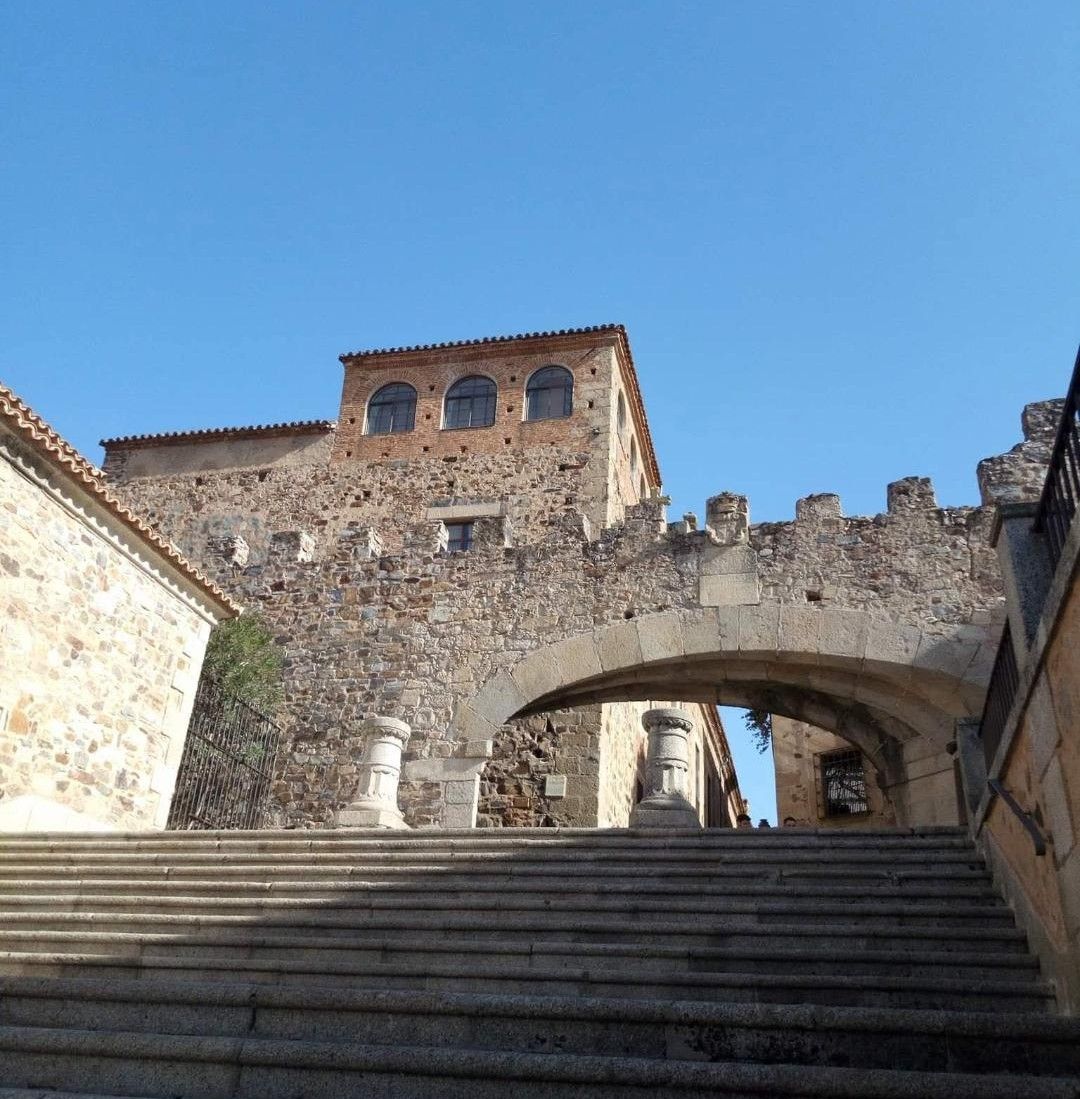
The Arco de la Estrella has been the main entrance to the walled enclosure since the 15C, being the best known in the medieval city. Located next to the Torre de Bujaco tower, it was opened at the same point where there was a small gate to allow the passage of carriages from the Plaza Mayor, by then the wall had lost much of its defensive nature. It was then called, for obvious reasons, the puerta Nueva or New gate. Before it they swore the laws and privileges of the city, granted centuries before by Alfonso IX, the Catholic Monarchs, Isabel on June 30, 1477 and Fernando on February 27, 1478. On the outside, the arch is crowned by the coat of arms of Cáceres, while on the inside there is a small temple with an image of Nuestra Señora de la Estrella or Our Lady of the Star, which gives the arch its name. The image is illuminated by a small star-shaped lantern, and beneath it is a stone coat of arms of the Carvajal family.
The emblem of Cáceres and the most striking building in the Plaza Mayor, the Torre de Bujaco tower protects the northwest flank of the city. The current name of the tower is a modern name, perhaps coming from the Caliph Abu Ya’qub (Abu Jacob), builder of the tower. This is believed to be the origin of its name. It is a genuinely Arab building with a square floor plan erected on reused Roman ashlars. It is essentially built of masonry, reinforced with ashlar at the corners. Like many other military buildings from the Almohad period, it is a keep connected to the wall by a powerful masonry arch. It is topped by a ring of battlements, two side machicolations and a front one, added much later. On the western side, facing the Plaza Mayor, is the small balcony of the Fueros, dating back to the 16C and decorated with volute corbels and a coat of arms. The tower measures about 10 meters on each side and 25 meters high. Its construction dates back to the rebuilding of the city by the Almohads in the 12C. When the Christian troops were able to take Cáceres for the first time in 1169, they used this construction to their advantage, but it was soon reconquered by the Muslims in the spring of 1173. The Bujaco Tower was the last stronghold defended by the Christian knights after a six-month Almohad siege. In the 21C the tower has been restored for public use and is open to tourism. It currently houses an interpretation center, a must-see for tourists, and allows visitors to contemplate a large part of the monumental city from the top of the battlement.
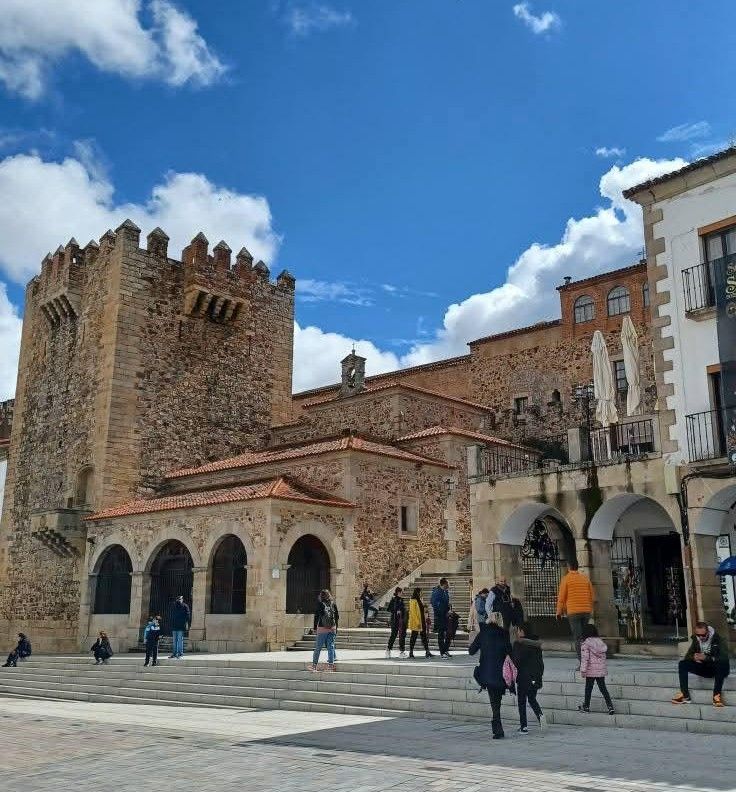
Other things to see here, plenty if more time are the Cathedral of Santa Maria, Palacios de las Veletas y los Golfines, Casa del Sol ,as the towers above are among the most beautiful monuments of the city. Surrounded by Arab walls defended by towers, this district groups together Gothic and Renaissance stately homes, unique in Spain for its homogeneity. The noble houses built in the 15-16C have smooth, ochre facades, without excessive decoration; their knightly owners were the Ulloa, Ovando or Saavedra who gained more prestige than wealth by fighting against the “infidel” – Moor or American Indian. Coats of arms, fine ribs framing windows, or sculpted cornices are the only ornaments of these residences whose fortified towers, which affirmed the power of their inhabitants, were truncated in 1477 on the orders of Isabel the Catholic. The Plaza Santa Maria or Plaza Mayor of the old city, this elongated and crooked square multiplies the perspectives on ochre facades. That of the Mayoralgo Palace has regained, after restoration, its elegant twin windows. The bossed portal of the Episcopal Palace dates from the 16C. The medallions on either side of the latter represent the Old World (on the left) and the new (on the right). Plaza San Jorge , the Church of Saint Francis Xavier, built by the Jesuits 18C facade dominates the Plaza San Jorge. The Santa Maria Church completed in the 16C, Saint Matthew Church ,high Gothic nave, begun in the 14C completed in the 16C, the Santiago Church is considered the cradle of the military order of the friars of Cáceres, at the origin of the military order of Saint James of the Sword. It was built at the beginning of the 13C, in a Romanesque-Gothic style, and restored in the 15C. The Carvajal Palace to the left of the Church of Santa Maria, at the beginning of Calle de las Tiendas, it is flanked by a 15C tower. Palace of the Golfines de Abajo. This rich residence twice hosted the Catholic Monarchs; Gothic with touches of Plateresque, late 15C. There is also a Palais des Golfines de Arriba, the Palacio de Godoy, The ramparts partially restored, they have Roman foundations, Moorish parts and more modern sections that date from the 15C. Two towers overlook the two main gates of the old town, one built on a Roman foundation and the other a Moorish work dating from the 12C. The Museum of Cáceres was inaugurated in February 1933, in two houses: the Palacio de las Veletas (weathervanes), which houses the museum’s archaeology and ethnography sections and, in its basement, the best-preserved Hispano-Arab cistern in Spain, a remnant of an Almohad military fortress; the Casa de los Caballeros, or House of the Knights, next to the Palacio de las Veletas ,and which has housed the museum’s Fine Arts collection since 1992.
A bit of history I like tell us that in the 1C BC, the Romans settled permanently in encampments such as Castra Cecilia and Castra Servilia on the hill where the Norba Caesarina settlement was located, close to the important communication route that would later be known as the Via de la Plata (Silver route). Around the 5C, the Visigoths razed the city, which disappears from historical records until around the 8-9C. In 1147, the Almohad ruler Abd al-Mumin refounded the city and made it a military base to face the kingdoms of León, Castile and Portugal. The city was fortified with adobe walls which are still preserved today. Despite its defenses, King Alfonso IX of León took the citadel after several years of siege, on April 23, 1229, the day of San Jorge (Saint George), who has since been celebrated in the city as its patron Saint. From that moment on, Cáceres began to transform, building churches within the mosques and Christian palaces on the primitive Muslim ones, thanks to the fortunes made by the conquistadors in America. These contributed most to the powerful and grandiose character of the city. Despite some alterations until the 18C, it is the one that has survived to the present day. The old town of Cáceres was declared the Third Monumental Ensemble of Europe in 1968 and declared a World Heritage Site by UNESCO in 1986.
The Càceres tourist office on the Arco de la Estrella : https://turismo.caceres.es/es/recurso-poi/arco-de-la-estrella
The Unesco world heritage sites on Càceres : https://whc.unesco.org/en/list/384/
The City of Càceres on its cultural agenda : https://www.ayto-caceres.es/agenda-cultural/
The province of Càceres tourist office on Càceres : https://www.turismocaceres.org/es/comarcas-turisticas/caceres
The Extremadura region tourist office: https://www.turismoextremadura.com
There you go, another dandy in my beloved Spain, and the needs as usual to come back to these beautiful places, eventually, Càceres is worth the detour indeed. Again, hope you enjoy the post on this is Càceres !!! as I
And remember, happy travels, good health, and many cheers to all !!!

 Paris1972-Versailles2003