
I bring you to the wonderful town of Barbastro in marvelous Aragon of my beloved Spain. I have been by here several times and did came in with my usual road warrior trails going elsewhere. Glad to found me a picture in my cd rom vault that made me do this post for you and me, Therefore, let me tell you a bit on this is Barbastro !!! Hope you enjoy it as I.
The town of Barbastro is located in the province of Huesca, autonomous community of Aragon in the kingdom of Spain, It is 55 km from Huesca, 120 km from Jaca, 154 km from Urdos (France) , 127 km from Zaragoza, 436 km from Madrid, We visit as a side step from Jaca on our way to Madrid taking the A23 or Autovia Mudéjar and N330a by Monrepos and Nueno at exit/salida 362 take the N240 or carretera de Tarragona by and around Huesca continue until a trafic circle bearing left into the A1219 road and on next trafic circle bear right into the A22 or autovia Huesca-Lleida continue to exit/salida 62 to get on the N240 again,to Barbastro.
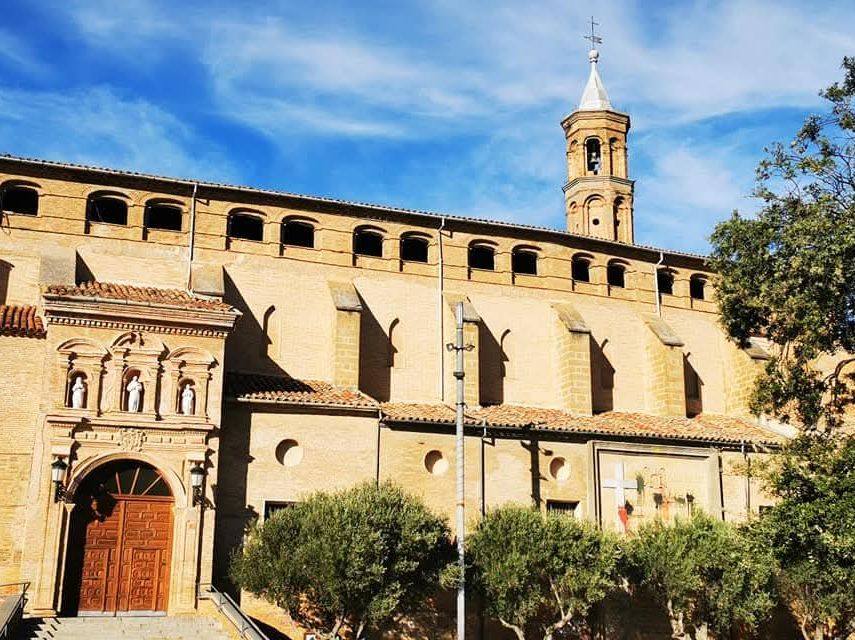
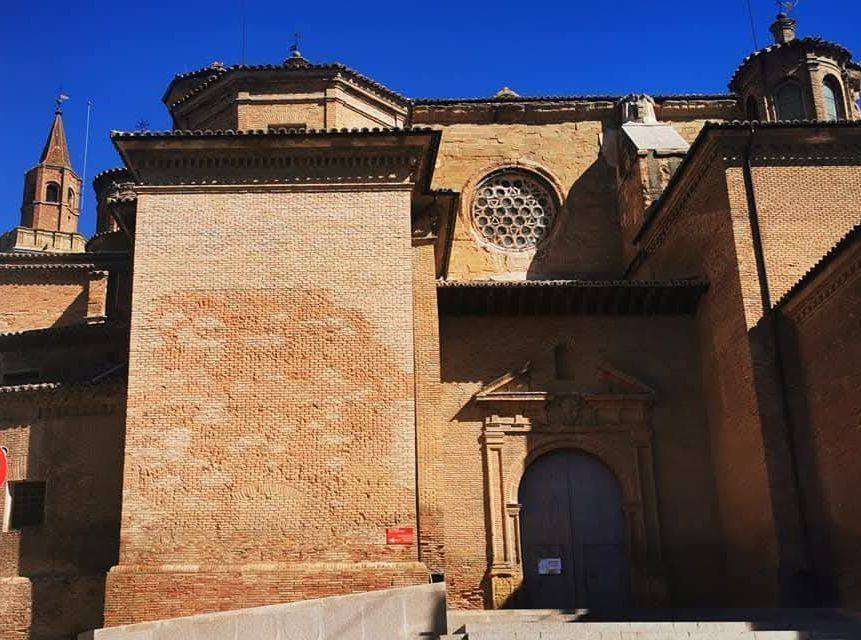
The Cathedral de Santa María de la Asunción: dedicated to the Assumption, it is the most important monument in the city. Construction began on the main mosque in 1517 and was completed sixteen years later in 1533. It is a temple of Gothic inspiration and Renaissance development, with three naves of equal height, without a dome or transept. The ribbed vaults are supported by six columns about 15 meters high. The main altarpiece has a spectacular alabaster base, Starting in the 17C, the temple was enriched with new chapels. The two located at the foot of the church are distinguished by their 18C Baroque style. The tower stands to the north, detached from the cathedral choir. This is probably because the mosque’s minaret was reused as a bell tower after the Christian Reconquest, when it was consecrated as a cathedral. At the beginning of the 14C, this minaret was demolished and replaced by a medieval tower with the walls of the lower levels are 2 meters thick. In the early 17C, an additional section was added to the tower as a counter-tower or inner tower. It was built of brick on the inside and cut stone on the outside. The construction of the spire in the 18C gave it its definitive appearance. The sound of its bells punctuated the city’s life. In addition to its civil and religious functions, it was used on several occasions as a watchtower and refuge. This complex includes the Diocesan Museum, which houses an interesting collection of goldwork and fabrics, and also brings together beautiful medieval sculptures and paintings mostly from abandoned villages.
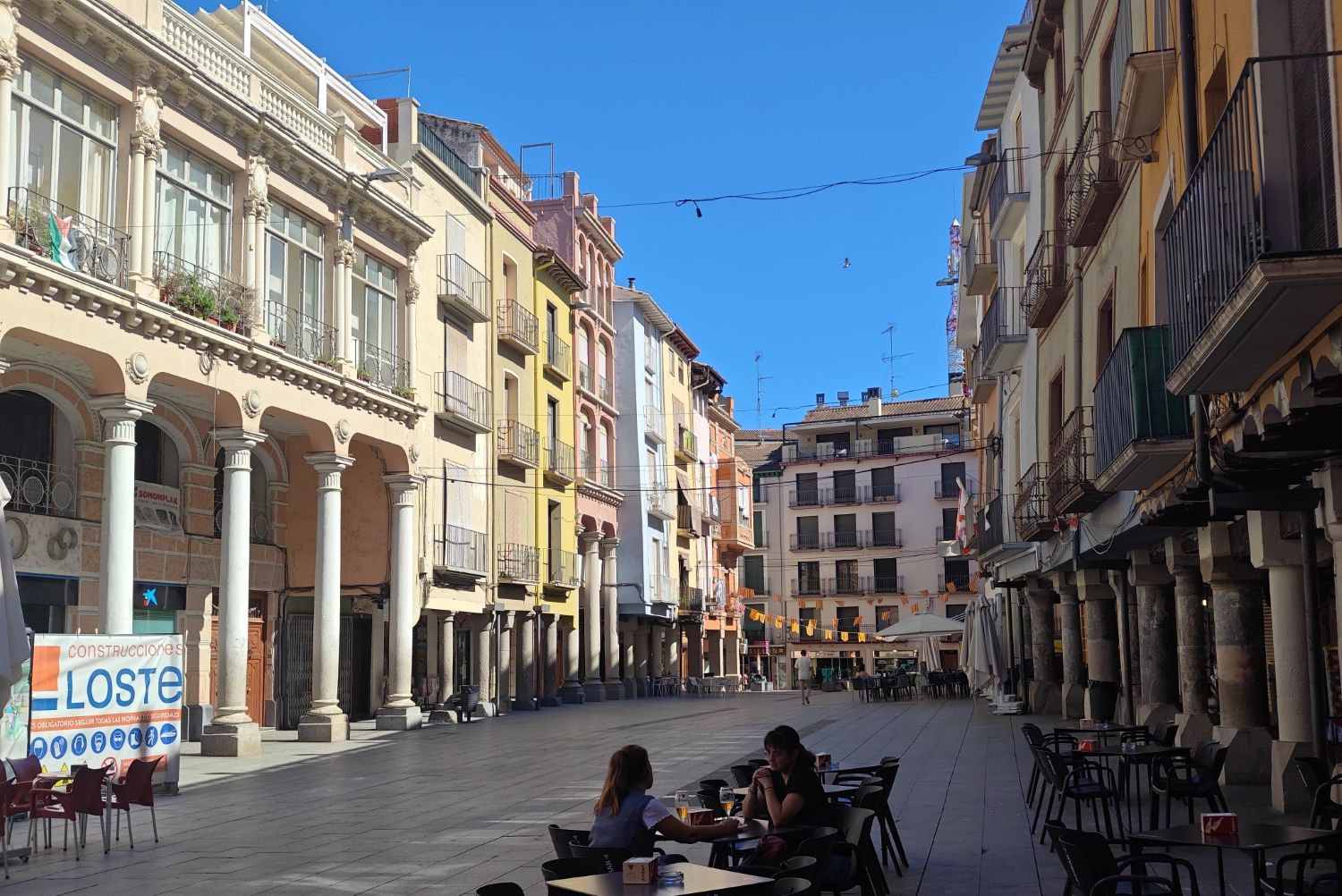
In my road warrior trail of Barbastro I passed by an interesting square, the Plaza del Mercado luckily it was not market day ! This square was born and developed alongside trade, favored by the strategic geographic location of the town of Barbastro. Since its origins, it has brought together numerous merchants and market gardeners who displayed for all to see their baskets filled with vegetables and fruits, and everything else the land produced in its fields. Unlike other Spanish squares, it did not house an official building. Buying and selling… such is the role of the Market Square, Every Saturday, this public space once again becomes a scene of trade and commerce, a place of sociability, culture, and expression; it once again becomes a center of political life in the streets and also a place of celebration. Of course, all holidays, fairs, and events. At one of the ends of the plaza we find the Capilla de Santa Ana. This is a very familiar reference for the neighbors of the Plaza del Mercado and all locals in general.
Other things to see with more time are the Episcopal Palace follows the Aragonese style of other buildings in the city. Its construction dates back to the 16C, with a later extension in the 17C. Its façade is divided into three strips, with an arched gallery topped by a large eaves and two balconies. The Argensola Palace is a manor house from the 16-17C, notable for its arched gallery crowned by a large, ornately carved wooden eaves. The famous poets Lupercio Leonardo de Argensola and Bartolomé Leonardo de Argensola, as well as General Ricardos y Carrillo de Albornoz, were born in the original palace. The Sanctuary of Our Lady of El Pueyo is a traditional and ancient hermitage visited annually by the inhabitants of Barbastro and many surrounding towns on various pilgrimages. This hermitage/monastery is located in a privileged viewpoint from which you can take in the entire region and many of the important peaks of the Huesca Pyrenees. Of note is the Colmenar del Santuario de Nuestra Señora del Pueyo or Beehive Gardens of Our Lady of Pueyo Sanctuary. Museum of the Claretian Martyrs is a religious museum built in honor of 51 Claretian missionaries, martyrs of the Church, who died in August 1936 at the beginning of the Spanish Civil War. The Wine Museum is on the first floor of the former San Julián Hospital, you’ll find the designation of origin, collectively titled “El Espacio del Vino del Somontano.” It’s a modernist museum, divided into two areas, where the winemaking process is explained in an entertaining and scientific way. Plaza de la Candelera is the heart of the Entremuro neighborhood and the original center of the entire city. It is the oldest square and possibly one of the most emblematic in the city. This square was also the physical space where, on November 13, 1137, the betrothal of Doña Petronila of Aragon, daughter of King Ramiro II, to the Count of Barcelona, Ramon Berenguer IV, was signed.
A bit of history I like, condense, tell us that in Roman times it was part of Hispania Citerior, later called Hispania Tarraconensis. The city was taken by the Arabs under the leadership of Muza in 711, who gave it the name Barbaschter, which derives from the name Barbastrum, according to the commonly accepted opinion. In 800 it became the power base of Jalaf ibn Rashid, an Andalusian military man who confronted the lord of Zaragoza and Huesca, Bahlul ibn Marzuq. He in turn found himself opposed to the Cordoban power, so Jalaf was rewarded after killing Bahlul with the confirmation of his government in Barbastro and Huesca. Jalaf rebuilt and fortified Barbastro, which became the capital of a cora called Barbitania. Sancho Ramírez, with the help of troops from Frankish counties in the Pyrenees, took Barbastro in 1064 in what is considered the first known call for a crusade, the Crusade of Barbastro. This historical event is referred to in the French epic poem of the Carolingian cycle Le siège de Barbastre or The Siege of Barbastro, of which a manuscript copy from the early 13C is preserved in the National Library in Paris. In 1065, Al-Muqtadir reacted by requesting help from all of Al-Andalus, and calling for a jihad, he recaptured Barbastro. It was finally recaptured in 1101 by King Pedro I of Aragon, who, with the Pope’s permission, made it an episcopal see. In 1137, one of the most significant historical events took place in the city: in the Entremuro neighborhood, the betrothal was signed between Count Ramón Berenguer IV of Barcelona and Petronilla, daughter of Ramiro II. This event gave rise to the creation of the Crown of Aragon. Its importance at the time is reflected in the frequent visits made by Alfonso II, who since its reconquest earned the rank of a noble city with a vote in the Cortes, hosting those held by Pedro II in 1196. Two centuries later, upon the death of Juan I, Barbastro was siege by the Count of Foix in 1395. Again, in 1626, the Cortes Generales of Aragon were convened in the city under the reign of Felipe IV. Under this monarch, Barbastro was a rearguard in the Catalan War, reiterating a leading role in military life that would be repeated in the War of Independence (peninsular war), in the first clash between liberals and Carlists. The British writer George Orwell, who was recovering in Barbastro from a war wound, refers on several pages of his book Homage to Catalonia to the life and urban landscape of this city during the Spanish Civil War; the greatest religious persecution in the country took place in this area, where 87% of the priests and monks of the entire diocese died.
The town of Barbastro on its history : https://barbastro.org/la-ciudad/historia
The Barbastro tourist office on its heritage : https://barbastroturismo.com/lugares-con-mucha-historia/
The local Somontano tourist office on Barbastro : https://turismosomontano.es/en/que-ver-que-hacer/pueblos/barbastro
The official museo Diocesano de Barbastro : https://museodiocesano.es/galeria-de-fotos/
The Diocese of Barbastro-Monzon on the cathedral : https://www.diocesisbarbastromonzon.org/inicio/catedral-de-barbastro/
There you go folks, a wonderful, terrific, glad had stop by to architecturally and historically stunning Barbastro of my dear Spain, A good spot to enjoy the gorgeous Pyrénées and winter sports, Again, hope you enjoy the post on this is Barbastro !!! as I.
And remember, happy travels, good health,and many cheers to all !!!

 Paris1972-Versailles2003