
And I am going back to a wonderful far away land in my beloved Spain. The Real Monasterio de Santa María de Guadalupe or the Royal Monastery of Santa María de Guadalupe is a Franciscan monastery located in the village of Guadalupe, in the province of Cáceres, in the autonomous community of Extremadura and in the kingdom of Spain, I am thrill to have found pictures in my cd rom vaults to do a post on the monastery Therefore, here is my take the Real Monasterio de Santa Maria de Guadalupe !!! Hope you enjoy it as I.
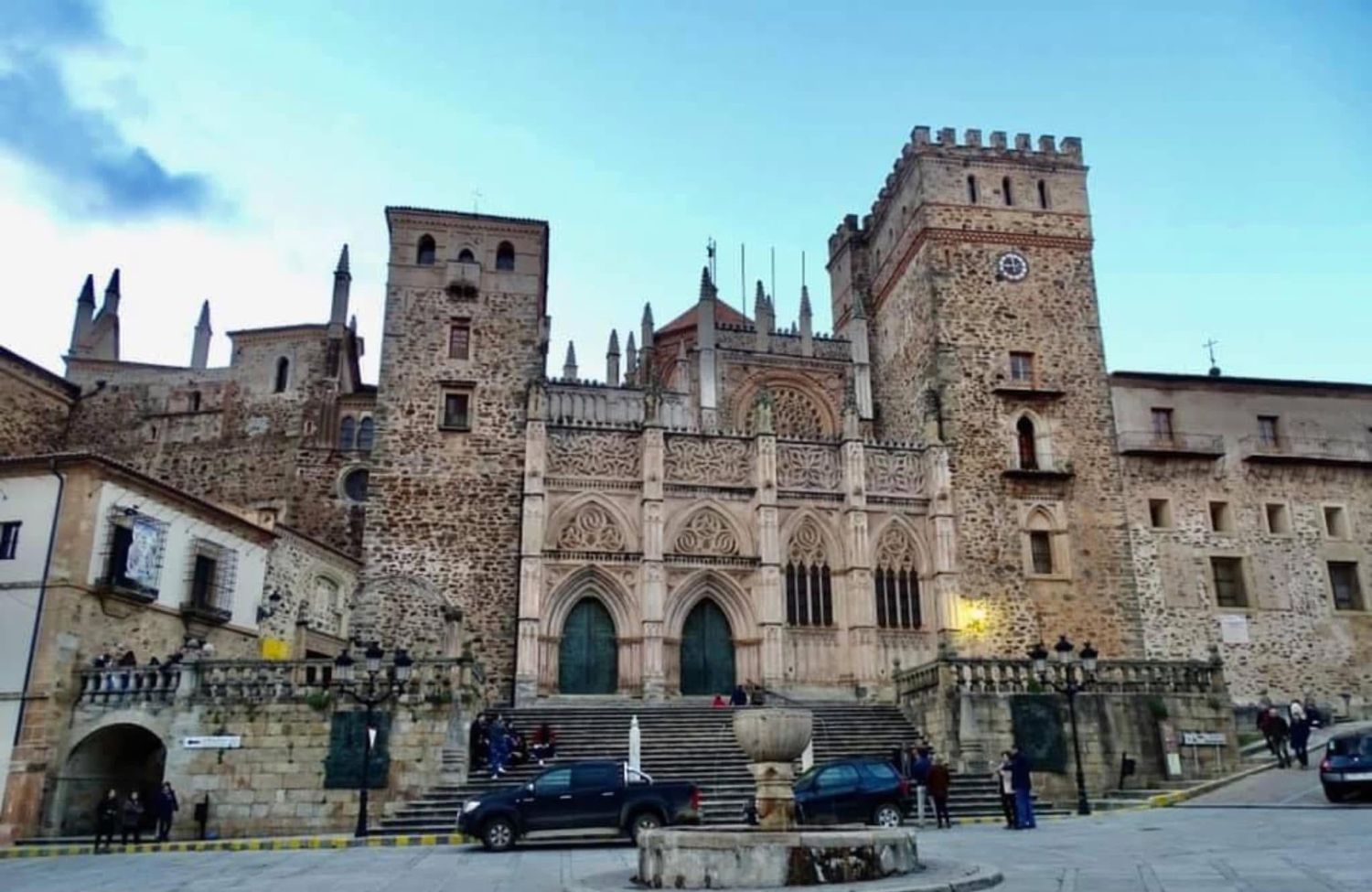
The façade is the best-known image of the monastery. It overlooks the Plaza Mayor and is in the advanced Gothic style with Mudejar elements. It is flanked by two solid medieval towers and dominated by the rose window on the south side of the transept. It is displayed above a large staircase that leads to the two pointed bronze doors that give access to the temple. These doors, which depict motifs from the lives of Jesus and the Virgin, date from the late 14C, making them some of the oldest preserved bronze doors in Spain. The doors of the temple communicate with the right-hand nave, or the Epistle nave. This access space was the original portico of the church, built in the 15C, which has become the Chapel of Santa Ana. It is presided over by a Renaissance altarpiece (16C) with an oil painting of Saint Anne, dated 1587. The Royal Chapel of Santa Catalina was built in the mid-15C. It has a square floor plan and is covered with a ribbed vault. It houses two 17C Baroque altarpieces dedicated to Saint Catherine and Saint Paula. The temple is Gothic, built in the 14C and renovated in the 15-18C. It has a rectangular floor plan, with three naves with four sections covered with ribbed vaults, more complex in the central nave than in the lateral ones. The central part is higher and is traversed by a gallery open to the temple. The highest part features Gothic arches that illuminate the interior. The transept is the length of the three naves. An octagonal dome rises above the crossing.
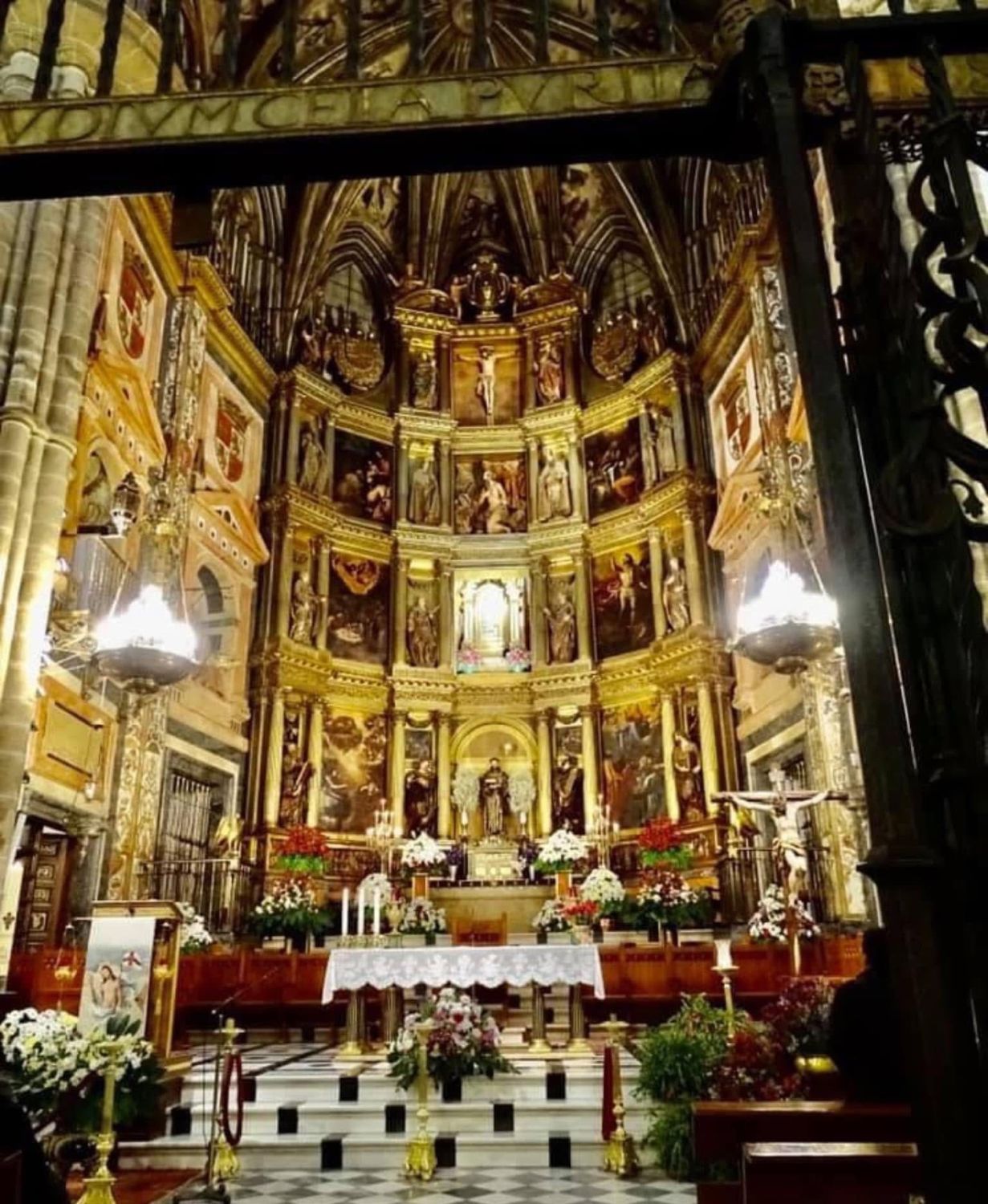
The main altarpiece rises above a steep staircase. Built at the beginning of the 17C, it maintains Romanesque Revival features with others typical of the Baroque. The bench runs along the lower part and displays seventeen reliefs. It has three sections, the central one being wider, and two spaces defined by pairs of classical columns. It rises in three floors topped by a crucifix, covered with a curved, broken pediment of Baroque design in the middle of which there is a vase with lilies, which symbolize the purity of Mary and are the emblem of the monastery. It is flanked by ornamental sculptures and the coat of arms of the Habsburgs, the reigning dynasty in Spain at that time. The altarpiece is presided over on the third floor of the central section by Saint Jerome, as a reference to the order of the Hieronymites, the friars of the monastery. The altarpiece houses a unique piece; it is called the “Desk of Felipe II”. It is actually a Renaissance chest, made of cedar and steel, adorned with silver and gold damascening; the lower part displays five rectangular gilded plates with a pair of Renaissance-style female figures. It is flanked by two pairs of Ionic columns and closed with a split pediment. It was made in Rome in 1561, and Felipe (Philip) II donated it to the monastery to be used as a tabernacle. The paintings (17C) occupy the side sections of the altarpiece. The three on the left represent the Annunciation, the Birth and the Adoration of the Magi. Those on the right represent the Assumption, Resurrection and Pentecost. Here are the tombs of Enrique (Henry) IV of Castile and his mother Maria of Aragon, represented in an attitude of prayer, and those of Don Dionís of Portugal and his wife, frustrated candidates to the throne of the neighboring country. The side altarpieces are dedicated to Saint Peter and Saint Paul.
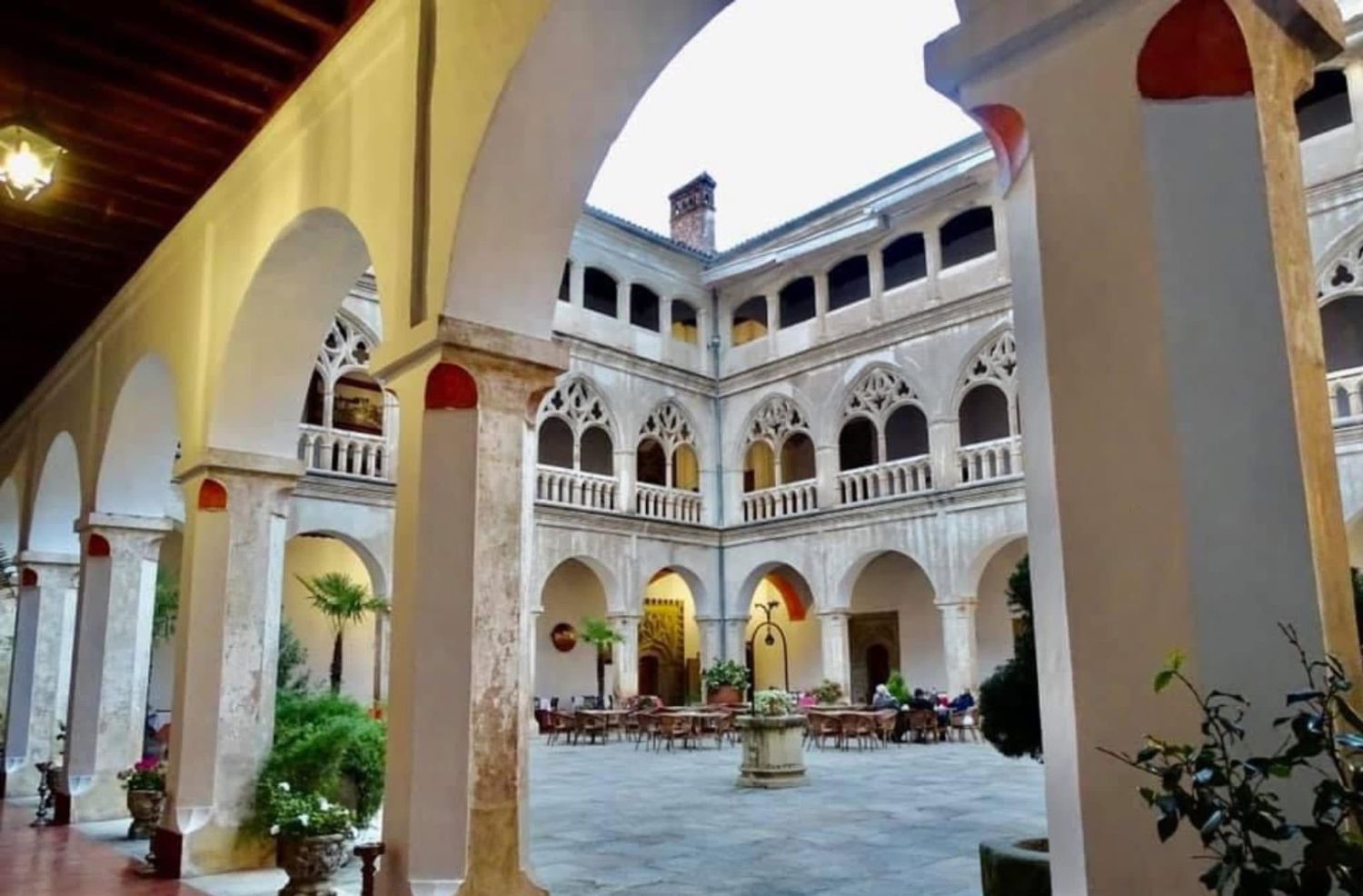
The Gothic cloister is located in the buildings to the west of the monastery; its rooms were mainly used as a hospital and pharmacy and, for this reason, it was also called the “chemist’s cloister”. The monastery had four hospitals: St. John the Baptist’s, the women’s, the bishop’s, and the foundlings’ hospital. Currently, the cloister is part of the monastery’s guest house, which has 47 rooms. The cloister has a square floor plan, covers an area of 840 square meters, and was built between 1519 and 1533. Therefore, it belongs to the Renaissance period, although it maintains Gothic elements. It has three floors. Among the guest house’s rooms, the spacious dining room, built in 1994, stands out. On the exterior façade, near the entrance to the guest house, Mudejar windows made of brick are preserved.
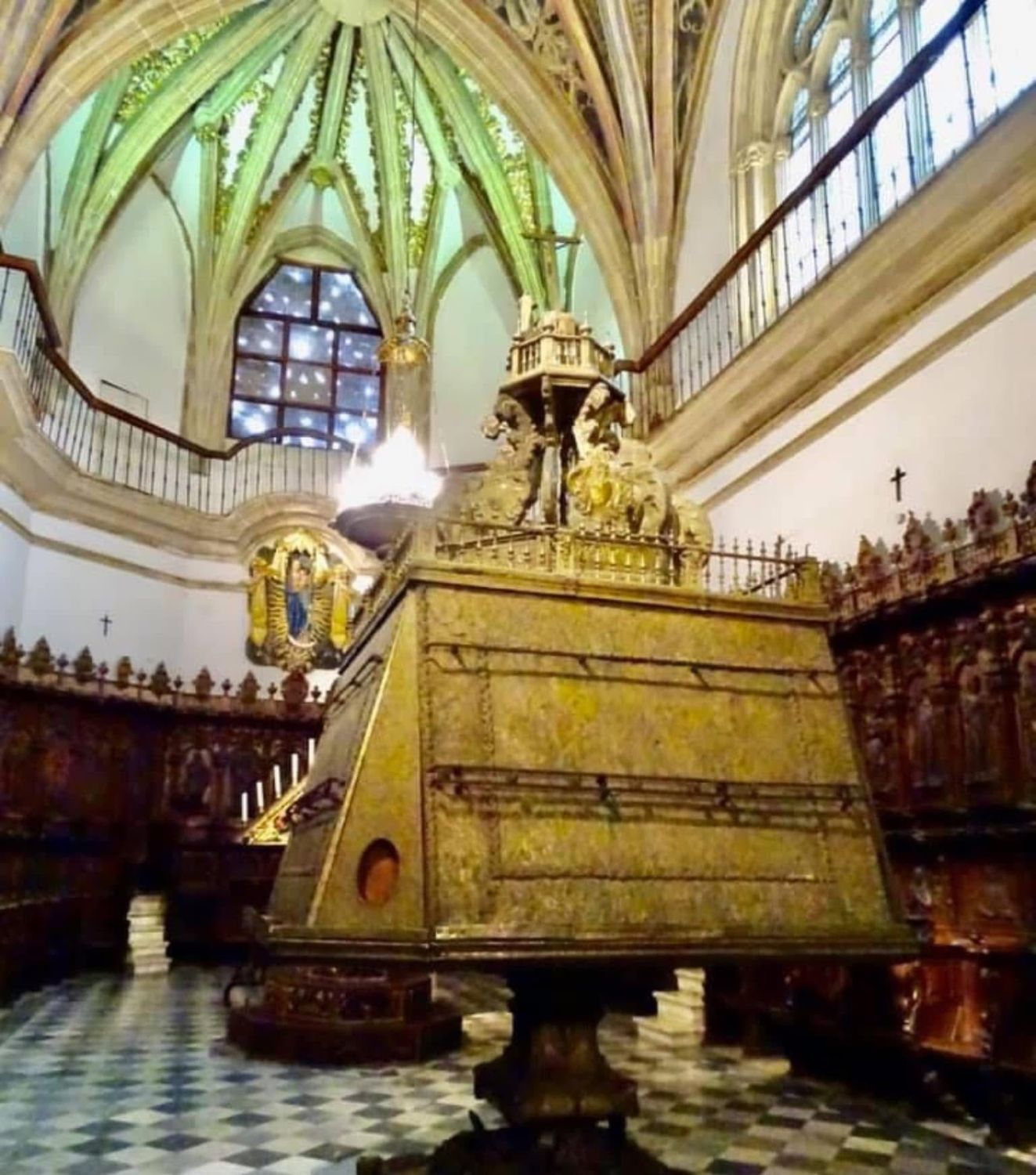
The choir stalls were built in the 14C and were renovated in the 18C, They are built on a lowered Gothic vault, cover two sections of the central nave and extend to the foot of the temple, towards the west. The rear vaults of the upper choir are decorated with frescoes of musical angels (15C). The choir stalls are Baroque (17C), made of walnut. They have two levels of seats, 45 on the lower floor and 49 on the upper one; the backrests of the lower one are decorated with reliefs of saints framed in squares, while those of the upper one are framed in larger rectangles and have reliefs of full-length saints. Above the presidential chair is the carving of the Virgin of the Choir; it belongs to the Flemish-Gothic period (15C), is made of polychrome wood, carries the moon at her feet and holds the naked Child.
The architectural complex consists of the ante-sacristy, the sacristy and the chapel: It was built between 1636 and 1645. It is a solemn, spacious, harmonious room with walls, vaults and a dome decorated in a decidedly Baroque style. It is one of the most dazzling Baroque sacristies in Spain. The ante-sacristy is a Gothic room covered with groin vaults. It houses three large paintings. Next you enter the sacristy. It is a large rectangular room with a barrel vault divided into five sections resting on Tuscan pilasters. The vault displays mural paintings with scenes from the life of Saint Jerome. The walls are covered with eight paintings of extraordinary quality and size, five on the left and three on the right. The sacristy is presided over by the chapel of Saint Jerome, the founder of the order that ran the monastery from 1389 until its confiscation in 1835. The altarpiece features an image of the saint made of baked clay from the early 16C. It also houses three splendid canvases by Zurbarán related to the subject of the altarpiece. The upper part shows the Apotheosis of Saint Jerome; on the right wall, the Temptations of this saint; and on the left, the Scourging of the same. From the dome of the chapel hangs the lantern that Don Juan of Austria captured from the Turks in the Battle of Lepanto (1571) and that Felipe II donated to the monastery six years later.
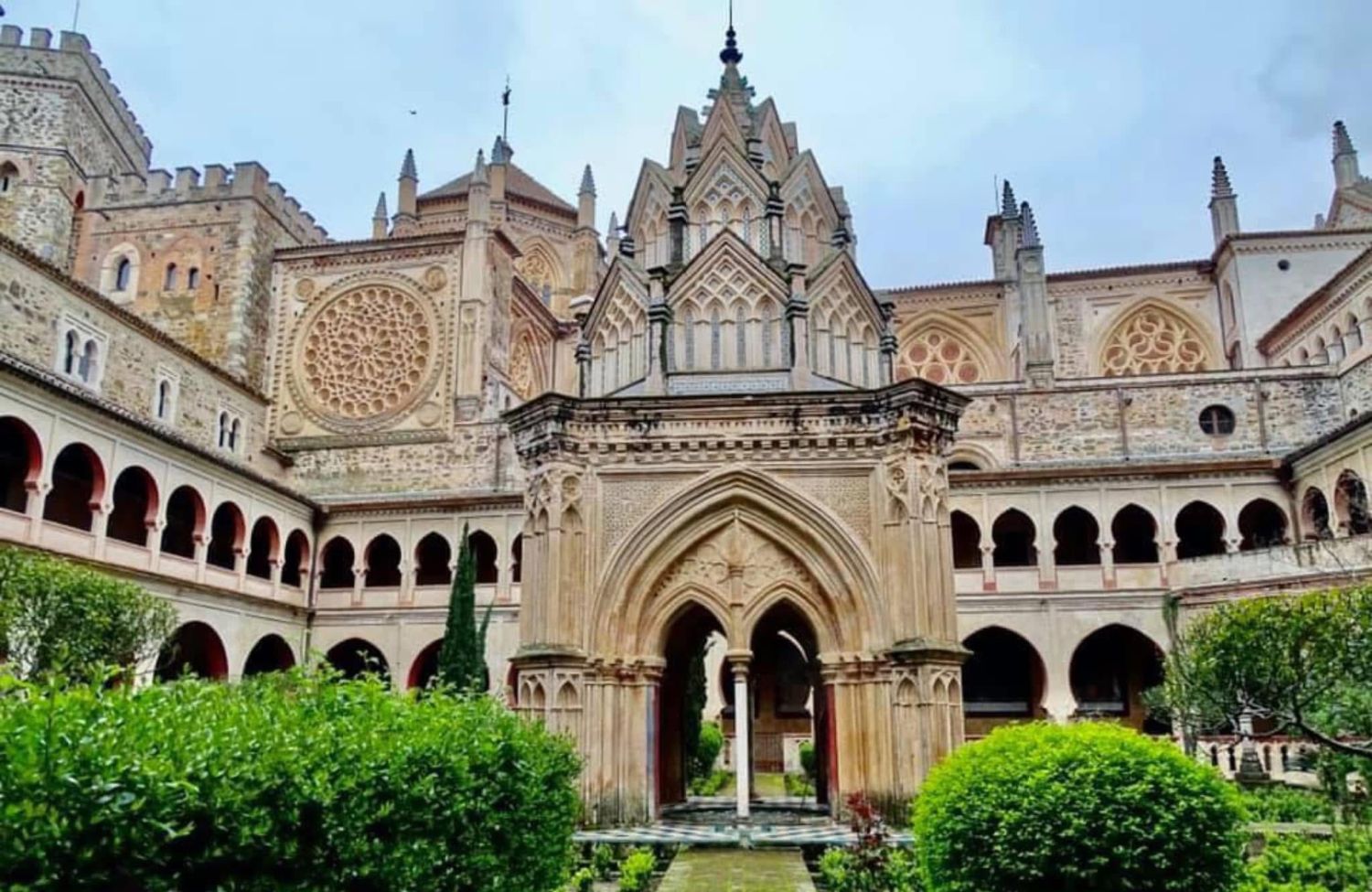
The cloister was built between the 14C and 15C in the Gothic-Mudejar style. It has a rectangular floor plan, two floors, and a surface area of 1,680 square meters. The ground floor is defined by pointed Islamic arches joined at the bottom by a small wall constructed from serial pointed arches. The first-floor gallery has horseshoe arches of Islamic influence supported by pillars joined by a continuous parapet. In the center stands a small temple, the most characteristic element of the cloister. Built in 1405, it is dominated by Mudejar ornamental motifs that, as is usual in this style, are highlighted with ceramic pieces in which green predominates. Here is the lavatory; that is, the fountain that the monks used for washing before entering the dining hall, which was located nearby. The interior walls of the cloister hang thirty large canvases depicting miracles attributed to the Virgin of Guadalupe, hence the name “Cloister of Miracles.” Most of them belong to the monastery monk, Fray Juan de Santa María, who painted them around 1620. They are crudely Baroque in composition, design, and color.
The Capilla de las reliquias or Chapel of the relics is a construction with an octagonal floor plan covered with a dome, from the late 16C. Among the reliquaries, the Ark of the Enamels stands out, in the Gothic style (15C). It was made by Friar Juan de Segovia, a monk of the monastery. On the front it shows twelve scenes from the life of Jesus, six are enamels and the rest are embossed silver. The chapel also displays the jewels and dresses of the rich and abundant trousseau of the Virgin. The Camarín de la Virgen or dressing room of the Virgin is a Baroque construction, with an octagonal floor plan, covered with a drum, dome and skylight. It was built in 1696 to house the image of the Virgin of Guadalupe. The sculptures surrounding the throne of the Virgin hang nine large-format paintings with scenes from the life of Mary, painted at the end of the 17C by commission of Carlos II el Hechizado ( the Bewitched). The mural paintings were executed between 1736 and 1741,
The Museums are located in an outbuilding attached to the cloister. Guided visits are required, making leisurely viewing difficult. The Museo de libros miniados or Museum of Illuminated Books displays a collection of handwritten books (codices), most of which were produced in the parchment, writing, illumination and bookbinding workshops active in the monastery from the 14C to the 19C. The monastery houses 107 codices, a large portion of which are on display in this museum. The Museo de bordados or Embroidery Museum occupies the former community refectory. Built in the 14C, it houses the clothing used in liturgical offices (chasubles, dalmatics, pluvial capes, etc.), liturgical accessories (stoles, chalice covers), altar frontals, lecterns (fabrics for covering the lectern), sleeves for processional crosses, etc. The embroidery was done on rich fabrics, such as brocade,done with velvet, satin and Moorish fabrics. The oldest piece dates back to the 15C, and the most recent dates back to the 19C. The Museo de pintura y escultura or Museum of Painting and Sculpture is located in the room that was the community wardrobe, built in the 15C. It preserves a Mudejar coffered ceiling. It houses a select collection of paintings, from the Gothic to the 19C. The Monastery of Guadalupe houses the image of the Virgin of Guadalupe, patron saint of Extremadura and Queen of Hispanic America, and holds the title of basilica, granted by Pope Pius XII in 1955.
The Real Monasterio de Santa Maria de Guadalupe or Royal Monastery of Saint Mary of Guadalupe is an exceptional example of the confluence of styles that characterized the great religious centers of the Iberian Peninsula. Royal devotion was key to the development of the monastery. The Catholic Monarchs visited it on multiple occasions and considered it a favorite sanctuary. Isabella I the Catholic even made a pilgrimage to Guadalupe on foot as an act of penance and gratitude. The connection with the monarchy was also manifested in the celebration of political and diplomatic events within its grounds.
The monastery bears a direct relationship with the process of American expansion. Cristobal Colon or Christopher Columbus visited Guadalupe. There he prayed in thanksgiving before the Virgin, to whom he had particular devotion, and attributed part of the success of his enterprise to her. Its archives contain key documents for the history of Castile, America, and the Church. Illuminated hymn books, gold-embroidered liturgical objects, and a remarkable collection of sculpture, goldsmithing, and painting are still preserved today. Today, the Royal Monastery of Saint Mary of Guadalupe remains active as a sanctuary and pilgrimage destination. Its artistic value, its role in the religious and cultural history of Spain, and its close connection with the discovery and evangelization of the New World make this monument a key element in understanding the spiritual and artistic legacy of the Spanish Catholic monarchy.
A bit of history tell us that before the monastic expansion, the sanctuary remained a secular priory between 1341 and 1389, under royal patronage and civil lordship. In 1389, it became a monastery, according to a royal provision issued by King John I , the second Trastámara. Its new inhabitants were a community of 32 Hieronymite monks from the Monastery of San Bartolomé in Lupiana (Guadalajara province). In 1835, the church was exclaustrated, leaving the church for use as a parish dependent on Toledo. Four decades later, during the Bourbon Restoration (1874-1931), the complex was declared a National Monument in 1879. King Alfonso XIII issued a Royal Order for the monastery to be handed over to a community of observant Franciscans, thus beginning a new era. The relationship that this monastery had with the Catholic Monarchs and Christopher Columbus is well-known and historic. The monarchs welcomed Columbus here in 1486 and 1489; In 1492, after the conquest of Granada, they came to this place in search of peace and rest. In June, the monarchs signed two over-letters that they sent to Juan de Peñalosa: one for Moguer and other places; the other for Palos. The text required compliance with the royal provisions of April 30, 1492. In 1493, Columbus returned to Guadalupe in fulfillment of the promise written in his logbook to give thanks for having survived the return voyage from the Americas. On July 29, 1496, the baptism of the American Indians brought to the Old Continent as servants took place. Pope Pius XII granted the temple the title of minor basilica in 1955, and John Paul II visited it on November 4, 1982. The monastic complex and its surroundings were declared a World Heritage Site. Several members of the royalty are buried in the facilities of the monastery. Enrique (Henry) IV of Castile, King of Castile. Son of John II of Castile and Mary of Aragon. Maria of Aragon, first wife of John II of Castile and mother of Henry IV, Denis of Portugal, son of Peter I of Portugal and Inés de Castro, in the Royal Chapel of Santa Catalina. Juana Enríquez of Castile, natural daughter of Henry II of Castile and Juana de Cifuentes, as well as being the wife of the former, next to whom she is buried in the Royal Chapel of Santa Catalina.
The official Real Monasterio de Santa Maria de Guadalupe : https://monasterioguadalupe.com/
The official UNESCO on the Royal Monastery of Santa María de Guadalupe : https://whc.unesco.org/en/list/665/
The province of Càceres tourist office on the monastery : https://www.turismocaceres.org/es/turismo-cultural/real-monasterio-de-guadalupe-patrimonio-de-la-humanidad
There you go not bad after all, and the needs as usual to come back to these beautiful places of my beloved Spain. Guadalupe is on the list to return again, eventually. Again, hope you enjoy the post on the Real Monasterio de Santa Maria de Guadalupe !!! as I
And remember, happy travels, good health, and many cheers to all !!!

 Paris1972-Versailles2003