
One of my favorite regions of my beloved Spain, and very sentimental for me is visiting the Autonomous region of Castilla La Mancha Once again looking into my cd rom vaults found me a picture that should be in my blog for you and me, Therefore, here is my take again on this is Moya !!! Hope you enjoy the post as I .
The fascinating village of Moya in the province of Cuenca, region of Castilla La Mancha in the kingdom of Spain is a huge medieval ruined city declared a Historic-Artistic Site, occupying 140,000 m2 in a privileged strategic location; it rises on a hill, at 1,155 meters above sea level, and dominates a large area of the provinces of Cuenca, Teruel and Valencia. For a better understanding of the walled perimeter structure of the ruins of Moya and the layout of its main buildings, one can imagine an elongated irregular polygon, oriented northwest-southeast, surrounded by 5 walled enclosures whose construction responds to different historical periods from the 12C to the 15C. Eight gates open into the different walled enclosures, built at different historical moments. In the urban complex of the ruins of Moya, various civil and military buildings stand out: town hall, castle and coracha, four churches, two hospitals…etc.
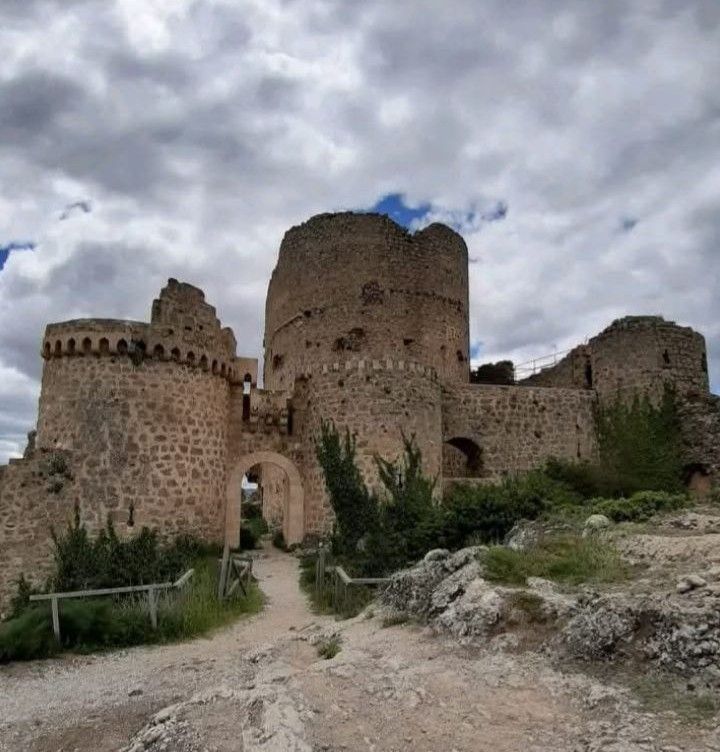
The Castillo de Moya castle is located at the southern end of the elongated plateau that extends over the high hill on which the remains of the town’s urban complex are located.
It has an irregular layout to adapt to the terrain on which the castle rises. The old medieval castle or fortress was transformed in the late 15C or early 16C by Don Andrés de Cabrera, the first Marquis of Moya, into a stately residence with a moat separating it from the town, a drawbridge, two artillery barrages, and a large “D”-shaped keep. In addition to this imposing tower, the castle area includes other buildings, including a large fortified tower on the southern side and another sloping enclosure next to it, the two spaces separated by a crenellated wall. A northern artillery barrage located in front of the town, with the entrance to the castle through an access gate defended between two cubes, and to the right of the Torre del Homenaje cube. Behind the wall, inside, is the large D-shaped tower. A platform on a low stone wall, which replaced the vanished drawbridge, leads to the ashlar entrance gate, which is closed off with a semicircular arch, above which protrude brackets supporting a machicolation or skylight. The lateral cubes of the gate, which display cross and orb loopholes, are crowned at the top with a continuous molding formed by blind pointed arches. The Keep, which has a “D” shape, has two entrance doors. One of them opens on the east side of the ground floor. The other entrance is accessed via the walkway.
Other things to see in Moya , me think and with more time are the different walled enclosures of the ruins of Moya there are eight gates, built at different historical moments to allow access to the town Puerta de Carros (14C), Puerta de San Juan (13C), Puerta de la Villa (16C), Puerta de San Diego (13C), Puerta de la Calzadilla (13C), Puerta de San Francisco (14C), Puerta de los Ojos (renovated in the 15C) , and Puerta de la Albacara (12C), In the Historic-Artistic Complex of the ruins of Moya, different components stand out due to their architectural importance and significance. Among the civil and military buildings it is worth highlighting the ayuntamiento or City/Town Hall, corresponding to the old pósito (municipal granary), located in the Plaza Mayor, Casa del Comendador: located;also in the Plaza Mayor, The Coracha,(14-15C): fortified enclosure with a double wall, contains two towers ; the Torre del Agua or Water Tower, and the Torre de San Roque Tower, through which goods from the Kingdom of Aragon and the Kingdom of Valencia, Among the religious buildings the Convent of the Franciscan Conception (17C), Hospital Madre de Dios Abajo or Mother of God below, located at Calle Madre de Dios Abajo, between this and Calle Madre de Dios Abajo ,the Hospital de Cautivos or House of Mercy, founded by the knights of the Order of Santiago in the 13c, namely 1211, The Church of the Trinity (12-13C), Church of Santa María la Mayor (12-14C): restored and in use, it is located at the Plaza Mayor, on the Bajada de San Bartolomé, and has a splendid Herrerian bell gable.
A bit of history I like tell us that its appearance in history does not begin until the conquest of the territory of the pre-Rincón de Ademuz at the beginning of the 13C, namely 1212, by Pedro II of Aragon, without any evidence that the place was previously occupied. The king of Castile Alfonso VIII “el de la Navas” populated Moya and granted it a charter, and in the second decade of the 13C namely 1215, Enrique (Henry) I of Castile gave the area to the Order of Santiago, its first lord was the Master of Calatrava, Don Juan González, thus beginning the era of the Lordship. But it was Fernando III of Castile “the Saint” who consolidated the settlement, ratifying charters and granting new privileges to its inhabitants, constituting a border area on the border of Castile with the neighboring kingdoms, Aragon and Valencia. At the beginning of the 14C namely 1319, Fernando IV of Castile “El Santo” declared Moya “patrimony of the Crown”. In the middle of the 15C namely 1451, Juan (John) II of Castile granted Moya to Don Juan Pacheco, Marquis of Villena, a move that was actively resisted by the Moyans. In the following decade, Enrique (Henry) IV of Castile “the Impotent” donated the Lordship of Moya to Don Andrés de Cabrera, whom the Castilian king described as a “good vassal” in1463. The Catholic Monarchs confirmed the donation of King Henry in 1475, and the fact that in the succession conflict Moya had remained on the side of Isabel I of Castile (the Catholic) earned it the Lordship to be converted into a Marquisate in 1480. In the first years of the reign of Carlos (Charles) I of Spain, during the War of the Communities (1520-1522), Moya remained on the side of the Crown, going against the Germanías (rebellions by Valencia) . At the beginning of the 19C, during the Spanish War of Independence (peninsular war), Moya made a proclamation against Napoleon in 1808, and resisted the French, which brought it new looting and destruction. Having sided with Isabel II of Spain, “the Castiza Queen” in the Carlist Wars, it suffered attacks from General Cabrera and was destroyed in 1835. Following the ecclesiastical confiscations (1836), the former Marquisate began to disintegrate, its inhabitants dispersed throughout the various urban centers and its walls and fortress began to crumble. Its agony lasted until the mid-20C, when the village was finally abandoned, leading to the looting of its buildings , public and private, religious and civil , including the castle, and much of its architectural heritage was lost.
The Cultural Heritage site of Castilla La Mancha region on Moya : https://cultura.castillalamancha.es/patrimonio/catalogo-patrimonio-cultural/conjunto-historico-de-moya
The province of Cuenca tourist office on Moya : https://descubrecuenca.es/en/enclaves-y-poblaciones/la-serrania/moya-castillo-de-moya-33
The village of Moya, Cuenca with the municipal web : https://moya.dipucuenca.es/
There you have it , another jewel of my beloved Spain in architecturally and historically Castilla La Mancha. Again, hope you have enjoyed this post on this is Moya !!! as I.
And remember, happy travels, good health, and many cheers to all !!!

 Paris1972-Versailles2003